

Details
Description
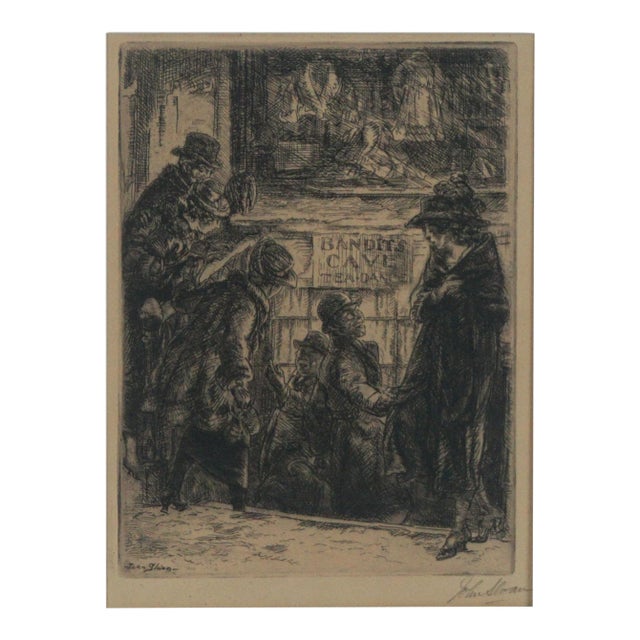
1920 Social Realism Etching by John French Sloan titled "Bandits Cave"
Compelling etching by John Sloan (American 1871 - 1951), …
Read more
1920 Social Realism Etching by John French Sloan titled "Bandits Cave"
Compelling etching by John Sloan (American 1871 - 1951), 1920 during first year of prohibition showing a establishment of dubious repute and most likely a speak-easy ironically promoting itself as offering "tea dances." Hallmarks of John Sloan's fine pen and ink technique are evident and this image perfectly captures the tension of the Prohibition era. According to a diary kept by Sloan, this etching represents, "Uptown thrill seekers during the period of Prohibition about to venture into a basement 'tea room' in Bohemia . . . one of the cafes in the Village." This scene of New York, Prohibition-era nightlife shows a group of cheerful revelers entering an underground, Greenwich Village speakeasy, advertising "tea and dance" on their sign. These downtown New York "tea rooms" were well known to patrons for serving illegal liquor. (From the New Republic). (ref. Morse 195)
Medium: Etching on paper
Signed: In etching and in pencil
Condition: Very good; some tonal aging consistent with its age and previous matting. Matted with conservation acid-free mat board.
Plate size: 7"H x 5"W
Embossed Paper size: 7.50"H x 5.25"W
Paper size: 13.25"H x 10.25"W
Provenance: Peter Morse
Mat size: 20"H x 15"W
Born in Lock Haven, Pennsylvania, John Sloan became one of the major early 20th- century figures in New York, pioneering the Social Realist movement with Robert Henri and his circle. He was also an illustrator and early eastern painter in the Southwest.
Sloan moved with his family to Philadelphia where he attended Central High School and became a close friend of William Glackens. He worked for a print dealer and as illustrator for the Philadelphia Inquirer and the Philadelphia Press. He also studied at the Pennsylvania Academy with Thomas Anshutz and met Robert Henri.
In 1904, he moved to New York and while continuing as an illustrator, became a part of Henri's circle of urban realists. He was an avid walker who continually strolled the streets for subject matter, especially exploring Greenwich Village and the Lower East Side. His work with great humanitarian bent flourished especially during this time because he was so committed emotionally to his subject matter.
He joined the Socialist Party in 1910 and espoused utopian ideas of equality but was never a political activist. However, from 1912 to 1916, he was art editor of the party's monthly periodical The Masses, and his skillful illustrations elevated the quality of the publication. The realities of World War I caused him, like so many, to become disenchanted with hard-line socialism.
He taught at the Art Students League, and his students included Reginald Marsh, Raphael Soyer, and Alexander Calder.
Opposing the traditional hold that the National Academy had over the art world in America, he exhibited as one of "The Eight" in 1908 at the Macbeth Gallery. In 1913, he was much affected by the Armory Show exhibition of modernist painting, particularly the Post-Impressionist, Fauve, and Cubist works and after that year became experimenting with more radical painting styles. He was also an avid etcher.
Influenced by his friend Henri, who had spent summers of 1916 and 1917 in New Mexico, Sloan and his wife Dolly first visited Santa Fe in 1919. From that time, he made several painting trips to the Southwest and was active in the Santa Fe colony and in getting other eastern artists to head West. Unlike many of his contemporaries there, he refused to paint romanticized views of the Mexican and Indian culture. He served as President of the Exposition of Indian Tribal Arts in the 1930s and lobbied the Society of Independent Artists to include work by Native Americans in their exhibitions.
In 1944, Sloan married Helen Farr, who had been one of his students, and after her husband's death in 1951, she devoted herself to turning his estate into a philanthropic instrument. The largest benefactor was the Delaware Art Museum, which received more than 5000 works including painting representing every phase of his career and his archival papers. With these acquisitions, the Museum became the leading repository for the study of Sloan. In honor of the ongoing support by Helen Farr Sloan, museum representatives named its library the Helen Farr Sloan Library.
See less
- Dimensions
- 15ʺW × 0.25ʺD × 20ʺH
- Styles
- Realism
- Frame Type
- Unframed
- Period
- 1920s
- Country of Origin
- United States
- Item Type
- Vintage, Antique or Pre-owned
- Materials
- Etching
- Condition
- Good Condition, Original Condition Unaltered, Some Imperfections
- Color
- Black
- Condition Notes
- Very good; some tonal aging consistent with its age and previous matting. Matted with conservation acid-free mat board. Very good; some tonal aging consistent with its age and previous matting. Matted with conservation acid-free mat board. less
Questions about the item?
Returns & Cancellations
Return Policy - All sales are final 48 hours after delivery, unless otherwise specified in the description of the product.
Cancellation Policy - Prior to shipping or local pickup, buyers may cancel an order for up to 48 hours, unless otherwise specified.
Related Collections
- Byzantine Original Prints
- George Barbier Original Prints
- Frank Stella Original Prints
- Teak Original Prints
- Shaun Ellison Original Prints
- Tatiana Alida Original Prints
- Silver Finish Original Prints
- Abraham Rattner Original Prints
- Robert Kipniss Original Prints
- Balmain Original Prints
- Damien Hirst Original Prints
- Botanical Prints
- Framed Prints
- Japanese Woodblock Prints
- Screen Prints
- Woodblock Prints
- Thomas McKnight Original Prints
- Bird Prints
- Spray Paint Original Prints
- Chaim Gross Original Prints
- Paul Wunderlich Original Prints