




Details
Description
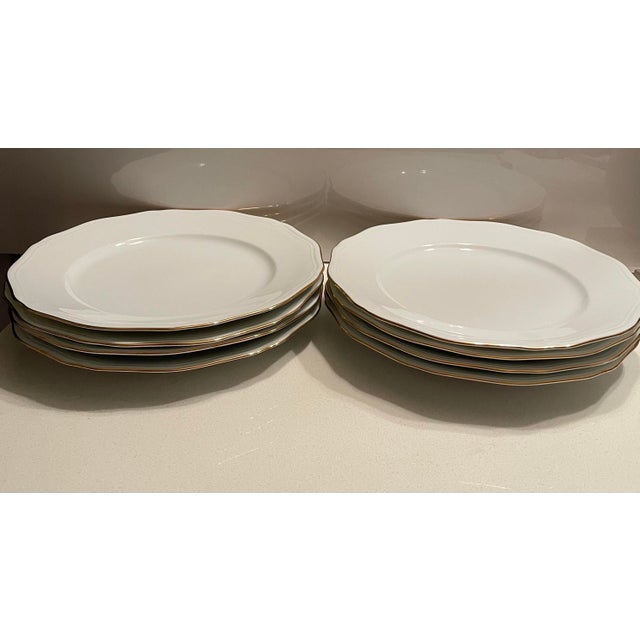
Set of 8 Dinner Plates.
Description: All White, Embossed Line On Edge
Pattern: Gold Coin by Mikasa
Status: Discontinued.
Period: …
Read more
Set of 8 Dinner Plates.
Description: All White, Embossed Line On Edge
Pattern: Gold Coin by Mikasa
Status: Discontinued.
Period: 1985 - 1985
These pieces are part of the Mikasa "Gold Coin" pattern, which is characterized by its white bone china material, oval shape, and elegant gold trim along the scalloped edge. It was made in Japan and is designed for serving various dishes.
This lovely, simple and elegant pattern was originally released by Mikasa in 1985. Items from this collectible set are very well-preserved.
Crafted In Japan
Vintage/Discontinued Pieces
Additional pieces available; sold separately.
Mikasa’s from the Start to the 1990s:
Mikasa's predecessor was a company named All Star Trading, founded in 1936. The ties that connected All Star Trading and Mikasa were familial--the business legacy of the Aratani family. Setsuo Aratani, a Japanese-American, started All Star Trading as an import-export enterprise specializing in trade with Japan. When hostilities between Aratani's source country and his supply country erupted on December 7, 1941, the business abruptly closed. However, but following World War II, Setsuo’s son George and a partner named Alfred Funabashi revived the trading company. The younger Aratani and Funabashi sold flash-frozen tuna and developed the company into one of the largest importers of toys, distributing its merchandise through a half-dozen department store chains on the East Coast. Before the end of the 1950s, the pair began concentrating on importing china made in Japan, using the trademark they adopted in the 1950s—“Mikasa,” Japanese for “three umbrellas.”
A fast-growing retailer and wholesaler, Mikasa, Inc. sells causal and formal dinnerware, displaying its greatest strength in the casual segment of the market. Mikasa sold its dinnerware and decorative accessories through wholesale accounts in the United States and abroad and through a network of approximately 150 U.S.-based factory outlet stores.
Unlike many of its competitors, the company did not own manufacturing facilities. Instead, Mikasa contracted out designs to approximately 175 factories in 25 countries. Production was concentrated in Germany and Austria, where 30 percent of the company’s merchandise was manufactured. The flexibility engendered by contracting out production enabled Mikasa to introduce numerous patterns into the market each year and quickly expand production of designs that proved popular.
During the 1990s, the company increasingly broadened its product categories, experimenting with cookware, bath accessories, and other decorative accessories for the home—all patterned after its popular dinnerware designs. The company was partly controlled during the late 1990s by chairman emeritus George Aratani, the son of Mikasa’s founder.
The gradual move into the chinaware business evolved into the company’s exclusive occupation by the early 1960s. In 1965, the company’s path crossed with a young department store merchandiser named Alfred Blake, who was impressed by the Mikasa designs he saw while working with Hudson’s Bay stores in Canada. Blake’s interest was sufficient to prompt a career move. He joined Mikasa as a commissioned sales representative for western Canada in 1965, when the California-based company was collecting $5 million a year in sales. Blake’s esteem for Mikasa’s merchandise translated into high sales, fueling his promotion within the company’s sales ranks. When Alfred Funabashi died in 1976, the impressive Blake was named president and began working alongside George Aratani.
Under Blake’s operational control, Mikasa flowered into a vibrant enterprise. He made wholesale changes with alacrity. Blake broadened the company’s line of merchandise, adding crystal stemware and new, less expensive brands to buttress the company’s flagship Mikasa brand. For housewares departments in department stores, Blake created “Studio Nova,” which sold for roughly 40 percent less than Mikasa brand china. For mass merchants and discount stores, Blake created a more affordable brand, dubbed “Home Beautiful.” Blake’s innovative approach also broadened the awareness of the Mikasa name and its assorted brands. He opened a showroom in New York City, where the company’s tableware was showcased in midManhattan, and in 1978 he directed the company’s foray into the retail sector, establishing an outlet store in a warehouse in Secau-cus, New Jersey—the first of many more to follow. Blake’s influence on the maturation of Mikasa was profound, evidenced in the robust financial growth of the company during his first decade of control. When Blake was named to the presidential post, Mikasa was collecting $26 million a year in sales; by 1985, the company was generating $137 million in annual sales.
By the mid-1980s, confidence at the company’s headquarters was running high. Blake and a group of senior executives, who each held small investment stakes in the company, were ready to significantly increase their financial investment in the company. In 1985, the management group initiated a leveraged buyout (LBO) of the company, offering $1 million in cash and borrowing $31 million to obtain ownership from George Aratani. The LBO, completed in 1985, was a sign of the executives’ faith in Mikasa’s future, but to their chagrin, outside influences conspired against the new owners shortly after the deal was concluded.
In 1986, Japan’s currency began to appreciate quickly against the U.S. dollar, making goods produced in Japan more expensive in the United States. To make matters worse, U.S. department stores were struggling with their own ills, forcing some retailers to close stores and others either to consolidate or to streamline their operations. The net effect was fewer china departments within department stores nationwide, delivering a second pernicious blow to Mikasa’s business. After their first year of ownership, the new owners had little to celebrate: losses for the year amounted to a numbing $3.6 million. The future would have looked even bleaker had Mikasa’s group of executive-owners known the tableware industry was destined for a decade-long slump. Between the mid-1980s and mid-1990s, the “tabletop” industry, which included flatware, cups, saucers, plates, crystal, serving platters, and Christmas plates, recorded little growth.
Although the company did not escape the 1980s without experiencing several difficult years, strident growth arrived as the 1990s began, thanks in large part to the measures taken by Blake. His response to the growing strength of Japanese currency was crucial to the company’s trend-bucking success. Blake moved some of Mikasa’s production out of Japan to low-cost, contract operations in Malaysia, Thailand, and Yugoslavia, essentially doing what Nike did during the early 1980s to record prolific growth in a lackluster industry. While other chinamakers struggled to make money in the face of rising labor and operating costs incurred from their own factories, Mikasa thrived mainly because it owned no factories. The company contracted its designs to other manufacturers and prospered, while many of its competitors were held in check by escalating overhead.
The cost-savings realized from outsourcing production also gave Mikasa another important advantage, namely, flexibility. The company could quickly increase production volume on popular patterns and quickly abandon designs that failed to impress customers. Additionally, enhanced flexibility in production enabled Mikasa to churn out a greater diversity of patterns than many of its competitors. With a larger number of designs introduced into the market each year, the company’s odds for success increased, frequently putting Mikasa on the leading edge of emerging trends. Blake also began to emphasize the expansion of the company’s outlet stores, which reduced the reliance on department stores and strengthened Mikasa’s brand identity.
Blake’s meaningful operational changes began to pay substantial dividends by the beginning of the 1990s, as the company strove to shrug aside the industrywide malaise affecting its competitors and effectively market tableware to what Blake referred to as the “McDonald’s/microwave generation.” To accomplish this goal, the company moved in three general directions. The first relied on Mikasa’s production flexibility. When the company identified a popular design from one of its numerous pattern introductions in a given year, it would quickly orchestrate the production of the particular design on a number of supplementary products, such as servers, carafes, napkin rings, and butter dishes—occasionally branching far afield by adorning the popular pattern on non-tableware items such as picture frames. “Customers,” Blake remarked, “are treating dinnerware like sportswear, and accessorizing,” so the company followed suit and began broadening and diversifying its product lines and product categories. The other two areas of emphasis that fueled the company’s rise were international expansion and the expansion of its network of retail stores. In 1991, Mikasa formed a joint marketing venture named Mikasa Europe Distribution with a German partner to market the company’s products in Europe. As the 1990s progressed, Mikasa intensified its efforts overseas, adding a relatively small yet growing facet to its operations. A greater contributor than international sales to the company’s revenue growth during the 1990s was the company’s chain of factory outlet stores. As their numbers grew, providing a means to dispose of excess inventory, the retail stores became increasingly important to Mikasa’s well-being, accounting for roughly half of the company’s total sales by the early 1990s.
See less
- Dimensions
- 10.5ʺW × 10.5ʺD × 1.11ʺH
- Styles
- Early American
- Designer
- Mikasa
- Period
- Late 20th Century
- Country of Origin
- Japan
- Item Type
- Vintage, Antique or Pre-owned
- Materials
- Bone China
- Condition
- Good Condition, Original Condition Unaltered, Some Imperfections
- Color
- White
- Condition Notes
- These are in astonishingly great shape! The entire set is well cared for. It is shiny and has good enameling. … moreThese are in astonishingly great shape! The entire set is well cared for. It is shiny and has good enameling. As these are vintage pieces, some signs of wear or imperfections may be present. However, no flaws are noted under good lighting in the studio. A very well cared for set. Additional dinnerware pieces are available via separate listing. This is to ensure adequate photography can be shared per listing, and to ensure safest shipments. less
Questions about the item?
Returns & Cancellations
Return Policy - All sales are final 48 hours after delivery, unless otherwise specified in the description of the product.
Cancellation Policy - Prior to shipping or local pickup, buyers may cancel an order for up to 48 hours, unless otherwise specified.
Related Collections
- William Morris Dinnerware
- Castleton - USA Dinnerware
- Oxblood Red Dinnerware
- Ashworth Ironstone Dinnerware
- Fornasetti Dinnerware
- Baccarat Dinnerware
- Vetri Dinnerware
- Dinnerware in Aspen
- China Dinnerware
- Mikasa Dinnerware
- Royal Doulton Dinnerware
- China Lenox Dinnerware
- Franciscan China Dinnerware
- Porcelain Rosenthal Dinnerware
- Noritake Dinnerware
- Ruby Red Dinnerware
- Limoges, France Dinnerware
- Mid-Century Modern Dinnerware
- Blue Dinnerware
- Japanese Dinnerware
- Russel Wright Dinnerware
- Ironstone Dinnerware
- Early American Dinnerware
- English Traditional Dinnerware
- Green Dinnerware