




Details
Description
Giuseppe Zais (Canale d’Agordo, Belluno 1709 - Treviso 1781)
Pendant of Paintings
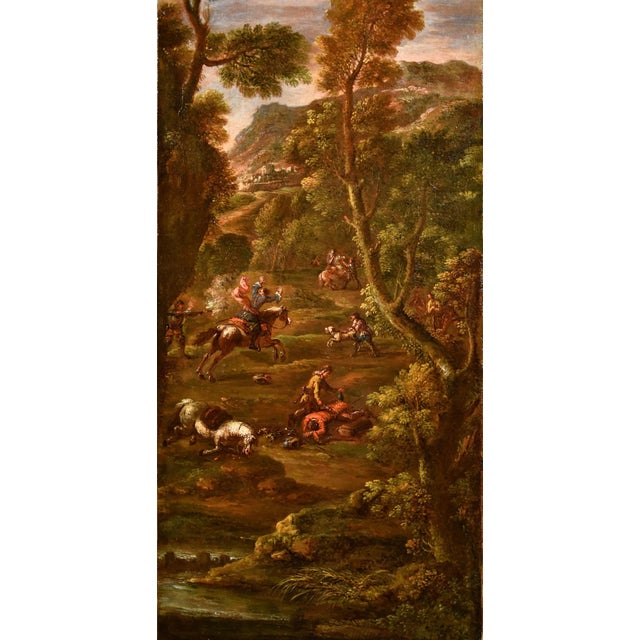
The Attack of the Brigands
After the Attack
…
Read more
Giuseppe Zais (Canale d’Agordo, Belluno 1709 - Treviso 1781)
Pendant of Paintings
The Attack of the Brigands
After the Attack
Oil on canvas, 108 x 42 cm each
Framed 128 x 62 cm.
We thank Dr. Federica Spadotto for studying and matching this pair of paintings to Giuseppe Zais's catalogue. Below, we offer the in-depth critical study.
The Venetian landscape of the Golden Age has by now accustomed the public and scholars to extraordinary—and unexpected—intersections between genres, establishing an artistic landscape highly permeable to international influences. This undoubtedly occurs by virtue of the "forest" origins linked to the rural repertoire, which records the fundamental contribution of transalpine influences (Spadotto, 2014) in terms of the inspiration and expressive language of native artists.
Among the latter, the experience of Giuseppe Zais (Belluno 1709 - Treviso 1781) is crucial. He emigrated to the city of the lion, likely between the 1630s and 1640s, where he would have served his apprenticeship with the battle painter Francesco Simonini (Parma, 1686 - Venice or Florence, post-1755). It was, in fact, standard practice for any painter aspiring to an official role—that is, membership in the Guild—to train alongside an established figure, such as the Parma master. Rather than a true apprenticeship, one should imagine the young painter working as an apprentice, tackling the war themes that had made Simonini famous in the lagoon, where commissions poured in, necessitating the assignment of some of the work to a capable assistant (namely, our Giuseppe).
Only recently, thanks to the pictorial essays published by Egidio Martini, has a core group of paintings by Giuseppe (fig. 1) been identified, closely adhering to his master's repertoire and long believed to be Simonini's own work.
Analysis of these works highlights close affinities in form and style with Francesco's counterparts, on which Zais grafted some key features that would become typical of his style, particularly the round tower and the characteristic facial features.
Over the years, our artist would put this experience aside in favor of Zuccarelli-inspired sunny afternoons, as well as collaborating with his son Gaetano (documented between 1765 and 1798) in his chosen genre. And a landscape created by the latter, made known by the author (Spadotto, op. cit., 2014, fig. 284, plate XLV; fig. 2), offers an important documentary piece shedding light on our artist's final creative period, overlooked by sources and devoid of autograph works.
In his Landscape with Figures, Statues, and Animals at the Watering Place (fig. 2), Zais Jr. offers a compendium of his father's work, expressed through a rather dense style and a color scheme based on earthy tones, in keeping with the revival of Marco Ricci (Belluno, 1676-Venice, 1730), which was very popular in the second half of the 18th century. Zuccarelli himself (Pitigliano, 1702-Florence, 1788) had also succumbed to the influence of Ricci, creating The Bull Hunt (fig. 3), now in the Gallerie dell'Accademia in Venice, a true example of the theme, where the same pictorial ingredients mentioned above emerge.
This remarkable companion piece fits into this context, "laying out" like a true testament Giuseppe's long artistic career, from his early days as a battlefield specialist to the extreme synthesis of the late eighteenth century.
Simonini's soldiers become knights at the mercy of an attack by bandits, who kill them and strip them of all their possessions, as happens in Dopo l'assalto (After the Assault), where the compositional layout of the post-battle camp hosts the outcome of the fatal crime, perpetrated by characters in whom we recognize the dress and physique of the peasants immortalized by Giuseppe in his famous country songs.
A taste for detail, clearly influenced by Zuccarelli, blends with a rapid, immediate style that, however, does not betray the definition of foliage in the characteristic, large trees that frame the scenes, where Ricci's inspiration merges with the Northern European "fashion" that prevailed in Venetian figurative culture in the late eighteenth century.
Despite what public taste expressed for much of the Golden Age, electing languid Arcadian poetry as the territory of its aesthetic ideals, the decline of the Serenissima brought back echoes of that "stepmother nature" frequented by the first generation of landscape painters, which returns, highly relevant, as a metaphor for a world destined to disappear a decade after his death. This piece is attributed to the mentioned designer/maker. It has no attribution mark and no
official proof of authenticity,
however it is well documented in design history. I take full responsibility for any authenticity
issues arising from misattribution
See less
- Dimensions
- 24.41ʺW × 4.72ʺD × 50.39ʺH
- Period
- 18th Century
- Country of Origin
- Italy
- Item Type
- Vintage, Antique or Pre-owned
- Condition
- Good Condition, Unknown, Some Imperfections
- Color
- Condition Notes
- Patina Consistent with Age and Use,Reupholstered,Partially Restored Patina Consistent with Age and Use,Reupholstered,Partially Restored less
Returns & Cancellations
Return Policy - All sales are final 48 hours after delivery, unless otherwise specified in the description of the product.
Cancellation Policy - Prior to shipping or local pickup, buyers may cancel an order for up to 48 hours, unless otherwise specified.
Related Collections
- Photorealism Canvas Paintings
- Ed Ruscha Paintings
- Ralph Lauren Paintings
- Photorealism Paintings in New York
- Richard Serra Paintings
- Louise Nevelson Paintings
- Silk Velvet Paintings
- Herman Miller Paintings
- BDDW Paintings
- Jean-Paul Barray Paintings
- Johannes Andersen Paintings
- Peter Behrens Paintings
- Carl-Axel Acking Paintings
- Joseph Stella Paintings
- Karl-Erik Ekselius Paintings
- Pedro Friedeberg Paintings
- Piet Hein Eek Paintings
- James McCray Paintings
- Milton Avery Paintings
- Raphael Paintings
- Jaanika Peerna Paintings
- Hans Andersen Paintings
- Cassina Paintings
- Photorealism Paintings in Los Angeles
- Leroy Neiman Paintings