









Details
Description
“The Allegory of Civilization: A Historical Collage of Progress and Virtue”
This monumental and highly unusual large-scale decoupage tableau—measuring 44.25 …
Read more
“The Allegory of Civilization: A Historical Collage of Progress and Virtue”
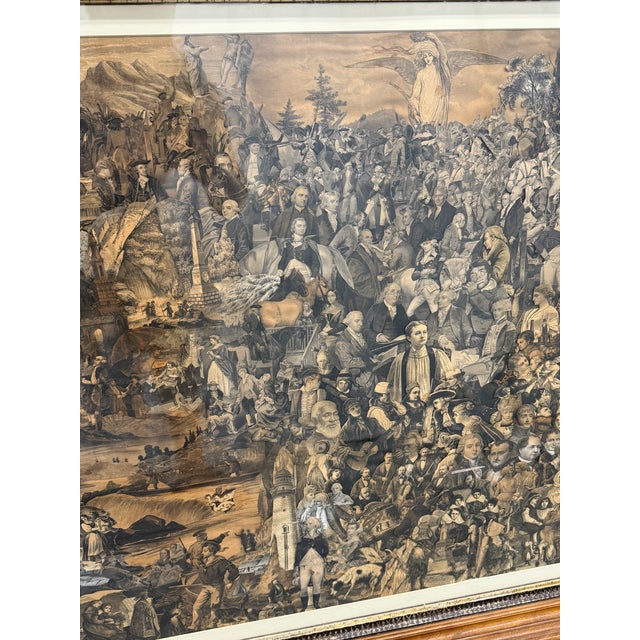
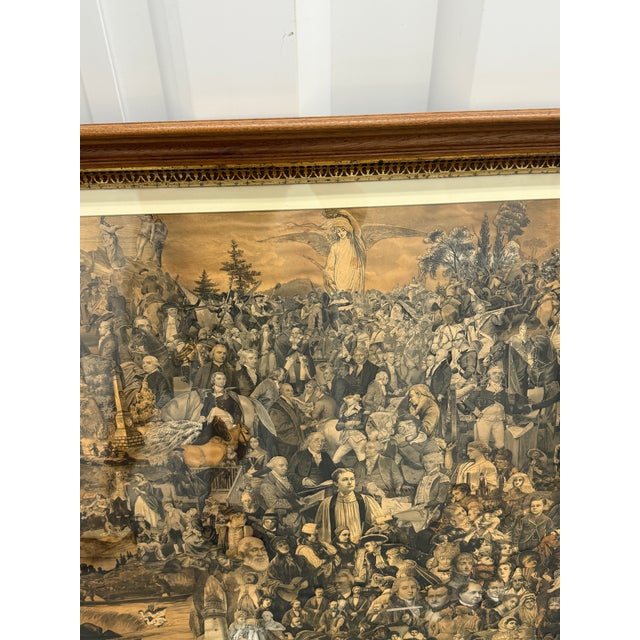
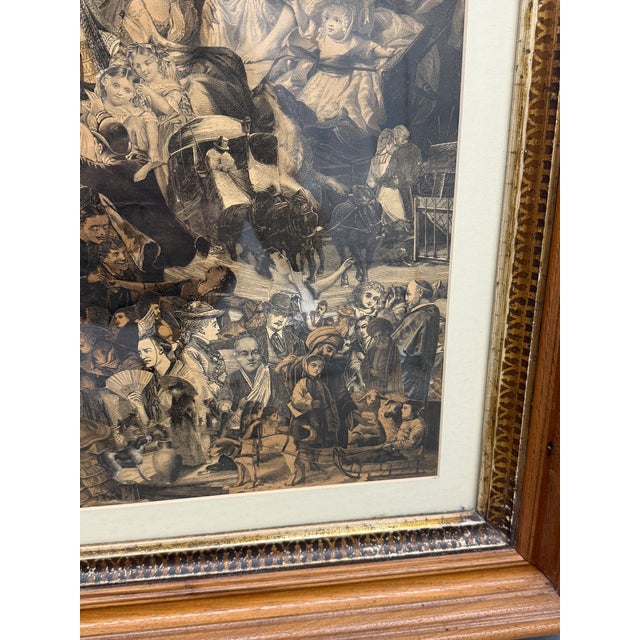
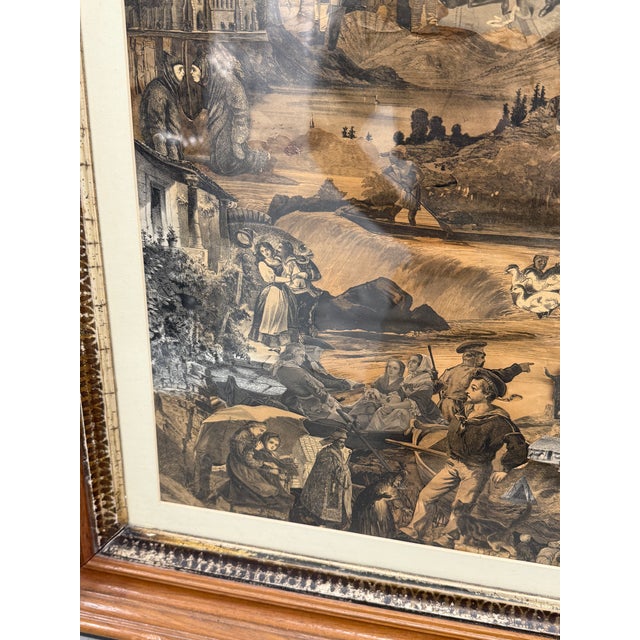
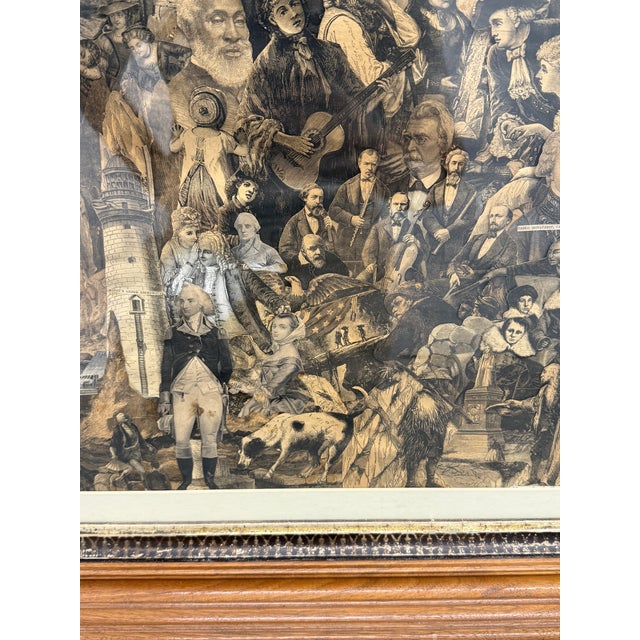
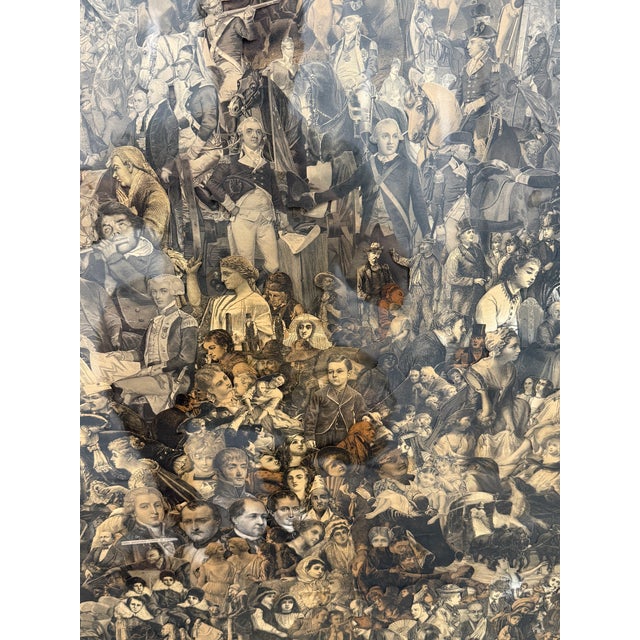
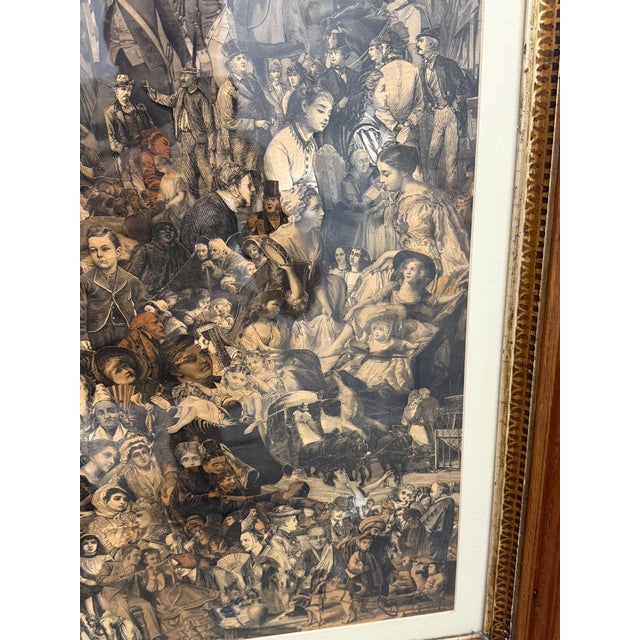
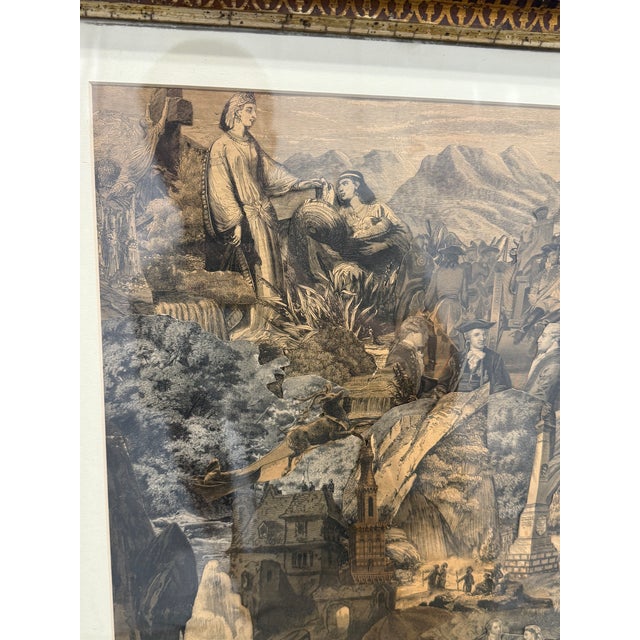
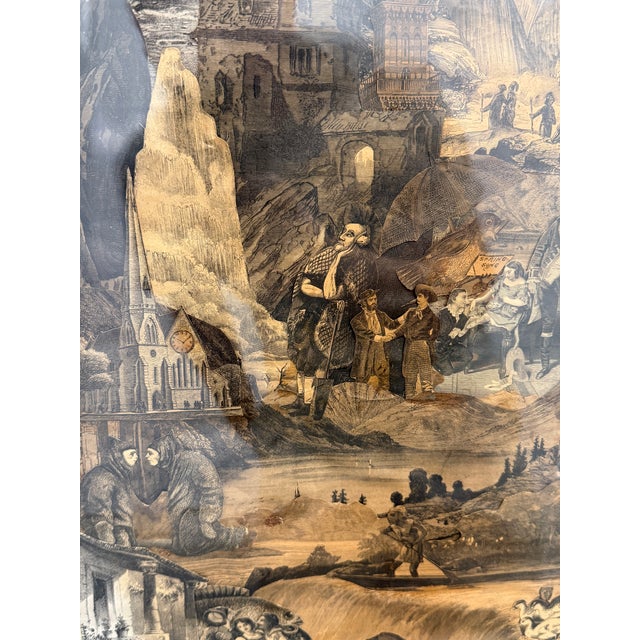
This monumental and highly unusual large-scale decoupage tableau—measuring 44.25 inches wide by 35 inches high—is an extraordinary and densely composed visual compendium of 18th- and 19th-century figures of global significance. Executed in a monochrome palette with light hand-tinting, the work comprises hundreds of individual portrait engravings and narrative vignettes intricately collaged together to form a panoramic composition of historical, cultural, scientific, literary, and military figures, interspersed with allegorical and architectural elements.
This form of assemblage is rooted in the 19th-century practice of *papiers collés* and popular scrapbooking traditions, but this work surpasses decorative craft in both ambition and intellectual scope, bordering on the encyclopedic. The hand-cut images appear to have been culled from period illustrated books and engraved portrait sources—most notably from publications such as *The Illustrated London News*, *Harper’s Weekly*, and *The Eclectic Magazine*—as well as engraved frontispieces and serialized pictorial histories. The result is a vast visual lexicon of Enlightenment and Romantic thought, likely intended as a celebration of moral, intellectual, and national achievement.
At the composition’s apex, presiding over the assembled figures, is a classically draped winged allegory—possibly *Fame* or *Liberty*—holding a trumpet and laurel branch. The mountainous background, waterfalls, architectural ruins, and pastoral settings lend the piece a theatrical and didactic ambiance, evoking 19th-century didascalic panoramas.
A partial identification of historical figures visible in the composition includes:
* **George Washington** – Posed centrally, gesturing outward with one hand; he appears multiple times in the scene and is shown in both military uniform and formal dress.
* **Napoleon Bonaparte** – Recognizable by his uniform, bicorne hat, and stern gaze; appears in profile and frontal portraits.
* **Benjamin Franklin** – Seen holding a scroll; a common figure in Enlightenment iconography.
* **William Shakespeare** – Near the lower central register; recognizable from the famous Chandos portrait derivative.
* **Johann Wolfgang von Goethe** and **Friedrich Schiller** – Likely placed in the literary cluster with other Germanic figures.
* **Florence Nightingale** – Shown in nurse’s cap and shawl, likely near a grouping of women in medical service.
* **Queen Victoria** and **Prince Albert** – Appearing in regalia, along with a number of courtly figures.
* **Ludwig van Beethoven**, **Franz Liszt**, and **Niccolò Paganini** – Present in a musical grouping holding instruments.
* **Sir Isaac Newton** – Possibly included among other scientific luminaries such as **Michael Faraday** and **Charles Darwin**.
* **Thomas Jefferson**, **John Adams**, and **Marquis de Lafayette** – Interspersed among Revolutionary War-era figures.
* **Harriet Beecher Stowe** and **Sojourner Truth** – May be included within abolitionist clusters.
* **Lord Nelson** and **Duke of Wellington** – Among the military grouping featuring redcoats and epaulettes.
* **Victor Hugo**, **Honoré de Balzac**, and **Charles Dickens** – Near the bottom edge in literary groupings.
* A host of **Romantic and Victorian women**, possibly including **Mary Shelley**, **Elizabeth Barrett Browning**, and **Jenny Lind**.
The base includes animals (goats, dogs), architectural references (lighthouses, ruins), and symbolic motifs (a mother and child, a clergyman with open book), reinforcing the composition’s moral and didactic undertones. The decoupage method—while charmingly naive in some juxtapositions—is executed with precision, giving the illusion of a seamless historical landscape.
This work is best understood as a Victorian-era *panoramic collage of moral and national greatness*, likely created by a learned amateur or clergyman with access to printed matter and a strong classical education. Its scale, completeness, and ambition place it in the rarefied category of *pedagogical visual culture*, deserving of scholarly cataloging.
See less
- Dimensions
- 44.25ʺW × 1ʺD × 35ʺH
- Styles
- Victorian
- Frame Type
- Framed
- Art Subjects
- Figure
- Period
- Mid 19th Century
- Country of Origin
- France
- Item Type
- Vintage, Antique or Pre-owned
- Materials
- Giltwood
- Paper
- Condition
- Good Condition, Original Condition Unaltered, Some Imperfections
- Color
- Brown
- Condition Notes
- Minor wear commensurate with age and handling. Minor wear commensurate with age and handling. less
Questions about the item?
Returns & Cancellations
Return Policy - All sales are final 48 hours after delivery, unless otherwise specified in the description of the product.
Cancellation Policy - Prior to shipping or local pickup, buyers may cancel an order for up to 48 hours, unless otherwise specified.