



Details
Description
Eleanora & M. Magdalena Dei Medici Wax Portraits on Slate
Measures: 4.5" DA
18th Century or Earlier Wax Portraits of …
Read more
Eleanora & M. Magdalena Dei Medici Wax Portraits on Slate
Measures: 4.5" DA
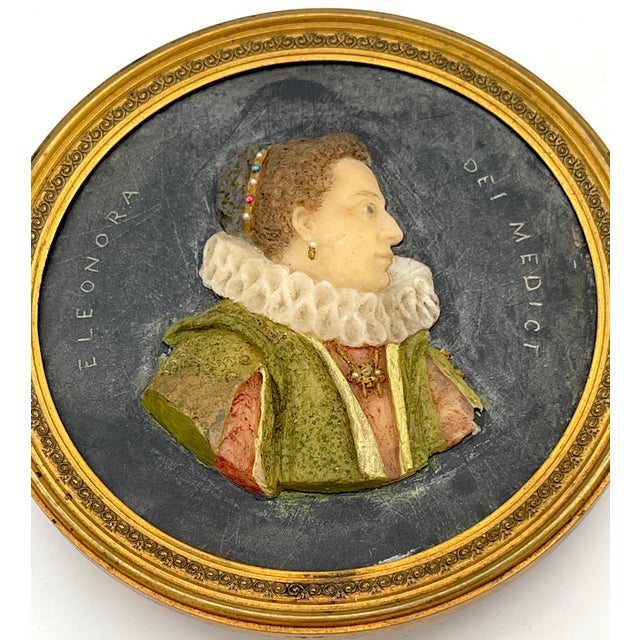
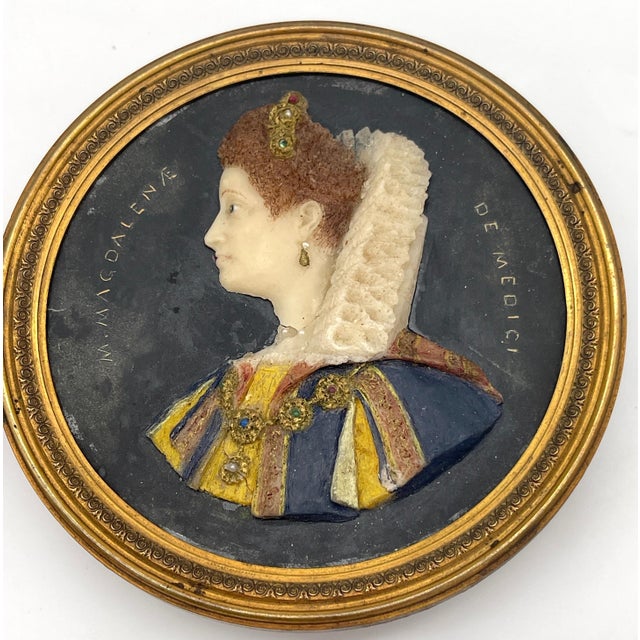
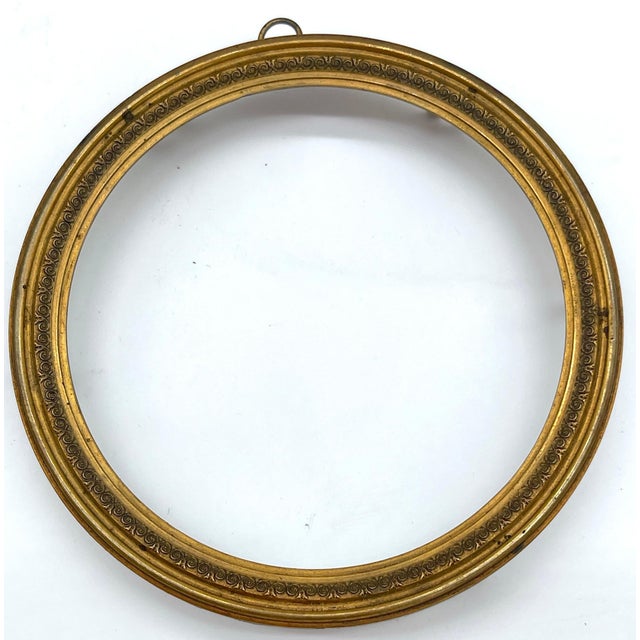
18th Century or Earlier Wax Portraits of Eleonora de' Medici and Maria Magdalena de' Medici in Ormolu Frames with Convex Glass
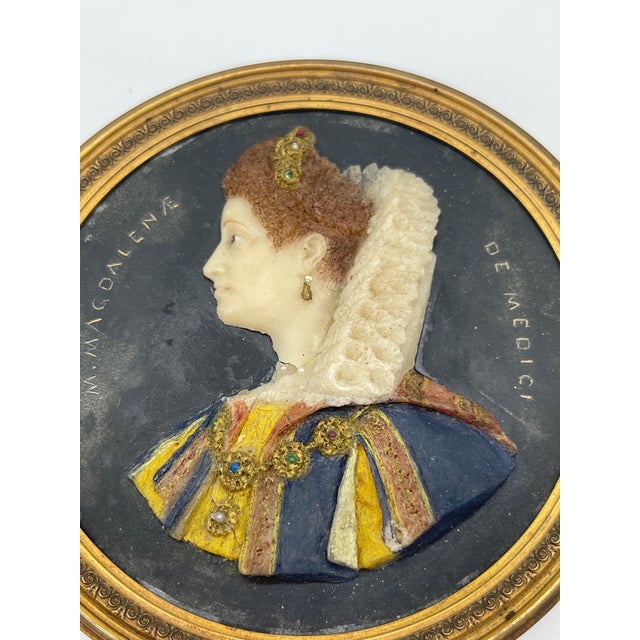
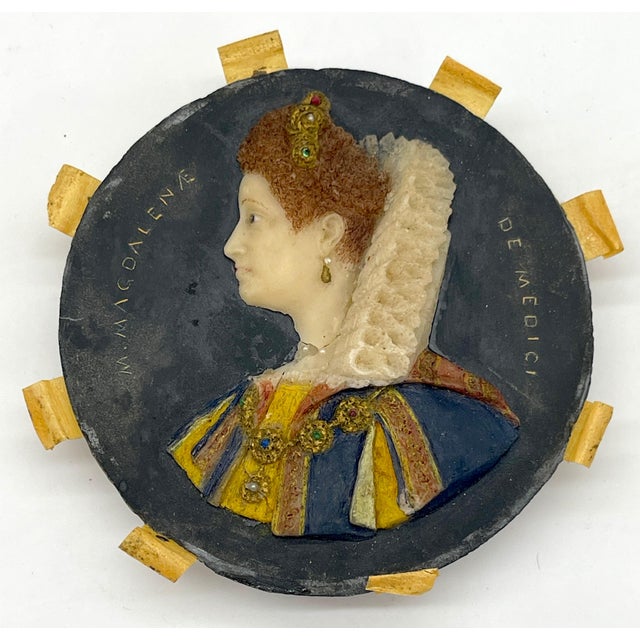
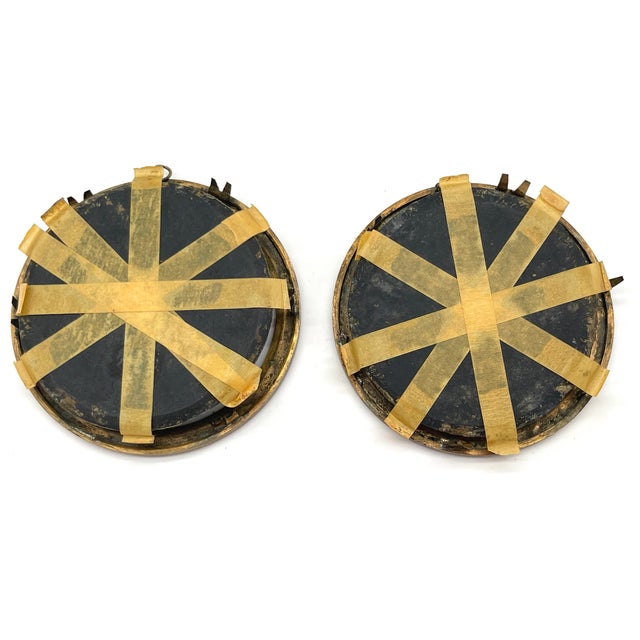
This exquisite pair of wax portrait reliefs on slate depicts Eleonora de' Medici (1567–1611) and Maria Magdalena de' Medici (1575–1626), two notable women of the illustrious Medici family. Each portrait is housed in an elegant ormolu (gilt bronze) frame with convex glass, measuring 4.5 inches in diameter. The finely detailed wax portraits showcase vibrant period attire adorned with delicate jewelry, ruffled collars, and carefully coiffed hair, reflecting the noble status and refined aesthetic of the late Renaissance.
The wax medium, expertly modeled, demonstrates a sophisticated artistry popular in the 18th century, though these pieces could potentially be earlier, given the subject matter and style. Wax portraiture on slate became fashionable during the 18th century as part of the neoclassical revival, celebrating Renaissance figures such as the Medici family. The ormolu frames and convex glass suggest these works were highly valued, designed for display in an elite interior setting.
Eleonora de' Medici, daughter of Grand Duke Francesco I de' Medici and Joanna of Austria, was known for her patronage of the arts and refined taste. Her marriage to Vincenzo I Gonzaga, Duke of Mantua, positioned her as a key figure in Italian court life, where she played a significant role in cultural diplomacy. Her younger sister, Maria Magdalena de' Medici, became Grand Duchess of Tuscany through her marriage to Cosimo II de' Medici. Maria Magdalena acted as regent for her son, Ferdinando II, and was influential in maintaining Medici power during a critical period in Florentine history.
This rare pair of portraits offers collectors an exceptional opportunity to own works that honor two prominent Renaissance women, encapsulated in finely preserved frames that highlight the enduring legacy of the Medici family.
Further Notes:
Eleonora de' Medici (1567–1611) and Maria Magdalena de' Medici (1575–1626) were notable members of the powerful House of Medici, a family that played a pivotal role in the political, cultural, and artistic life of Renaissance Florence and Tuscany. As daughters of Francesco I de' Medici, Grand Duke of Tuscany, and Joanna of Austria, they were central figures in European aristocracy, often involved in strategic marriages and alliances that shaped the political landscape of the time.
Eleonora de' Medici (1567–1611)
Eleonora, known for her beauty and intelligence, was a Medici princess who embodied the sophistication and influence of her family. In 1584, she married Vincenzo I Gonzaga, Duke of Mantua, aligning the Medici family with the Gonzagas, another significant ruling house in Italy. This union strengthened the political power of both families. Eleonora's marriage brought cultural exchanges between Florence and Mantua, influencing the arts, literature, and music. She was known for her patronage of the arts and her refined taste, typical of the Medici women who played essential roles in promoting Renaissance culture.
Maria Magdalena de' Medici (1575–1626)
Maria Magdalena was equally significant, though her influence was primarily within the Tuscan court. In 1608, she married Cosimo II de' Medici, her cousin and the Grand Duke of Tuscany. As Grand Duchess of Tuscany, Maria Magdalena played a vital role in court life and politics. She was a patron of science and the arts, supporting figures like Galileo Galilei, who dedicated some of his works to the Medici family. Maria Magdalena also acted as regent for her son, Ferdinando II de' Medici, after Cosimo II's death, demonstrating her political acumen and leadership.
The Medici Legacy
The Medici women, including Eleonora and Maria Magdalena, were more than just symbols of dynastic alliances; they were patrons of the Renaissance, fostering the growth of the arts and sciences that defined the era. Their portraits, such as the wax bas-reliefs on slate, celebrate their enduring legacy as cultural icons and political influencers. These portraits highlight not only their regal appearances but also their roles in shaping the artistic and intellectual heritage of Tuscany and beyond.
See less
- Dimensions
- 4.5ʺW × 0.25ʺD × 4.5ʺH
- Styles
- Baroque
- Period
- 18th Century
- Country of Origin
- Italy
- Item Type
- Vintage, Antique or Pre-owned
- Materials
- Bronze
- Wax
- Condition
- Good Condition, Original Condition Unaltered, Some Imperfections
- Color
- Gold
- Condition Notes
- Good Wear consistent with age and use. Minor losses. Good Wear consistent with age and use. Minor losses. less
Questions about the item?
Returns & Cancellations
Return Policy - All sales are final 48 hours after delivery, unless otherwise specified in the description of the product.
Cancellation Policy - Prior to shipping or local pickup, buyers may cancel an order for up to 48 hours, unless otherwise specified.
Related Collections
- Ralph Lauren Sculptural Wall Objects
- Helmut Friedrich Schäffenacker Sculptural Wall Objects
- Antique Copper Finish Sculptural Wall Objects
- Medium-Density Fibreboard Sculptural Wall Objects
- Maison Jansen Sculptural Wall Objects
- Dada Sculptural Wall Objects
- Asian Sculptural Wall Objects
- Greg Copeland Sculptural Wall Objects
- Mid-Century Modern Sculptural Wall Objects
- Curtis Jere Sculptural Wall Objects
- Plaster Sculptural Wall Objects
- Brutalist Sculptural Wall Objects
- Japanese Sculptural Wall Objects
- Sarreid Ltd. Sculptural Wall Objects
- Wenge Sculptural Wall Objects
- Arteriors Home Sculptural Wall Objects
- Stainless Steel Sculptural Wall Objects
- Silverplate Sculptural Wall Objects
- Platinum Sculptural Wall Objects
- The American School Sculptural Wall Objects