









Details
Description
Measurements:
cup: height: 5 cm; width: 15.5 cm; depth: 11.3 cm
saucer: diameter 14.8 cm; total weight: 0.291 kg
description …
Read more
Measurements:
cup: height: 5 cm; width: 15.5 cm; depth: 11.3 cm
saucer: diameter 14.8 cm; total weight: 0.291 kg
description of the item:
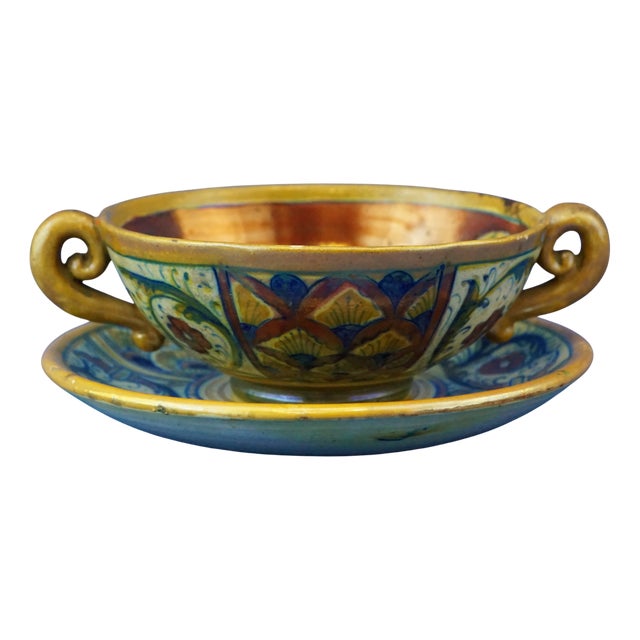
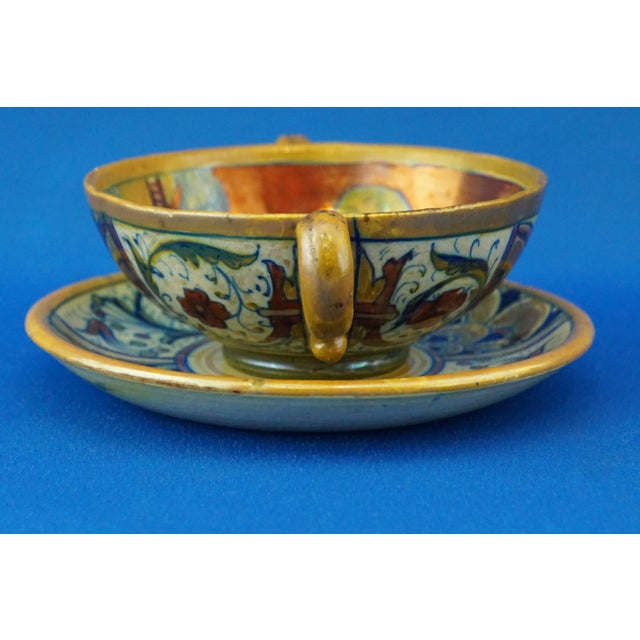
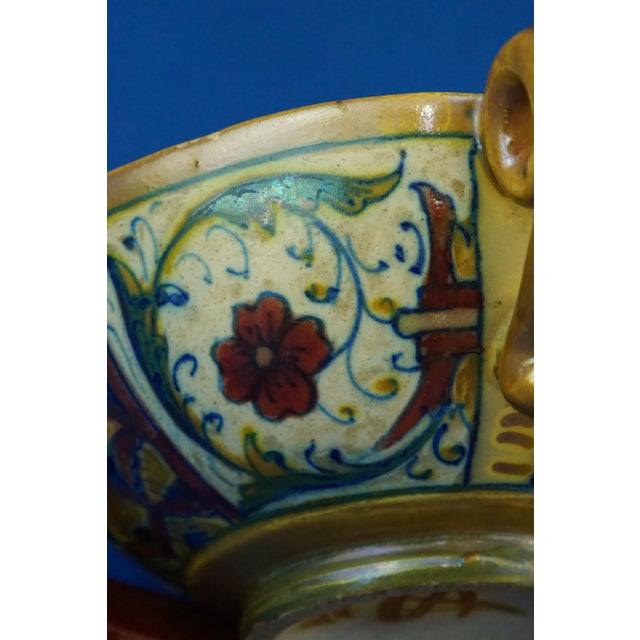
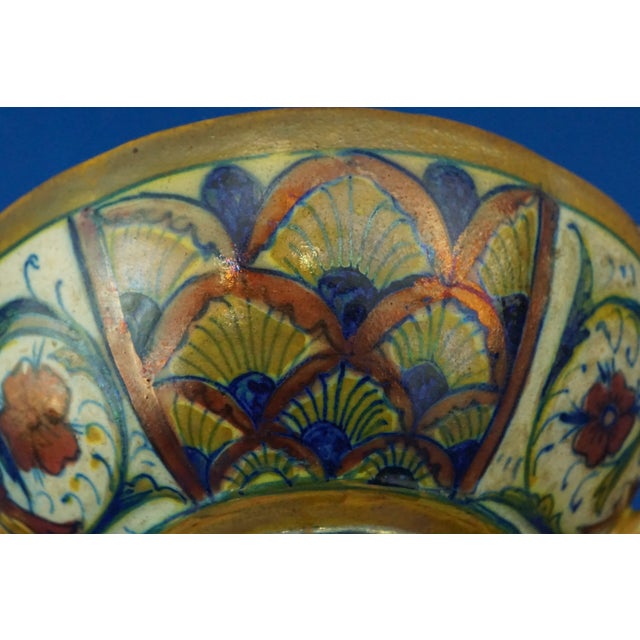
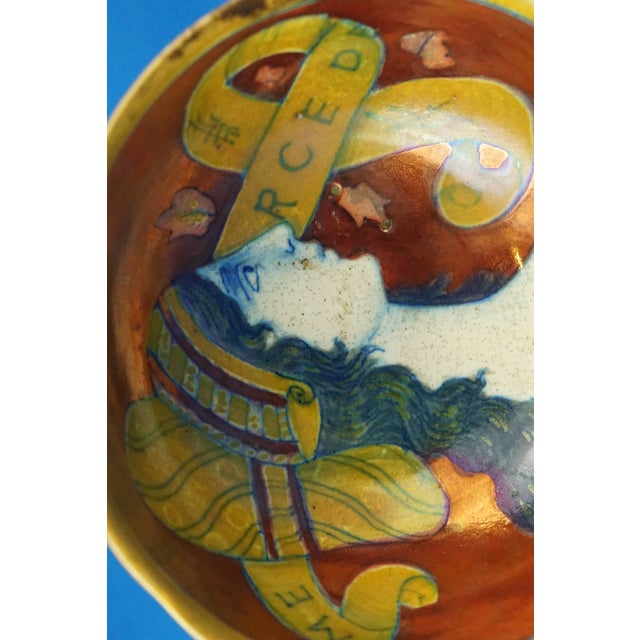
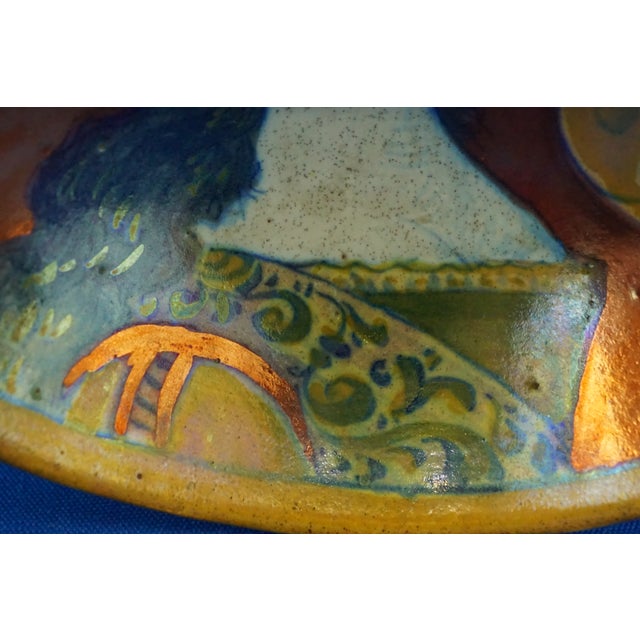
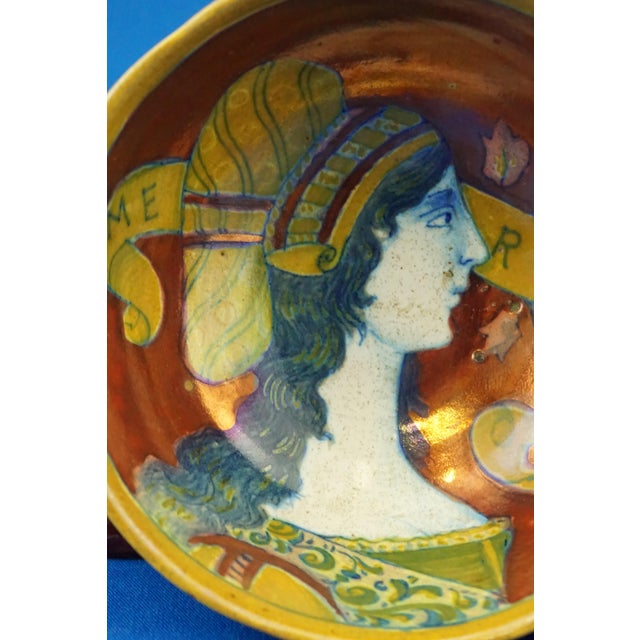
wonderful two-handled soup cup with saucer, made of glazed ceramic, entirely hand-modeled on a potter's wheel and then hand-decorated with raphaelesque decorations and a central female portrait with the name "mercede" written in latin, finished with beautiful golden and ruby metallic sienese lustres. The cup is signed with alfredo santarelli's first and most important mark, the overlapping a and s in gold, belonging to the artist's oldest and most valuable productions, dating back to the late 1800s or early 1900s. The raphaelesque decorations on the side of the cup and on the saucer are particularly beautiful, as are the fish scale decorations on the saucer, a classic ginori decoration. The central portrait in the neo-renaissance style is beautiful, as is the evident antique patina that covers the entire ceramic and the fabulous metallic glazes.
useful information for evaluating the item:
our web research shows that the four highest auction results achieved by alfredo santarelli's ceramics range from €1,200 to over €2,600, plus auction fees of 25-30%, while on high-end online art and antiques platforms, such as pamono, his ceramics are offered for sale at very high prices, ranging from a minimum of €400-500 for smaller items to several thousand euros for larger ones, with peaks of over €6,000 for very large and important vases. For sets, on the other hand, prices of €2,000-3,000 are also requested. It should be noted that our soup cup has a gold mark and is much rarer and older than most of the ceramics found online.
information about the artist and/or manufacturer:
alfredo santarelli was born in gualdo tadino in 1874 and studied at the royal academy of fine arts in perugia, graduating in 1897. He approached ceramics while working at the rubboli kiln in pesaro, as a pupil of the ceramist giuseppe discepoli. Fascinated by the art of majolica, in 1899 he began his first experiments to reproduce the gold and ruby reflections of the ancient ceramics of his homeland. His early works were awarded prizes for the metallic reflections applied to the majolica at exhibitions in perugia and foligno. At the end of the 19th century, he collaborated with the gualdo-based manufacturer "fedi ceramiche." encouraged by the results obtained, in 1900 santarelli opened a workshop without a kiln where, in addition to training new workers, he produced ceramics that he fired in an external kiln, on the site where the kilns of francesco biagioli, known as il monina, had stood in the 17th century. In 1901, he married eleonora sergiacomi, daughter of the ceramist salvatore and an expert muffler. Between 1906 and 1908, he taught at the school of design in gualdo and collaborated with many of the kilns in the area. In 1907 and 1912, he won a cup of honor and a grand prize in perugia, and in 1908, he won a gold medal in gubbio. In 1919, he was invited to deruta to direct the local school of design applied to ceramics and opened a ceramics factory there, which he ran for two years. In 1921, he returned to gualdo and, with the help of his son vittorugo, quickly turned his factory, santarelli ceramiche, into a large, well-equipped, modern facility, opening a free school of applied design within it. In 1925, he was one of the promoters of "c.i.m.a.", in which he participated with his factory until 1933. In 1940, he left the management of the factory to his son vittorugo, but continued his work as a ceramist. In the 1940s, in addition to producing traditional metallic lustre ceramics, he began a modern style of production in which the use of gold was combined with opaque glazes and rough surfaces that seemed to be influenced by contemporary deruta ceramics. In the 1950s, the factory was located at via monina 11 in gualdo tadino. In 1953, the factory was taken over by ceramist teobaldo pimpinelli and alfredo santarelli, who, with the help of his son and ezio rondelli, founded a company called "ceramiche di gualdo e deruta prof. A. Santarelli," which remained active until 1955. Alfredo santarelli died in gualdo tadino in 1957.
this piece has an attribution mark,
i am sure that it is completely authentic and take full responsibility for any authenticity
issues arising from misattribution
See less
- Dimensions
- 5.91ʺW × 4.33ʺD × 1.97ʺH
- Country of Origin
- Italy
- Item Type
- Vintage, Antique or Pre-owned
- Materials
- Ceramic
- Condition
- Original Condition Unaltered, Some Imperfections
- Color
- Goldenrod
Returns & Cancellations
Return Policy - All sales are final 48 hours after delivery, unless otherwise specified in the description of the product.
Cancellation Policy - Prior to shipping or local pickup, buyers may cancel an order for up to 48 hours, unless otherwise specified.
Related Collections
- William Morris Dinnerware
- Oxblood Red Dinnerware
- Oyster Gray Dinnerware
- Scarlet Dinnerware
- Castleton - USA Dinnerware
- Ashworth Ironstone Dinnerware
- Vetri Dinnerware
- Dinnerware in Salt Lake City
- Dinnerware in Aspen
- Fornasetti Dinnerware
- Baccarat Dinnerware
- China Dinnerware
- Mikasa Dinnerware
- Royal Doulton Dinnerware
- China Lenox Dinnerware
- Porcelain Rosenthal Dinnerware
- Noritake Dinnerware
- Franciscan China Dinnerware
- Ruby Red Dinnerware
- Mid-Century Modern Dinnerware
- Limoges, France Dinnerware
- Blue Dinnerware
- Japanese Dinnerware
- Early American Dinnerware
- Russel Wright Dinnerware