






Details
Description
When Urban sprawl and infrastructure building reached ancient Chinese cities and villages in the 1980's, old buildings were demolished in …
Read more
When Urban sprawl and infrastructure building reached ancient Chinese cities and villages in the 1980's, old buildings were demolished in favor of growth. Chinese entrepreneurs found trading architecture artifacts a lucrative business, as intricate window and door panels found a second life as decorative objects at home and abroad. When the demand exceeded the supply, thievery were rampant in sacking historical preserved homes. The government stepped in and as of the early years of this century, the exportation of Chinese architectural artifacts were banned. Punishment was severe, leading to stiff fines, confiscation of containers of goods and cancellations of export licenses. UNESCO preserved several old cities and if one should visit Salem MA, one can visit Yu Tang, a late Qing dynasty merchants' home was originally located in southeastern China and re-erected at the Peabody Essex Museum. Yin Yu Tang opens to the public in June 2003 and the original door and window panels are on display.
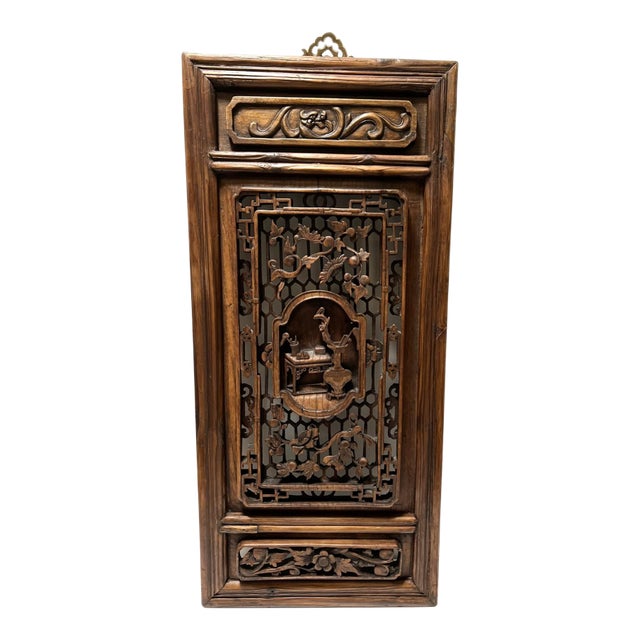
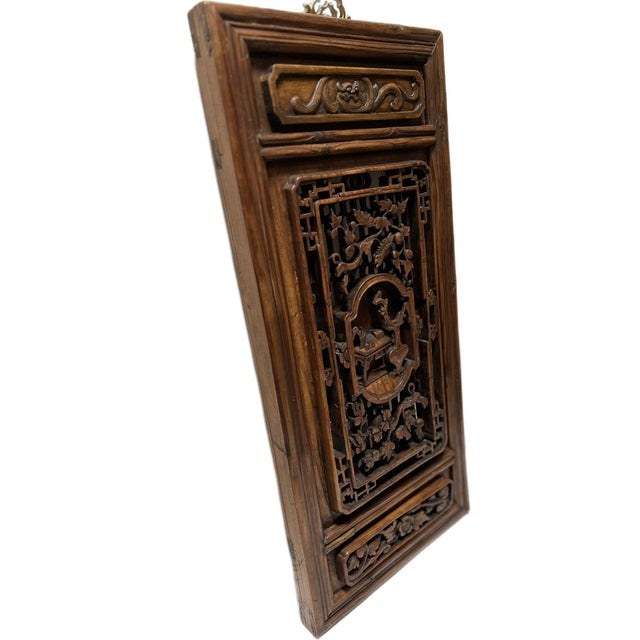
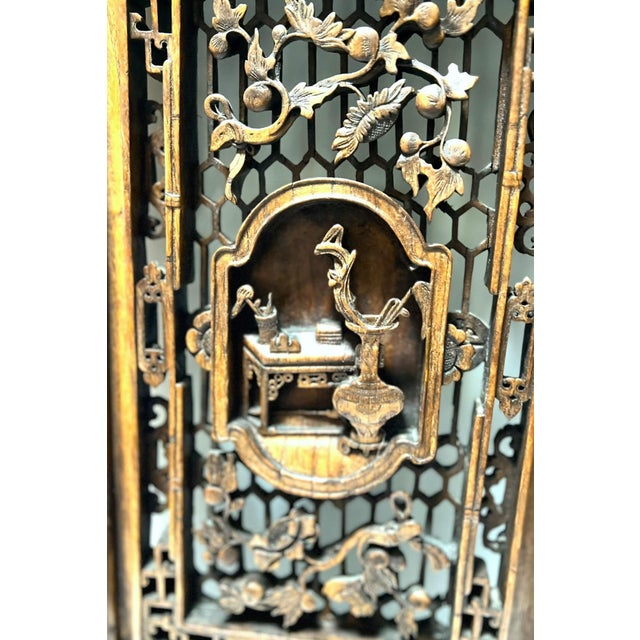
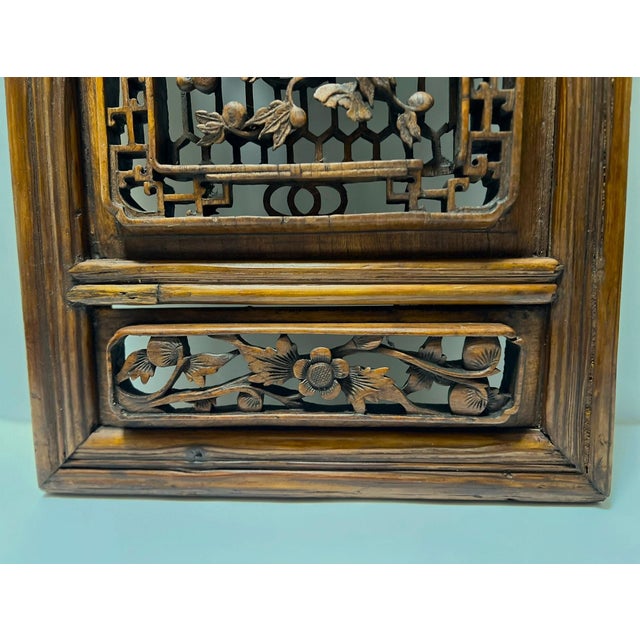
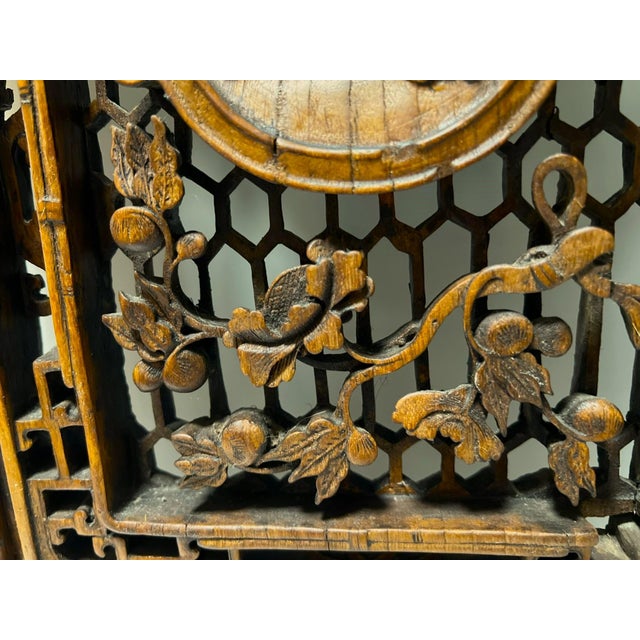
This is one of the rare panels that show the Chinese literati's love for scholar objects. The center panel shows a scholar's desk with elaborate spandrels. On the desk are a brush pot with brushes and other implements such as a fly whisk, a brush rest shaped like the sacred mounts and a stack of books. In front of the desk is a large vase that holds an interesting looking root and a few painting scrolls. This window panel is made of three parts. The top and bottom segments are carvings of floral scrolls. The carving had to be carefully done because the work is done in layers, the flowers are on top of the open lattice design. (It is easier to see from the back how the carving was done.) I am very partial to this panel with the scholar objects. It was purchased in the 1990's and I kept it all this time, as the dust can attest to this fact. After handling architectural artifacts for so many years, it is my observation that each region has its own style, and this particular repeat geometric pattern could be from the Zhejiang, Jiangsu Province, or Anhui Province of Southeast China. Similar pieces, but without the scholar theme, are on displayed in the Chinese House - Yin Yu Tang.
See less
- Dimensions
- 13ʺW × 1.5ʺD × 29.5ʺH
- Styles
- Qing
- Period
- Early 19th Century
- Country of Origin
- China
- Item Type
- Vintage, Antique or Pre-owned
- Materials
- Metal
- Wood
- Condition
- Good Condition, Restored, Some Imperfections
- Color
- Brown
- Condition Notes
- The object was removed from a home in China. It was washed and revarnished. It has cracks and small losses … moreThe object was removed from a home in China. It was washed and revarnished. It has cracks and small losses that are hard to see. The panel has been in storage and is still dusty in hard to reach places. less
Questions about the item?
Returns & Cancellations
Return Policy - All sales are final 48 hours after delivery, unless otherwise specified in the description of the product.
Cancellation Policy - Prior to shipping or local pickup, buyers may cancel an order for up to 48 hours, unless otherwise specified.
Related Collections
- Medium-Density Fibreboard Sculptural Wall Objects
- Maison Jansen Sculptural Wall Objects
- Antique Copper Finish Sculptural Wall Objects
- Ralph Lauren Sculptural Wall Objects
- Dada Sculptural Wall Objects
- Helmut Friedrich Schäffenacker Sculptural Wall Objects
- Asian Sculptural Wall Objects
- Mid-Century Modern Sculptural Wall Objects
- Greg Copeland Sculptural Wall Objects
- Curtis Jere Sculptural Wall Objects
- Plaster Sculptural Wall Objects
- Brutalist Sculptural Wall Objects
- Japanese Sculptural Wall Objects
- Sarreid Ltd. Sculptural Wall Objects
- Wenge Sculptural Wall Objects
- Arteriors Home Sculptural Wall Objects
- Silverplate Sculptural Wall Objects
- Stainless Steel Sculptural Wall Objects
- The American School Sculptural Wall Objects