




Details
Description
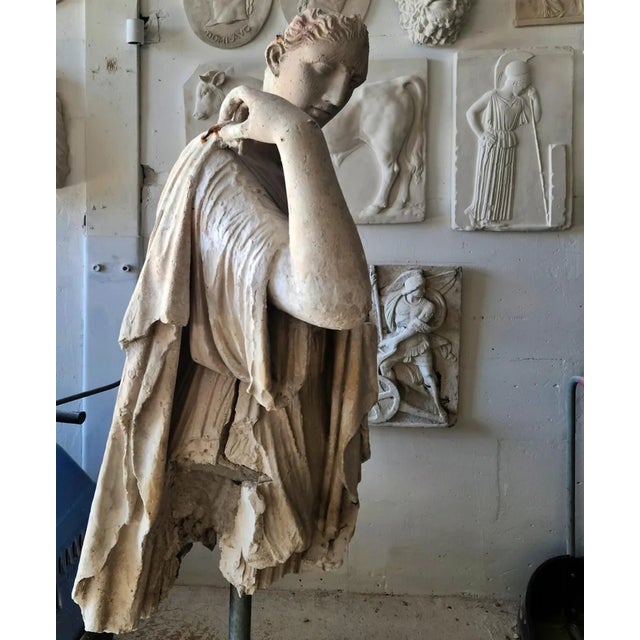
Antique 19th century plaster of the diana of gabi from the louvre ancient plaster with identical measurements to the original …
Read more
Antique 19th century plaster of the diana of gabi from the louvre ancient plaster with identical measurements to the original greek marble exhibited at the louvre. Diana of gabi, discovered in 1792 by gavin hamilton in rome. The plaster is an original ancient and shows all its years, we will supply it partially restored with the iron base included. The object was acquired from a famous sculpture workshop that had owned it since 1959 but which in turn the owner had acquired it from another craftsman from carrara who had owned it since the mid-1800s. The object is fascinating, beautiful. Original iron base included. The diana of gabi is a statue depicting a woman wrapped in a drape; most likely it represents the goddess artemis, and is traditionally attributed to praxiteles. In the past it was part of the borghese collection and is preserved at the louvre museum. The statue was discovered in 1792 by gavin hamilton, in the properties of prince marcantonio iv borghese near rome, where the city of gabi once stood, and was immediately included in the prince's collection. In 1807, due to financial difficulties, prince camillo ii borghese, son of marcantonio, was forced by napoleon to sell 344 works from the borghese collection to france. Since 1820, the diana of gabi has been on display at the louvre. The statue became very popular in the 19th century: a plaster cast was placed at the athenaeum club in london; a marble copy was present among the reproductions of ancient statues intended to decorate the cour carrée, the square court of the louvre, and a copy decorated a fountain in the french town of grancey-le-château-neuvelle, in the côte-d'or. In addition, smaller-scale reproductions were made and then sold to art enthusiasts. The young woman is depicted larger than life-size. The weight of the body is discharged on the right leg, reinforced with a tree stump; the left leg, however, does not contribute in any way to supporting the figure: the left foot, in fact, has a raised heel and toes turned outwards. The statue is generally identified as artemis, goddess of virginity, hunting and the woods, exclusively because of her clothes. In fact, she wears a chiton that is not particularly long with wide sleeves, typical of the goddess. The chiton is tied with two straps, one visible around her waist, the other hidden, which hold part of the fabric, shortening the chiton and showing her knees. The goddess is depicted in the act of fastening her cloak with a pin: her right hand holds a fibula and holds up a fold of the dress on her right shoulder, while the left hand holds another fold of the dress at chest height. The movement causes the collar of the chiton to fall, leaving the left shoulder uncovered. Her head is slightly turned to the right, but the goddess does not seem to be paying attention to what she is doing. Instead, her gaze is directed to her surroundings, a typical feature of classical statues. Her flowing hair is pulled back by a band tied above the neck, then gathered into a bun held in place by a second, invisible ribbon. According to pausanias, praxiteles created the statue of artemis brauronia for the acropolis of athens. The inventories of the temple, dated 347-346 bc, mention a "dedicated statue", describing it as depicting the goddess in a chitoniskos. It is also known that the cult of artemis brauronia also included the consecration of garments offered by maidens. Praxiteles' statue has long been associated with the diana of gabii: the goddess appears wearing the gift of her devotees. In addition, the head strongly resembles those of the cnidian aphrodite and the apollo sauroctonos, both attributed to praxiteles. On the other hand, the identification of the statue has been questioned for several reasons. First, regarding the inventories discovered in athens, it has been shown that they are copies of those concerning the main sanctuary at brauron and it is therefore not certain that the cult in athens also included the consecration of the garments. Furthermore, the short chiton is anachronistic for the 4th century bc, thus suggesting a hellenistic placement. Finally, a recent hypothesis relates the statue of artemis brauronia to a head present in the museum of the ancient agora of athens, known as the despinis head. The diana of gabii is nevertheless considered a work of impressive quality and conforms to what is commonly considered the praxitelean style, leading some scholars to continue to consider the statue a work by praxiteles or one of his sons. Height 110 cm width 56 cm depth 40 cm weight 45 kg artist / designer / architect praxiteles historical period 347-346 bc material ancient plaster museum: louvre. This piece is attributed to the mentioned designer/maker. It has no attribution mark and no
official proof of authenticity,
however it is well documented in design history. I take full responsibility for any authenticity
issues arising from misattribution
See less
- Dimensions
- 22.05ʺW × 15.75ʺD × 43.31ʺH
- Styles
- Baroque
- Country of Origin
- Italy
- Item Type
- Vintage, Antique or Pre-owned
- Materials
- Plaster
- Condition
- Unknown, Some Imperfections
- Color
- Gold
- Condition Notes
- Very Good — This vintage item has no defects, but it may show slight traces of use\. Repaired: little repairs Very Good — This vintage item has no defects, but it may show slight traces of use\. Repaired: little repairs less
Returns & Cancellations
Return Policy - All sales are final 48 hours after delivery, unless otherwise specified in the description of the product.
Cancellation Policy - Prior to shipping or local pickup, buyers may cancel an order for up to 48 hours, unless otherwise specified.
Related Collections
- Virginia Metalcrafters Home Accents
- Piero Fornasetti Home Accents
- Moser Glassworks Home Accents
- Line Vautrin Home Accents
- Design Home Accents
- Gracie Home Accents
- Velour Home Accents
- 9K Gold Home Accents
- Stickley Home Accents
- Dimitri Omersa Home Accents
- Goat skin Home Accents
- Bijan Home Accents
- Unlacquered Brass Finish Home Accents
- Violet Home Accents
- Mario Buatta Home Accents
- Mission Home Accents
- Spalding Home Accents
- Silk Velvet Home Accents
- Home Accents in Des Moines, IA
- Spanish Revival Home Accents
- Verdigris Copper Finish Home Accents
- Ruby Home Accents
- Carlo Scarpa Home Accents
- Medium-Density Fibreboard Home Accents
- Sandalwood Home Accents