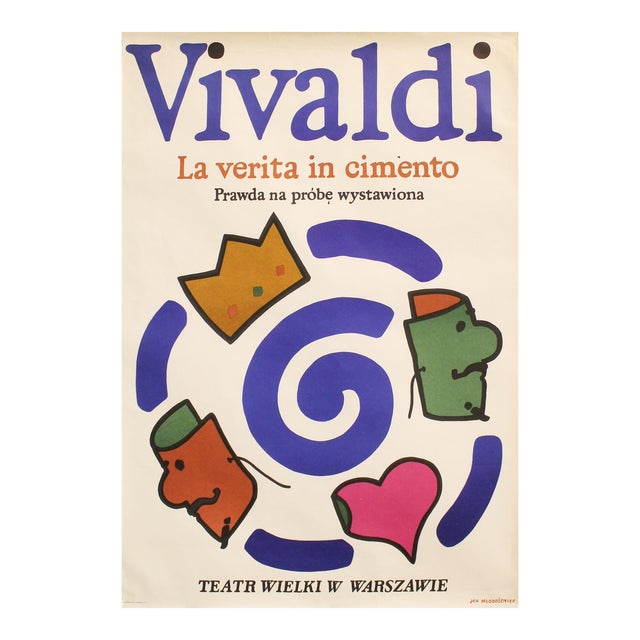


Details
Description
Date: 1981
Size: 26 x 38.5 inches
Artist: Jan Mlodozeniec
About the Poster: Beginning in the 1950s and through the …
Read more
Date: 1981
Size: 26 x 38.5 inches
Artist: Jan Mlodozeniec
About the Poster: Beginning in the 1950s and through the 1980s, the Polish School of Posters combined the aesthetics of painting with the succinctness and simple metaphor of the poster. It developed characteristics such as painterly gesture, linear quality, and vibrant colors, as well as a sense of individual personality, humor, and fantasy. It was in this way that the polish poster was able to make the distinction between designer and artist less apparent.
Polish posters have come to stand apart from the advertising design conventions fostered in Europe during the 20th century. It was during the communist regime, a time when culture was closely monitored by the state, that Polish artists found liberation in poster art. Ironically, this foremost public art form became ground for individual expression. During that period, the cultural institutions, of theatre and cinema especially, flourished as they were funded by government agencies. Artists freshly out of the fine arts academy flocked towards poster production as the demand for this art was rapidly growing. The result became some of the most unique and expressive posters the world has ever seen - and artworks in themselves.
About the Artist: Born in 1929 in Warsaw, Poland, Jan Mlodozeniec is considered to be one of the great masters of Polish poster design. The artist graduated from the Warsaw Academy of Fine Arts and had won many prizes over the course of his career. Among them ,several awards and medals at the National Poster Biennial in Katowice (1965, 1971, 1977), First prize at the 2nd Biennial of Applied Graphic in Brno (1966), Gold medal at the 8th International Poster Biennial in Warsaw (1980) and a gold medal at the 5th International Biennial of Posters in Lahti, Finland (1983).
About the Opera: Mamud had two sons, one by his favourite Damira and one by the Sultana Rustena. He had them exchanged at birth, so that Melindo, in truth the son of Damira, is thought to be the legitimate heir, a position rightfully held by Zelim. When marriage is proposed between Melindo and Rosane, the heiress to another Sultanate (who is in fact beloved by Zelim), Mamud resolves to reveal the true state of affairs. After various twists and turns, Zelim inherits the larger portion of his empire, while Melindo contents himself with a secondary kingdom (Rosane's country) and is allowed to marry the fickle princess Rosane. This leaves everyone satisfied. (Wikipedia)
The poster has some minor ruffling in the top right corner. Rare and ready to frame!
See less
- Dimensions
- 26ʺW × 0.1ʺD × 38.5ʺH
- Styles
- Abstract
- Illustration
- Frame Type
- Unframed
- Art Subjects
- Pop Culture
- Music
- Artist
- Jan Mlodozeniec
- Period
- 1980s
- Country of Origin
- Poland
- Item Type
- Vintage, Antique or Pre-owned
- Materials
- Paper
- Condition
- Good Condition, Original Condition Unaltered, Some Imperfections
- Color
- Blue
- Condition Notes
- As described, ready to frame. As described, ready to frame. less
Questions about the item?
Returns & Cancellations
Return Policy - All sales are final 48 hours after delivery, unless otherwise specified in the description of the product.
Cancellation Policy - Prior to shipping or local pickup, buyers may cancel an order for up to 48 hours, unless otherwise specified.
Related Collections
- Le Corbusier Posters
- Ceramic Posters
- Silk Posters
- Leather Posters
- Art Deco Posters
- Posters in Los Angeles
- Marc Chagall Posters
- Screen Print Posters
- Mark Rothko Posters
- Mid-Century Modern Posters
- French Posters
- Pablo Picasso Posters
- Peter Max Posters
- Milton Avery Posters
- Polish Posters
- Lee Krasner Posters
- Keith Haring Posters
- Museum Posters
- Japanese Posters
- Framed Posters
- Woodcut Posters
- Beaux-Arts Posters
- Posters in Orlando