





Details
Description
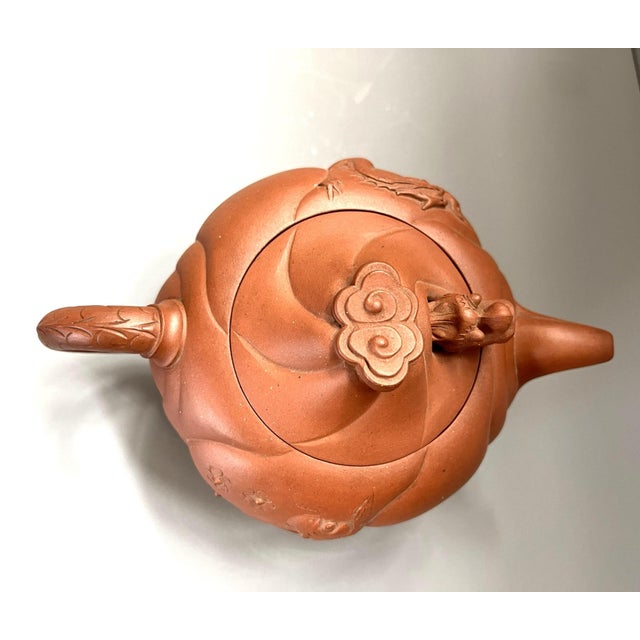
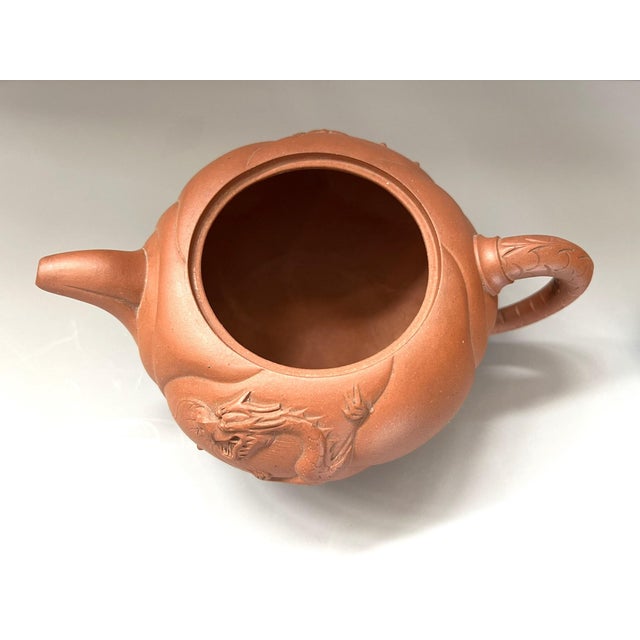
The folklore of the transformation of fish to dragon is best exemplified by this red stoneware clay teapot from Yixing, …
Read more
The folklore of the transformation of fish to dragon is best exemplified by this red stoneware clay teapot from Yixing, the pottery center of Southeast China. Yixing teapots are best for brewing tea. The clay body allows the tea to breathe and it is not hot to the touch. The 1920's and 30's were prolific times for the teapot productions in Yixing. Many teapots were exported to the world expositions all over. This teapot would have been purchased in one of the fairs in Chicago. It was always kept in the Curio Cabinet and never been used.
The prototype of this teapot with open mouth dragon was made as early as the late 19th century, and it is still being made today. The whimsy of the teapot with the protruding dragon tongue as the tea is being poured is always a favorite. The body of the teapot with the swirls radiating from the bottom and continue up to the teapot lid, representing clouds, s a masterful design. Everything about this teapot, from the Dragon emerging from clouds to the Carp coming out of the waves, to the removable Dragon head with protruding tongue is all handmade. The texture of the Yixing clay is such that teapots cannot be molded so good handwork is necessary to make teapots. The teapot finial represents clouds and the handle - the scales of the Dragon and the Carp. There is a 2 character maker's mark under the lid, but the name of the potter is not known.
Finally, the lore of the carp transformation to dragon relates to a Buddhist story. The short version is about the carps, like salmons have to return to their birthplace to spawn. The journey up the Yangzi River in South China is long and arduous, when there are rapids to cross. At the end of their journey, Buddha chose a Carp and turned it into a Dragon.
This teapot was made in the first half of the 20th century, likely in the 1920's and 30's before WWII. When production of Yixing teapots resumed in the 1950's, the teapots were fired to a different color red, and later all purple brown, due to the use of oil fired kilns, instead of the traditional wood fired dragon kilns.
See less
- Dimensions
- 7ʺW × 5.5ʺD × 4.75ʺH
- Styles
- Chinese
- Period
- Early 20th Century
- Country of Origin
- China
- Item Type
- Vintage, Antique or Pre-owned
- Materials
- Stoneware
- Condition
- Good Condition, Original Condition Unaltered, Some Imperfections
- Color
- Brick Red
- Condition Notes
- The teapot has never been used. There is no visible flaw, just some dust collected in the crevices. The teapot has never been used. There is no visible flaw, just some dust collected in the crevices. less
Questions about the item?
Returns & Cancellations
Return Policy - All sales are final 48 hours after delivery, unless otherwise specified in the description of the product.
Cancellation Policy - Prior to shipping or local pickup, buyers may cancel an order for up to 48 hours, unless otherwise specified.
Related Collections
- Tea Pots in Savannah
- Tea Pots in Mobile
- Tea Pots in Greenville, SC
- Pop Art Tea Pots
- Teal Tea Pots
- Tea Pots in Cincinnati
- Gold Leaf Tea Pots
- Silverplate Tea Pots
- Antique Teapots
- French Tea Pots
- Regency Tea Pots
- Early American Tea Pots
- Villeroy and Boch Tea Pots
- Bordallo Pinheiro Tea Pots
- Tea Pots in Jacksonville, FL
- Tea Pots in Louisville
- Industrial Tea Pots
- Majolica Tea Pots