



Details
Description
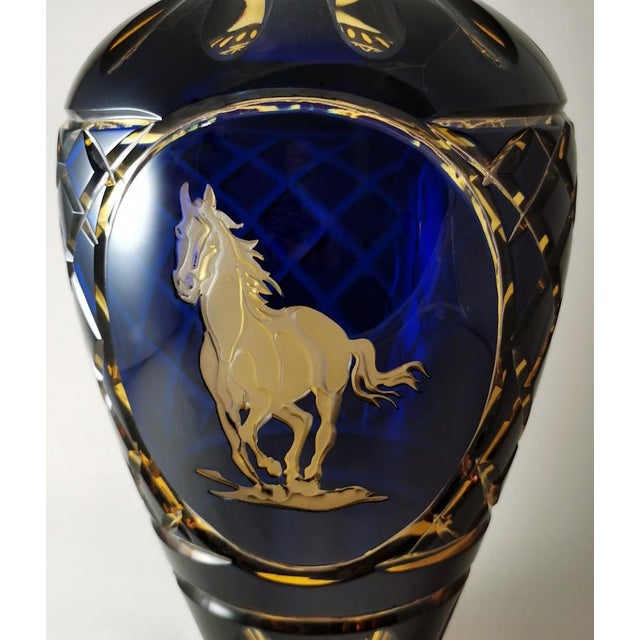
Before describing the object under consideration we must make an important clarification; the artifact, one of many that we will … Read more Before describing the object under consideration we must make an important clarification; the artifact, one of many that we will publish over time, is part of the museum collection of a historic Florentine mill that unfortunately closed recently. It is the Marcello Galgani & Figlio company, whose completely manual and artisanal work has not withstood the disproportionate advance of mass-produced mechanical processes! Marcello Galgani began his craftsmanship as a grinder and restorer in 1960; as the years went by, Marcello gained mastery and familiarity with particular techniques and shapes, resulting in the production of objects that manage to retain the freshness of grinding and engraving, the warmth and softness of light, and the inimitable flavor of unique artifacts. After several years, his son Lorenzo, who grew up among crystals, also entered the business and immediately became passionate about this ancient craft with skill and ability. Stimulated by the aesthetic sense of the past, father and son, set up a workshop in which the shapes they researched and created themselves were mouth-blown by traditional Tuscan glassmakers in Empoli, then ground and engraved using ancient sixteenth-century techniques, with motifs born from the inexhaustible imagination of the Galgani family or culturally inspired by designs of objects seen and studied in Florentine museums (Uffizi, Galleria Palatina, Museo degli Argenti, etc.). As mentioned the company recently closed and disposed of all its last production, only Marcello's old private museum collection remained, which includes unique and special objects created over time, a collection that the craftsman made available to us for a planned sale. All of the objects were made entirely by hand with old grinding wheels, but there were mainly two tools that allowed the creation of masterpieces: the right hand and the left hand of the master craftsman. Ancient glassmaking techniques were used for all the ground and engraved products: first the object was ground with an emery wheel fed continuously by a jet of abrasive sand and water, then re-polished with a very fine-grained sandstone wheel also fed with water; the engravings were done freehand using as many as 10-15 small stone wheels for each design (flowers, branches, animals, etc.); then the object was polished and polished. We must make, at this point, an important clarification about these last two operations: towards the end of the 1960s, acid crystal polishing was devised, the object was immersed and rotated in a solution of sulfuric acid, fluoridic acid, and water and in a short time all the defects left by the previous processes were eliminated, it was a fast, industrial operation that allowed to lower costs considerably, with discrete but not excellent results. But for Galgani's products polishing is done with a cork bark wheel wet with water and pumice, to make the surfaces more transparent, finally, polishing was achieved with a felt wheel wet with a paste of water, iron oxide, and cerium oxide. This series of processes takes an average of two days of work ( sometimes much longer) for each object; each engraving or grinding is the result of the creative inventiveness of the two craftsmen, inventiveness that transforms crystal into a material reality of the highest aesthetic value and inestimable worth. All objects in the entire collection have never been used; they were part of the exhibition. Large blue and amber Art Deco-style vase; the vase was produced in a kiln in Empoli (Italy) using the technique of "incamiciatura," which consists of superimposing on the glass mass, in the first stage of processing, one or more successive layers of glass of various colors; in our vase the amber-colored mass was superimposed on the blue color; the cutting and grinding performed afterward revealed the underlying amber color, creating an unparalleled work of art; Master Marcello personally ground the horse figure with exceptional artistic dexterity, then sandblasted to enhance the depth of grinding. The complex stages of fabrication took 7 days to complete. The object was created in Marcello Galgani's workshop in 1984 and made with the techniques (grinding, engraving, and polishing) we explained in the introductory description. Only two examples of this object are available. Measures diameter cm.23. height cm.33. The vase is in excellent condition. For all our shipments we use special packaging materials (wooden crates, styrofoam, etc.) for maximum protection and safety of the objects. See less
- Dimensions
- 9.06ʺW × 9.06ʺD × 13ʺH
- Styles
- Art Deco
- Period
- 1980s
- Country of Origin
- Italy
- Item Type
- Vintage, Antique or Pre-owned
- Materials
- Crystal
- Condition
- Mint Condition, No Imperfections
- Color
- Blue
Questions about the item?
Returns & Cancellations
Return Policy - All sales are final 48 hours after delivery, unless otherwise specified in the description of the product.
Cancellation Policy - Prior to shipping or local pickup, buyers may cancel an order for up to 48 hours, unless otherwise specified.
Related Collections
- Clarice Cliff Vases
- Franco Bucci Vases
- Dorothy Draper Vases
- St. Louis Crystal Vases
- Arcore Ceramica Vases
- Poltronova Vases
- Surface Ceramics Vases
- Graphite Vases
- Bimini Glass Vases
- Libbey Glass Co. Vases
- Raymor Import Vases
- Workaday Handmade Vases
- Liz Marsh Vases
- Karl Springer Vases
- Southeast Asia Vases
- The American School Vases
- From Vienna Vases
- Lenox Vases
- Blenko Vases
- Swung Vases
- Fenton Art Glass Company Vases
- Haeger Vases
- Viking Glass Company Vases
- Italian Vases
- Orrefors Vases