




Details
Description
The Textile Table: A Folk Art Still Life in Felt
Object: Picture of Fruit in a Bowl
Medium: Cut and …
Read more
The Textile Table: A Folk Art Still Life in Felt
Object: Picture of Fruit in a Bowl
Medium: Cut and Layered Feltwork (Appliqué) on a Dark Ground
Origin: Probably New York State, United States
Date: Circa 1890-1910
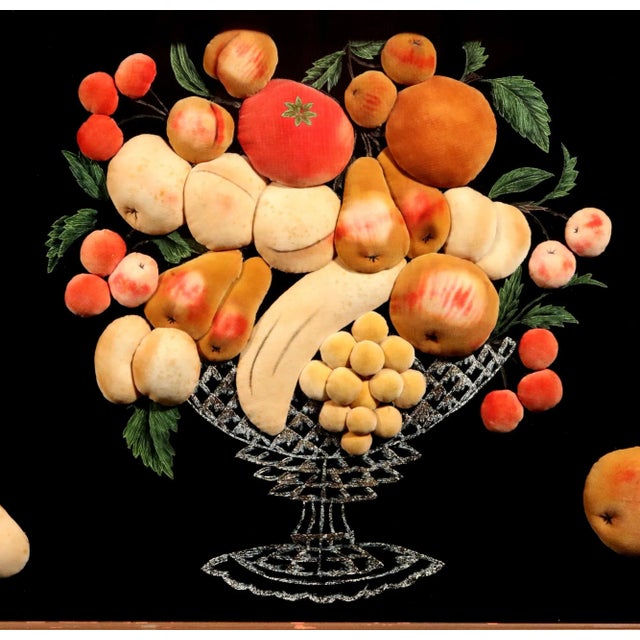
This strikingly large American feltwork picture transforms the classical subject of the still life into a vibrant, textural folk art medium. The composition features a highly detailed arrangement of various fruits—including peaches, pears, apples, grapes, bananas, and cherries—overflowing from an openwork, metal-footed bowl. The strong, original colors of the felt are beautifully preserved against a deep, dark background, giving the work a dramatic depth.
Visual Analysis and Technique
The piece utilizes the technique of appliqué, where shapes cut from different colored wool felt are layered and stitched onto a backing material.
Textural Detail: The artist achieved dimensionality by carefully cutting, padding, and positioning the pieces. The felt naturally absorbs light, giving the fruit a soft, volumetric quality, while the simulated metal bowl—likely created with small, meticulously cut white or grey felt pieces—provides a central element of delicate detail.
The Subject: The subject of a bountiful fruit bowl is common in still life painting, symbolizing abundance and domestic prosperity. The inclusion of diverse fruits, such as the tropical banana alongside local apples and pears, reflects the expanding American food market at the turn of the 20th century.
Historical Context: American Folk Crafts
This work belongs to a rich tradition of American amateur craft, particularly popular among women in the late Victorian and Edwardian periods. Unlike professional oil painting, feltwork was an accessible medium that used common, inexpensive materials to create lasting decorative objects.
Regional Production: While the origins are noted as "Probably New York State," such felt pictures were made throughout the Northeastern United States. They served as important decorative pieces, showcasing the maker's skill and providing colorful art for the home at a time when purchasing expensive framed artwork was beyond the means of most families.
Dimensions
Height: 21 1/4 inches (53.98cm) high
Width: 31 inches (78.74cm) wide
Depth (Framed): 4 inches deep
References
Vlach, John Michael., Plain Painters: Making Sense of American Folk Art (For analysis of materials and methods in amateur and folk traditions).
Wadsworth Atheneum Museum of Art Collection (Holds significant collections of American folk textiles and decorative arts for comparative study).
Bishop, Robert., American Folk Art: Expressions of a New Spirit (For an overview of decorative home crafts and their social context in the period).
(Ref: NY10375-nurr)
See less
- Dimensions
- 31ʺW × 4ʺD × 21.25ʺH
- Period
- Late 19th Century
- Country of Origin
- United States
- Item Type
- Vintage, Antique or Pre-owned
- Materials
- Textile
- Condition
- Good Condition, Original Condition Unaltered, Some Imperfections
- Color
- Orange
- Condition Notes
- Good, bright color Good, bright color less
Questions about the item?
Returns & Cancellations
Return Policy - All sales are final 48 hours after delivery, unless otherwise specified in the description of the product.
Cancellation Policy - Prior to shipping or local pickup, buyers may cancel an order for up to 48 hours, unless otherwise specified.
Related Collections
- Loloi Rugs Textile Art
- Antique Gold Finish Textile Art
- Workaday Handmade Textile Art
- Chanel Textile Art
- Louis XIII Textile Art
- Cashmere Textile Art
- Kenneth Ludwig Chicago Textile Art
- Resin Textile Art
- Ralph Lauren Textile Art
- Mid-Century Modern Textile Art
- Chinese Textile Art
- Framed Scarves
- Tapestry
- Japanese Textile Art
- Scandinavian Textile Art
- Aubusson Tapestry
- Brutalist Textile Art
- Surrealism Textile Art
- Space Age Textile Art
- Asian Style Textile Art
- Cork Textile Art
- Old New House Textile Art
- Cardboard Textile Art
- Märta Måås-Fjetterström Textile Art
- Pablo Picasso Textile Art