




Details
Description
Title: Book or Linen Press.
Maker: Unknown.
Origin: England.
Period: 19th Century.
Materials: Iron, steel, walnut.
Description: Offered is an …
Read more
Title: Book or Linen Press.
Maker: Unknown.
Origin: England.
Period: 19th Century.
Materials: Iron, steel, walnut.
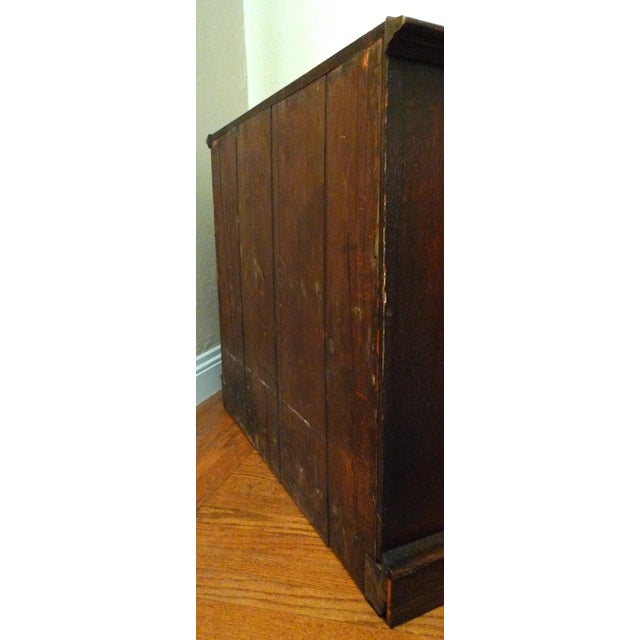
Description: Offered is an antique cast iron and steel screw linen press, with a hand wheel at center, rests on a walnut two-drawer chest accented with threaded screw design corners and brass hardware. The plate is lowered by pressure from the hand wheel due to the threaded screw mechanism. The press is mounted with three bolts on each side for attaching to the chest foundation.
Features: 9 inch daylight (being the maximum distance that the press can be opened to), square cut thread - cut at a shallow angle (allows for provision of additional tightening, to apply maximum pressure), molded arch detailed with pierced design pillars and finials. The walnut upper press plate and base edge are accented with a beveled edge. Felt strips adhered to bottom.
Measures: 36 L x 21 D x 52.75 H (Plate - 30 L x 19 D) inches.
Approximate weight: 200 pounds.
History and Purpose: Predominantly, these old linen presses are being sold as book presses, their original purpose forgotten. As early as the 6th - 7th century CE, Ancient Romans used similar presses to give a good finish to togas, sometimes called clothes presses. In the 17th - 18th & 19th centuries, presses of this type were used for smoothing both freshly washed and recently-used linen, especially table linen.
Ornate presses were more than functional. Often called napkin presses, they were kept near the dining table - for show and for convenience. Plainer presses might be in a pantry or laundry room. They were a good way of displaying your best white cloths and napkins in a fine piece of furniture, and this was particularly true in 17th - 18th century Europe and North America.
The pressure on the cloth does more than flatten it. It may give linen a smooth lustrous surface, and it emphasizes the folds. So folding linen neatly in a regular pattern was important and could even be decorative. Folding along the old creases when putting a tablecloth back in the press after a meal was important - as Victorian servants' advice manuals insist.
See less
- Dimensions
- 36ʺW × 21ʺD × 52.75ʺH
- Period
- 19th Century
- Country of Origin
- United Kingdom
- Item Type
- Vintage, Antique or Pre-owned
- Materials
- Brass
- Cast Iron
- Steel
- Walnut
- Condition
- Good Condition, Restored, Some Imperfections
- Color
- Brown
- Condition Notes
- Good; operational and structurally sound, wear commensurate with age and use; e.g. naturals, shrinkage, old repairs, finish wear at extremities. … moreGood; operational and structurally sound, wear commensurate with age and use; e.g. naturals, shrinkage, old repairs, finish wear at extremities. A striking piece. less
Questions about the item?
Returns & Cancellations
Return Policy - All sales are final 48 hours after delivery, unless otherwise specified in the description of the product.
Cancellation Policy - Prior to shipping or local pickup, buyers may cancel an order for up to 48 hours, unless otherwise specified.
Related Collections
- Cast Iron Chests of Drawers
- Rope Chests of Drawers
- Nautical Chests of Drawers
- Chests of Drawers in Monterey, CA
- Tangerine Chests of Drawers
- Chinoiserie Chests of Drawers
- Thomasville Chests of Drawers
- Campaign Chests of Drawers
- Pennsylvania House Chests of Drawers
- Mahogany Chests of Drawers
- Burlwood Chests of Drawers
- Hitchcock Chests of Drawers
- Painted Chests Of Drawers
- Ethan Allen Chests of Drawers
- French Provincial Chests of Drawers
- Davis Cabinet Company Chests of Drawers
- Asian Chests of Drawers
- Chests of Drawers in Los Angeles
- Gilbert Rohde Chests of Drawers
- Bunny Williams Home Chests of Drawers
- Grosfeld House Chests of Drawers
- Raymond Loewy Chests of Drawers
- Edmond J. Spence Chests of Drawers
- Antique Bronze Finish Chests of Drawers
- Canvas Chests of Drawers