




Details
Description
Charming pastel painting on paper by Pio Santini (1908-1986), named "nude with lace", and signed bottom left corner "Santini".
Lovely …
Read more
Charming pastel painting on paper by Pio Santini (1908-1986), named "nude with lace", and signed bottom left corner "Santini".
Lovely romantic composition with a nude young lady kneeling and holding a piece of white lace. Flamboyant magenta red drape background.
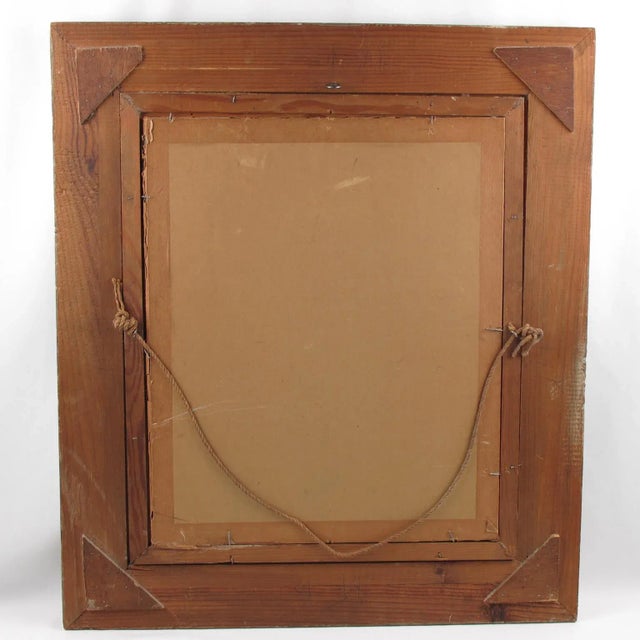
Originally framed in an elegantly carved wood frame with gesso and off-white wood liner and glass protection.
Measurements:
With frame: 22.75 in. wide (58 cm) x 26 in. high (66 cm)
Opening view: 14.50 in. wide (36.5 cm) x 17.75 in. (45 cm).
Artist Biography: Pio Santini (1908-1986)
Pio Santini was born on April 17th, 1908 close to Rome, in Tivoli, Italy.
He showed a precocious and pronounced artistic taste and gifts, to begin with, drawing and painting. From his childhood drawings, as early as 5 or 6 years old, he showed a gift and a technique above the average.
As early as 1933, Pio Santini moved to Paris, in Montparnasse, the artists' area, where he settled in his first Parisian studio. Because of that, he can be considered as belonging to the Academy of Paris, a significant artistic movement of the first half of the 20th Century along which Amedeo Modigliani and other Italian artists.
While attending the classes of the Estienne School for further training in plastic art, Pio Santini started to attract attention in various Parisian Salons (particularly the Winter Salon, the Independents’ Salon, and the French Artists’ one) and to find a place in the Parisian universe of painting, as is shown in the press of the time.
WWII, the conflict between his native and his adopted country upset him a lot. It was certainly during this period that the rooted idea of a united and reconciled Europe was born in his mind.
In a way, he played a part in the resuming cultural exchanges between France and Italy, by founding, the association "The Romans in Paris" after the war, and especially by creating and animating the Villa d’Este Prize for about ten years, rewarding each year a French artist or writer by offering him or her a one month stay at the Villa, in Tivoli. Later, the "Montparnasse Prize" would reward Italian artists in Paris in the same way.
While devoting himself to painting, he worked as an art illustrator for edition and press and left us a rich but unrecognized work from this period. In the early 1960s, Pio Santini decided, imperiously and bravely, to live on his painting. A member of the Society of Independent Artists since 1934, he then took an active part in many group exhibitions in France and abroad.
He regularly exhibited in Parisian salons most of which he was a member: the Independents’ Salon, the Autumn, and Winter Salons, the National Salon of the Fine Arts, and the Comparison Salon.
As an assiduous participant in the prestigious Salon of the French Artists, he was often rewarded there: Great Price of the Salon in 1970, then in 1974, gold medal in 1971, and Prize-winner of the Ernest Marché Prize in 1974.
Pio Santini lived his last years in his house in Garches, near Paris. He worked there until the last moment and died of illness at the age of 78.
Keeping himself a part of the avant-garde of contemporary art, Pio Santini developed a personal work of great formal coherence very steadily. He is a two-time artist, one of the beginnings of his career, the Thirties, and the other one, his rebirth, the Sixties when the artist can again devote himself body and soul to paint.
Between these two periods, the Second World war badly hit the pictorial growth of Pio Santini, yet it had all started auspiciously for the young painter whose determination to be devoted to painting is clearly shown in his self-portrait, 1928, as a manifesto. The Thirties, after the successive revolutions of cubism, abstraction, and surrealism, had made figurative art and the "carnal one" fashionable again, by the assertion of an aesthetic vitality quite close to Pio Santini’s concerns. His former sculptor talent (Bust of Count Colonna, 1929) can be found in his painting in the proportions and volumes of the bodies.
His nudes have a hedonist vitality in which the animated touch intensifies the sensuality. The chosen subjects are traditional and the approach is deliberately figurative, but the animated touch of Santini, his bold but sure taste for colors, transfigures his iconography. Pio Santini avoided all the traps of the "restoring order" represented by the Neo-classic movement, pomposity, and totalitarian ideology... At this time, the painter is already, fully and serene.
After 1945, the predominating taste changed and the legitimacy of naturalist figuration is a debatable point. The 1960s triumphing language tended more towards Pop Art, opposite to Santini’s pictorial universe. Modernity, in a cyclical break with tradition, wanted then to be synonymous with progress and provocation. These concepts nourished the uncompromising avant-garde ideology. On the other hand, Santini was in keeping with the figurative tradition, then so disparaged, with courage and modesty. During this unsettled artistic period, the painter started to exhibit in Paris, Rome, and Milan.
Little by little, the Parisian galleries were opening up for him, reputation took shape, thanks to the great prizes he won during Parisian official Exhibitions, among which the prestigious Great Prize of the French Artists (1970). Although he had committed himself to the great figurative tradition of classical style, in a time when it was out of fashion, Pio Santini’s work is still ignored by the general public.
See less
- Dimensions
- 22.75ʺW × 1.5ʺD × 26ʺH
- Frame Type
- Framed
- Art Subjects
- Nude
- Period
- 1940s
- Country of Origin
- France
- Item Type
- Vintage, Antique or Pre-owned
- Materials
- Glass
- Paper
- Pastel
- Wood
- Condition
- Good Condition, Original Condition Unaltered, Some Imperfections
- Color
- Pink
- Condition Notes
- Good - A dark stain and some minor miss on the edges of the original wood frame. Good - A dark stain and some minor miss on the edges of the original wood frame. less
Questions about the item?
Returns & Cancellations
Return Policy - All sales are final 48 hours after delivery, unless otherwise specified in the description of the product.
Cancellation Policy - Prior to shipping or local pickup, buyers may cancel an order for up to 48 hours, unless otherwise specified.
Related Collections
- Photorealism Canvas Paintings
- Ed Ruscha Paintings
- Photorealism Paintings in New York
- Richard Serra Paintings
- Louise Nevelson Paintings
- Silk Velvet Paintings
- Herman Miller Paintings
- BDDW Paintings
- Carl-Axel Acking Paintings
- Joseph Stella Paintings
- Karl-Erik Ekselius Paintings
- James McCray Paintings
- Milton Avery Paintings
- Jaanika Peerna Paintings
- Photorealism Paintings in Los Angeles
- Leroy Neiman Paintings
- Jo Baskerville Paintings
- Nicola Simbari Paintings
- Soicher Marin Paintings
- Cassina Paintings
- Black Photorealism Paintings
- Lawson-Fenning Paintings
- White Abstract Paintings
- Vienna Secession Paintings
- Red Abstract Paintings