





Details
Description
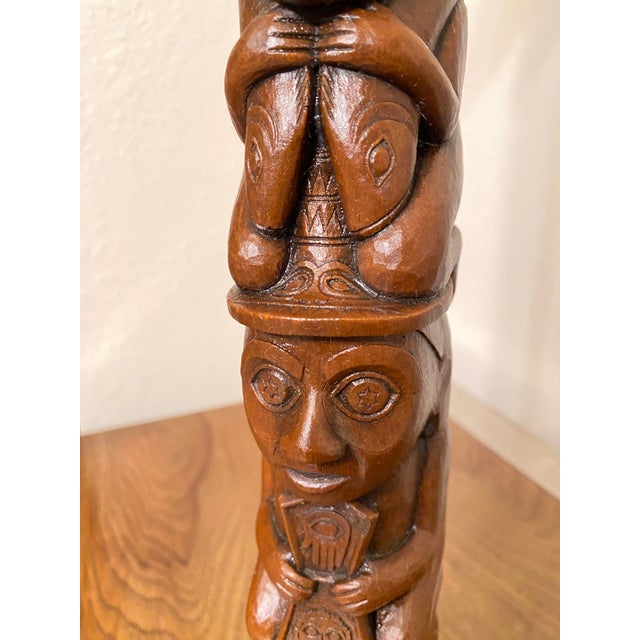
“In the absence of a written language, the Indians of the Northwest had preserved their stories and events carved from …
Read more
“In the absence of a written language, the Indians of the Northwest had preserved their stories and events carved from cedar logs. They were the nearest thing people had to books. The characters on a totem pole provide an outline so that, after hearing the story, listeners can read the pole for themselves.”
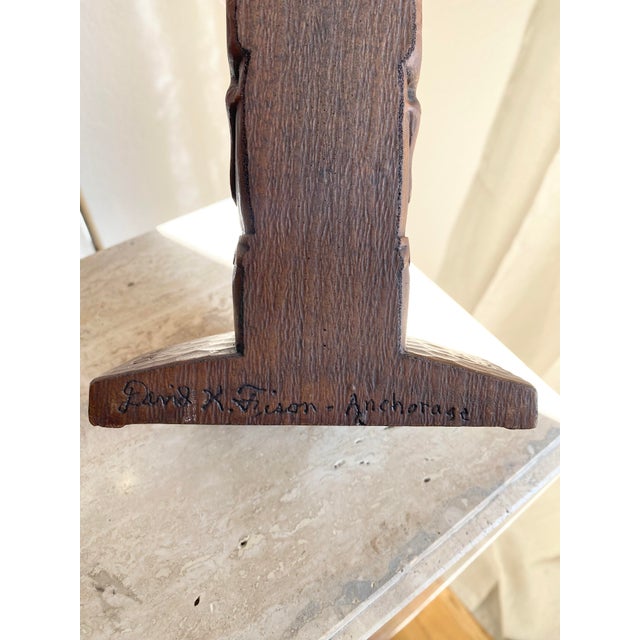
—David K. Fison (quoted in an article by Mike Dubose, United Methodist Communications, November 13, 2000)
In 1965, near the end of his tenure as pastor of First United Methodist Church of Ketchikan, Alaska, the Rev. David K. Fison was asked to serve as an interim pastor in the nearby Tsimshian village of Metlakatla. (The Christian community there has been longstanding; the village was founded in 1887 by missionary William Duncan and a large group of Tsimshian converts who followed him there from “Old” Metlakatla, British Columbia.)
While in Metlakatla, Fison fell in love with the Tsimshian people and their culture. He was especially interested in their use of totem poles to tell stories and to commemorate important events. But he noticed a void: among all the magnificent poles they had erected, where were the ones that told the story of their encounter with Christ.
In Western culture, a visual language for telling the Jesus story has long been established. The word “nativity” instantly generates a standard image in the Western mind—a baby in a manger inside a barn, surrounded by an adoring Mary and Joseph, shepherds, three kings, angels, and a smattering of domesticated animals. The words “crucifixion” and “resurrection” likewise carry automatic visual associations. That’s because these events from the life of Christ have been the subject of much of the corpus of Western art since the Middle Ages. But the Tsimshian had no such precedent to follow. Their artistic tradition consists mainly of highly stylized and compressed depictions of humans, birds, fish, and mammals, stacked on top of or within one another. How might they go about rendering the gospel story in their own visual language.
After leaving his post in Metlakatla, Fison spent years studying Tsimshian culture at the University of Alaska, Fairbanks. He decided to translate the gospel into a visual format that the Tsimshian could identify with. He wanted them to know that Jesus’s birth, life, death, and resurrection were historical events that could be part of their tribal history if they wanted to claim them.
The Christmas Totem Pole
In 1987, after much research and preparation, Fison completed a twelve-foot-tall Christmas totem pole, which he proudly displays in the living room of his home in Anchorage. (His work as a wood patternmaker in his younger years had equipped him with much of the necessary technical skill.) He wrote the following poem to explain the details of the narrative.
My friend, behold the carving,
Now open up your soul,
And you will learn the legend
Of the Christmas Totem Pole.
Now the Ancient Tsimshian
Had “books” for all to see,
For when they “wrote” a story
They carved it from a tree.
While gazing at old Totems
One Christmas dreamingly
I beheld a vision
Of a strange nativity.
Now, I sought to hold it,
But it escaped my grasp.
Not ’til I searched long their culture
Did it return at last.
Yet did some Ancient Craftsman
Guide by hands to lift the veil
Of how He would have carved it
If He had only known the tale?
From the lore of these people
Then let this pole proclaim:
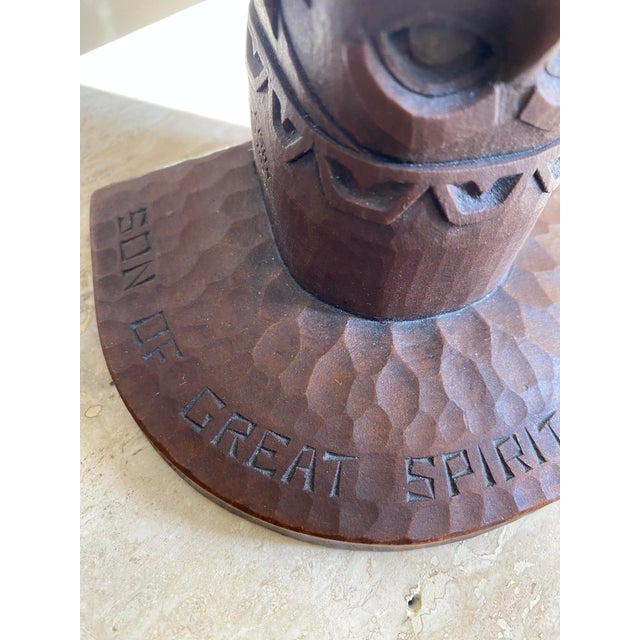
That “Great Chief of the Heavens”
Was their Creator’s name
Another Christmas Totem poem by Mr. Folsom:
Black Raven was His messenger
To bring His word, it seems.
And Frog, the lesser creature,
He sent to them in dreams.
To a lowly Maid came Raven,
To plan that Holy Birth,
While Frog assured Woodcarver
Her Child would bless the earth.
An order for a potlatch
Was given in that day.
They journeyed there by dugout
Through inland waterway.
No place was found for shelter,
Except the forest wild.
Where Bear feeds on the berries
Was born that Holy Child.
Men tending village fishtraps
Heard the Raven’s song
And ran to find a Saviour
Promised e’er so long.
Then traveling to that village
Came leaders from afar
With gifts for a newborn Chieftan,
Being guided by a star.
Yet there were those who feared Him,
And one who wished Him dead,
But Great Chief of the Heavens
Had a plan of love instead.
So He sent Frog to warn them;
And they hid with another clan.
He would become the Great Chief
And fulfill His Father’s plan.
Yes, He comes to every people
No matter where they live;
Just as they are, accepts them,
His Holy love to give.
So take Him as your Chief, my friend,
And He shall make you whole.
This fulfills the purpose
Of the Christmas Totem Pole.
Fison also wrote an interpretive key to the pole to further explain his choice of images:
RAVEN (Angel): Raven is the emissary of “The Great Chief of the Heavens,” the Tsimshian term for God. Raven holds the star of Bethlehem in his beak.
WOODCARVER (Joseph): Since all villages were connected by water, travel between villages was usually by canoe. Thus Joseph is depicted with a canoe paddle for the journey to Bethlehem.
MOTHER AND CHILD (Mary and the infant Jesus): In this version of the Christmas story there was no room in the village because it was filled with visitors who had come for a potlatch, a gathering where a powerful chief would display his wealth and power.
BEAR (symbolizes the place of Jesus’s birth): Since the ancient Tsimshian had no domestic animals, there can be no stable or manger. With no room in the village, Jesus would have been born where the forest animals feed. A bear, feeding on berries, takes the place of the manger.
KEEPERS OF THE VILLAGE FISH TRAPS (Shepherds): Since the Tsimshian had no sheep or other domesticated animals, keepers of the village fish traps would have been the nearest equivalent.
CHIEF (Wise Men): They came from distant villages following the star. The Tsimshian had no gold, but a very valuable possession would have been a copper shield.
FROG (The Angel of Dreams): Gives reassurances to Joseph to take Mary as his wife and later warns him of Herod’s plan to kill the Child.
POTLATCH CHIEF (King Herod): Herod is upside down in Frog’s clutches, symbolizing how Herod was outwitted by Frog’s warning to Joseph.
Fison was officially adopted into the Killer Whale Clan of the Tsimshian people by tribal elders Doug and Mary Ann Yates. The Yateses, whom Fison had pastored in Metlakatla decades earlier, had heard about his totem poles and wanted to honor him for his efforts at honoring and preserving their culture. They gave him the name Nadáam Nłomsk, which means “Carver of Sacred Things.”
Fison’s work has contextualized the gospel to Tsimshian culture. He doesn’t compromise any core components, he just changes their dressing, in order to emphasize that Jesus’s work was for the Tsimshian. By using the totem pole art form in a Christian context, Fison implies that the gospel story is identity-shaping, something to be memorialized and proclaimed to the world—and to be integrated, not separated, from the rest of who you are. Just as totem poles are traditionally used to welcome those from outside one’s clan, so too should the gospel.
In showing that Christianity can be perfectly at home in Native culture, David Fison has made an enormous contribution to the church’s witness in the world. He has shown that foreign does not necessarily mean idolatrous, and that rather than hastily condemning cultural practices that are different from our own, we should seek to understand their meaning and appreciate their beauty, because our God is a transcultural God who seeks praise in whatever form we want to give it to him.
Ray Buckley, director of the Native American Communications Office of United Methodist Communications, summed up Fison’s gift like this: “Here was a man who spoke the language of a people he loved, and convinced them that God spoke their language also.”
See less
- Dimensions
- 7.38ʺW × 3.75ʺD × 27.13ʺH
- Art Subjects
- Animals
- Architecture
- Geometric
- Figure
- Mythology
- Period
- 1970s
- Country of Origin
- United States
- Item Type
- Vintage, Antique or Pre-owned
- Materials
- Wood
- Condition
- Good Condition, Original Condition Unaltered, Some Imperfections
- Color
- Brown
- Condition Notes
- Excellent condition Excellent condition less
Questions about the item?
Returns & Cancellations
Return Policy - All sales are final 48 hours after delivery, unless otherwise specified in the description of the product.
Cancellation Policy - Prior to shipping or local pickup, buyers may cancel an order for up to 48 hours, unless otherwise specified.
Related Collections
- Straw Sculpture
- Roman Bronze Works Sculpture
- Fernando Botero Sculpture
- Constantin Brancusi Sculpture
- Louis XIV Sculpture
- Georgian Sculpture
- Antique Iron Finish Sculpture
- Medium-Density Fibreboard Sculpture
- Gold-Plate Sculpture
- Bakelite Sculpture
- Sculpture in Columbus
- Polished Brass Finish Sculpture
- René Lalique Sculpture
- Albert Ernest Carrier-Belleuse Sculpture
- Sculpture in Panama City, FL
- Gourd Sculpture
- Recycled/Repurposed Sculpture
- Photography Sculpture
- Geode Sculpture
- Worlds Away Sculpture
- Flavio Poli Sculpture
- Barovier and Toso Sculpture
- Far Pavilions Sculpture
- Emmanuel Villanis Sculpture
- Maison Jansen Sculpture