




Details
Description
A museum-worthy 1940s Turkish kilim from Ordu featuring the symbolic Tree of Life and vibrant Caucasian motifs. Entirely handwoven from …
Read more
A museum-worthy 1940s Turkish kilim from Ordu featuring the symbolic Tree of Life and vibrant Caucasian motifs. Entirely handwoven from wool, never used, and preserved in excellent condition — a rare textile masterpiece for collectors and designers alike.
For interior designers, collectors, and design enthusiasts seeking a piece that tells a story beyond its beauty, this rare 1940s Turkish Ordu kilim offers an extraordinary opportunity to bring cultural depth and authenticity into any space. Originating from Ordu — the only city in Turkey’s Black Sea region with a continuous kilim weaving tradition — this piece is a tangible expression of Anatolia’s rich textile heritage.
At its heart lies the Tree of Life, an ancient motif revered across cultures and faiths for symbolizing growth, eternity, and the connection between heaven and earth. The surrounding composition, filled with stylized floral and geometric motifs influenced by Caucasian weaving traditions, adds layers of meaning and narrative — transforming this kilim from a decorative textile into a piece of cultural storytelling.
Handwoven from 100% wool on a wool foundation, this kilim was never used and has been chest-stored for decades, preserving its vibrant color palette and precise craftsmanship. The balanced proportions and striking pattern make it as versatile as it is meaningful — ideal as a statement area rug, a layered accent under a curated furniture arrangement, or even displayed as a wall tapestry in a gallery-like interior.
Designers value pieces like this not only for their aesthetic impact but also for the emotional resonance they bring to a project. A room anchored by a textile with such historic and symbolic weight gains an instant sense of narrative and soul. Whether styled in a modern minimalist loft, a rustic farmhouse living room, or a bohemian eclectic space, this kilim elevates its surroundings with a rare authenticity that cannot be replicated by contemporary production.
Perfect for clients seeking a one-of-a-kind heirloom piece, this Ordu kilim bridges the past and present — an enduring work of art that invites conversation, admiration, and a deeper connection to the spaces we inhabit.
✦ Description & Design:
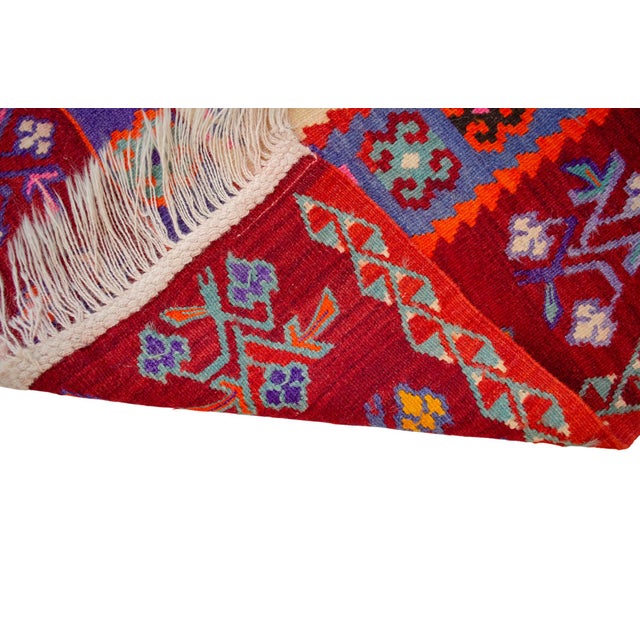
An authentic mid-20th century handwoven kilim from Ordu, Turkey, distinguished by its striking Tree of Life central motif — a symbol of continuity and spiritual unity. Its multi-layered geometric and floral border reflects the influence of Caucasian weaving traditions, making this piece both artistically significant and highly collectible.
✦ Materials & Construction:
Meticulously woven using 100% wool on wool, entirely hand-spun and naturally dyed. The flat-weave construction showcases traditional Anatolian craftsmanship techniques passed down through generations.
✦ Measurements:
Approx. 6′0″ × 6′5″ (72 cm × 77 inches)
✦ Condition:
Chest-stored and never used. Professionally washed, completely odor-free, and ready for immediate use. Minor fringe loss is visible, as shown in the photographs — a common and easily restorable characteristic of vintage pieces.
Color & Motif Description:
Motifs & Symbols:
The dominant Tree of Life motif anchors the kilim, symbolizing eternity, spiritual growth, and the bond between earth and sky. It is framed by stylized floral figures representing fertility and life, as well as protective geometric patterns derived from traditional Caucasian aesthetics.
Color Palette:
Main colors: Deep crimson red (primary field), soft aqua mint (inner field), ivory cream (inner border)
Accent tones: Orchid purple, warm terracotta orange, pale lavender, moss green, muted coral, charcoal black
Highlight details: Subtle blush pink zigzags, pastel lilac florets, golden ochre accents
What is the Ordu Kilim?
Among the many weaving traditions of Anatolia, the kilims of Ordu, a coastal city along Turkey’s Black Sea, stand apart as a rare and culturally significant phenomenon. Unlike the weaving centers of Central and Eastern Anatolia — where carpet-making has flourished for centuries — the Black Sea region has historically produced very few kilims. Ordu is the remarkable exception: a place where isolated communities preserved this ancient craft, blending local symbolism with the stylistic influences of the Caucasus across the water.
Ordu kilims are instantly recognizable for their bold geometric patterns, vivid color contrasts, and the inclusion of sacred motifs deeply rooted in the region’s cultural memory. The Tree of Life, which features prominently in this piece, is perhaps the most meaningful of these motifs. Shared by ancient Mesopotamian, Persian, Turkic, and Semitic traditions alike, the tree represents the connection between the underworld, the earth, and the heavens — a visual metaphor for continuity, protection, and regeneration. Its presence on a domestic textile transforms the kilim from a mere household object into a piece of living spiritual heritage.
Beyond their symbolic language, Ordu kilims also stand out for their technical excellence. They are typically woven from hand-spun wool, using traditional flat-weave techniques that require remarkable precision and patience. Many were created not for trade but for family use — as dowry pieces, wedding gifts, or heirlooms — and were often treasured too deeply to ever see daily wear. As a result, surviving examples are rare, and many, like this one, remain in near-pristine condition decades after their creation.
Collectors and interior designers prize Ordu kilims not only for their scarcity but also for their ability to bridge tradition and modernity. Their bold compositions, timeless symbolism, and artisanal authenticity make them ideal statement pieces in contemporary interiors — whether displayed as floor coverings, wall hangings, or centerpiece textiles. Owning one is more than acquiring a decorative object; it is a way of preserving and living with a fragment of Turkey’s cultural soul, one woven thread at a time.
See less
- Dimensions
- 6′ × 6′5″ and 0.1″ thick
- Pattern
- Other
- Rug Construction
- Flatweave
- Period
- 1940s
- Country of Origin
- Turkey
- Item Type
- Vintage, Antique or Pre-owned
- Materials
- Wool
- Condition
- Good Condition, Original Condition Unaltered, Some Imperfections
- Color
- Ruby Red
- Condition Notes
- Chest-stored and never used. Professionally washed, completely odor-free, and ready for immediate use. Minor fringe loss is visible, as shown … moreChest-stored and never used. Professionally washed, completely odor-free, and ready for immediate use. Minor fringe loss is visible, as shown in the photographs — a common and easily restorable characteristic of vintage pieces. less
Questions about the item?
Returns & Cancellations
Return Policy - All sales are final 48 hours after delivery, unless otherwise specified in the description of the product.
Cancellation Policy - Prior to shipping or local pickup, buyers may cancel an order for up to 48 hours, unless otherwise specified.
Related Collections
- Seagrass Rugs
- Bamboo Fabric Rugs
- Cashmere Rugs
- Classical Greek Rugs
- Josef Albers Rugs
- Beaux-Arts Rugs
- Blue Moroccan Rugs
- White Moroccan Rugs
- Ivory Moroccan Rugs
- Cream Moroccan Rugs
- Beige Moroccan Rugs
- Brown Moroccan Rugs
- Tan Moroccan Rugs
- Rugs in Chicago
- Moroccan Rugs
- Scandinavian Rugs
- Persian Rugs
- Art Nouveau Rugs
- Rugs in Dallas
- Spanish Rugs
- Rugs in New York
- Early American Rugs
- Khotan Rugs
- Rugs in Washington DC
- Rugs in Los Angeles