

Details
Description
Albert Genick Large Framed Chromolithograph of an Ancient Greek Red-Figure Vase, “Amphora”, 1883
Berlin, 1883
This large folio chromolithograph shows …
Read more
Albert Genick Large Framed Chromolithograph of an Ancient Greek Red-Figure Vase, “Amphora”, 1883
Berlin, 1883
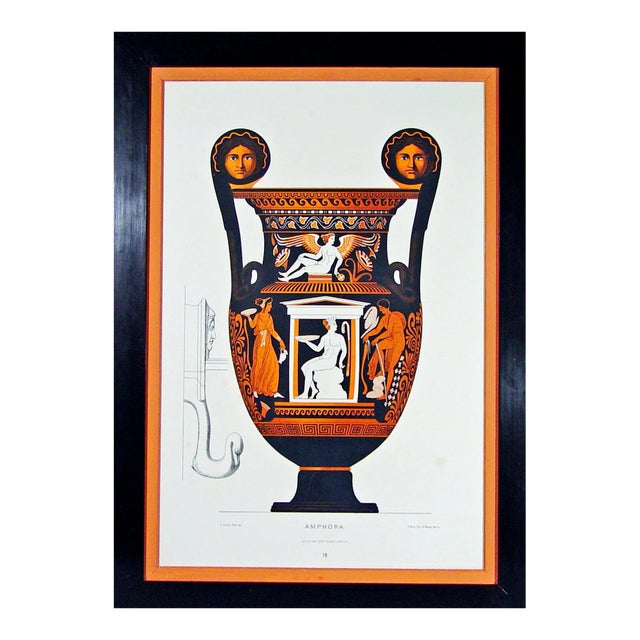
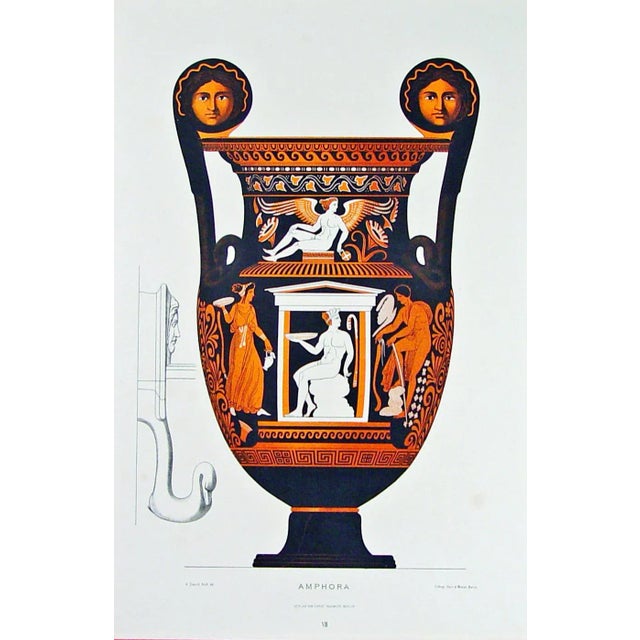
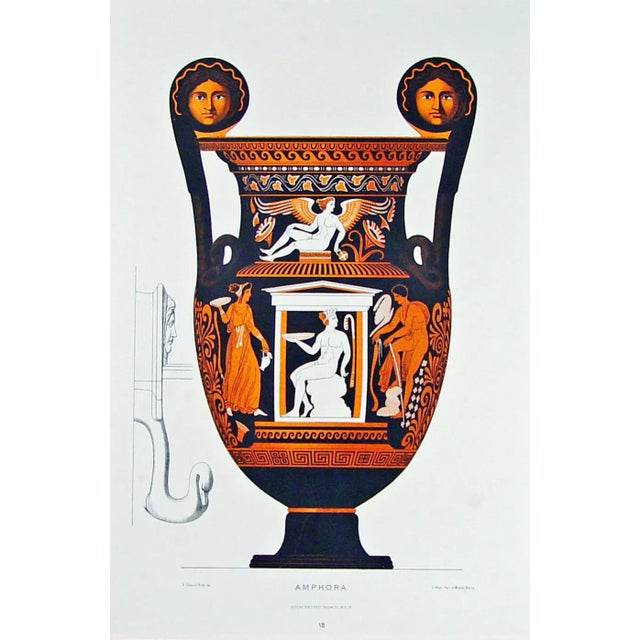
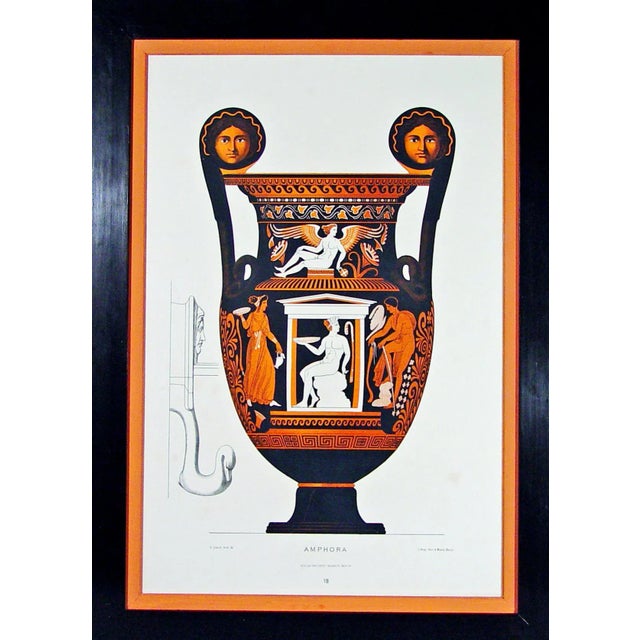
This large folio chromolithograph shows an ancient Greek red-figure vase of monumental form, drawn by the Berlin architect Albert Genick and published by Ernst Wasmuth in 1883 as Plate VII of Griechische Keramik. The vase stands in strict elevation against the white sheet, printed in black, terracotta red and a deeper brown, with the white of the paper reserved for the figures and details that the ancient painter added in white.
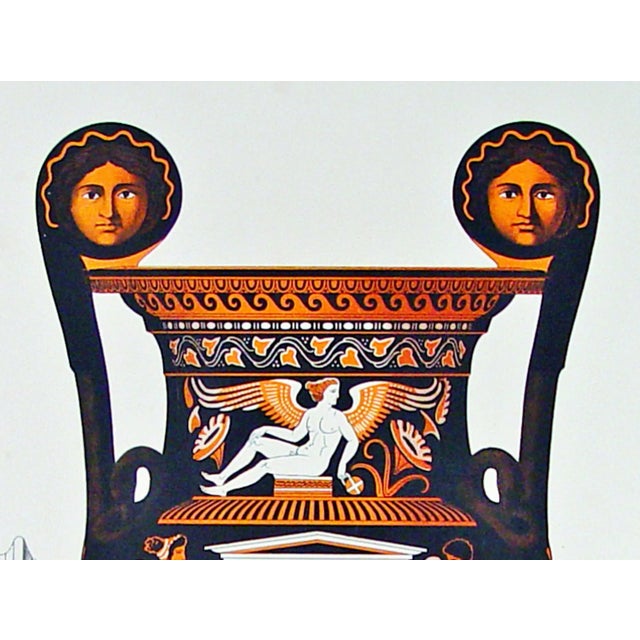
The vessel has an ovoid body on a stepped black foot, a tall flaring neck, and two high looped handles that rise above the rim and end in roundels, each painted with a frontal mask framed by waved hair. The rim carries an egg-and-dart molding above a running wave, and the neck a row of beads and a trailing ivy vine. Beneath these a winged nude figure, an Eros, reclines on a plinth with a ball in his lowered hand, between large bell-shaped flowers and tendrils. A band of tongues marks the shoulder.
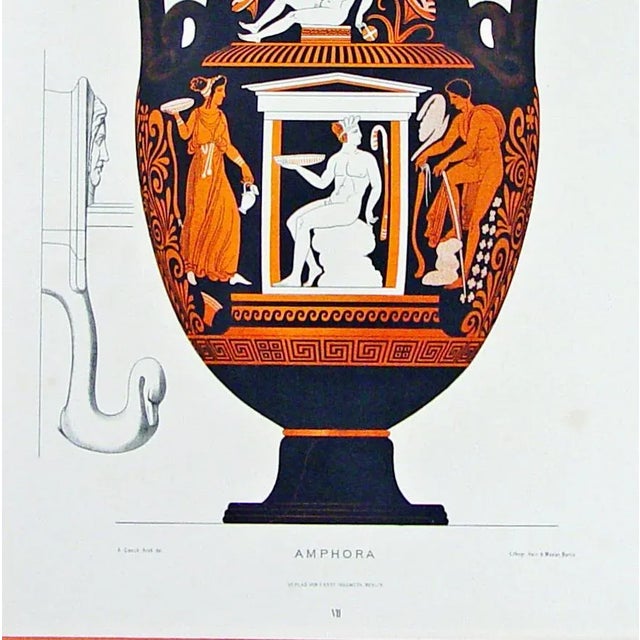
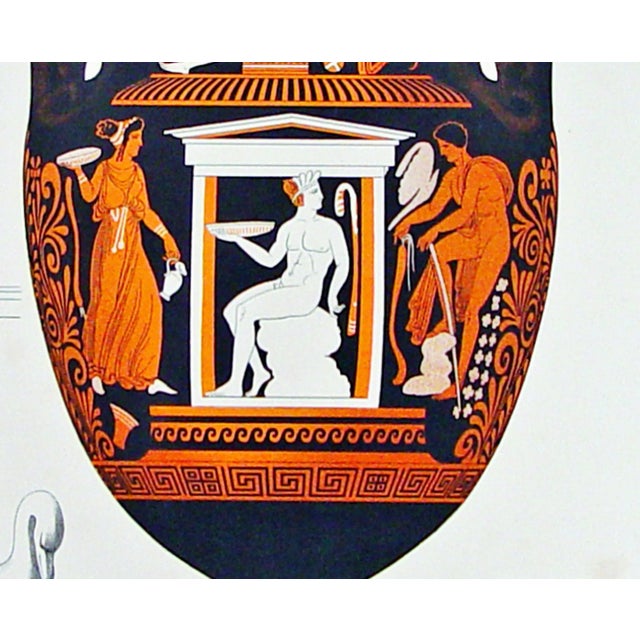
The principal scene is set at a tomb. At the center stands a small white shrine with a pediment, a naiskos, within which a nude youth is seated on a rock, a shallow offering dish held out in his right hand and a crook-handled staff beside him. He is shown in white, as though he were a marble statue of the dead. A woman in a long belted chiton approaches from the left with a dish and a wine jug, and at the right a nude youth, a cloak over his arm and one foot raised on a pile of stones, brings a fan and a fillet. Tall palmettes and scrolls close the scene at either side, and bands of wave pattern and of meander broken by saltire squares run beneath.
At the left margin Genick has added a line drawing of one handle in profile, showing the mask in relief on the roundel and the swan’s head in which the handle ends at the shoulder. The sheet is lettered AMPHORA and is housed in a flat black wood frame with a narrow terracotta-colored inner fillet.
At just over thirty-two inches high, the print holds a wall on its own above a console, chest or mantel, and its black and terracotta palette sits well with dark wood, stone and neutral upholstery. It is equally at home in a library or hall, hung with other classical subjects.
Dimensions
Height (framed): 32⅛ inches (81.6 cm)
Width (framed): 23¼ inches (59.1 cm)
Marks
Lettered in the lower margin “A. Genick Arch. del.” at the left, “Lithogr. Hein & Mosler, Berlin.” at the right, “AMPHORA” at the center, and beneath it “VERLAG VON ERNST WASMUTH, BERLIN” and the plate number “VII”.
Provenance
Earle D. Vandekar of Knightsbridge
Condition
Good. Some minor wear to the black frame.
References
Albert Genick and Adolf Furtwängler, Griechische Keramik: XL Tafeln ausgewählt und aufgenommen von A. Genick, mit Einleitung und Beschreibung von Adolf Furtwängler (Berlin: Ernst Wasmuth, 1883), Plate VII. The complete work is digitized by Heidelberg University Library.
Royal Academy of Arts, London, Library, record number 13/419 (the portfolio of plates, second edition, 1883).
A. D. Trendall and Alexander Cambitoglou, The Red-Figured Vases of Apulia (Oxford: Clarendon Press, 1978–1982), for vases of this class.
Historical Context
Albert Genick (1836–1906) was a Berlin architect who turned his draftsmanship to the study of ancient vase forms, first in the self-published Kunstgewerbliche Vorbilder of 1876 and then in Griechische Keramik, a portfolio of forty large chromolithographed plates issued by Ernst Wasmuth with an introduction and descriptions by the archaeologist Adolf Furtwängler (1853–1907). The plates were printed by the Berlin lithographers Hein & Mosler. They follow in the tradition begun by the publication of the collection of Sir William Hamilton (1730–1803) in the 1760s and 1770s, and their scale and color printing served designers and schools of applied art as well as scholars.
Red-figure painting, in which the figures are reserved in the color of the clay against a black ground, was devised in Athens around 530 B.C. and was carried to the Greek cities of southern Italy in the later fifth century B.C. The vase shown here is of that later South Italian school. Its mask handles and its scene of offerings brought to the dead in a naiskos are characteristic of the large funerary vases made in Apulia in the second half of the fourth century B.C., a shape now called the volute krater; the title “Amphora” is the terminology of Genick’s day.
(Ref: NY5904A-nmrr)
See less
- Dimensions
- 23.25ʺW × 1.5ʺD × 32.08ʺH
- Styles
- Figurative
- Illustration
- Art Subjects
- Architecture
- Interiors
- Frame Type
- Framed
- Period
- Late 19th Century
- Country of Origin
- Germany
- Item Type
- Vintage, Antique or Pre-owned
- Materials
- Lithograph
- Wood
- Condition
- Good Condition, Original Condition Unaltered, Some Imperfections
- Color
- Burnt Orange
- Condition Notes
- Good Good less
Questions about the item?
Returns & Cancellations
Return Policy - All sales are final 48 hours after delivery, unless otherwise specified in the description of the product.
Cancellation Policy - Prior to shipping or local pickup, buyers may cancel an order for up to 48 hours, unless otherwise specified.
Related Collections
- Rattan Original Prints
- Medium-Density Fibreboard Original Prints
- Soicher Marin Original Prints
- Silver Finish Original Prints
- Original Prints in Salt Lake City
- Original Prints in Panama City, FL
- Ralph Lauren Original Prints
- Damien Hirst Original Prints
- Johannes Kip Original Prints
- Original Prints in Lexington, KY
- Sam Francis Original Prints
- Dye Transfer Original Prints
- Botanical Prints
- Framed Prints
- Bird Prints
- Woodblock Prints
- Screen Prints
- Japanese Woodblock Prints
- Thomas McKnight Original Prints
- George Barbier Original Prints
- Frank Stella Original Prints
- Gustave Baumann Original Prints
- Teak Original Prints
- Louis XIII Original Prints
- Clay Original Prints