





Details
Description
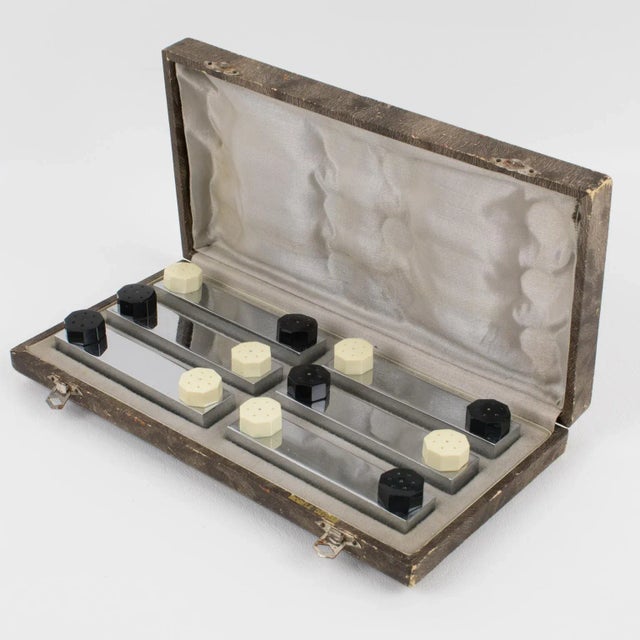
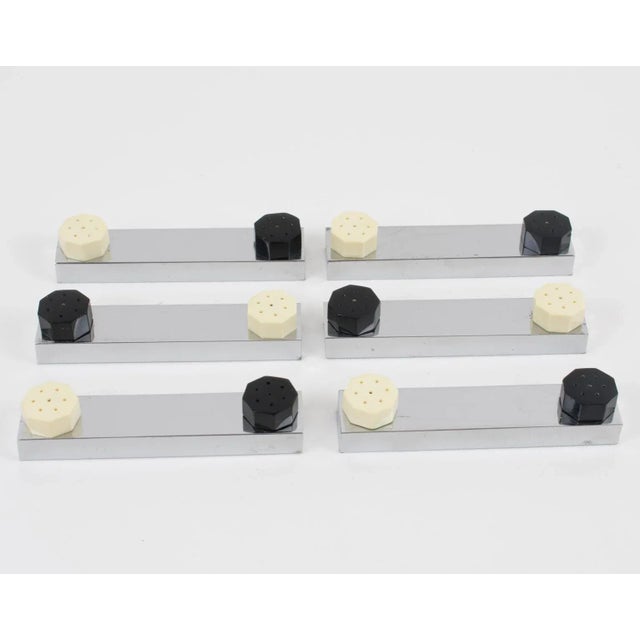
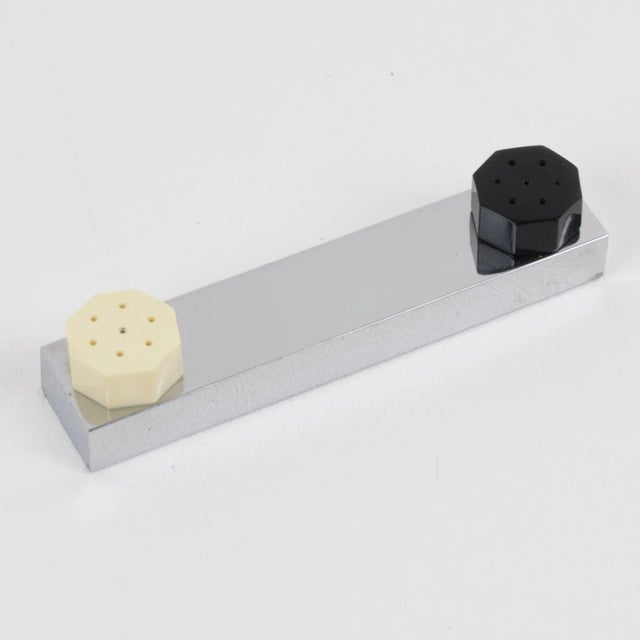
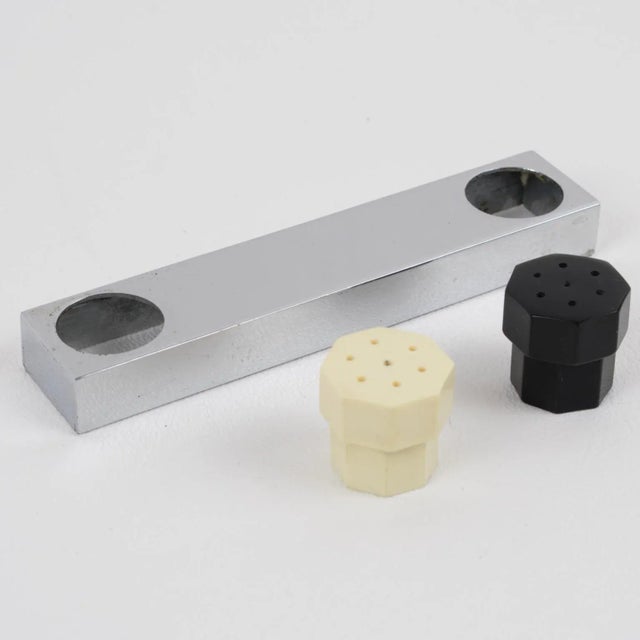
Lovely French Art Deco knife or chopstick rests set of 6 pieces, in original box. Geometric shape in chromed metal …
Read more
Lovely French Art Deco knife or chopstick rests set of 6 pieces, in original box. Geometric shape in chromed metal with individual salt and pepper shaker insert in black and off-white Galalith. Marked "modéle déposé" (patented) on the box.
Measurements:
Box: 9.07 in. wide (23 cm) x 5.13 in. deep (13 cm) x 1.19 in. high (3 cm).
Each knife rest is 3.75 in. wide (9.5 cm) x 0.82 in. deep (2 cm) x 0.82 in. high (2 cm).
salt or pepper shaker is 0.69 in. diameter (1.5 cm) x 0.69 in. high (1.8 cm).
(measurements in item detail are for the presentation box).
(knife and chopstick not included in the sale).
About:
Galalith (Erinoid in the UK) is a synthetic plastic material manufactured by the interaction of casein and formaldehyde. The commercial name is derived from the Greek words gala (milk) and lithos (stone). It is odorless, insoluble in water, biodegradable, non-allergenic, antistatic, and virtually non-flammable. It was produced under other names such as Aladdinite (in the US), Casolith (in the Netherlands), and Lactoloid (in Japan).
In 1893, French chemist Auguste Trillat discovered the means to insolubilize casein by immersion in formaldehyde.
Galalith could not be molded once set, so it had to be produced in sheets, but it had the advantage that it was inexpensive to produce. It could be cut, drilled, embossed, and dyed without difficulty, and its structure could be manipulated to create a range of effects. No other plastic at the time could compete on price, however, and with ivory, horn, and bone products becoming far more expensive, it found a natural home in the fashion industry.
This new plastic was presented at Paris Universal Exhibition in 1900.
Galalith could produce gemstone imitations that looked strikingly real. In 1926, Gabrielle "Coco" Chanel published a picture of a short, simple black dress in Vogue. Chanel revamped her designs to accessorize the little black dress, thus facilitating the breakthrough and mass popularity of costume jewelry. Galalith was used for striking Art Deco jewelry designs by artists such as Jacob Bengel and Auguste Bonaz.
Although Galalith was historically cheap, the fact it could not be molded led to its demise by commercial end-users. Production slowed as the restrictions of World War II led to a need for milk as food and new oil-derived wartime plastic developments.
Nowadays Galalith continues to be produced in Europe in extra small quantities for specific industries.
(Credit: Wikipedia).
See less
- Dimensions
- 9.07ʺW × 5.13ʺD × 1.19ʺH
- Period
- 1930s
- Country of Origin
- France
- Item Type
- Vintage, Antique or Pre-owned
- Materials
- Chrome
- Plastic
- Condition
- Good Condition, Original Condition Unaltered, Some Imperfections
- Color
- Silver
Questions about the item?
Returns & Cancellations
Return Policy - All sales are final 48 hours after delivery, unless otherwise specified in the description of the product.
Cancellation Policy - Prior to shipping or local pickup, buyers may cancel an order for up to 48 hours, unless otherwise specified.
Related Collections
- 22K Gold Serving Dishes and Pieces
- Gold Finish Serving Dishes and Pieces
- Carlsbad Porcelain Serving Dishes and Pieces
- Societa Ceramica Italiana Serving Dishes and Pieces
- Studio Pottery Serving Dishes and Pieces
- Tole Serving Dishes and Pieces
- Melamine Serving Dishes and Pieces
- Luneville Serving Dishes and Pieces
- Ralph Lauren Serving Dishes and Pieces
- Cake Stands
- Crystal Serving Dishes and Pieces
- Amber Serving Dishes and Pieces
- Silver Serving Dishes and Pieces
- Carnival Glass Candy Dishes
- Chinese Serving Dishes and Pieces
- Glass Serving Dishes and Pieces
- Limoges, France Serving Dishes and Pieces
- Aluminum Serving Dishes and Pieces
- Mid-Century Modern Serving Dishes and Pieces
- Italian Serving Dishes and Pieces
- French Serving Dishes and Pieces
- English Traditional Serving Dishes and Pieces
- Red Wing Pottery Serving Dishes and Pieces
- Wedgwood Serving Dishes and Pieces
- Pink Serving Dishes and Pieces