






Details
Description
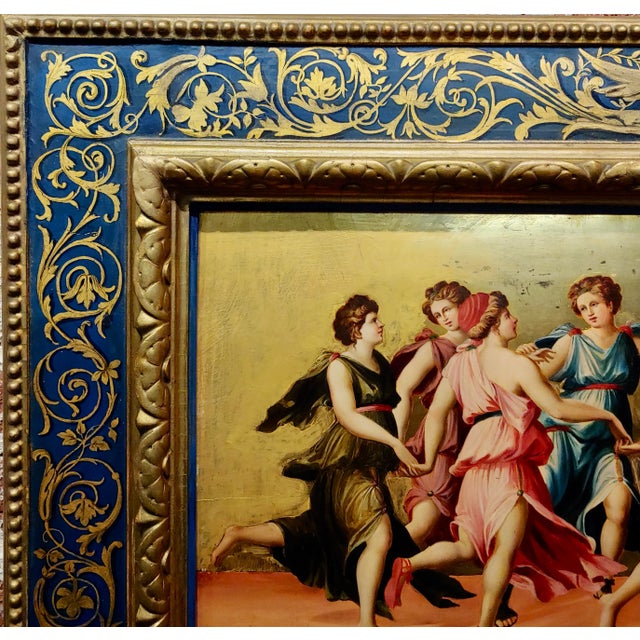
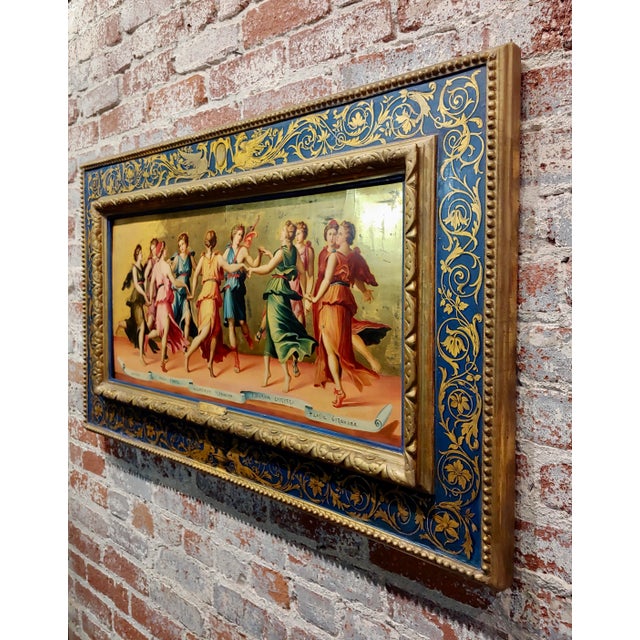
After Baldassare Peruzzi -Apollo Dancing w/9 Muses-Oil painting by Romoli c.1870s
Oil painting and gold gilt lacquered on panel and …
Read more
After Baldassare Peruzzi -Apollo Dancing w/9 Muses-Oil painting by Romoli c.1870s
Oil painting and gold gilt lacquered on panel and painted frame -
Panel size 14x32" - Frame size 24x42" -
This artwork was painted in the 19th century by italian artist C.L. Romoli
and is a circa 1870s antique copy after the original painting by Baldassarre Peruzzi (1481-1536) which is in the Pitti Palace in Florence.
Biography
Baldassare Tommaso Peruzzi (1481 - 1536) was active/lived in Italy.He is known for Mannerist, high renaissance religious subject painting.Baldassare Tommaso Peruzzi was an Italian architect and painter, born in a small town near Siena and died in Rome. He worked for many years, beginning in 1520, under Bramante, Raphael, and later Sangallo during the erection of the new St. Peter's. He returned to his native Siena after the Sack of Rome (1527) where he was employed as architect to the Republic. For the Sienese he built new fortifications for the city and designed (though did not build) a remarkable dam on the Bruna River near Giuncarico. He seems to have moved back to Rome by 1535.He was a painter of frescoes in the Cappella San Giovanni in the Duomo of Siena.His son Giovanni Sallustio was also an architect.Almost all art critics ascribe also to him the design of the originally Villa Chigi, now Villa Farnesina. In this villa, two wings branch off from a central hall with a simple arrangement of pilasters, and a decorative frieze on the exterior of the building. The frescoed paintings which adorn the interior rooms are for the most part by Peruzzi. One example is the Sala delle Prospettive, in which Peruzzi revived the perspective schemers of Melozzo da Forli and Mantegna, possibly under the influence of both. The walls the room are painted so that when one stands toward the left, one has the illusion that one is staning in an open-air terrace, lined by pillars, looking out over a continuous landscape. The decoration of the façade, the work of Peruzzi, has almost entirely vanished, but it is documented in a drawing by an anonymous French artist in the New York Metropolitan Museum of Art. To decorate this villa on the Tiber many artists were employed, and just as the style of the villa in no wise recalls the old castellated type of country-house, so the paintings in harmony with the pleasure-loving spirits of the time were thoroughly antique and uninspired by Christian ideas. Raphael designed the composition of the story of Amor and Psyche as a continuation of the Galatea. On a plate-glass vault Peruzzi painted the firmament, with the zodiacal signs, the planets, and other heavenly bodies. The interior room has a striking use of illusionistic perspective.The close proximity of Raphael's work has overshadowed Peruzzi's work in the ceiling decoration of the Stanza d'Eliodoro in the Vatican. While Raphael may have designed the general plan for the decoration of the hall, it is certain that the tapestry-like frescoes on the ceiling are to be ascribed to Peruzzi. Four scenes represent God's saving omnipotence as shown in the case of Noah, Abraham, Jacob, and Moses. The manifestation of the Lord in the burning bush and the figure of Jehovah commanding Noah to enter the ark were formerly considered works of Raphael.Peruzzi had produced for the church of S. Croce in Jerusalem a mosaic ceiling, the beautiful keystone of which represented the Saviour. Other paintings ascribed to him are to be found in Sant'Onofrio and San Pietro in Montorio. That Peruzzi improved as time went on is evident in his later works, e.g., the "Madonna with Saints" in S. Maria della Pace at Rome, and the fresco of Augustus and the Tiburtine Sibyl in Fontegiusta at Siena. As our master interested himself in the decorative art also, he exercised a strong influence in this direction, not only by his own decorative paintings but also by furnishing designs for craftsmen of various kinds.His final architectural masterpiece, the Palazzo Massimo alle Colonne (1535) located on the modern day Corso Vittorio Emanuele, is well known for its curving facade, ingenious planning, and architecturally rich interior.
A beautiful piece that will add to your décor!
See less
- Dimensions
- 42ʺW × 2ʺD × 24ʺH
- Art Subjects
- Figure
- Frame Type
- Framed
- Period
- 19th Century
- Country of Origin
- Italy
- Item Type
- Vintage, Antique or Pre-owned
- Materials
- Fresco
- Glass
- Gold
- Lacquer
- Mosaic
- Condition
- Good Condition, Original Condition Unaltered, Some Imperfections
- Color
- Brown
- Condition Notes
- Excellent - Minor wear consistent with age and history Excellent - Minor wear consistent with age and history less
Questions about the item?
Returns & Cancellations
Return Policy - All sales are final 48 hours after delivery, unless otherwise specified in the description of the product.
Cancellation Policy - Prior to shipping or local pickup, buyers may cancel an order for up to 48 hours, unless otherwise specified.
Related Collections
- Photorealism Canvas Paintings
- Ed Ruscha Paintings
- Richard Serra Paintings
- Photorealism Paintings in New York
- Louise Nevelson Paintings
- Karen Offutt Paintings
- Jo Baskerville Paintings
- Nicola Simbari Paintings
- Herman Miller Paintings
- BDDW Paintings
- Leroy Neiman Paintings
- Jaanika Peerna Paintings
- Vienna Secession Paintings
- Johannes Andersen Paintings
- Pedro Friedeberg Paintings
- Peter Behrens Paintings
- Piet Hein Eek Paintings
- Raphael Paintings
- Jeff Slemmons Paintings
- Karl-Erik Ekselius Paintings
- Hans Andersen Paintings
- Jean-Paul Barray Paintings
- Cassina Paintings
- Carl-Axel Acking Paintings
- Soicher Marin Paintings