

Details
Description
English Creamware Large Teapot with Puce Flower Painted Decoration
Yorkshire or Staffordshire,
Circa 1770
This English creamware teapot of large …
Read more
English Creamware Large Teapot with Puce Flower Painted Decoration
Yorkshire or Staffordshire,
Circa 1770
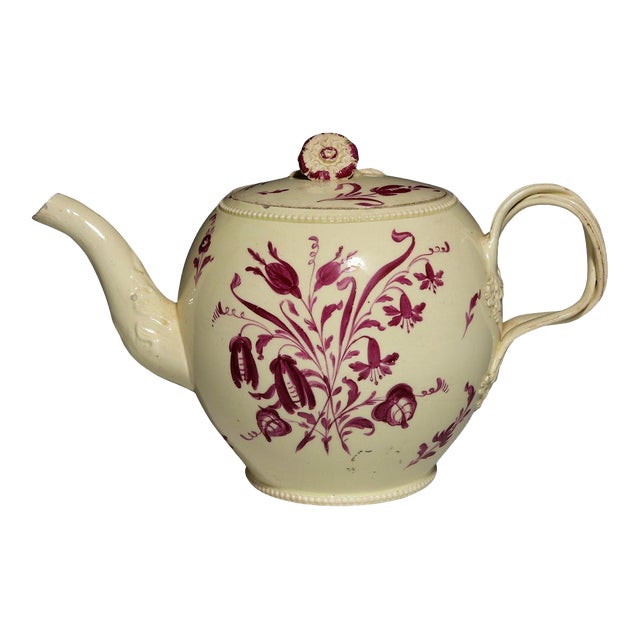
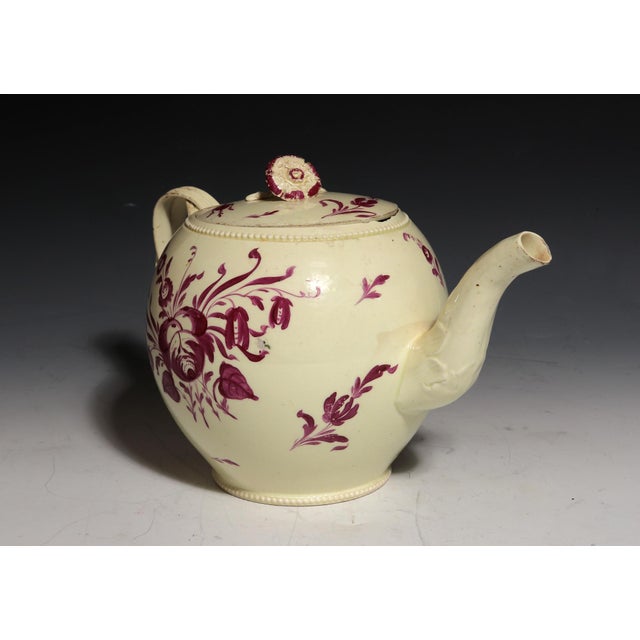
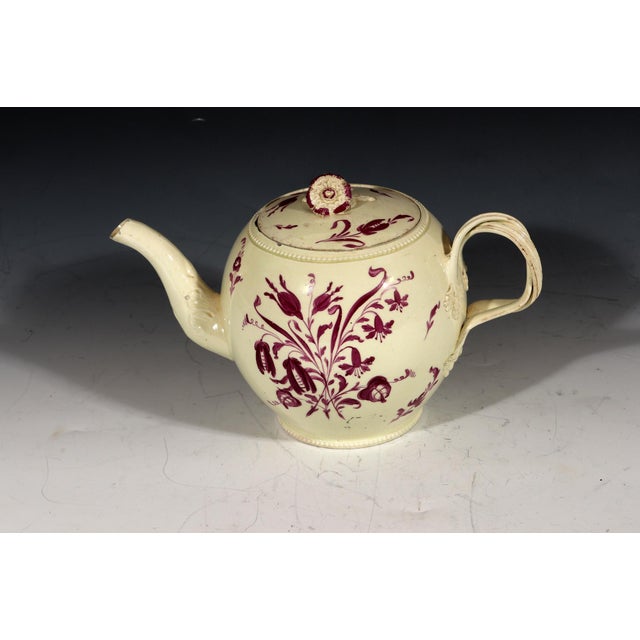
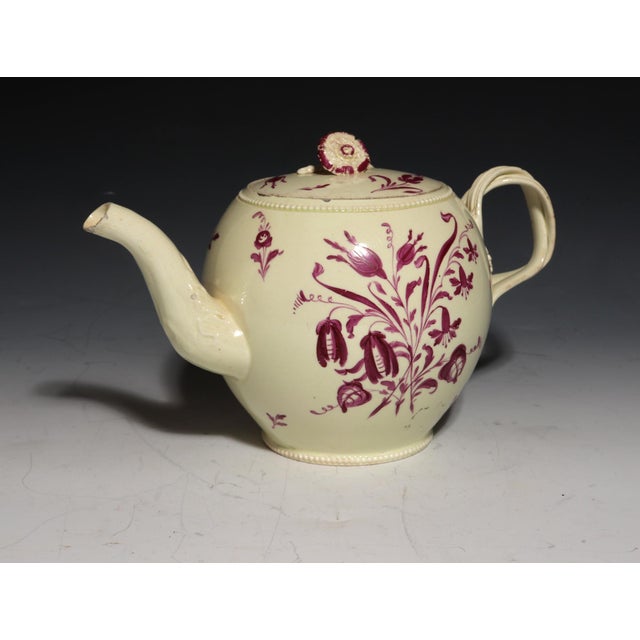
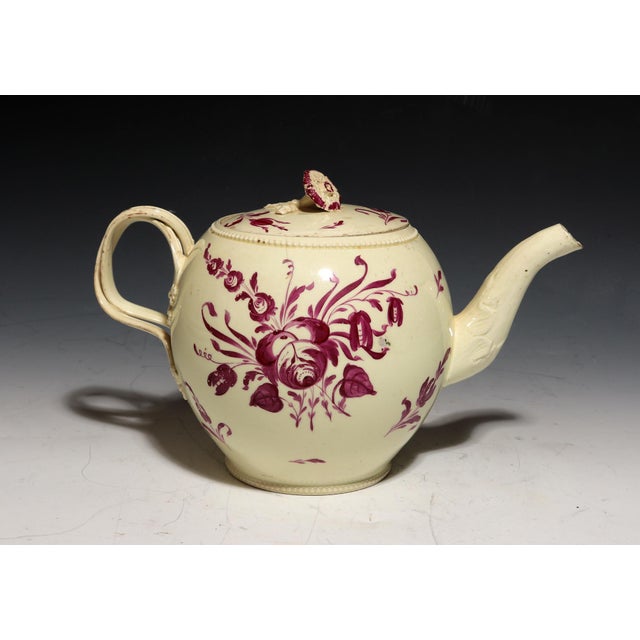
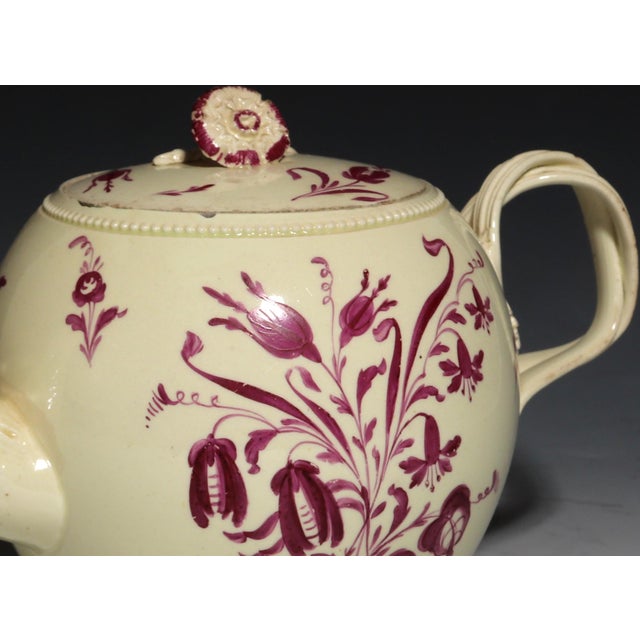
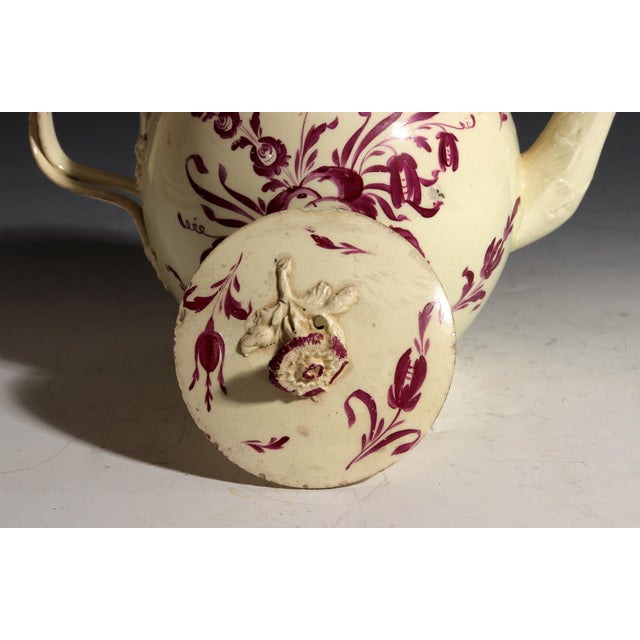
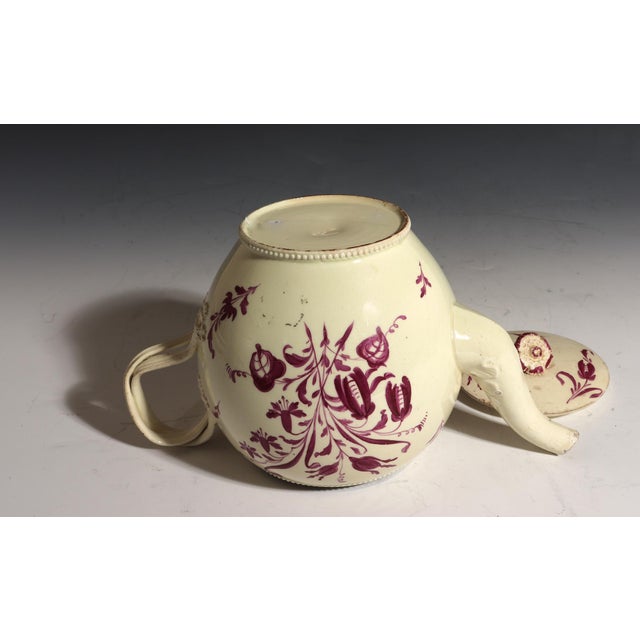
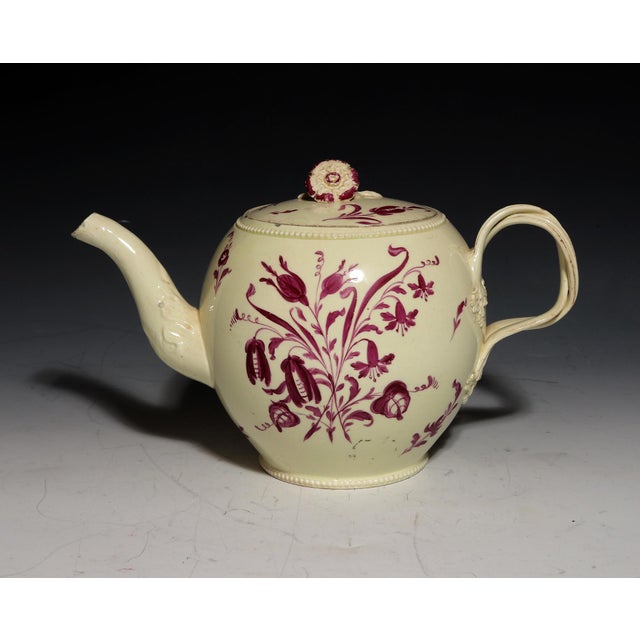
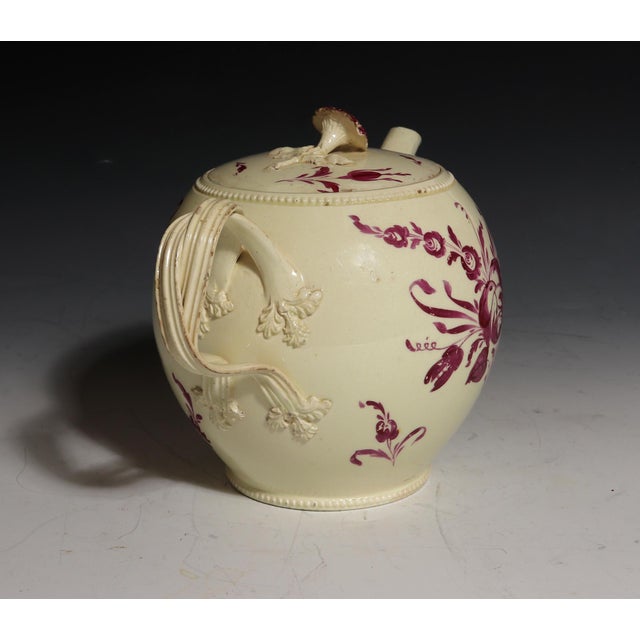
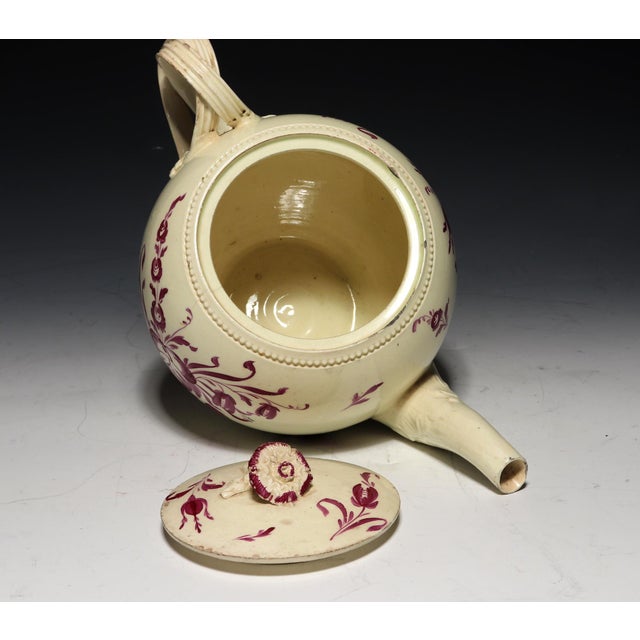
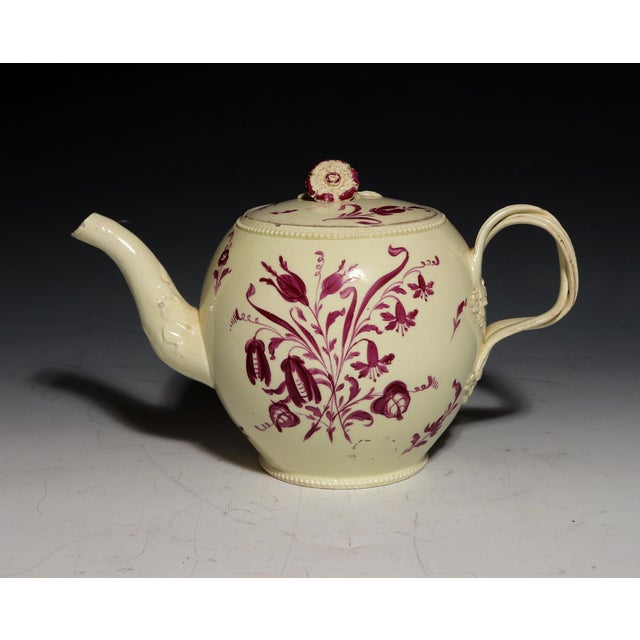
This English creamware teapot of large size dates from about 1770 and is painted in a single puce enamel with bouquets of garden flowers. The globular body stands on a narrow foot edged with a band of pearl beading, and a second beaded band encircles the recessed rim that holds the cover. The curved spout rises from molded acanthus leaves at its base, and the handle is formed of two reeded straps that cross over one another and end in applied flower-and-leaf terminals. The low domed cover is pierced with a steam vent and carries a molded flower-head knop on a curled stem with a leaf and bud, the edges of its petals picked out in puce.
Each side carries a large bouquet painted freely in puce. On one side a bunch of striped tulips, some upright in bud and others drooping, is set with pendant bell flowers and two roses among long curling leaves and fine tendrils, the stems crossing at the base. The other side centers on a full-blown rose with a stem of smaller roses, a drooping tulip and veined leaves. Smaller sprigs and single leaves are scattered over the shoulder and beside the spout and handle, and the cover has two flower sprigs of its own. The brushwork is quick and assured, with the petals shaded by thinning the enamel so that the cream glaze shows through.
The single puce color against the cream ground sits easily beside blue and white, other creamware or polished wood, and at 8¼ inches across the teapot has enough presence to stand alone on a mantel, bookshelf or dresser.
Dimensions
Height: 5¾ inches (14.6 cm)
Width: 8¼ inches (21 cm)
Depth: 5 inches (12.7 cm)
Marks
Unmarked.
Provenance
Earle D. Vandekar of Knightsbridge
Condition
A chip to the underside of the cover has been professionally repaired. There is a short hairline of approximately ½ inch at the rim on one side, and two areas of roughness to the edge of the recessed rim on which the cover sits.
References
For the form, compare a creamware teapot with the same double interlaced handle, flower-and-leaf terminals, acanthus-molded spout and flower knob in the Fitzwilliam Museum, Cambridge (accession no. C.1070 & A-1928, Glaisher Bequest), catalogued as possibly Yorkshire or possibly Staffordshire. The museum notes that knobs and terminals of this kind, traditionally associated with the Leeds Pottery, were also used by potters unconnected with it.
For the independent enameling workshops that decorated much English creamware of this date, see Peter Walton, Creamware and other English Pottery at Temple Newsam House, Leeds (1976), and Donald Towner, Creamware (1978).
Historical Context
Creamware, the cream-colored lead-glazed earthenware refined in Staffordshire in the early 1760s, is most closely associated with Josiah Wedgwood, whose tea service for Queen Charlotte in 1765 earned his version the name Queen’s Ware. By 1770 it was being made by many potters in Staffordshire, Yorkshire and Derbyshire. Light, clean and far less costly than porcelain, it offered an ideal surface for enamel painting, much of which was carried out in independent decorating workshops as well as at the potteries themselves. Double interlaced handles with flower-and-leaf terminals and flower knops have long been linked with Leeds, but they were shared widely among the creamware potters, and an unmarked teapot such as this is best described as English, Staffordshire or Yorkshire.
Flower painting in a single color was a fashion taken from porcelain, where bouquets in puce or crimson monochrome were well established by the middle of the century. The puce here is an overglaze enamel of the rose-purple family, a color that eighteenth-century enamelers obtained from gold and fixed in a low-temperature muffle kiln after the glaze firing. A teapot of this generous size speaks of tea drinking as a daily household ritual in the 1770s, by which time the custom had spread well beyond the fashionable few.
(Ref: NY9486-pamx)
See less
- Dimensions
- 8.25ʺW × 5ʺD × 5.75ʺH
- Styles
- English Traditional
- Period
- Late 18th Century
- Country of Origin
- United Kingdom
- Item Type
- Vintage, Antique or Pre-owned
- Materials
- Creamware
- Pottery
- Condition
- Good Condition, Original Condition Unaltered, Some Imperfections
- Color
- Cream
- Condition Notes
- Good antique condition Good antique condition less
Questions about the item?
Returns & Cancellations
Return Policy - All sales are final 48 hours after delivery, unless otherwise specified in the description of the product.
Cancellation Policy - Prior to shipping or local pickup, buyers may cancel an order for up to 48 hours, unless otherwise specified.
Related Collections
- Tea Pots in Greenville, SC
- Tea Pots in Cincinnati
- Tea Pots in Mobile
- Royal Albert Tea Pots
- Delft Tea Pots
- Gold Leaf Tea Pots
- Silverplate Tea Pots
- Antique Teapots
- French Tea Pots
- Regency Tea Pots
- Early American Tea Pots
- Villeroy and Boch Tea Pots
- Meissen Porcelain Tea Pots
- Tea Pots in Monterey, CA
- Industrial Tea Pots
- Tea Pots in Louisville
- Majolica Tea Pots
- Tea Pots in Jacksonville, FL