

Details
Description
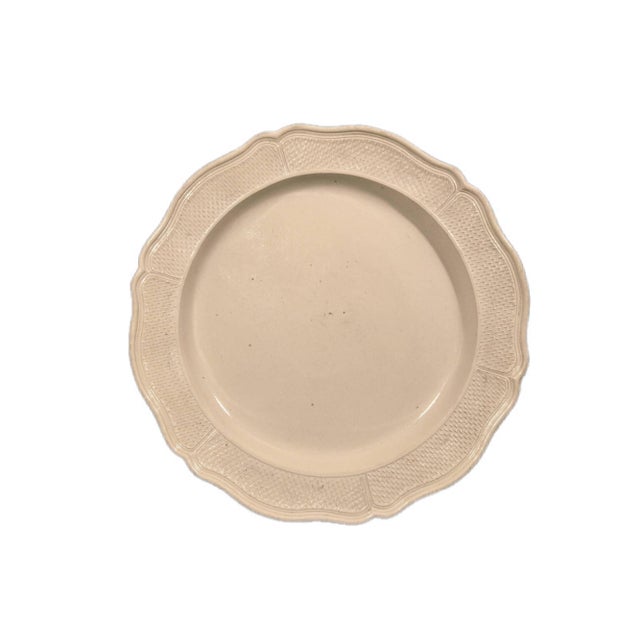
Massive Staffordshire White Salt-Glazed Stoneware Charger, Barley Pattern, Attributed to William Greatbatch
Fenton, Staffordshire
Circa 1762–1770
This massive charger is …
Read more
Massive Staffordshire White Salt-Glazed Stoneware Charger, Barley Pattern, Attributed to William Greatbatch
Fenton, Staffordshire
Circa 1762–1770
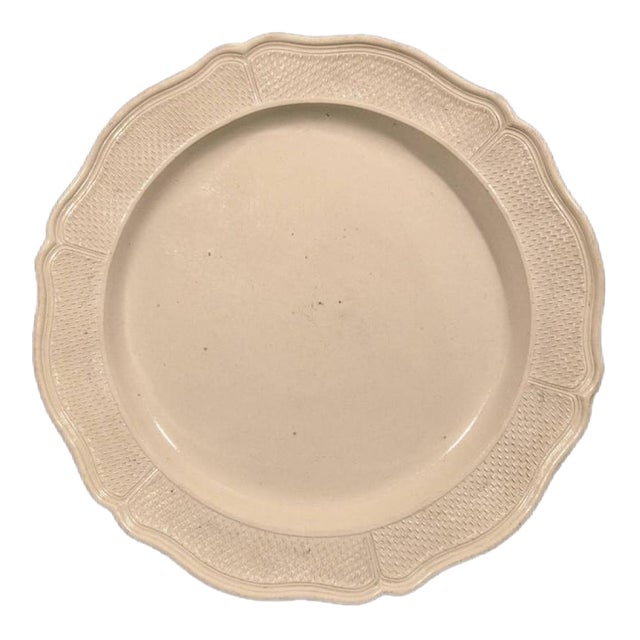
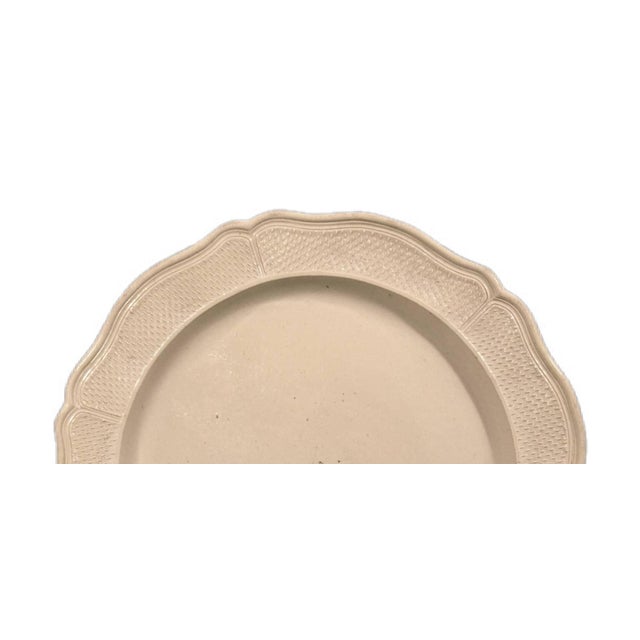
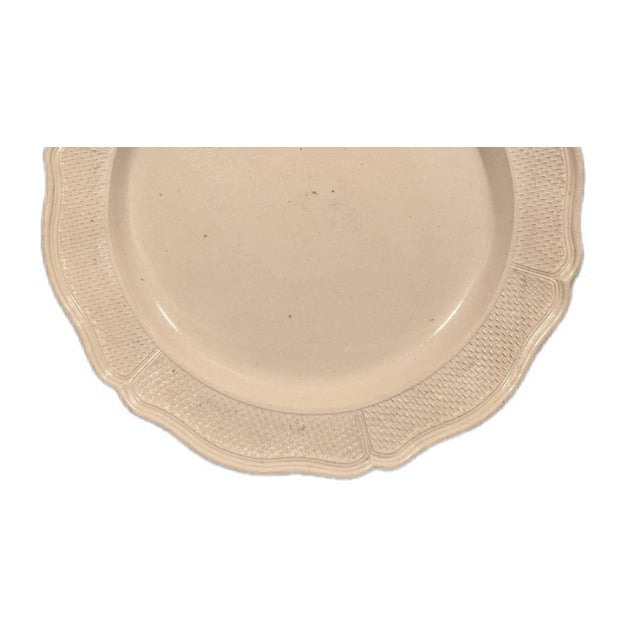
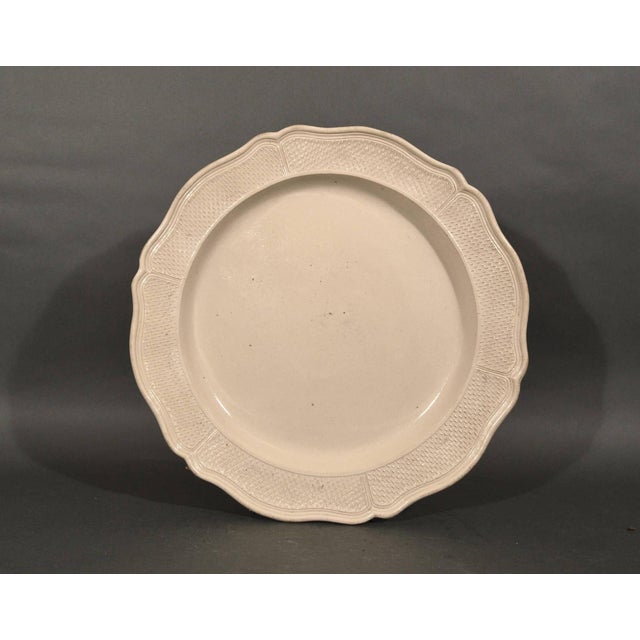
This massive charger is a superlative example of English white salt-glazed stoneware, remarkable both for its sheer scale and for the crispness of its molded decoration. The wide shaped border, of the alternately curved and indented outline known as silver shape, is molded in relief with the pattern called barley or barleycorn — close rows of small seed-like bosses set on a finely ribbed ground — contained within six shaped panels divided by plain radial bars, the outer edge and the boundary of the broad, shallow central well each defined by deeply molded double ridges. The surface carries the fine orange peel texture characteristic of the body, a lustrous, minutely pitted finish produced when salt thrown into the kiln at the height of the firing vaporized and combined with the silica in the surface of the clay to form the glaze.
The charger is unmarked, as white salt-glazed stoneware almost always is, and the attribution rests on archaeology. It is attributed to the workshop of William Greatbatch (circa 1735–1813), who ran his own factory at Lower Lane, Fenton, from about 1762 until his bankruptcy in 1782, and an identical rim fragment was recovered from the excavated waste of the Greatbatch factory site, the link documented by Diana Edwards and Rodney Hampson in White Salt-Glazed Stoneware of the British Isles. Apprenticed to Thomas Whieldon at Fenton Vivian, and supplying Josiah Wedgwood with wares and block molds from at least 1762, Greatbatch was among the most accomplished modelers of his generation, and the sharpness of the molding here shows that skill at full stretch on the largest scale the material allowed. Barley-pattern plates of this form ordinarily measure about nine inches across; at seventeen inches this charger is nearly twice their diameter.
At seventeen inches the charger has the scale to stand alone: hung on a wall, set on a stand at the center of a dresser or sideboard, or laid flat on a table as a centerpiece. The white body and crisp relief sit as comfortably with period oak and mahogany as in a pared-back contemporary room.
Dimensions
Diameter: 17 inches (43.2 cm)
Height: 1¾ inches (4.4 cm)
Provenance
Earle D. Vandekar of Knightsbridge
Condition
Good; the molding remains sharp, with scattered small kiln flecks to the well and rim as usual for the body.
References
Diana Edwards and Rodney Hampson, White Salt-Glazed Stoneware of the British Isles (Woodbridge: Antique Collectors’ Club, 2005), p. 209, fig. 189, for the identical rim fragment from the Greatbatch site
David Barker, William Greatbatch: A Staffordshire Potter (London: Jonathan Horne, 1991), the standard monograph, publishing the excavation of the factory waste
Janine E. Skerry and Suzanne Findlen Hood, Salt-Glazed Stoneware in Early America (Colonial Williamsburg Foundation and University Press of New England, 2009), for the molded plate patterns and the American trade
The Fitzwilliam Museum, Cambridge, Glaisher Bequest, C.510-1928, a plate of silver shape with six panels of the seed or barley corn pattern, circa 1755–1760
Colonial Williamsburg Foundation, 1973-42, a plate with a barley seed border in six lobed panels, circa 1755
George Washington’s Mount Vernon, archaeological collection, barley-pattern rim sherd from the House for Families site
Historical Context
White salt-glazed stoneware was the finest tableware Staffordshire produced in the half century before creamware: a hard, thin, near-white body of ball clay and calcined flint, fired at high temperature and glazed with common salt. At its peak, roughly 1720 to 1770, it served households on both sides of the Atlantic as the durable alternative to porcelain. George Washington ordered “6 dozn finest white stone plates” for Mount Vernon in December 1757 and added to the service for years afterward, and fragments of barley-pattern salt glaze — the pattern of this charger — are among the white stoneware excavated on the estate. Press-molded plates and dishes with diaper-patterned rims were the backbone of the trade; a charger of this size is another matter entirely, and survivals on this scale are rare.
William Greatbatch was apprenticed to Thomas Whieldon, had set up his own works at Lower Lane, Fenton, by 1762, and supplied Josiah Wedgwood with wares, designs and block molds until his bankruptcy in 1782; by 1786 he was in Wedgwood’s direct employ in a senior position at Etruria, where he remained until his retirement around 1807. His factory waste was discovered at Fenton in 1978, its significance first recognized by Donald Towner, and excavated by David Barker for the City Museum and Art Gallery, Stoke-on-Trent, the stratified layers documenting the full range of the works’ production from 1762 to 1782 — the excavation that made Greatbatch’s wares the best documented of any Staffordshire potter of the period, and the source of the attribution of this charger.
(Ref: NY9415-McM)
See less
- Dimensions
- 17.25ʺW × 17.25ʺD × 1.75ʺH
- Styles
- English Traditional
- Period
- Mid 18th Century
- Country of Origin
- United Kingdom
- Item Type
- Vintage, Antique or Pre-owned
- Materials
- Stoneware
- Condition
- Good Condition, Original Condition Unaltered, Some Imperfections
- Color
- Cream
- Condition Notes
- good- no rrpairs good- no rrpairs less
Questions about the item?
Returns & Cancellations
Return Policy - All sales are final 48 hours after delivery, unless otherwise specified in the description of the product.
Cancellation Policy - Prior to shipping or local pickup, buyers may cancel an order for up to 48 hours, unless otherwise specified.
Related Collections
- 22K Gold Serving Dishes and Pieces
- Tole Serving Dishes and Pieces
- Carlsbad Porcelain Serving Dishes and Pieces
- Gold Finish Serving Dishes and Pieces
- Cloisonné Serving Dishes and Pieces
- Melamine Serving Dishes and Pieces
- Societa Ceramica Italiana Serving Dishes and Pieces
- Egyptian Revival Serving Dishes and Pieces
- Studio Pottery Serving Dishes and Pieces
- Ralph Lauren Serving Dishes and Pieces
- Luneville Serving Dishes and Pieces
- Cake Stands
- Crystal Serving Dishes and Pieces
- Amber Serving Dishes and Pieces
- Silver Serving Dishes and Pieces
- Carnival Glass Candy Dishes
- Chinese Serving Dishes and Pieces
- Glass Serving Dishes and Pieces
- Limoges, France Serving Dishes and Pieces
- Aluminum Serving Dishes and Pieces
- Mid-Century Modern Serving Dishes and Pieces
- Italian Serving Dishes and Pieces
- French Serving Dishes and Pieces
- English Traditional Serving Dishes and Pieces
- Pink Serving Dishes and Pieces