

Details
Description
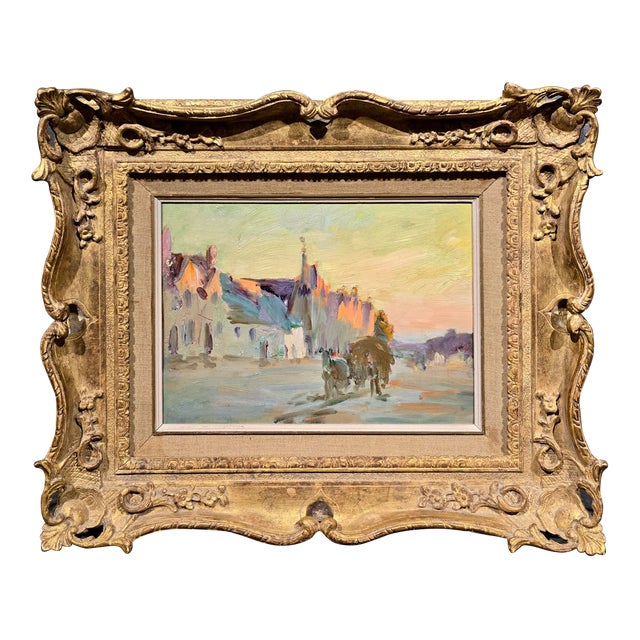
William Samuel Horton– Horse & Cart Crossing a Village at Sunset –c. 1920s American Impressionist Oil Painting
American Impressionist - …
Read more
William Samuel Horton– Horse & Cart Crossing a Village at Sunset –c. 1920s American Impressionist Oil Painting
American Impressionist - Oil painting on board - circa 1920s
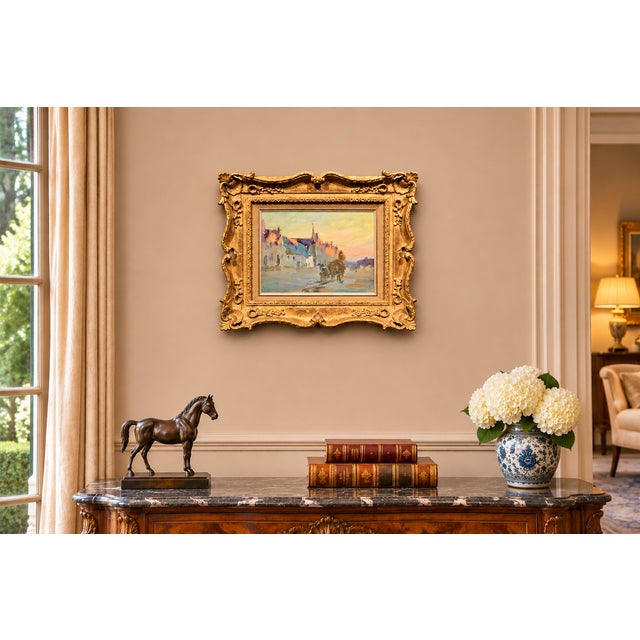
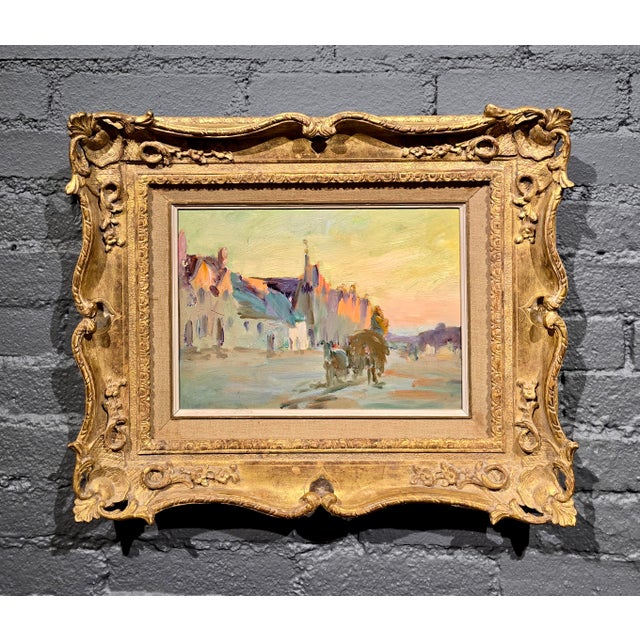
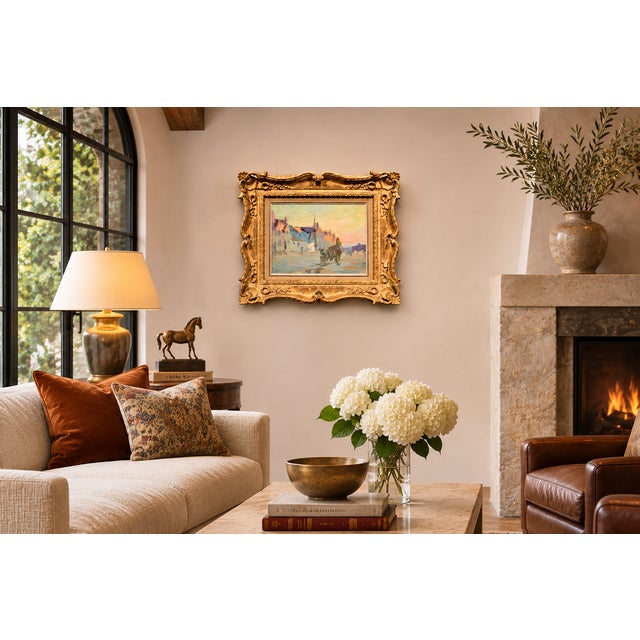
Board size: 9x13" - Frame size: 17x21x3" Description:
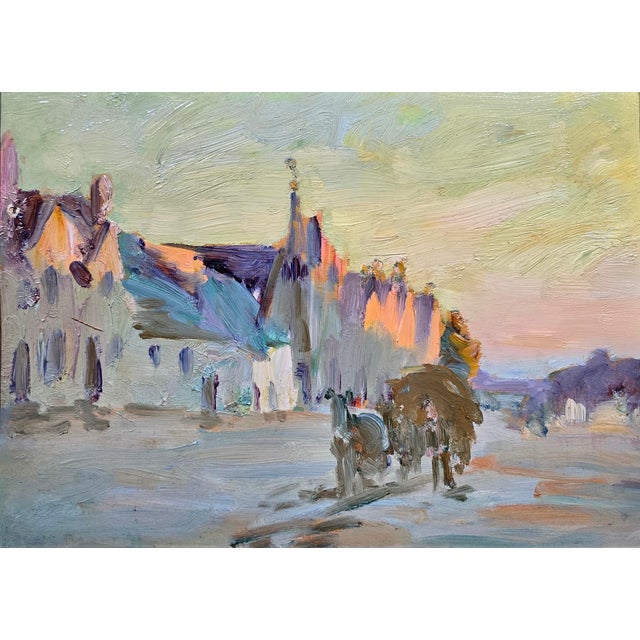
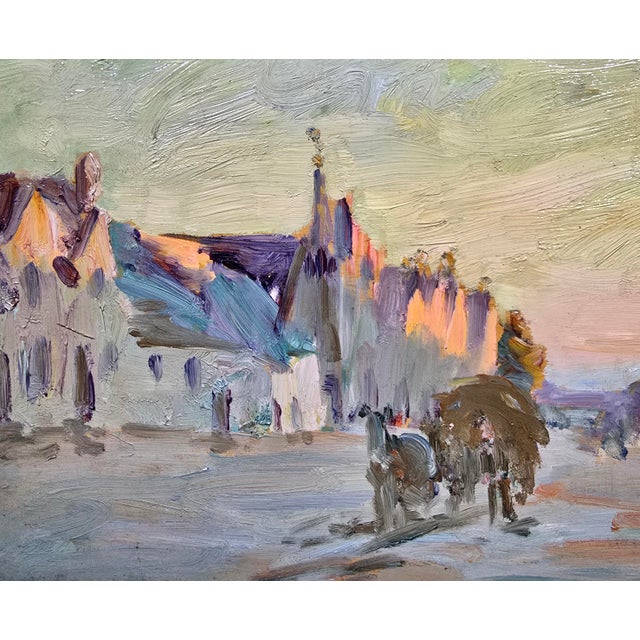
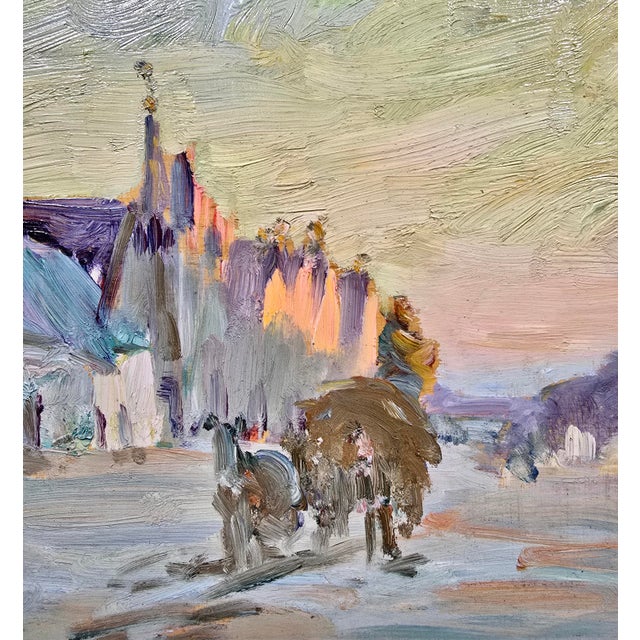
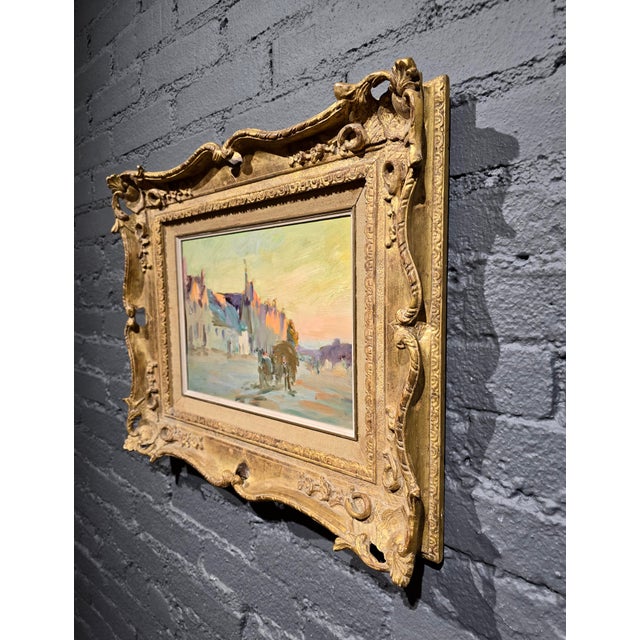
The painting is a masterful example of late-stage Impressionism, focusing on the dramatic effects of natural light at dawn or dusk. The artist captures a historic European village street using a dynamic, low-angle perspective. The composition is structured as follows:
The Foreground & Focal Point: In the lower center, a heavy horse-drawn carriage or hay cart, steered by a figure, anchors the scene. Rather than a detailed anatomical study, the horse and cart are rendered with loose, swift, gestural brushstrokes. This creates a palpable sense of movement and weight, underscoring the humble, rhythmic nature of rural, pre-industrial life.
The Architecture: Lining the left and extending into the background is a row of old stone houses or shops, topped by a prominent spire or steep-pitched roofline reminiscent of rural France or England. The building facades act as a large canvas for light. They reflect cool, shadowed tones on their lower sections while catching the warm, ambient glow of the sky above.
Atmosphere and Sky: The upper right quadrant opens up to a luminous sky. The palette shifts seamlessly from a soft, buttery yellow-green near the zenith into a warm, pale pink-coral gradient along the horizon line.
Palette & Brushwork
The work is characterized by a thick, deliberate impasto technique. The artist did not blend his oil paints smoothly on the board; instead, he applied them in unblended, mosaic-like patches of color.
Shadows: The darker, shadowed portions of the village path and the figures are filled with surprising accents of lavender, periwinkle, and deep violet, avoiding flat blacks or grays.
Highlights: The rooftops and the upper peaks of the architecture blaze with a dense, opaque coral-orange and gold, perfectly replicating the brief, blinding flash of a setting sun.
Physical Condition & Provenance Analysis
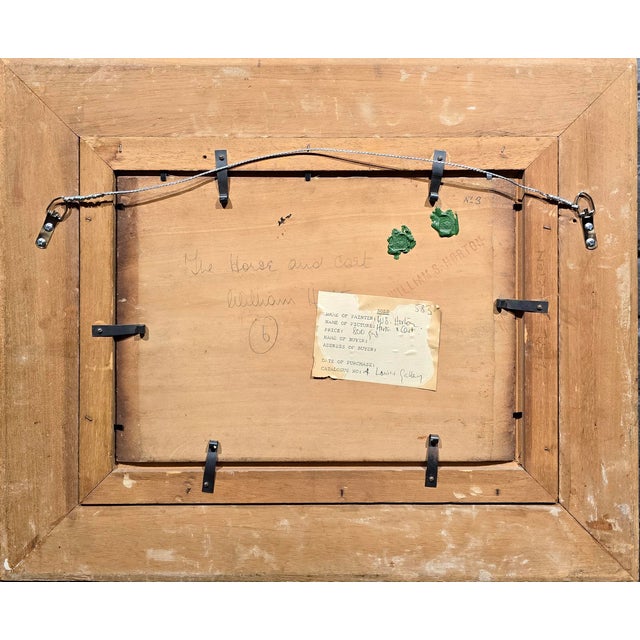
The back of the painting provides a wealth of historical data that confirms its authenticity, high status during the artist’s lifetime, and prestigious gallery history:
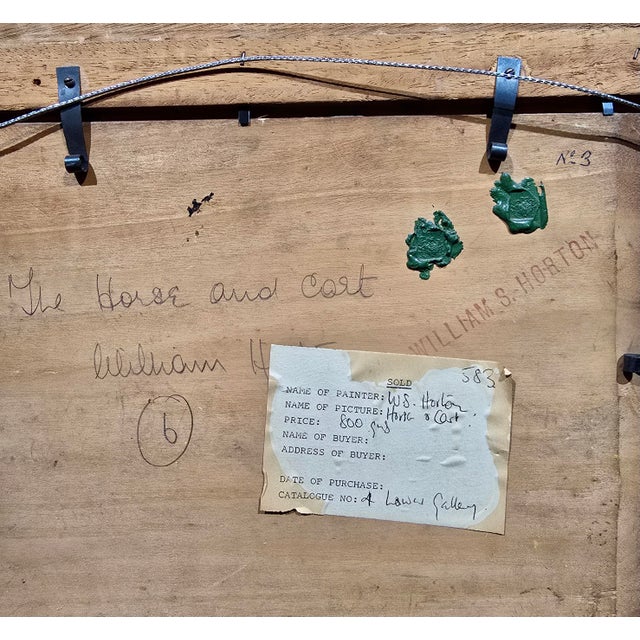
Artist Authentication: The wooden backing board features a direct, elegant pencil inscription identifying the work as "The Horse and Cart" alongside the artist's handwritten signature, "William S. Horton".
Gallery Distribution: A partially intact, vintage paper sales tag belongs to The Leicester Galleries (noted via its handwritten registry as 4 Leicester Gallery or Lowe Gallery, standard nomenclature variations for the prominent London firm).
Inventory Markings: The piece is officially cataloged with historical registry numbers: a stenciled "Nº 3" in the upper right, a circled "6" on the left, and "583" stamped on the tag. These point to a specific gallery solo exhibition or estate ledger.
Valuation: The original gallery selling price is preserved as 800 Guineas (800 gns). Historically, the guinea was a luxury currency used in Great Britain exclusively for major art transactions, professional fees, and high-end livestock. An 800-guinea valuation in the early-to-mid 20th century represents a remarkably high tier of commercial success, illustrating that Horton's works were premium acquisitions for elite collectors.
Wax Seals: Two distinct green wax gallery seals remain firmly melted into the upper right quadrant of the board, an antique practice used by high-end European art dealers to secure and guarantee provenance across international borders.
Artist Biography: William Samuel Horton (1865–1936)
William Samuel Horton was a critically acclaimed American Impressionist painter, pastellist, and illustrator who spent the vast majority of his life and career working at the highest echelons of the European art world.
Early Life and Rebellion
Born into an affluent, wealthy family in Grand Rapids, Michigan on November 16, 1865, Horton grew up in Lisbon, North Dakota. He discovered an intense passion for drawing and painting by age seven. His wealthy parents strongly disapproved of an artistic career, going so far as to destroy his early canvases and discard his art supplies to deter him. Undeterred, a teenage Horton took an illustrating job for the North West Magazine and ultimately fled his family home in 1883. This act of defiance led his parents to officially disinherit him.
Academic Training
Horton sought out premier formal training across the United States and Europe:
The School of the Art Institute of Chicago (AIC): Where he began his formal study.
The Art Students League & National Academy of Design (New York): Where he refined his draftsmanship and began exhibiting publicly by 1888.
Académie Julian (Paris): Moving to France in 1893, he studied under French academic giants Jean-Joseph Benjamin-Constant and Jean-Paul Laurens until 1896.
The Paris Expatriate & Impressionist Circles
In 1892, Horton married Carlotta Lorrie Gray, a wealthy New York socialite and daughter of a prominent shipowner. Backed by her considerable wealth, Horton was freed from the commercial pressures that plagued many artists. He permanently settled abroad as a cosmopolitan expatriate, maintaining studios in France, England, and Switzerland.Living in Paris, Horton integrated himself into the inner circle of the original Impressionist movement. He formed close personal friendships and painted alongside Claude Monet, Camille Pissarro, Edgar Pissarro, James McNeill Whistler, and André Derain. Pissarro’s influence pushed Horton toward a highly individualistic, vibrant palette that featured broken, almost pointillist brushwork. He became a celebrated regular exhibitor at the prestigious Salon d'Automne in Paris and the Royal Academy in London.
Artistic Themes and Later Years
Horton was a obsessive, dedicated plein-air landscape artist who spent hours outside capturing light shifting across natural surfaces. While he painted coastal beaches in England, Italian canals, and a famous series of New York’s skyscrapers late in life, his most celebrated body of work centered on the Swiss Alps (particularly Gstaad). His brilliant, light-filled alpine landscapes earned him high praise from his peer Claude Monet, who publicly lauded Horton as "the greatest painter of snow".
Death and Legacy
When William Samuel Horton passed away in 1936, he left behind a massive estate of over 1,000 finished oil paintings and pastels in his studio, which were inherited by his son, Captain William Gray Horton. In 1939, the Galerie Charpentier in Paris honored him with a major retrospective. In 1966, the prestigious Vose Galleries of Boston became the sole agent for his American estate, cementing his legacy in the annals of American Impressionism.Today, his masterpieces are highly sought after by global collectors and are preserved in major museum collections around the world, including:
Musée d'Orsay (Paris)
Musée Carnavalet (Paris)
National Museum of Stockholm (Sweden)
The National Gallery / Smithsonian American Art Museum (Washington, D.C.)
Los Angeles County Museum of Art (LACMA)
See less
- Dimensions
- 21ʺW × 3ʺD × 17ʺH
- Styles
- American
- Impressionist
- Frame Type
- Framed
- Period
- 1920s
- Country of Origin
- United States
- Item Type
- Vintage, Antique or Pre-owned
- Materials
- Oil Paint
- Wood
- Condition
- Good Condition, Original Condition Unaltered, Some Imperfections
- Color
- Stone Gray
- Condition Notes
- Excellent - Minor wear consistent with age and history Excellent - Minor wear consistent with age and history less
Questions about the item?
Returns & Cancellations
Return Policy - All sales are final 48 hours after delivery, unless otherwise specified in the description of the product.
Cancellation Policy - Prior to shipping or local pickup, buyers may cancel an order for up to 48 hours, unless otherwise specified.
Related Collections
- Photorealism Canvas Paintings
- Photorealism Paintings in New York
- Ed Ruscha Paintings
- Richard Serra Paintings
- Louise Nevelson Paintings
- Karen Offutt Paintings
- BDDW Paintings
- Joseph Stella Paintings
- Herman Miller Paintings
- Nicola Simbari Paintings
- Johannes Andersen Paintings
- Pedro Friedeberg Paintings
- Soicher Marin Paintings
- Jeff Slemmons Paintings
- Carl-Axel Acking Paintings
- Karl-Erik Ekselius Paintings
- Eames Paintings
- Stellar Union Paintings
- Stellar Works Paintings
- Claude Lalanne Paintings
- George Condo Paintings
- Jeff Koons Paintings
- James McCray Paintings
- Lawson-Fenning Paintings
- Cassina Paintings