

Details
Description
This original Cold War-era editorial cartoon by Jacob Burck (1907–1982) offers an excellent glimpse into mid-century American journalism and international …
Read more
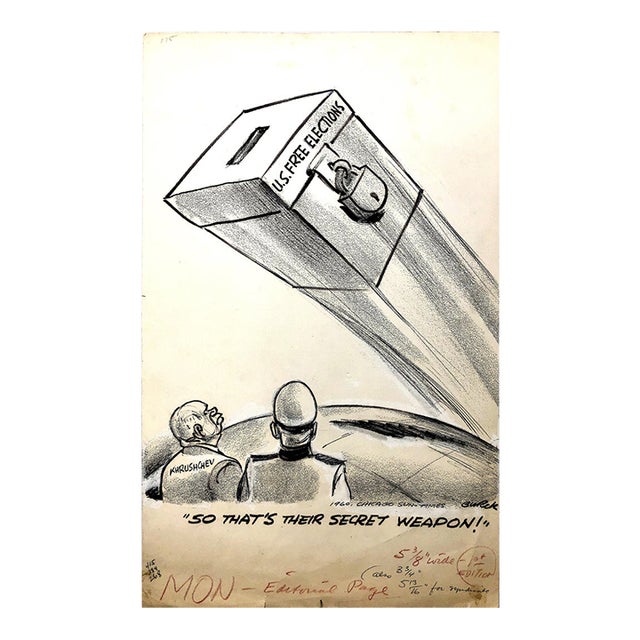
This original Cold War-era editorial cartoon by Jacob Burck (1907–1982) offers an excellent glimpse into mid-century American journalism and international geopolitical tension. This cartoon is directly relevant to the 1960 presidential campaign. The piece was published in the Chicago Sun-Times in 1960 during the intense race between Vice President Richard Nixon and Senator John F. Kennedy.
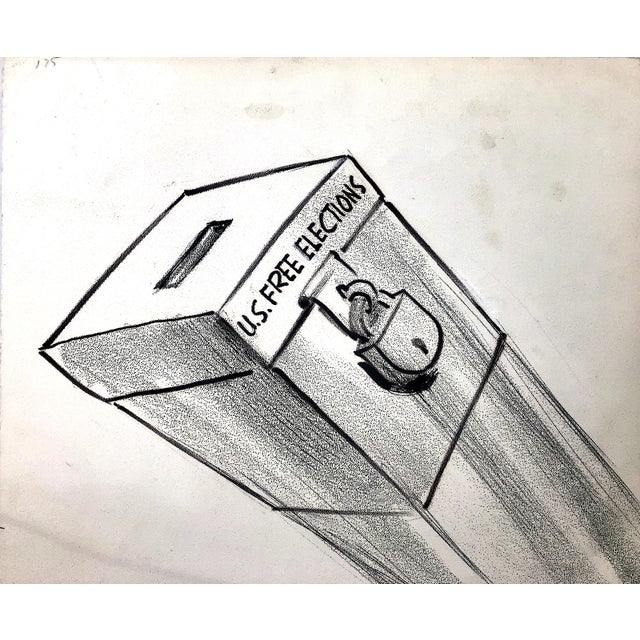
SCENE: A central topic of the 1960 election was the "Missile Gap"—a fierce debate over whether the United States had fallen behind the Soviet Union in nuclear ballistic missile capabilities. Rather than featuring a lethal weapon or a destructive warhead, the cartoon flips this anxiety on its head. The massive rocket soaring into space is actually a giant ballot box labeled "U.S. Free Elections," complete with a padlock on the front.
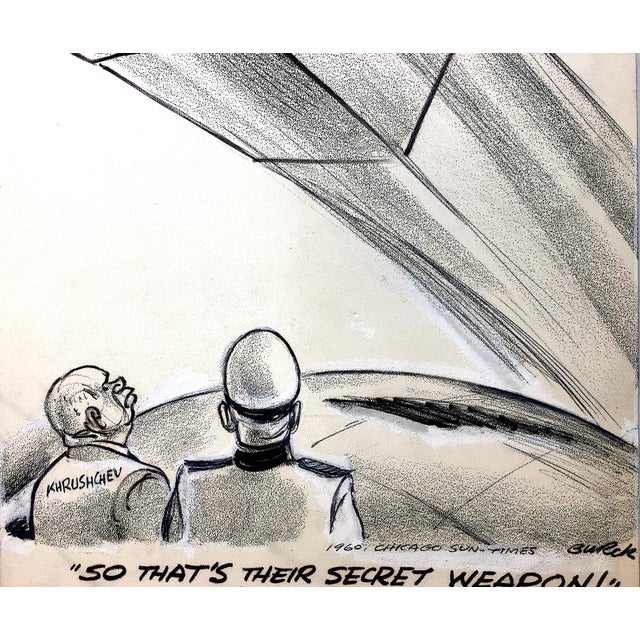
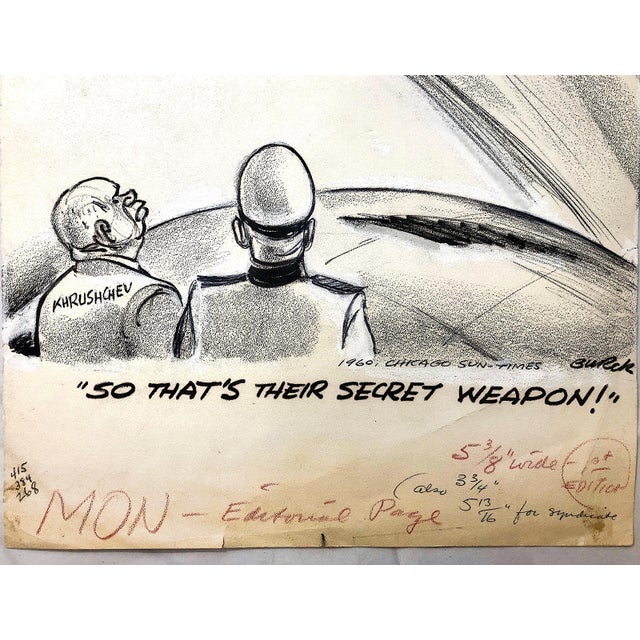
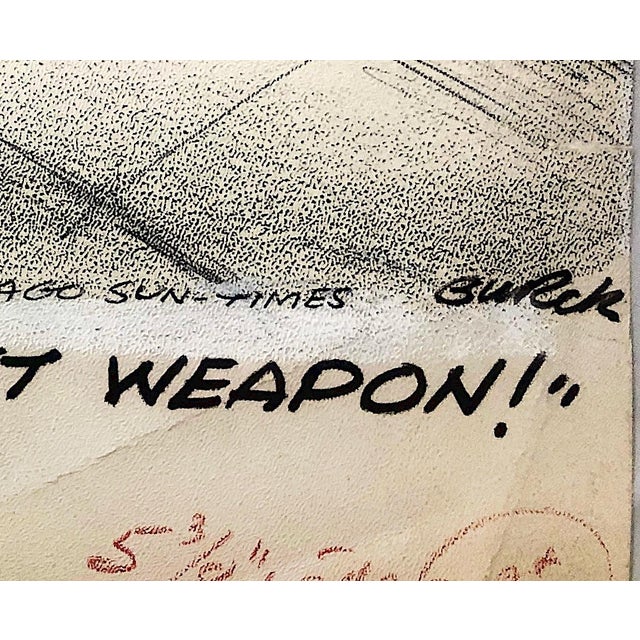
In the foreground, Soviet Premier Nikita Khrushchev and a military general peer up from the surface of the globe in awe, with a grumpy Khrushchev exclaiming, "So that's their secret weapon!" The core message serves as democratic propaganda typical of the era: America’s ultimate superiority and true geopolitical "secret weapon" against communist totalitarianism was not its physical arsenal, but the enduring strength of its democratic, free electoral process.
STYLE: The style of this cartoon is best classified as Mid-Century American Editorial Realism, specifically utilizing a technique known as Grease Pencil and Wash. Rather than relying purely on clean, sharp ink lines, Jacob Burck heavily used a lithographic grease pencil (or crayon) on textured Coquille paper or heavy illustration board. This creates a gritty, tonal, and almost painted look with rich gradients of deep blacks and soft charcoal grays.
Called the "Pulitzer School" Aesthetic, this gritty, high-contrast, heavily shaded look was the dominant style among the mid-century titans of American political cartooning—heavily championed by Burck, Daniel Fitzpatrick and Herblock. It favored dramatic lighting and atmospheric depth over simple line doodles. The figures, like Khrushchev here, are drawn with a distinct, easily recognizable caricature, but the central subject—the giant rocket ballot box—is rendered with a monumental heavy and dramatic realism. This stark contrast between political satire and monumental scale was a hallmark of Cold War-era propaganda art.
ARTIST: The artwork was created by Jacob Burck, a prominent Polish-born Jewish-American painter, sculptor and award-winning political cartoonist. In the late 1920s and early 1930s, Burck worked as a muralist and staff cartoonist for radical left-wing publications like the Daily Worker. However, after visiting the Soviet Union in 1936 and witnessing firsthand the regime's forced political manipulation of art, he grew deeply disillusioned and abandoned the Communist movement entirely. Upon his return to the U.S., he joined the St. Louis Post-Dispatch before transitioning to the Chicago Daily Times (later the Chicago Sun-Times) in 1938, where he remained for 44 years.
Burck won the 1941 Pulitzer Prize for Editorial Cartooning for his poignant piece "If I Should Die Before I Wake". His signature use of heavy graphite, grease pencil and ink brushwork heavily influenced peers of his generation. Because of his early radical ties, he was targeted and investigated during the McCarthyism "Red Scare" of the 1950s, though the deportation charges brought against him were ultimately dropped.
CIRCULATION: The production notes handwritten in red grease pencil and graphite at the bottom—marking it for the "MON—Editorial Page" and mapping out layout scaling constraints (e.g., "5 3/8" wide for 1st Edition")—speak to the vast printing operations of the era. In 1960, the Chicago Sun-Times was one of the largest and most influential daily regional tabloid newspapers in the United States. By 1960, the Chicago Sun-Times maintained a massive daily weekday (Monday through Friday) print circulation hovering between 530,000 and 550,000 copies.
Burck’s daily editorial cartoons were distributed nationwide via the Field Newspaper Syndicate (the syndication arm of Field Enterprises). In 1960, this syndicate successfully placed his artwork into more than 200 daily newspapers across the United States, giving this specific original Monday morning cartoon a combined nationwide syndication reach of several million readers.
Signature/Maker’s Mark: Lower right (photo #5).
See less
- Dimensions
- 14ʺW × 0.07ʺD × 24.5ʺH
- Styles
- American
- Frame Type
- Unframed
- Period
- Mid 20th Century
- Country of Origin
- United States
- Item Type
- Vintage, Antique or Pre-owned
- Materials
- Graphite
- Paper
- Pen and Ink
- Condition
- Good Condition, Original Condition Unaltered, Some Imperfections
- Color
- Slate Gray
- Condition Notes
- Condition commensurate with age and use. Please review all photos. Condition commensurate with age and use. Please review all photos. less
Questions about the item?
Returns & Cancellations
Return Policy - All sales are final 48 hours after delivery, unless otherwise specified in the description of the product.
Cancellation Policy - Prior to shipping or local pickup, buyers may cancel an order for up to 48 hours, unless otherwise specified.
Related Collections
- Jeff Slemmons Drawings
- Salvador Dalí Drawings
- Maison Jansen Drawings
- Guillaume Azoulay Drawings
- Leroy Neiman Drawings
- Piet Hein Eek Drawings
- Carl-Axel Acking Drawings
- Joseph Stella Drawings
- Erté Drawings
- Charcoal Drawings
- Fashion Drawings
- 1950s Fashion Drawings
- Pencil Drawings
- Ink Drawings
- Gustavian (Swedish) Drawings