

Details
Description
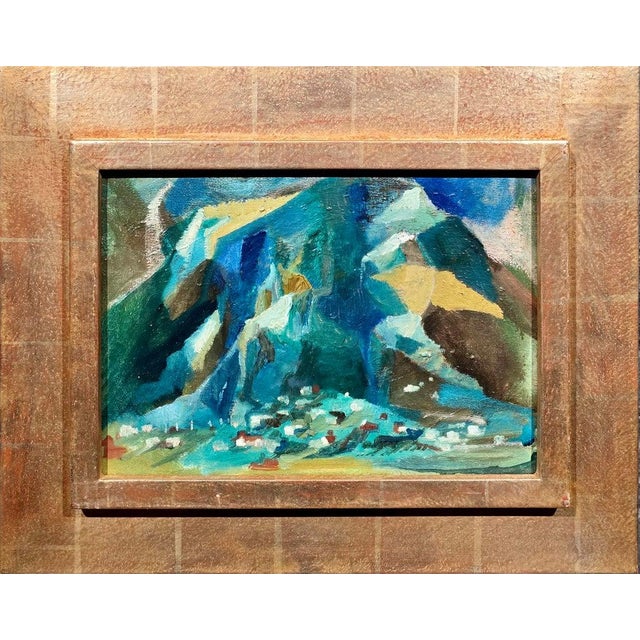
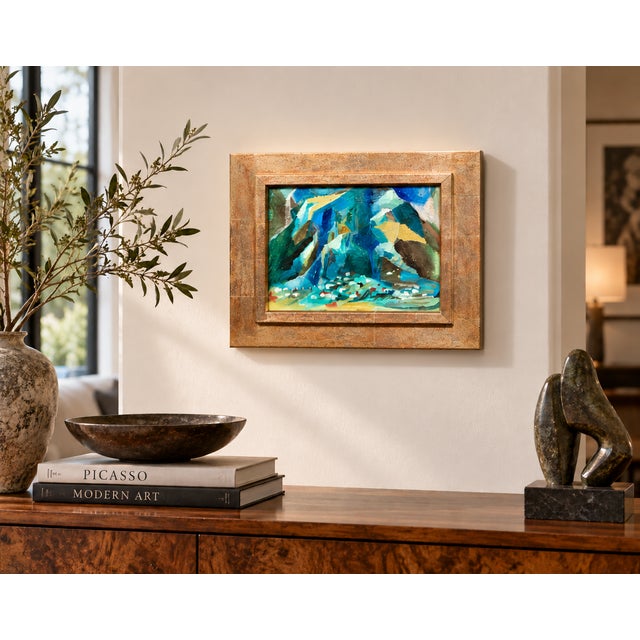
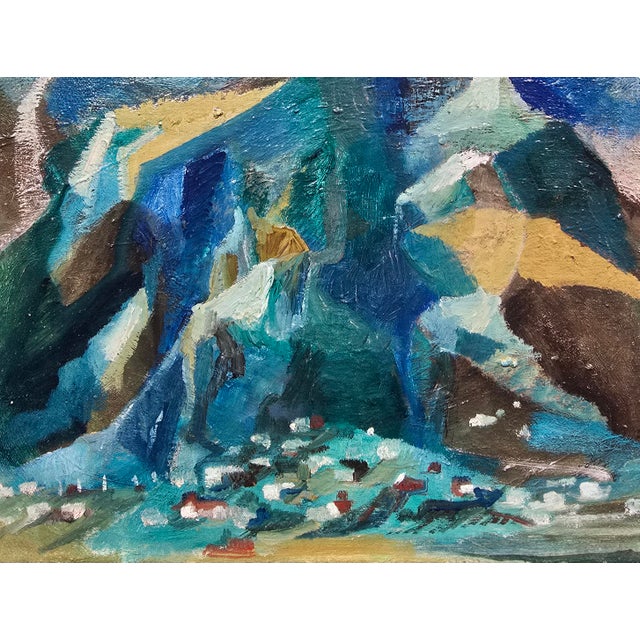
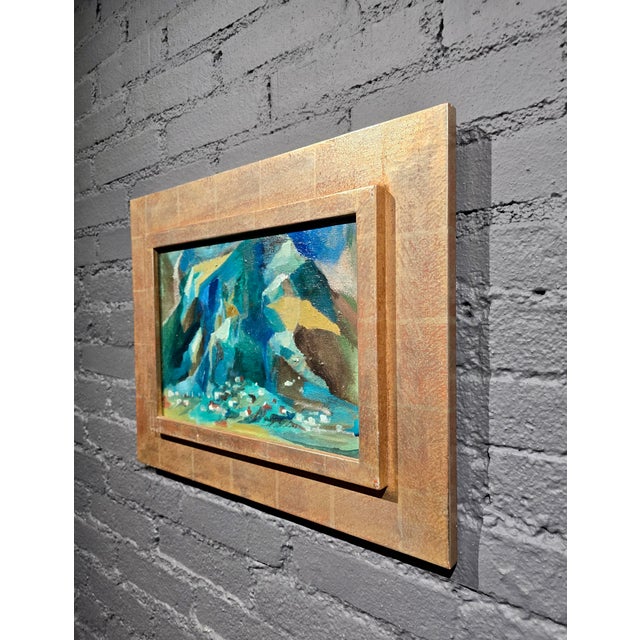
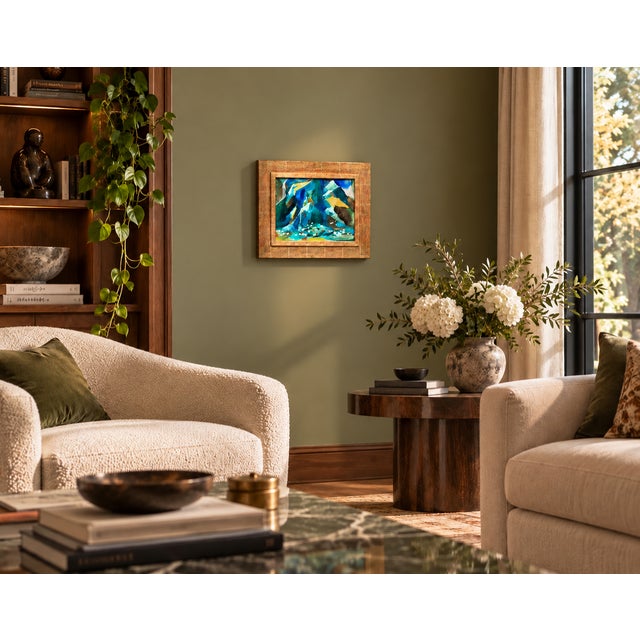
Phil Dike- Abstract Mountain Landscape with Village study -Oil painting
American Mid-Century Modern Expressionism -Oil painting on canvas board -unsigned
…
Read more
Phil Dike- Abstract Mountain Landscape with Village study -Oil painting
American Mid-Century Modern Expressionism -Oil painting on canvas board -unsigned
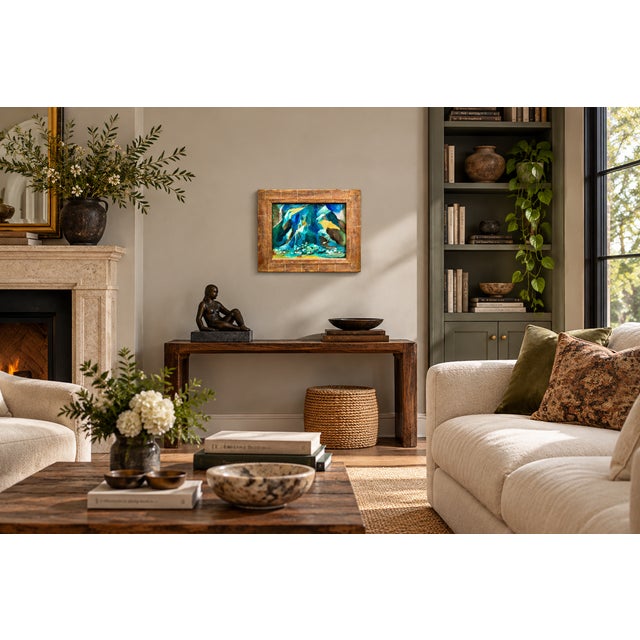
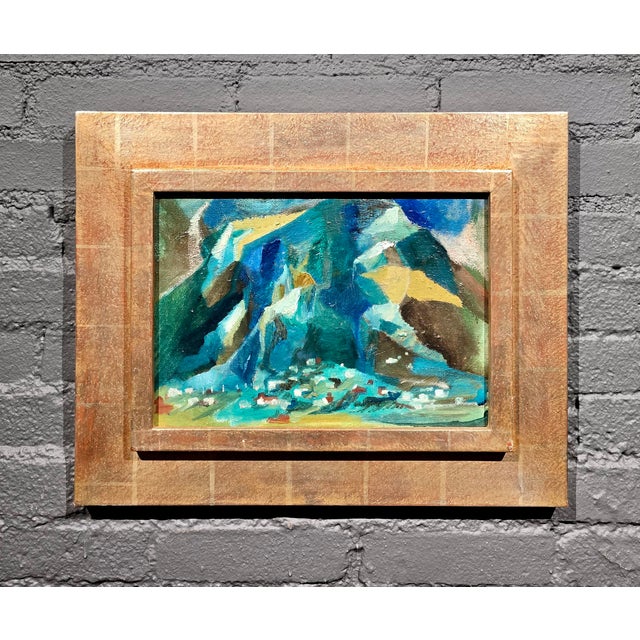
board size: 11x15" - Frame size 16x20x1"
Description
Composition and Artistic Vision
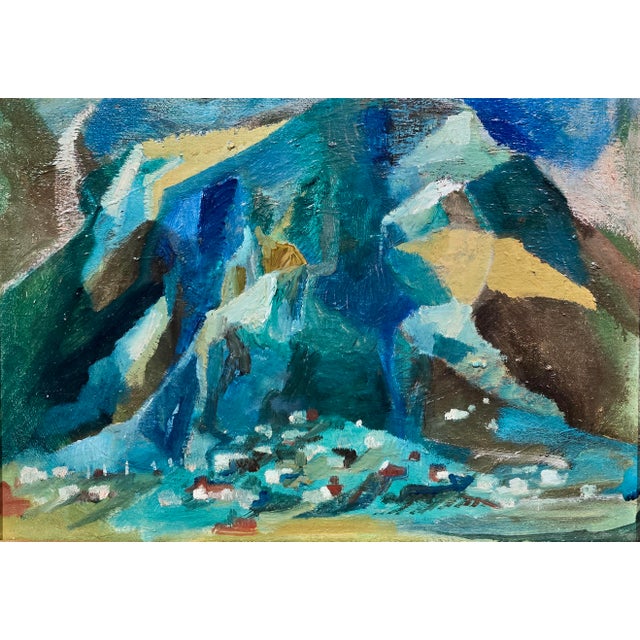
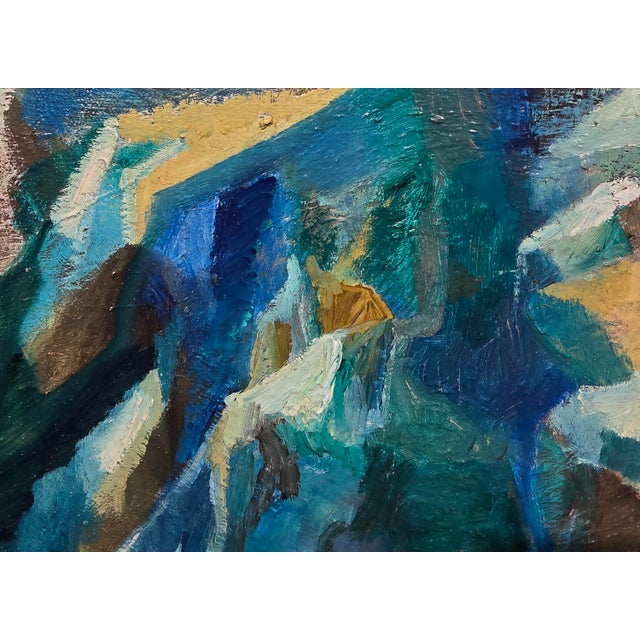
This captivating mid-century modernist oil painting presents a dramatically abstracted mountain landscape, rendered through an intricate interplay of angular forms, fractured planes, and richly saturated colors.The composition is dominated by a towering arrangement of mountainous formations that rise through the upper portion of the picture, creating an imposing architectural presence. Rather than describing the landscape through conventional naturalistic perspective, the artist reconstructs the terrain into an expressive arrangement of overlapping geometric shapes, irregular contours, and sharply contrasting tonal passages.The mountain formations appear simultaneously solid and fluid. Their rugged outlines suggest geological permanence, while the shifting planes of color introduce a remarkable sense of movement and visual rhythm.This approach reflects the broader development of twentieth-century modernist landscape painting, in which artists increasingly sought to interpret the underlying structure, energy, and emotional character of nature rather than reproduce its literal appearance.The composition retains a recognizable landscape motif while approaching the visual language of abstraction, allowing the viewer to experience the scene both as a mountainous environment and as an independent arrangement of color, form, and texture.
Color Palette and Chromatic Relationships
One of the painting's most compelling qualities is its exceptionally vivid and harmonious color palette.The artist employs an expressive range of deep cobalt blue, turquoise, teal, and emerald green, creating a complex network of cool tonal relationships throughout the composition.These colors are distributed across the mountain formations in irregular geometric passages, producing the impression of shifting light, atmospheric depth, and fractured geological surfaces.Subtle accents of pale cream, warm ochre, and muted earth tones introduce visual contrast along the upper ridges and rocky contours.Particularly striking is the interplay between the intense blues and greens, which creates a vibrant chromatic tension while maintaining a cohesive overall composition.The resulting landscape is not governed by conventional atmospheric color. Instead, color becomes an expressive instrument, communicating the emotional intensity and underlying rhythm of the natural environment.This imaginative approach to color is consistent with the experimental spirit of California modernist painting during the middle decades of the twentieth century.
The Village and Human Presence
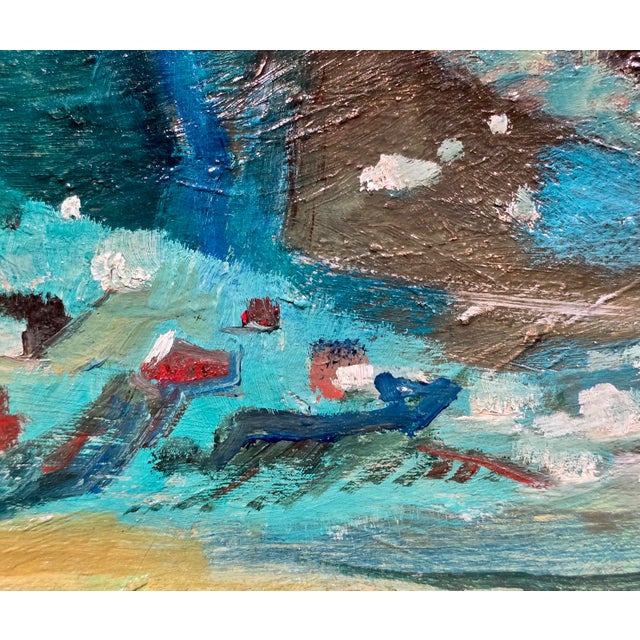
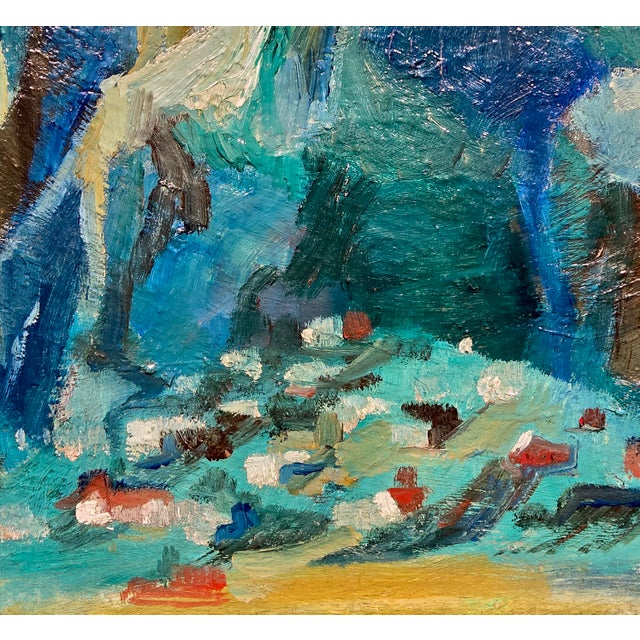
At the base of the imposing mountain formations, a lively cluster of smaller geometric shapes introduces an intriguing secondary element to the composition.Rendered in contrasting passages of white, pale gray, cream, and vibrant terracotta red, these compact rectangular forms suggest the rooftops and facades of a small mountain village nestled within the surrounding landscape.The arrangement creates a compelling contrast between the monumental scale of the mountains and the intimate suggestion of human habitation.The warm reddish accents provide a focal point within the predominantly cool composition, drawing the viewer's eye toward the lower portion of the painting.Although the forms remain deliberately abstract, their placement suggests a settlement integrated into the rugged terrain.This juxtaposition of architecture and nature adds a subtle narrative dimension to the painting, transforming an otherwise abstract landscape into a scene that invites exploration and interpretation.
Brushwork, Texture, and Surface Treatment
The painting demonstrates a lively and expressive approach to oil painting, characterized by energetic brushwork, angular applications of pigment, and a complex arrangement of intersecting color passages.Individual brushstrokes contribute directly to the construction of the landscape, functioning not merely as surface decoration but as essential elements of the composition's underlying structure.Broad passages of color are interrupted by smaller, more concentrated strokes, creating a dynamic relationship between expansive mountain forms and finely articulated details.The irregular contours and layered visual effects impart a strong sense of physicality to the landscape.Rather than relying upon smooth transitions or carefully blended modeling, the artist emphasizes the expressive potential of the painted surface.The resulting composition possesses an almost mosaic-like character, with each individual passage contributing to a larger, rhythmically organized whole.
Modernist Influences and Artistic Interpretation
The painting reflects several important developments in twentieth-century modernist art, particularly the influence of Post-Impressionism, Expressionism, and Cubist approaches to pictorial structure.its faceted mountain formations recall the modernist tendency to reduce natural subjects to their underlying geometric relationships.At the same time, the bold, non-naturalistic color relationships introduce an expressive dimension that moves beyond the analytical concerns of traditional Cubism.The work maintains a delicate balance between representation and abstraction.Although the mountainous subject remains recognizable, the landscape has been transformed into a composition in which color, rhythm, and structural relationships take precedence over descriptive realism.This approach is especially relevant to the development of California modernism, where artists increasingly combined their observations of the Western landscape with European modernist principles.The painting's intimate scale further enhances its character as a concentrated artistic exploration, suggesting an interest in experimenting with pictorial structure and color rather than producing a conventional panoramic landscape.
Frame and Historical Presentation
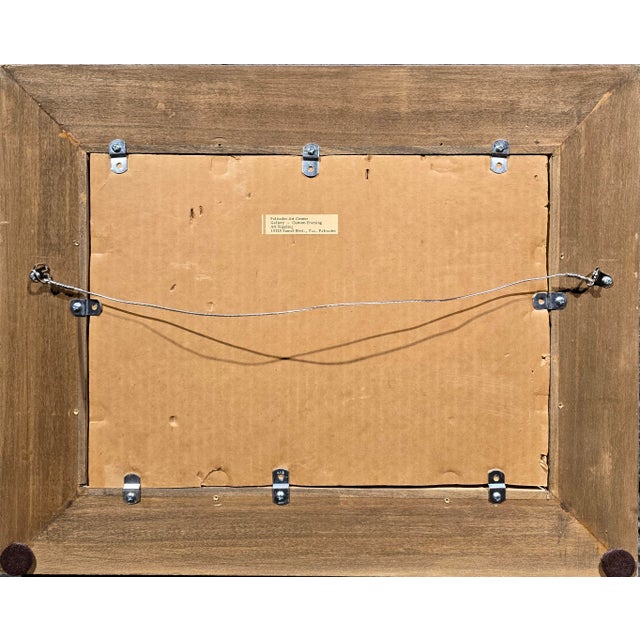
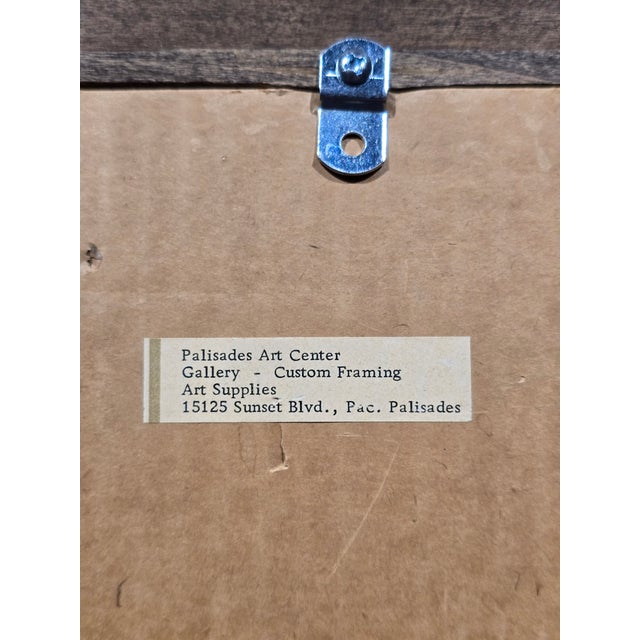
The painting is housed in an attractive vintage decorative frame featuring a warm gilt-toned finish and a distinctive hand-incised geometric pattern.The frame's textured surface and repeating linear decoration complement the angular forms within the composition, creating a visually harmonious presentation.The reverse retains a vintage label identifying:
Palisades Art Center
Gallery – Custom Framing – Art Supplies
15125 Sunset Boulevard
Pacific Palisades, California
The label provides an interesting connection to the Southern California art and framing community.While it does not establish the painting's original exhibition or sales history, it contributes to the object's documented history and is consistent with its association with the regional art market.The painting is presented in its existing vintage frame, which enhances its mid-century character and decorative appeal.
Artist Biography: Phil Dike, N.A. (1906–1990)
Early Life and Elite Academic Foundations
Phil Latimer Dike was born in Redlands, California, in 1906. Showing immense raw draftsmanship from an early age, he earned a scholarship to the prestigious Chouinard Art Institute in Los Angeles, studying there from 1924 to 1927 under the guidance of renowned instructors Clarence Hinkle and F. Tolles Chamberlin.Eager to expand his technical repertoire, Dike traveled eastward to New York City in 1929 to attend the celebrated Art Students League. While in New York, he studied under master anatomist George Bridgman and deeply immersed himself in the gritty, observational realism of the American Ashcan School while refining his eye inside the private studio of George Luks. Shortly thereafter, Dike crossed the Atlantic to France, absorbing European Modernism and academic landscape painting at the American Academy of Fontainebleau. Pioneering the "California Style" and Disney HistoryUpon returning to the West Coast, Phil Dike became an essential cornerstone of the Southern California art scene. He resumed teaching at Chouinard and, alongside fellow luminaries like Millard Sheets and Rex Brandt, pioneered the legendary "California Style" of watercolor painting. This movement rejected the tight, illustrative constraints of traditional English watercolor in favor of monumental scale, sweeping gestures, transparent washes, and vibrant, daylight-infused color expressionism. Dike’s prominence was so absolute that between 1927 and 1955, he exhibited more works in the California Water Color Society shows than any other single artist, eventually serving as the organization's president in 1939. Dike’s unparalleled mastery of color theory caught the attention of the commercial film industry. From 1935 to 1945, he worked at Walt Disney Studios, executing vital duties as an expert color coordinator, teacher, and story designer. He directly shaped the atmospheric palettes of several historic animated cinematic masterpieces, including teaching color theory for Snow White and the Seven Dwarfs (1937), designing sequences for the avant-garde classic Fantasia (1940), and color-consulting for The Three Caballeros (1944).
Mid-Century Transition into Abstraction
Following his tenure in the commercial film world, Dike returned fully to fine art, co-founding the highly influential Brandt-Dike Summer School of Painting in Corona del Mar with Rex Brandt. In 1950, he accepted a formal faculty position at Scripps College and the Claremont Graduate University, a position he would hold until his retirement as Professor Emeritus in 1970.During his decades in Claremont, Dike's style underwent a profound, celebrated evolution. Shifting away from the regionalist realism of the 1930s and 40s, his work became deeply philosophical and structurally abstract. Throughout the 1950s and 1960s, Dike used calligraphic lines, fragmented planes, and heavily geometric brushstrokes to interpret landscapes, coastal harbors, and mountain massifs. While his landscapes always retained a factual, representational anchor to nature (such as a coast, a mountain range, or an isolated village), they bordered on total abstraction, aiming to capture an internal sense of mysticism, rhythm, and cosmic scale. He famously stated his creative philosophy: “Whenever art becomes predictable, it is something apart from art.”
Institutional Collections & Legacy
Phil Dike passed away in Los Angeles in 1990, leaving a permanent mark on American art history. Today, his artwork is preserved in many of the most respected permanent institutional museum collections in the United States, including:
The Metropolitan Museum of Art (New York)
The Los Angeles County Museum of Art (LACMA)
The National Academy of Design
The Library of Congress (Washington, D.C.)
See less
- Dimensions
- 20ʺW × 1ʺD × 16ʺH
- Frame Type
- Framed
- Art Subjects
- Landscape
- Period
- Mid 20th Century
- Country of Origin
- United States
- Item Type
- Vintage, Antique or Pre-owned
- Materials
- Canvas
- Oil Paint
- Wood
- Condition
- Good Condition, Original Condition Unaltered, Some Imperfections
- Color
- Blue
- Condition Notes
- Excellent - Minor wear consistent with age and history Excellent - Minor wear consistent with age and history less
Questions about the item?
Returns & Cancellations
Return Policy - All sales are final 48 hours after delivery, unless otherwise specified in the description of the product.
Cancellation Policy - Prior to shipping or local pickup, buyers may cancel an order for up to 48 hours, unless otherwise specified.
Related Collections
- Photorealism Canvas Paintings
- Ed Ruscha Paintings
- Photorealism Paintings in New York
- Richard Serra Paintings
- Jo Baskerville Paintings
- Louise Nevelson Paintings
- Karen Offutt Paintings
- Nicola Simbari Paintings
- Herman Miller Paintings
- BDDW Paintings
- Leroy Neiman Paintings
- Jaanika Peerna Paintings
- Johannes Andersen Paintings
- Pedro Friedeberg Paintings
- Peter Behrens Paintings
- Piet Hein Eek Paintings
- Raphael Paintings
- Vienna Secession Paintings
- Carl-Axel Acking Paintings
- Karl-Erik Ekselius Paintings
- Hans Andersen Paintings
- Jean-Paul Barray Paintings
- Cassina Paintings
- Jeff Slemmons Paintings
- Soicher Marin Paintings