

Details
Description
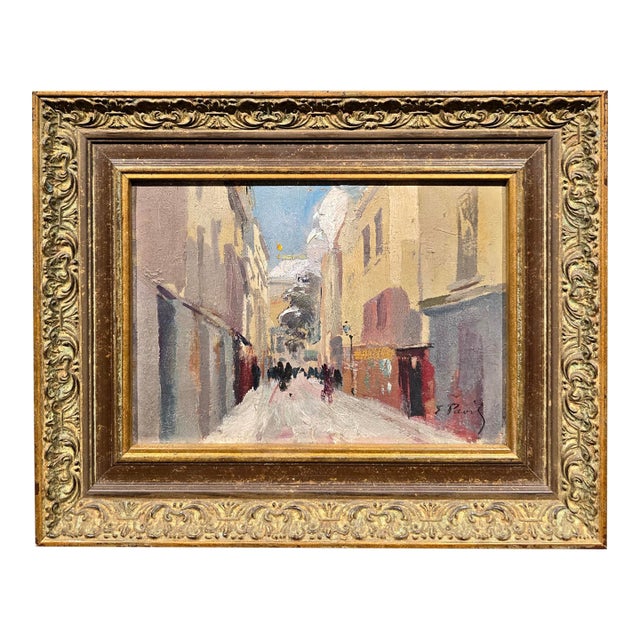
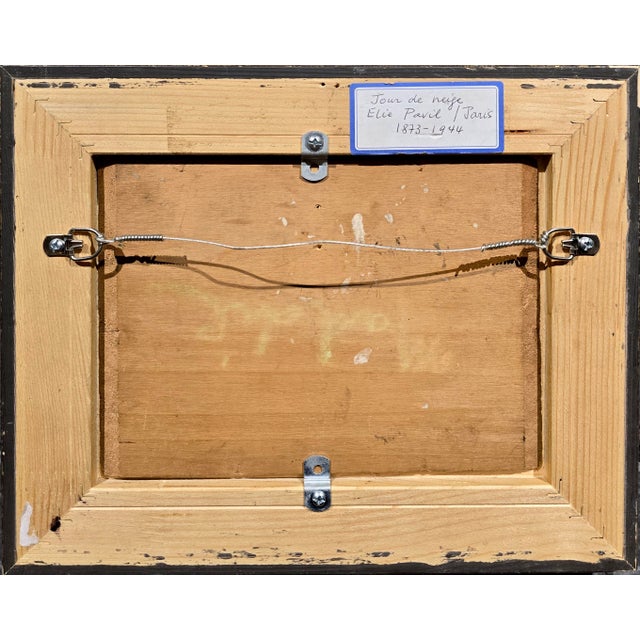
Élie Anatole Pavil (1873–1944) –Snowy Day on a Parisian Street, c. 1920s–Oil Painting
Ukrainian - French post Impressionist - Oil …
Read more
Élie Anatole Pavil (1873–1944) –Snowy Day on a Parisian Street, c. 1920s–Oil Painting
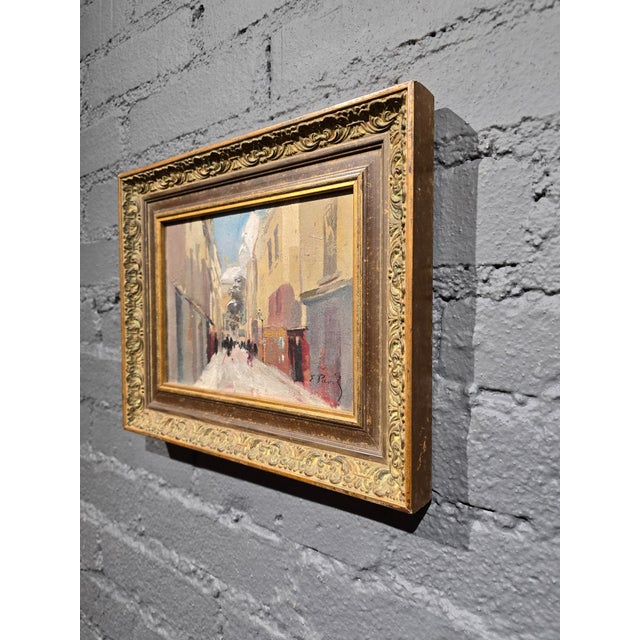
Ukrainian - French post Impressionist - Oil painting on board- Signed - circa 1920s
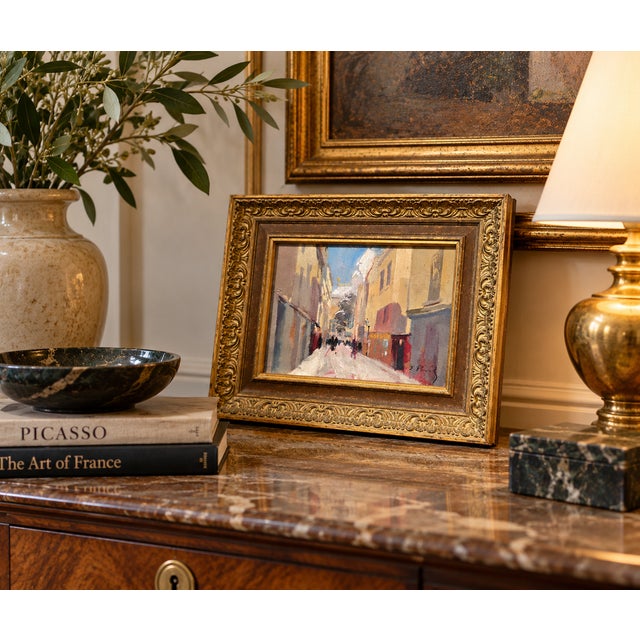
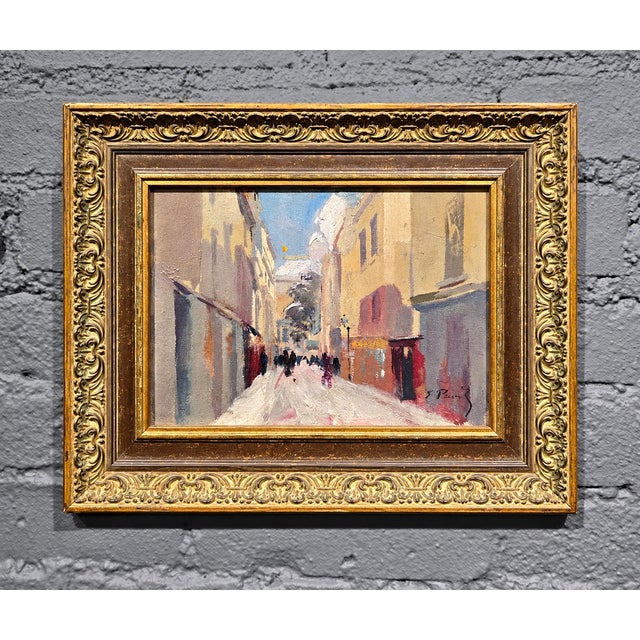
Panel Size: 6x9" - Frame size 10x13x2"
Description of the Artwork
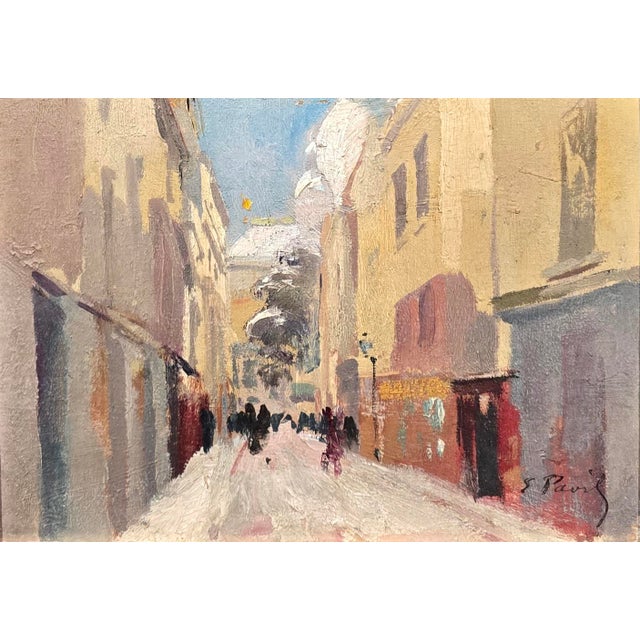
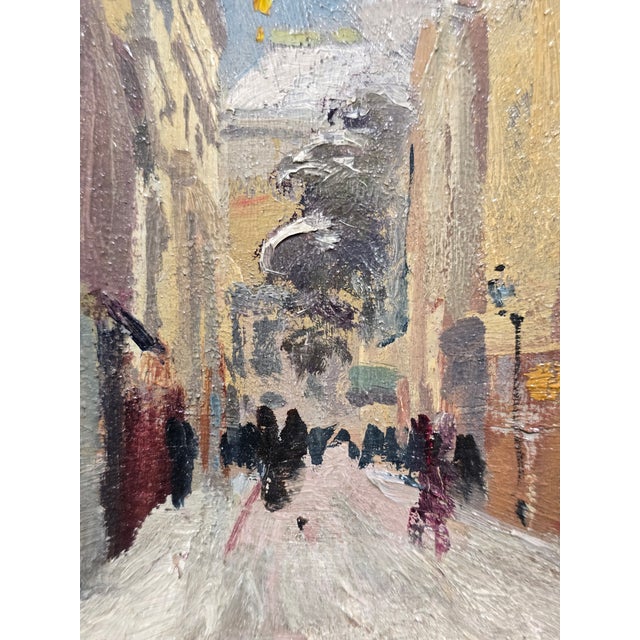
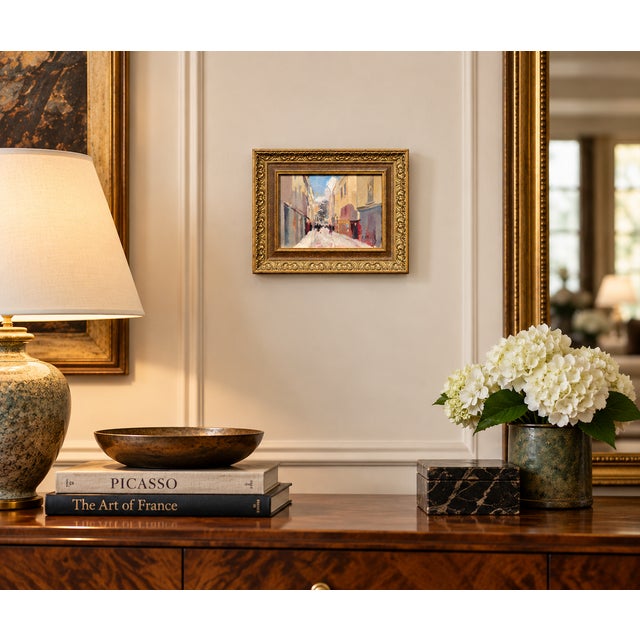
Snowy Day on a Parisian Street is an atmospheric and evocative work attributed to the celebrated Parisian painter Élie Anatole Pavil (1873–1944), capturing the quiet poetry of everyday life in the French capital during the early twentieth century.Executed with loose, expressive brushwork and richly textured passages of impasto, the composition reveals the artist's sensitivity to the interplay of light, architecture, and urban atmosphere. The painting presents an intimate view of a narrow Parisian street, where pedestrians move between historic buildings beneath a softly illuminated sky.
Composition and Perspective
The composition employs a strong linear perspective, drawing the viewer's eye along the gently receding street toward a luminous architectural backdrop, partially obscured by distant trees and the atmospheric haze.The surrounding buildings create a natural corridor through the composition, their irregular façades and varied rooflines evoking the picturesque character of old Paris. The intimate scale of the street, together with the loosely suggested storefronts and passing figures, conveys the charm of a neighborhood scene observed during an ordinary moment of city life.Rather than emphasizing architectural precision, Pavil concentrates on the overall impression of the setting, allowing color, texture, and light to communicate the atmosphere of the scene.
Light, Color, and Winter Atmosphere
One of the painting's most compelling qualities is its sophisticated treatment of light and color.The buildings on the right are illuminated in warm shades of pale ochre, golden cream, and muted rose, while the opposite façades are rendered in cooler tones of slate gray, lavender, and soft mauve. This subtle contrast between warm illumination and cool shadow creates a convincing sense of depth and atmosphere.The street itself is animated by broad, heavily textured strokes of white, silver-gray, pale blue, and delicate violet. These luminous passages suggest a possible covering of snow or slush, reflecting the subdued light of a winter day.The artist's expressive handling of the pavement gives the foreground an almost sculptural quality, with thick applications of pigment capturing the shifting effects of light across the uneven street surface.Overhead, a softly colored sky introduces delicate blue and warm cream tones, balancing the cooler passages below and lending the composition an unexpected sense of warmth.
Figures and Urban Life
Small pedestrian figures populate the middle distance, their forms suggested through economical, gestural brushstrokes.Rendered primarily in dark silhouettes, these figures introduce a subtle sense of movement and human activity. Their understated presence allows the architecture and atmospheric effects to remain the principal subjects while reinforcing the impression of a living, inhabited city.A particularly engaging detail appears along the lower right side of the composition, where accents of crimson and burgundy suggest a colorful storefront or awning. These rich tones provide a striking visual counterpoint to the predominantly muted palette of the surrounding buildings and street.
Technique and Artistic Character
The painting demonstrates the expressive qualities associated with the French Post-Impressionist tradition, particularly in its lively brushwork, simplified architectural forms, and emphasis on atmospheric color.Rather than relying on tightly controlled academic detail, the artist builds the composition through energetic applications of pigment, allowing individual strokes to remain visible across the painted surface.The result is a harmonious balance between recognizable urban subject matter and painterly spontaneity.The intimate scale and carefully organized perspective give the work the character of a Parisian cabinet painting, inviting close observation of its textured surface, subtle color relationships, and charming narrative details.
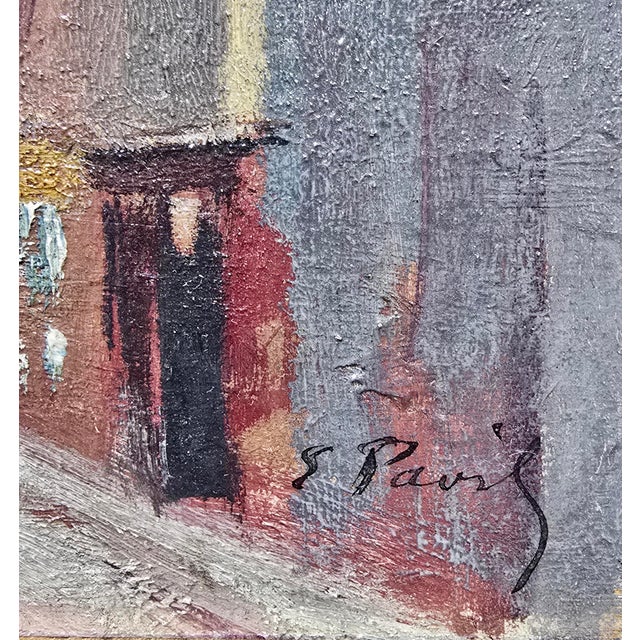
The painting bears the signature "E. Pavil" in the lower right corner.
Artist Biography: Élie Anatole Pavil (1873–1944)
Élie Anatole Pavil was a Ukrainian-born painter associated with the French school, best remembered for his atmospheric depictions of Parisian streets, boulevards, cafés, riverfronts, and everyday urban life.Born in Odessa in 1873, then part of the Russian Empire and today located in Ukraine, Pavil relocated to Paris in 1892, becoming part of the city's flourishing international artistic community.He studied at the prestigious Académie Julian, where he received academic training associated with the tradition of William-Adolphe Bouguereau. Nevertheless, Pavil developed a distinctly personal approach to painting, embracing the freer brushwork, luminous color, and observational immediacy of the Impressionist and Post-Impressionist movements.
Parisian Life and Artistic Development
Pavil became particularly associated with the artistic neighborhoods of Paris, especially Montmartre, where the city's lively streets, cafés, markets, and picturesque architecture offered an endless source of inspiration.His paintings frequently portray ordinary moments of Parisian life: pedestrians strolling along boulevards, figures gathering outside cafés, horse-drawn vehicles passing through busy streets, and atmospheric views of the Seine.Rather than concentrating exclusively on monumental landmarks, Pavil found beauty in the fleeting visual experiences of the modern city.His work demonstrates a particular sensitivity to changing weather conditions and seasonal light, often depicting the delicate effects of mist, rain, sunlight, and atmospheric haze upon the architecture and streets of Paris.These qualities place his work within the broader tradition of French painters who sought to capture not merely the appearance of the city but also its distinctive mood and character.
Exhibitions and Recognition
Throughout his career, Pavil participated in the Parisian exhibition circuit, including presentations at important French salons.His work attracted recognition for its lively observation, confident handling of paint, and appealing interpretations of contemporary Parisian life.He was awarded the distinction of Chevalier de la Légion d'Honneur, reflecting his standing within the French artistic establishment.
Later Years in Morocco
Around 1930, Pavil relocated to Morocco, where the brilliant North African light, colorful markets, architecture, and landscapes provided new artistic inspiration.His later paintings reflect his continuing fascination with atmospheric effects and the interaction of light and color, now interpreted through the warmer palette and distinctive visual character of North Africa.Pavil died in Rabat, Morocco, in 1944, according to French documentary records, although some published artist references give 1948.Today, his paintings remain appreciated by collectors of French Impressionist and Post-Impressionist art, particularly those drawn to the romantic atmosphere of early twentieth-century Paris.His work is associated with French public collections, including the Petit Palais in Paris, as well as private collections internationally.
Artistic Significance
Snowy Day on a Parisian Street embodies the qualities that make Pavil's Parisian subjects so appealing: an intimate sense of place, expressive handling of paint, harmonious color relationships, and an ability to transform an ordinary urban moment into a poetic visual experience.The combination of richly textured brushwork, luminous architectural passages, and delicately suggested pedestrian activity creates a composition that is both lively and contemplative.With its charming subject, atmospheric palette, and traditional presentation, this small-scale painting offers an engaging example of the enduring appeal of early twentieth-century Parisian street scenes.
See less
- Dimensions
- 13ʺW × 2ʺD × 10ʺH
- Styles
- Post Impressionist
- Art Subjects
- Cityscape
- Frame Type
- Framed
- Artist
- Elie Anatole Pavil
- Period
- 1920s
- Country of Origin
- Ukraine
- Item Type
- Vintage, Antique or Pre-owned
- Materials
- Oil Paint
- Wood
- Condition
- Good Condition, Original Condition Unaltered, Some Imperfections
- Color
- Slate Gray
- Condition Notes
- Excellent - Minor wear consistent with age and history Excellent - Minor wear consistent with age and history less
Questions about the item?
Returns & Cancellations
Return Policy - All sales are final 48 hours after delivery, unless otherwise specified in the description of the product.
Cancellation Policy - Prior to shipping or local pickup, buyers may cancel an order for up to 48 hours, unless otherwise specified.
Related Collections
- Photorealism Canvas Paintings
- Ed Ruscha Paintings
- Richard Serra Paintings
- Photorealism Paintings in New York
- Louise Nevelson Paintings
- Karen Offutt Paintings
- Jo Baskerville Paintings
- Nicola Simbari Paintings
- Herman Miller Paintings
- BDDW Paintings
- James McCray Paintings
- Leroy Neiman Paintings
- Jaanika Peerna Paintings
- Vienna Secession Paintings
- Johannes Andersen Paintings
- Pedro Friedeberg Paintings
- Peter Behrens Paintings
- Piet Hein Eek Paintings
- Raphael Paintings
- Jeff Slemmons Paintings
- Photorealism Paintings in Los Angeles
- Karl-Erik Ekselius Paintings
- Hans Andersen Paintings
- Jean-Paul Barray Paintings
- Cassina Paintings