

Details
Description
David Burliuk (1882-1967) Farm Scene at Twilight -Oil painting
Ukrainian-American Expressionist - Oil painting on panel | Signed
Dimensions: 7x10" …
Read more
David Burliuk (1882-1967) Farm Scene at Twilight -Oil painting
Ukrainian-American Expressionist - Oil painting on panel | Signed
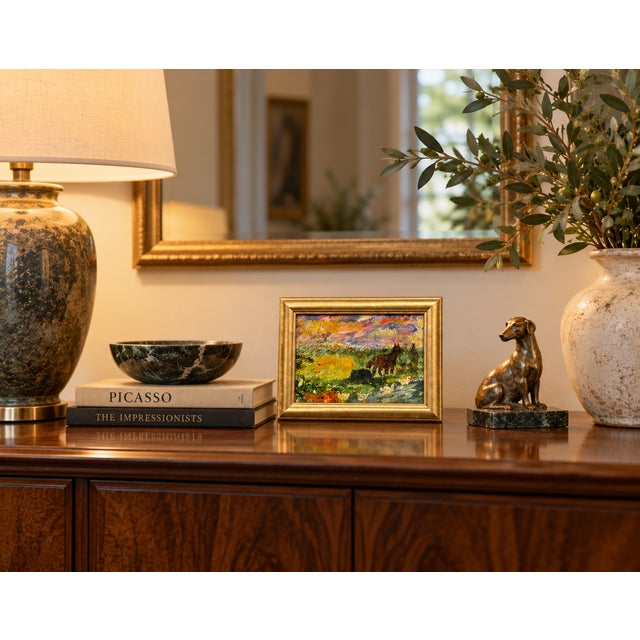
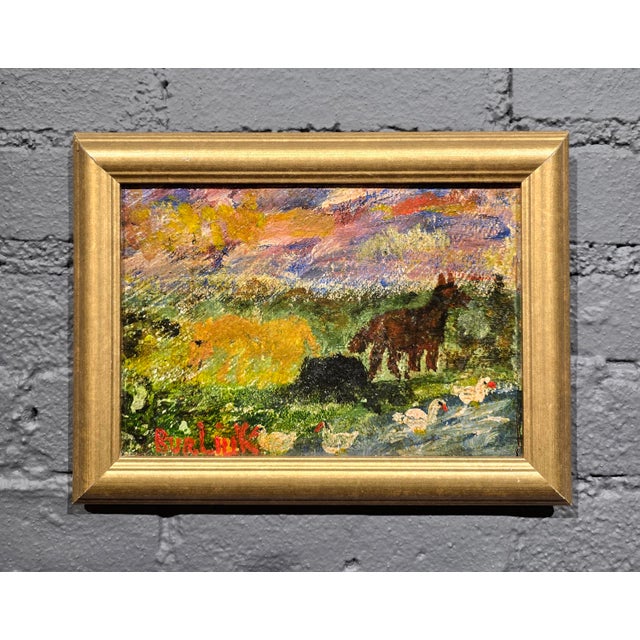
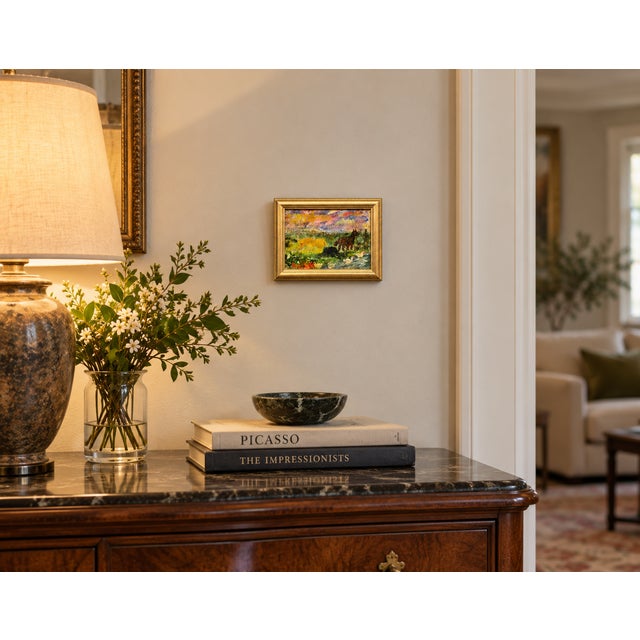
Dimensions: 7x10" - Frame size is approximately 9 x12x1"
Description
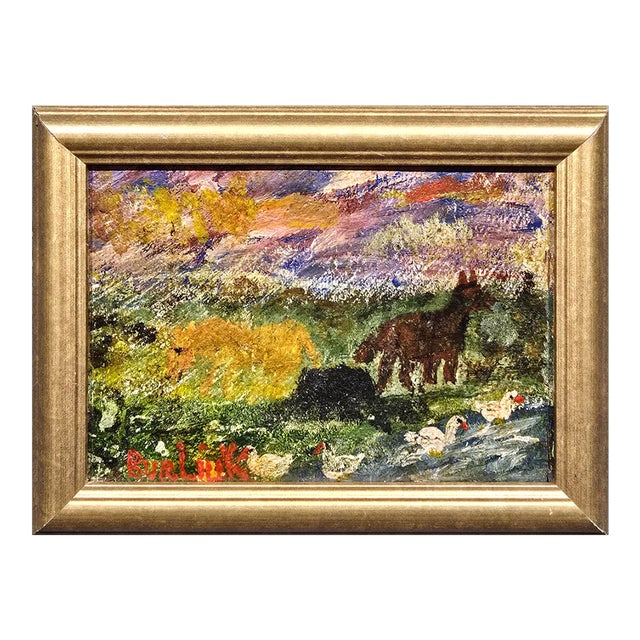
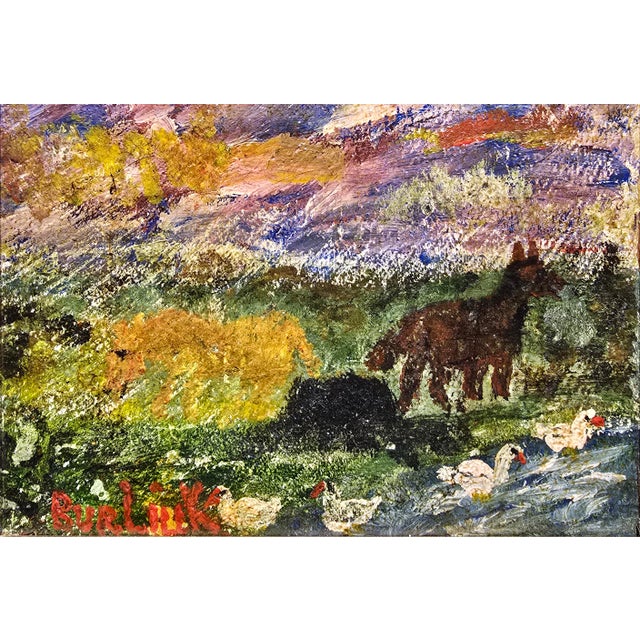
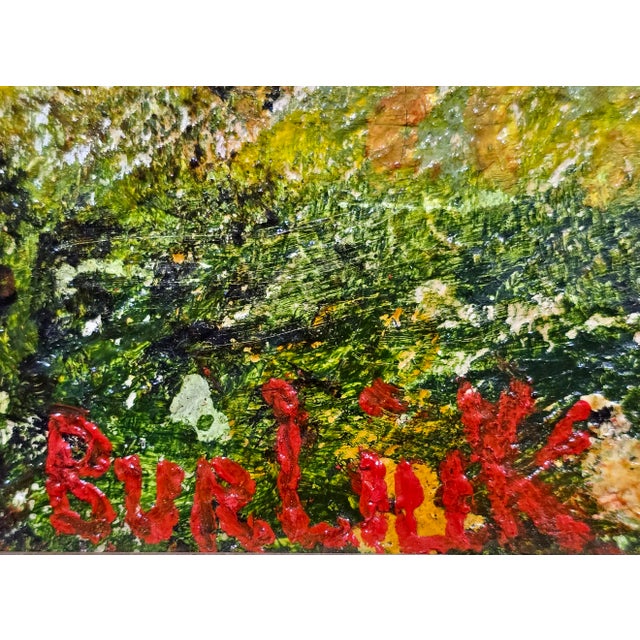
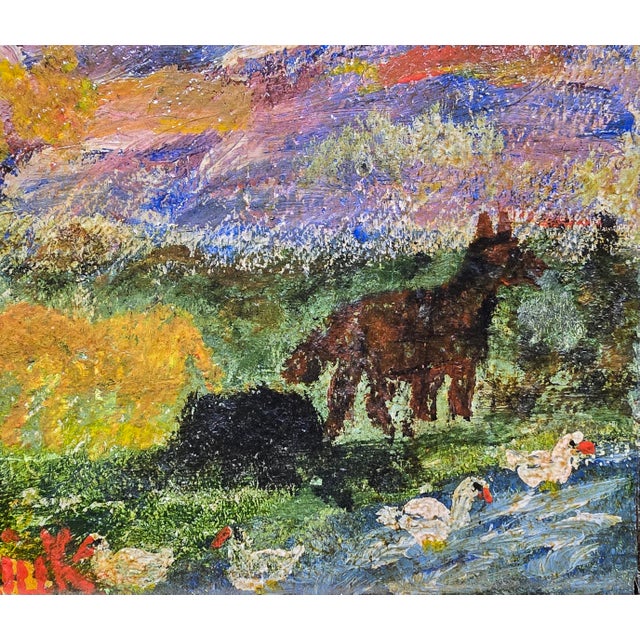
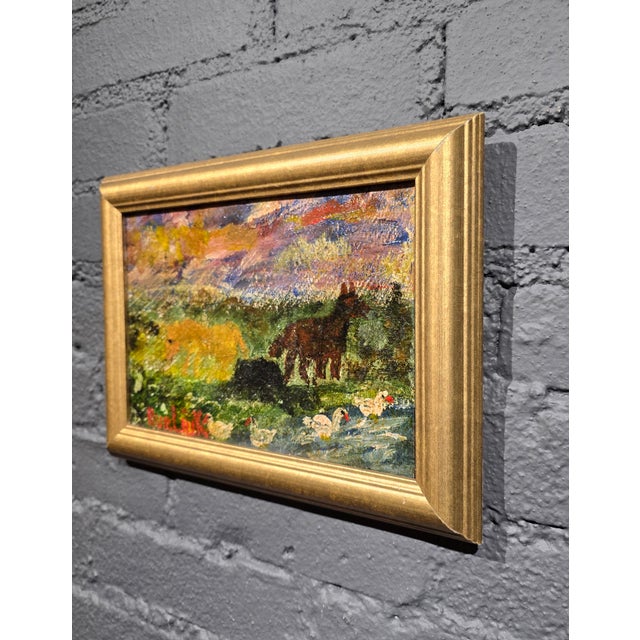
This vibrant and richly textured pastoral landscape, bearing the distinctive red signature BURLIUK at the lower left, exemplifies the expressive color, vigorous brushwork, and deliberately simplified forms associated with the artistic vocabulary of David Burliuk, the celebrated Ukrainian-born painter and pioneering figure of Russian Futurism.Executed in oil on panel, the composition transforms a seemingly tranquil rural scene into a dynamic interplay of color, texture, and movement. Thickly applied passages of impasto lend the surface an almost sculptural character, while the artist's spontaneous, energetic handling of paint conveys an immediate and deeply personal interpretation of the natural world.The painting combines elements of Expressionism, Post-Impressionism, and Neo-Primitivism, reflecting an artistic sensibility in which emotional intensity and the expressive possibilities of color take precedence over conventional realism.Despite its intimate cabinet scale, the composition possesses a remarkable visual presence, inviting close examination of its richly layered surface and intricate interplay of animals, landscape, and atmosphere.
Composition & Subject Matter
The painting depicts an idyllic yet animated pastoral landscape at twilight, populated by a variety of animals beneath a brilliantly colored evening sky.
Foreground
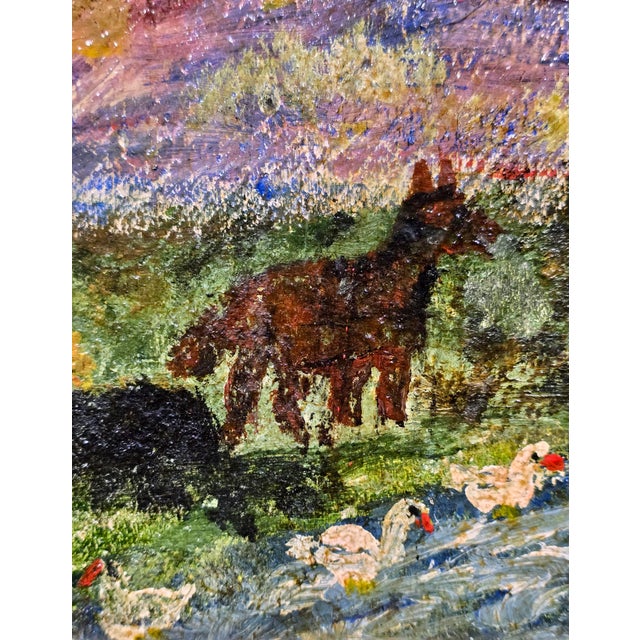
Along the lower right portion of the composition, several small white waterfowl, resembling ducks or geese, move through a narrow stream or shallow body of water. Their forms emerge from an energetic arrangement of blue, white, gray, and green brushstrokes, suggesting rippling water and movement.The birds are rendered with charming simplicity, their abbreviated silhouettes contributing to the painting's distinctly folk-inspired character.At the lower left, the bold red BURLIUK signature becomes an integral part of the composition. Its vibrant coloration contrasts sharply with the surrounding greens and yellows, functioning almost as an additional expressive element within the landscape.
Middle Ground
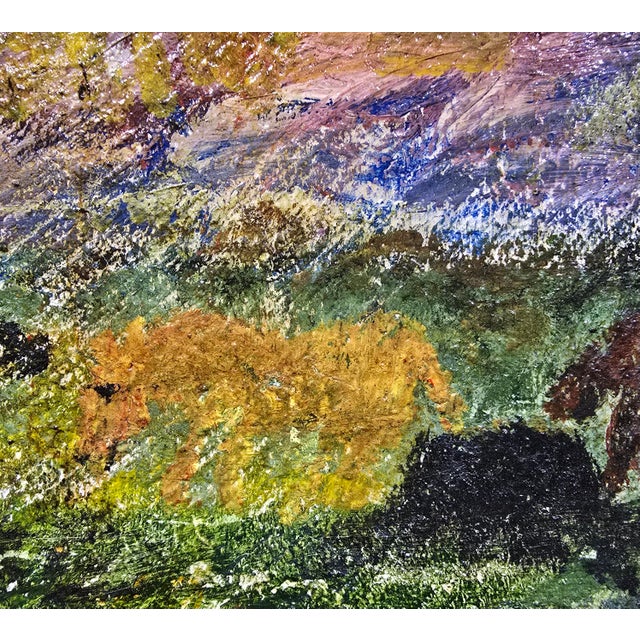
The central portion of the painting is dominated by a lush expanse of yellow-green pasture, punctuated by several loosely defined animal figures.On the right stands a prominent reddish-brown quadruped, possibly a horse, depicted in profile with an elongated head and simplified anatomical features. Its dark silhouette contrasts with the surrounding vegetation, establishing one of the composition's principal focal points.Near the center, a dense black animal-like form provides a powerful visual counterweight, while a smaller pale yellow figure, suggestive of a sheep or another grazing animal, appears partially absorbed into the brightly colored meadow.Rather than emphasizing zoological precision, these figures are interpreted through expressive silhouettes and broad, economical applications of paint. Their almost childlike simplicity contributes to the work's whimsical and imaginative atmosphere.
Background & Sky
Beyond the animals, the landscape rises into a series of undulating hills and richly colored fields.The upper portion of the painting is occupied by an extraordinary twilight sky, where overlapping passages of violet, lavender, deep blue, rose, orange, and crimson create a dramatic atmospheric effect.The sky appears almost to dissolve into the landscape below, with energetic strokes of color blurring the traditional distinction between earth and atmosphere.This interplay of saturated color and expressive movement gives the composition a heightened emotional quality, transforming an ordinary rural setting into a poetic and imaginative vision of nature.
Color, Technique & Artistic Style
One of the painting's most compelling characteristics is its remarkably tactile surface.The artist employs thick, vigorous applications of oil paint, building up passages of impasto that catch and reflect light across the composition. Short, broken strokes and areas of densely worked pigment create a lively surface that rewards close inspection.The palette is equally striking. Brilliant yellows and greens are juxtaposed against deep blacks, earthy browns, and the luminous pinks and violets of the evening sky.Rather than blending these colors into conventional tonal transitions, the artist frequently allows individual strokes and contrasting pigments to remain visible, emphasizing the physical presence of the paint itself.The composition also reveals a strong affinity with Neo-Primitivism, an artistic approach that embraced simplified forms, folk-art traditions, and an intentional departure from academic conventions.In this respect, the painting recalls the broader visual language of Burliuk's work, particularly his interest in rural subjects, expressive color, and the transformation of everyday scenes into emotionally charged compositions.The deliberately flattened spatial relationships and simplified animal forms lend the landscape a sense of immediacy and spontaneity, while the vigorous impasto introduces an additional dimension of physical energy.The result is a charming yet visually sophisticated pastoral scene that balances innocence and spontaneity with a highly expressive painterly technique.
Artist Biography: David Davidovich Burliuk (1882–1967)
David Davidovich Burliuk, widely celebrated as the "Father of Russian Futurism," was among the most influential and unconventional figures of the early twentieth-century avant-garde.A painter, poet, writer, publisher, and tireless promoter of experimental art, Burliuk played a central role in introducing radical modernist ideas to Eastern Europe and later became an important presence in the American artistic landscape.Born in 1882 in the Kharkiv Governorate of the Russian Empire, in present-day Ukraine, Burliuk grew up in an intellectually and artistically stimulating environment. His family encouraged creative pursuits, and his siblings Vladimir and Lyudmila also became artists.
Early Life and Artistic Education
Burliuk received an extensive artistic education, studying at art schools in Kazan and Odessa before continuing his training in Munich and Paris.His exposure to European modernism introduced him to the revolutionary developments of Impressionism, Post-Impressionism, Fauvism, and Cubism.Particularly influential were the expressive color theories of the Post-Impressionists and the structural experimentation of the emerging avant-garde.These influences would become essential components of Burliuk's artistic vocabulary, although he consistently transformed them into a highly individual and often deliberately unconventional style.Having lost the sight of one eye during childhood, Burliuk became recognizable for his glass eye and flamboyant appearance, which contributed to his reputation as one of the most colorful personalities of the modernist movement.
Russian Futurism and the Avant-Garde
During the years preceding the First World War, Burliuk emerged as a leading organizer and advocate of experimental art in Russia.He participated in the Jack of Diamonds exhibitions, which brought together artists interested in challenging academic traditions through the influence of French modernism, Russian folk imagery, and innovative approaches to form and color.Burliuk was also closely associated with Hylaea, the literary and artistic circle that became instrumental in the development of Russian Futurism.In 1912, he joined Vladimir Mayakovsky, Velimir Khlebnikov, and Aleksei Kruchenykh in signing the provocative Futurist manifesto A Slap in the Face of Public Taste.The manifesto rejected established artistic conventions and called for a radical transformation of literature and culture.Burliuk became one of the movement's most energetic public advocates, organizing exhibitions, lectures, and performances that challenged traditional expectations of art and artistic behavior.His work during this period explored Cubo-Futurism, Neo-Primitivism, and other experimental approaches, frequently combining bold color, fragmented forms, and the visual directness of folk traditions.
Japan and the Journey to America
Following the upheavals of the Russian Revolution and Civil War, Burliuk traveled eastward through Siberia and the Russian Far East before spending an important period in Japan between 1920 and 1922.During his time in Japan, he exhibited extensively, engaged with the local artistic community, and produced numerous paintings reflecting his encounters with Japanese landscapes and culture.In 1922, Burliuk immigrated to the United States, where he would spend the remainder of his life.Settling initially in New York City and later establishing a home on Long Island, he continued to paint, write, exhibit, and promote modern art.
American Period and Artistic Evolution
During his American years, Burliuk developed an increasingly personal artistic language that frequently combined the experimental spirit of his early avant-garde career with a renewed interest in recognizable subjects.Landscapes, rural scenes, portraits, flowers, and animals became recurring themes in his work.His paintings often employed brilliant, unconventional colors, simplified forms, and heavily textured surfaces, retaining the vitality of his earlier modernist experimentation while embracing a more lyrical and sometimes whimsical approach to representation.Burliuk's landscapes are particularly notable for their expressive treatment of nature. Rather than reproducing the visible world with strict naturalism, he frequently transformed familiar scenery through exaggerated color relationships, rhythmic brushwork, and imaginative simplification.His interest in rural subjects also reflected a lifelong connection to the landscapes and folk traditions of his early years.Together with his wife, Marussia, Burliuk published Color and Rhyme, a periodical devoted to art, literature, and the promotion of his creative activities.Throughout his American career, he remained remarkably prolific, continuing to exhibit and develop his artistic practice well into his later years.
Legacy
David Burliuk died in 1967 on Long Island, New York, leaving behind an extraordinarily diverse body of work encompassing painting, drawing, poetry, publishing, and artistic criticism.Today, he is recognized as a foundational figure of Russian Futurism and an important contributor to the international development of modern art.His artistic legacy bridges the experimental movements of early twentieth-century Europe with the evolving cultural landscape of the United States.Burliuk's paintings are represented in major museum collections, including the Museum of Modern Art in New York, the State Russian Museum in St. Petersburg, and the National Art Museum of Ukraine in Kyiv.His enduring appeal lies in his ability to combine the intellectual experimentation of the avant-garde with an unmistakably personal, exuberant, and emotionally direct approach to painting.
See less
- Dimensions
- 12ʺW × 1ʺD × 9ʺH
- Styles
- American
- Expressionism
- Frame Type
- Framed
- Period
- Mid 20th Century
- Country of Origin
- United States
- Item Type
- Vintage, Antique or Pre-owned
- Materials
- Oil Paint
- Wood
- Condition
- Good Condition, Original Condition Unaltered, Some Imperfections
- Color
- Sky Blue
- Condition Notes
- Excellent - Minor wear consistent with age and history Excellent - Minor wear consistent with age and history less
Questions about the item?
Returns & Cancellations
Return Policy - All sales are final 48 hours after delivery, unless otherwise specified in the description of the product.
Cancellation Policy - Prior to shipping or local pickup, buyers may cancel an order for up to 48 hours, unless otherwise specified.
Related Collections
- Photorealism Canvas Paintings
- Ed Ruscha Paintings
- Richard Serra Paintings
- Photorealism Paintings in New York
- Louise Nevelson Paintings
- Karen Offutt Paintings
- Jo Baskerville Paintings
- Nicola Simbari Paintings
- Herman Miller Paintings
- BDDW Paintings
- James McCray Paintings
- Leroy Neiman Paintings
- Jaanika Peerna Paintings
- Vienna Secession Paintings
- Johannes Andersen Paintings
- Pedro Friedeberg Paintings
- Peter Behrens Paintings
- Piet Hein Eek Paintings
- Raphael Paintings
- Jeff Slemmons Paintings
- Photorealism Paintings in Los Angeles
- Milton Avery Paintings
- Karl-Erik Ekselius Paintings
- Hans Andersen Paintings
- Jean-Paul Barray Paintings