




Details
Description
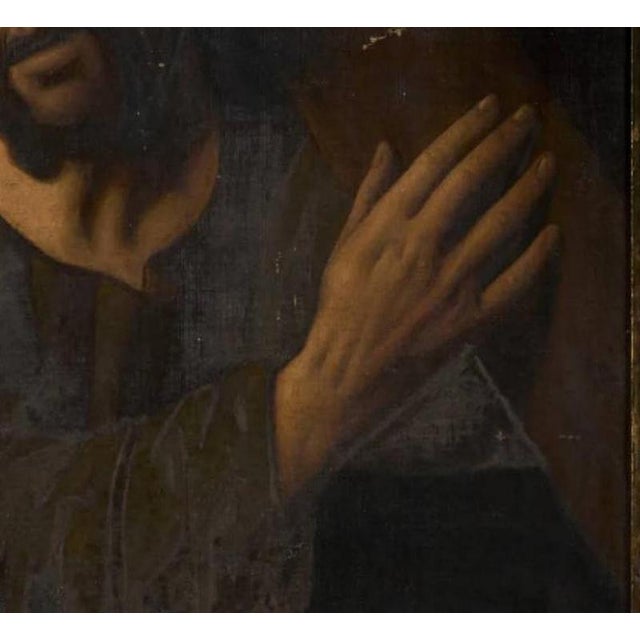
Spanish School, 17th century; circle of Juan Ribalta (1596–1628): *Christ Carrying the Cross* Oil on canvas 76 x 62 cm … Read more Spanish School, 17th century; circle of Juan Ribalta (1596–1628): *Christ Carrying the Cross* Oil on canvas 76 x 62 cm little damage on canvas (Madrid, 1596/1597 – Valencia, 1628). Spanish painter. The son of the better-known Francisco Ribalta, Juan demonstrated a highly distinctive artistic personality; having begun his training in his father's workshop, he appeared poised to become one of the most notable Spanish artists of the 17th century. However, his early death cut short a promising career. Working consistently in his father's studio, he signed his first work in 1615, proudly noting his age—eighteen—at the time. That work, *The Preparations for the Crucifixion*, demonstrates his remarkable precocity in handling a composition of such complexity, as well as his sure command of the Mannerist models his father had assimilated, infused with certain naturalistic touches. Palomino noted the extent to which the young Juan had absorbed his father's artistic style, observing that their works were difficult to distinguish except by their brushwork: "the father's manner was more defined, whereas the son's was somewhat looser and more vigorous." The arrival of Pedro de Orrente in Valencia in 1616 is considered a key influence that led Juan to adopt various elements from the Murcian painter—most notably a taste for anecdotal and everyday details directly derived from the Bassano workshop. These influences lent a gentler tone to his works in the years that followed. The year 1618 appears to have been significant for Juan Ribalta; his marriage placed him in a more comfortable financial position, while he also seems to have become increasingly involved in managing his father's workshop. That same year also saw the clearest evidence of his literary leanings, as he participated in the poetry contest held in Valencia during the festivities marking the canonization of Thomas of Villanova. from 1624 onwards, a shift toward a more restrained style is evident—likely influenced by the increasingly naturalistic tone Francisco was adopting in his own painting during those years. A prime example of this more rigorous approach from his final period is the monumental *Saint John the Evangelist* in the Prado, where the naturalistic treatment reinforces the figure's imposing presence. Juan Ribalta died in Valencia in October 1628—likely a victim of typhus—just nine months after his father. Three works by the artist are held by the Prado: two canvases depicting Evangelists come from the royal collections (possibly acquired by Charles IV during a trip to Valencia in late 1802), while the *Saint John the Evangelist* was acquired in 1961 and has no known prior provenance. See less
Returns & Cancellations
Return Policy - All sales are final 48 hours after delivery, unless otherwise specified in the description of the product.
Cancellation Policy - Prior to shipping or local pickup, buyers may cancel an order for up to 48 hours, unless otherwise specified.
Related Collections
- Photorealism Canvas Paintings
- Ed Ruscha Paintings
- Photorealism Paintings in New York
- Richard Serra Paintings
- Herman Miller Paintings
- Jo Baskerville Paintings
- Louise Nevelson Paintings
- Karen Offutt Paintings
- Nicola Simbari Paintings
- BDDW Paintings
- James McCray Paintings
- Jaanika Peerna Paintings
- Leroy Neiman Paintings
- Black Photorealism Paintings
- Jeff Slemmons Paintings
- Gold-filled Paintings
- Milton Avery Paintings
- Soicher Marin Paintings
- Vienna Secession Paintings
- Johannes Andersen Paintings
- Pedro Friedeberg Paintings
- Peter Behrens Paintings
- Piet Hein Eek Paintings
- Raphael Paintings
- Photorealism Paintings in Los Angeles