

Details
Description
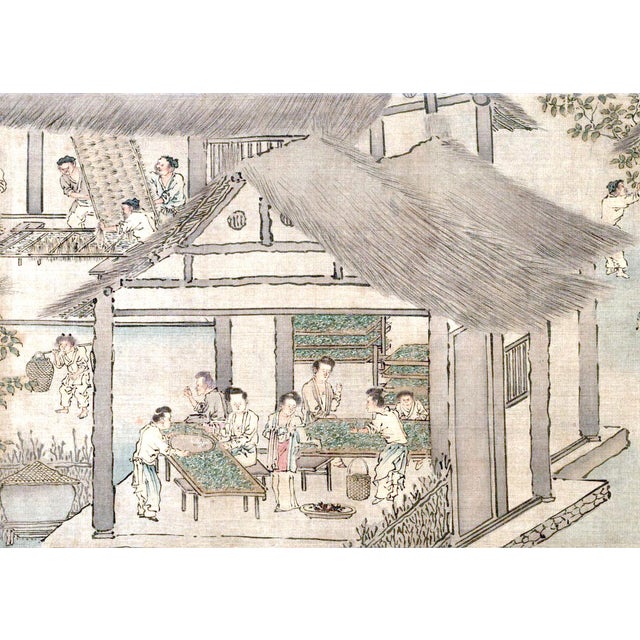
Fine China Trade Watercolor on Paper: Silk Processing—Feeding of Silkworms
Circa 1780–1820
This remarkably fine China Trade painting in watercolor …
Read more
Fine China Trade Watercolor on Paper: Silk Processing—Feeding of Silkworms
Circa 1780–1820
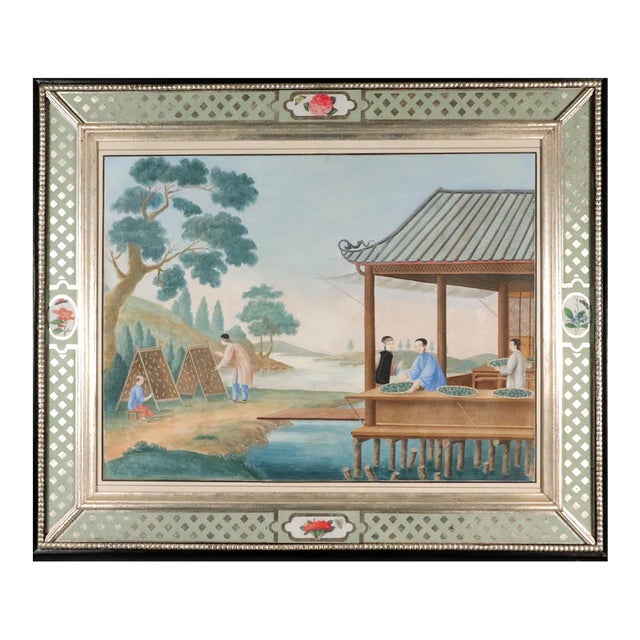
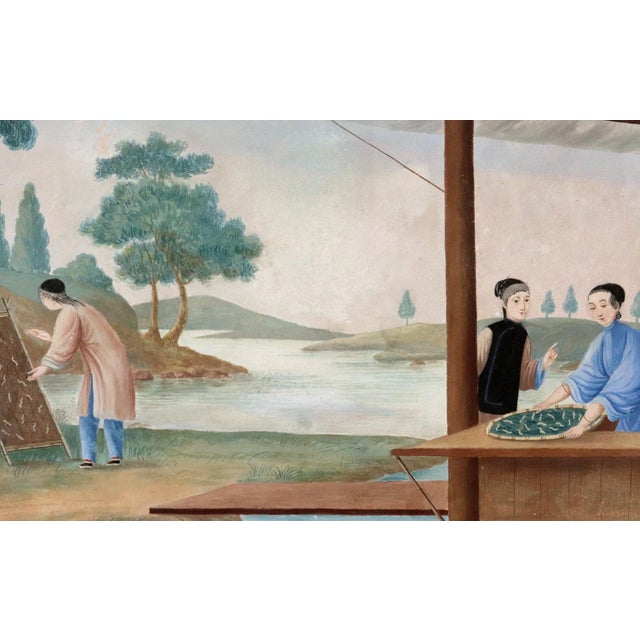
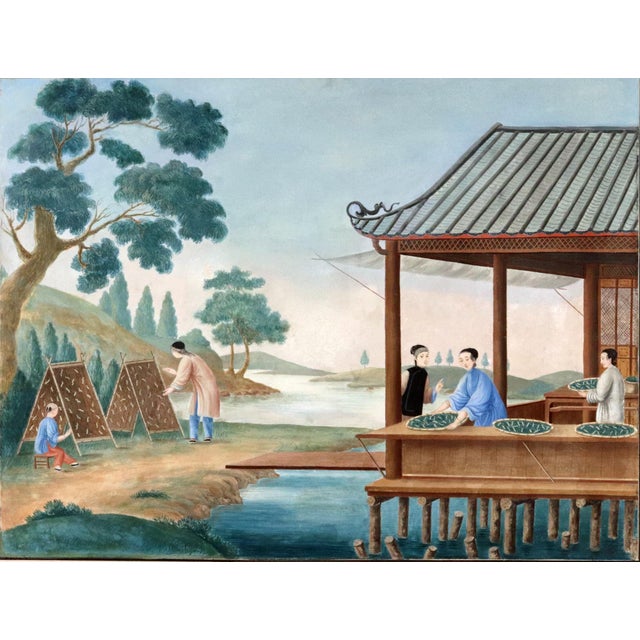
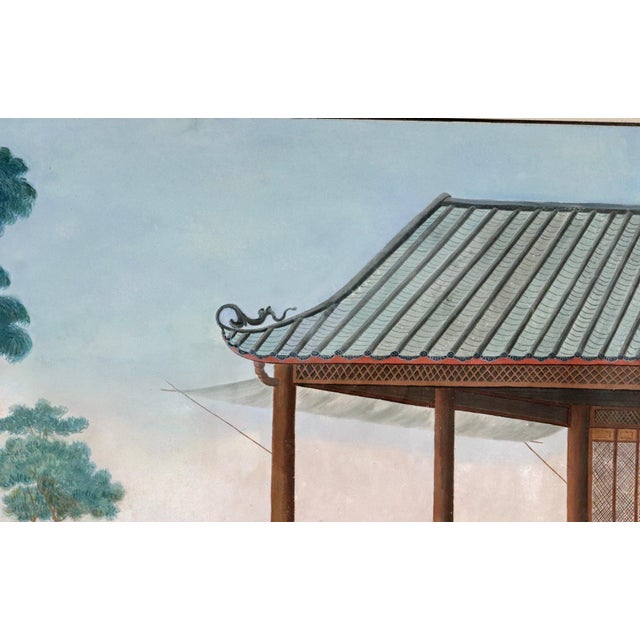
This remarkably fine China Trade painting in watercolor and gouache on paper depicts an idealized view of the early stages of silk production, a subject of great interest to the Western merchants engaged in the trade at Canton. The scene is set in a serene river landscape, with wooded hills and a broad stretch of water receding to distant islands, and the foreground is given over to two stages in the raising of silkworms.
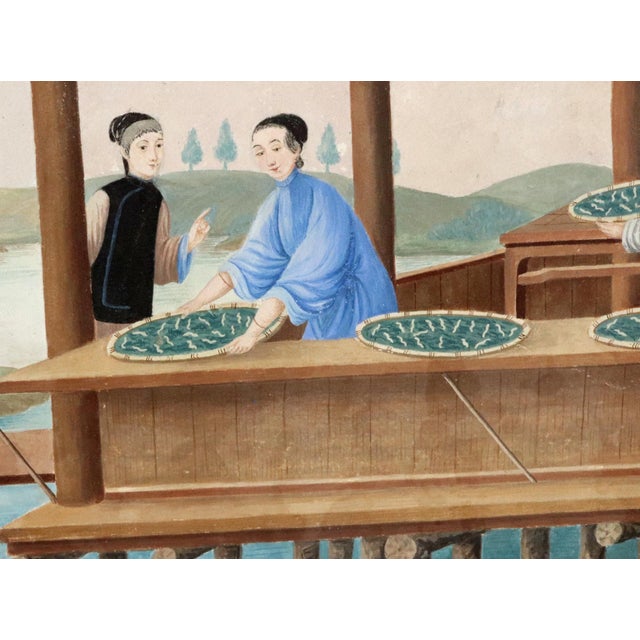
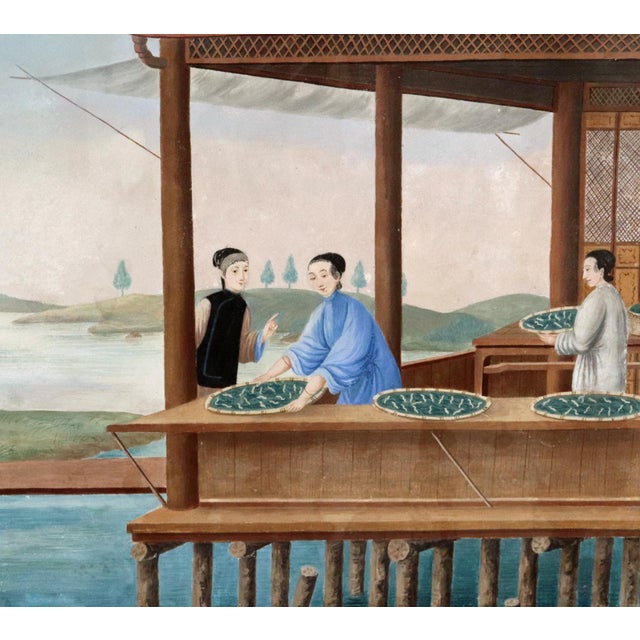
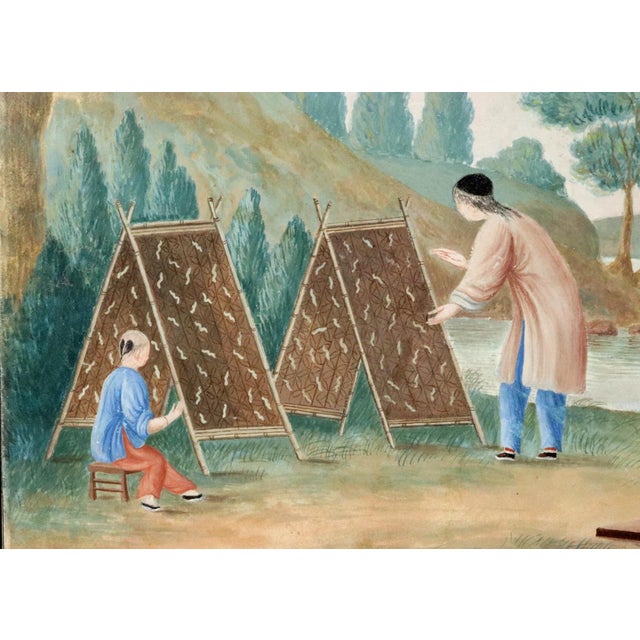
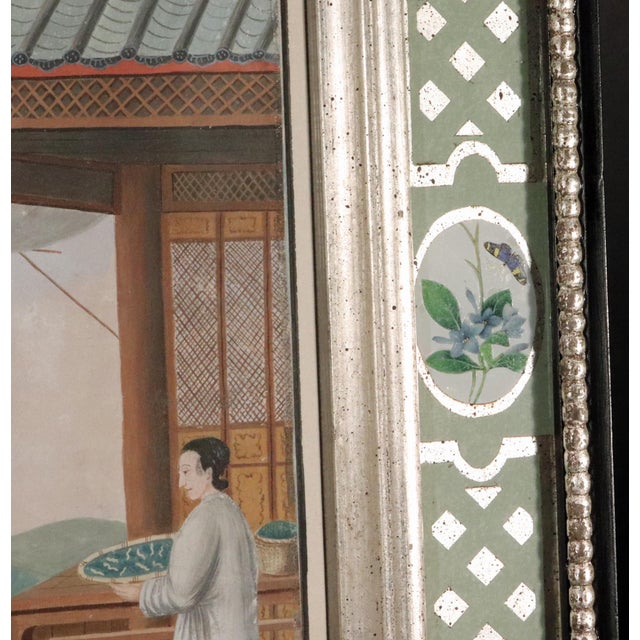
On the right, a pavilion raised on timber piles over the water, its tiled roof finished with an iron-red eave band, a lattice frieze and a curling ornament at the upturned corner, shelters three figures tending shallow round woven trays in which the worms feed on beds of mulberry leaves. A woman in blue arranges one tray on the long counter while a companion in a black sleeveless jacket gestures toward her, and a third figure carries another tray from the lattice-screened interior, where a basket of fresh leaves stands ready; a cloth awning stretched on poles shades the open front. On the left, on the bank beneath a great spreading tree, a man in a pale pink robe and a seated child in blue attend two A-frame stands of brushwood on which the fully grown worms have been set to climb and spin their cocoons. The architecture, the costume and the textures of foliage, timber and water are all meticulously rendered.
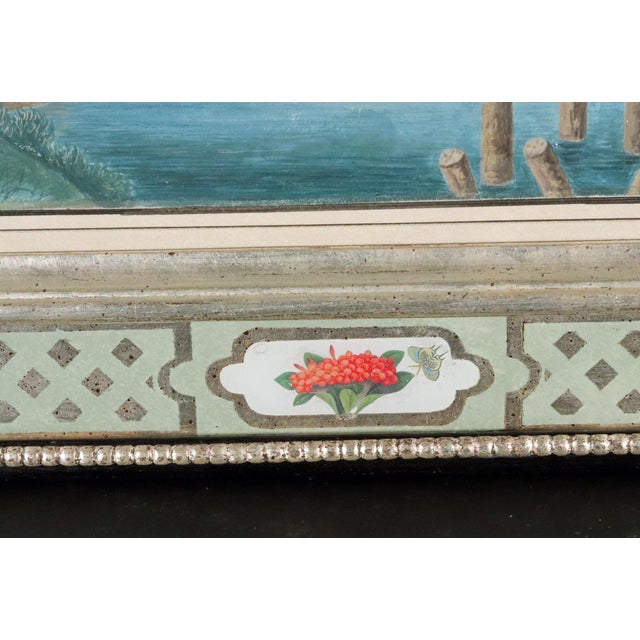
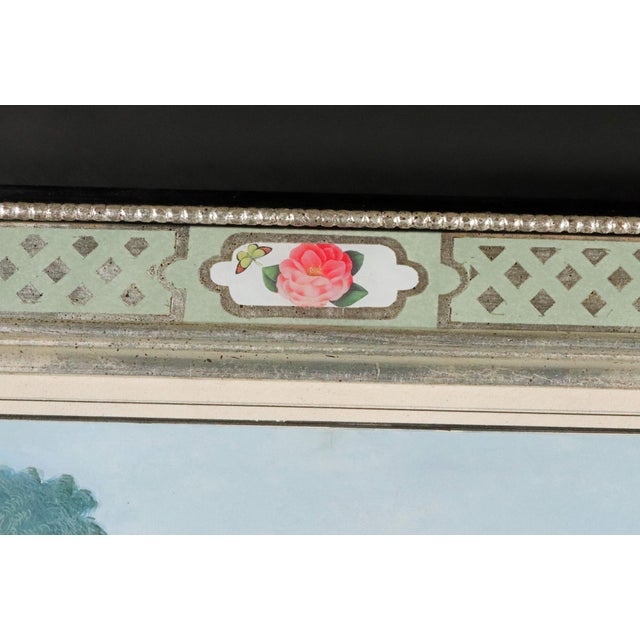
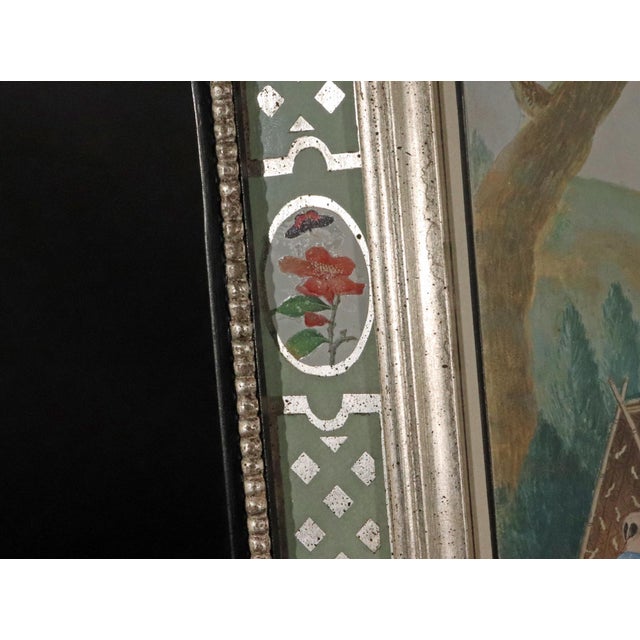
The painting is presented in a fine 20th-century silvered découpage frame with a verre églomisé border of silver diamond trelliswork on a pale celadon-green ground, interrupted at the center of each side by a reserve inset with découpage flowers and butterflies, and finished with a beaded outer molding—a sophisticated presentation in keeping with the quality of the painting.
Its soft celadon, blue and silver palette suits a dining room, library or drawing room, where it can be hung singly as a focal point above a sideboard or chimneypiece, and it sits naturally alongside Chinese export porcelain and English furniture.
Dimensions
Framed Height: 21¼ inches (54.0 cm)
Framed Width: 25¼ inches (64.1 cm)
Framed Depth: 1¼ inches (3.2 cm)
Provenance
Earle D. Vandekar of Knightsbridge
Condition
Excellent, with colors remaining bright and vibrant.
References
Carl L. Crossman, The Decorative Arts of the China Trade: Paintings, Furnishings and Exotic Curiosities (Woodbridge: Antique Collectors’ Club, 1991), p. 179, color plate 61 (a silk shop interior), and p. 180 (on the idealized setting of the large silk-industry paintings).
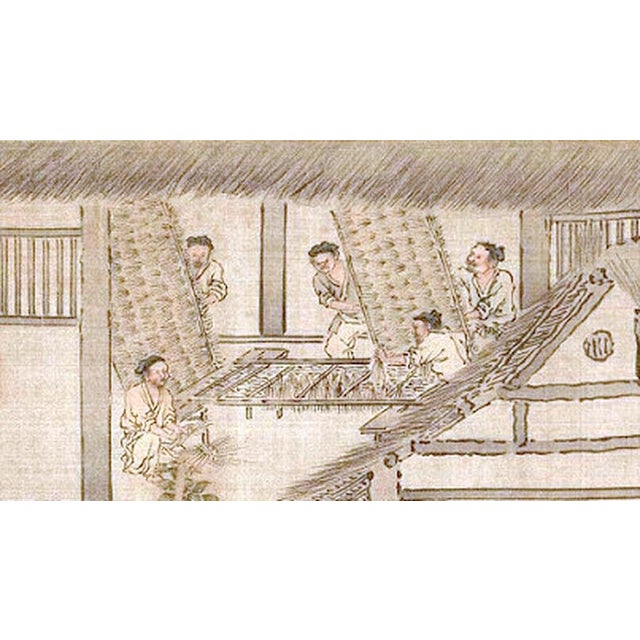
Attributed to Liang Kai, Sericulture (The Process of Making Silk), handscroll, ink and color on silk, early 13th century, The Cleveland Museum of Art, John L. Severance Collection, 1977.5 (for the ancient precedent).
Columbia University, Asia for Educators, “The Song Economic Revolution: Textiles and Silk” (reproducing details of the Cleveland scroll).
Historical Context
Silk, with tea and porcelain, was one of the three great commodities of the China Trade, and Western merchants confined to the foreign factories at Canton (Guangzhou) were fascinated by the processes behind it. The Canton studios answered with sets of paintings showing each stage, from the feeding of the worms to the reeling and weaving of the thread. As Carl L. Crossman observes, the large silk-industry pictures place the work within an idealized landscape, showing the “pavilions and gardens of the residence of a wealthy Chinese” rather than the actual place of manufacture (p. 180), a vision that answered the Western romance of a tranquil and prosperous China.
The subject has a long ancestry in Chinese painting. In the Southern Song dynasty the official Lou Shou (1090–1162) set out the stages of rice and silk production in his Pictures of Tilling and Weaving (Gengzhi tu), and Liang Kai, painter-in-attendance at the Hangzhou academy around 1201–1204, is credited with the sericulture handscroll now in Cleveland, where, as here, the worms are laid on trays of mulberry leaves beneath an open-sided building. The Kangxi emperor’s edition of 1696, designed by Jiao Bingzhen with the aid of Western perspective, gave the cycle its canonical Qing form. The Canton export painters adapted this narrative tradition to Western taste, working on imported European paper in the years before pith became the favored support, and the result is a true hybrid of Chinese subject and Western pictorial manner.
(Ref: NY10587-VM)
See less
- Dimensions
- 25.25ʺW × 1.25ʺD × 21.25ʺH
- Styles
- Chinese
- Traditional
- Frame Type
- Framed
- Art Subjects
- Landscape
- Architecture
- Period
- Early 19th Century
- Country of Origin
- China
- Item Type
- Vintage, Antique or Pre-owned
- Materials
- Watercolor
- Condition
- Good Condition, Original Condition Unaltered, Some Imperfections
- Color
- Blue
- Condition Notes
- Good condition with good color Good condition with good color less
Questions about the item?
Returns & Cancellations
Return Policy - All sales are final 48 hours after delivery, unless otherwise specified in the description of the product.
Cancellation Policy - Prior to shipping or local pickup, buyers may cancel an order for up to 48 hours, unless otherwise specified.
Related Collections
- Photorealism Canvas Paintings
- Ed Ruscha Paintings
- Richard Serra Paintings
- Photorealism Paintings in New York
- Herman Miller Paintings
- Louise Nevelson Paintings
- Karen Offutt Paintings
- Jo Baskerville Paintings
- Nicola Simbari Paintings
- BDDW Paintings
- James McCray Paintings
- Leroy Neiman Paintings
- Jaanika Peerna Paintings
- Vienna Secession Paintings
- Black Photorealism Paintings
- Johannes Andersen Paintings
- Pedro Friedeberg Paintings
- Peter Behrens Paintings
- Piet Hein Eek Paintings
- Raphael Paintings
- Jeff Slemmons Paintings
- Gold-filled Paintings
- Photorealism Paintings in Los Angeles
- Milton Avery Paintings
- Soicher Marin Paintings