

Details
Description
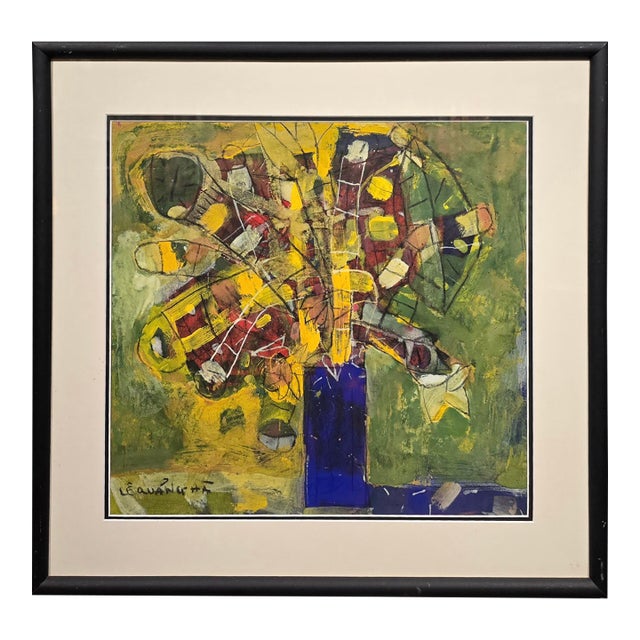
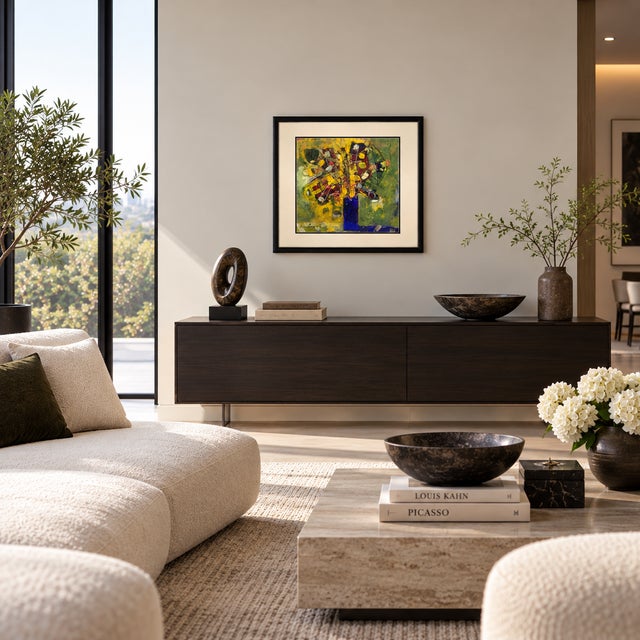
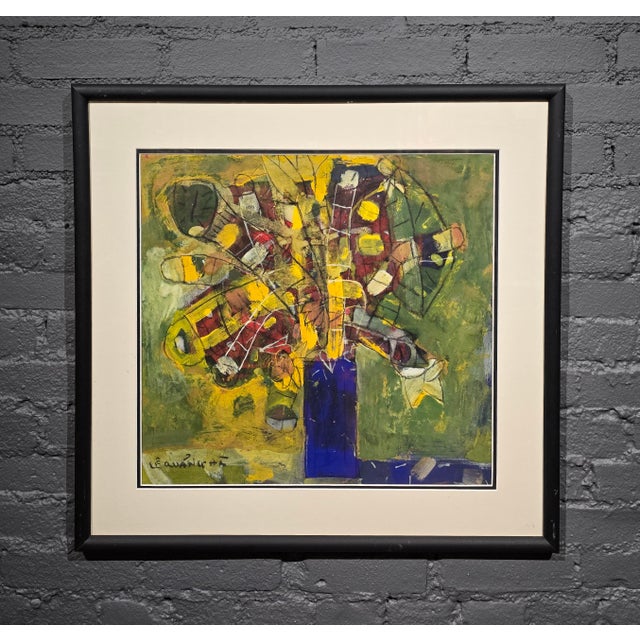
Lê Quảng Hà (Vietnamese) Abstract Floral Still Life w/ Phallic Symbolism–Oil Painting
Vietnamese Expressionist - Oil Painting on Paper - …
Read more
Lê Quảng Hà (Vietnamese) Abstract Floral Still Life w/ Phallic Symbolism–Oil Painting
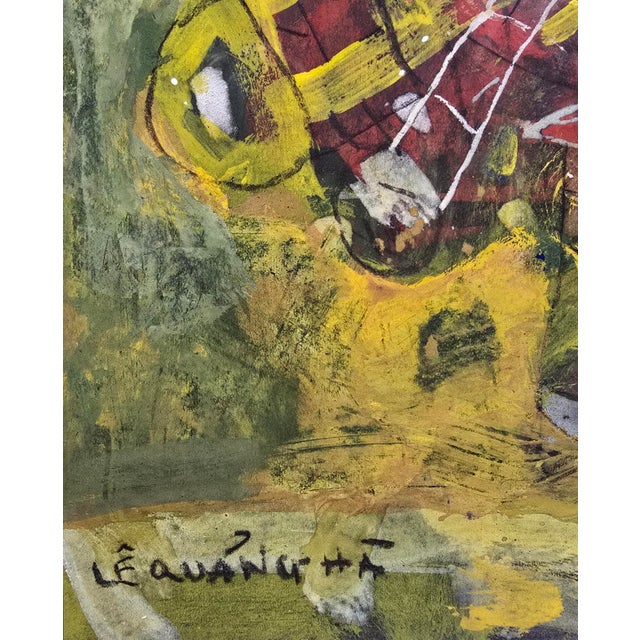
Vietnamese Expressionist - Oil Painting on Paper - Signed - Circa late 1990s
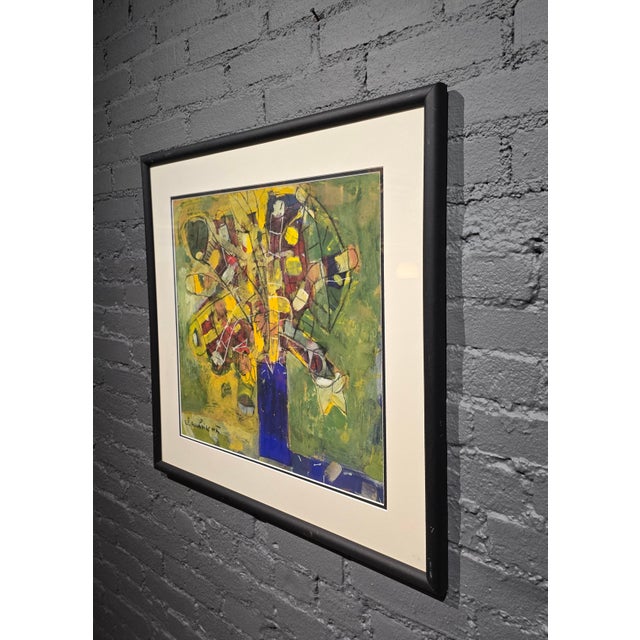
Image Dimensions: 19 × 20 inches (48.3 × 50.8 cm) Framed Dimensions: 27 × 28 inches (68.6 × 71.1 cm)
Artwork Description
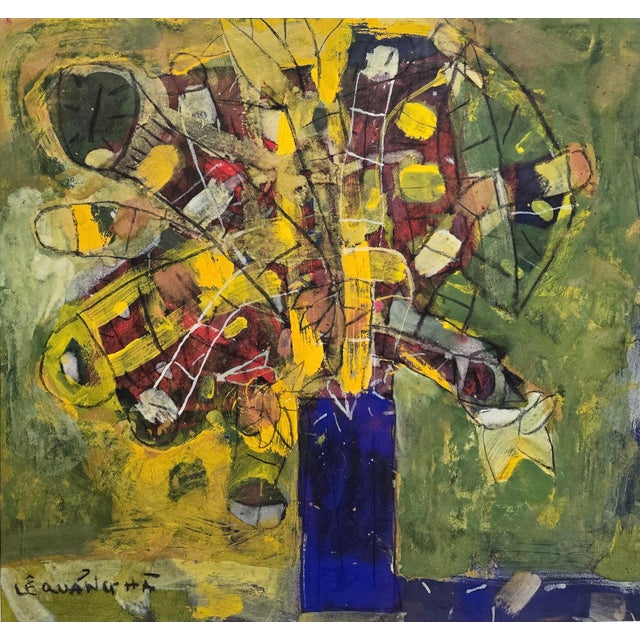
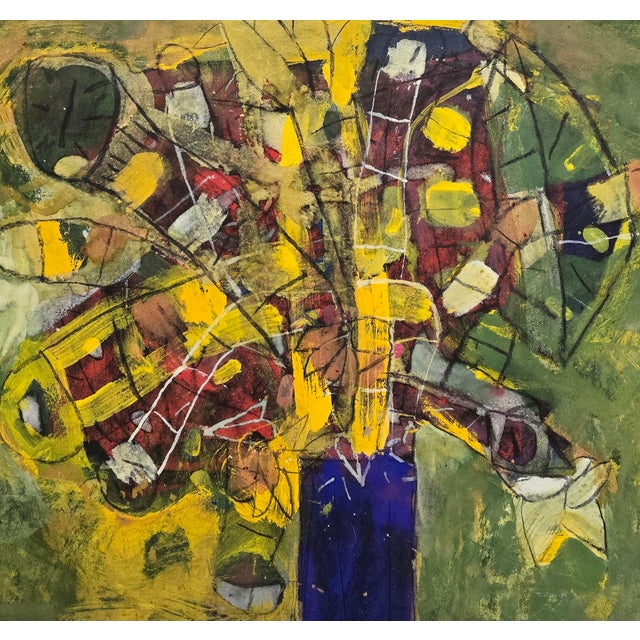
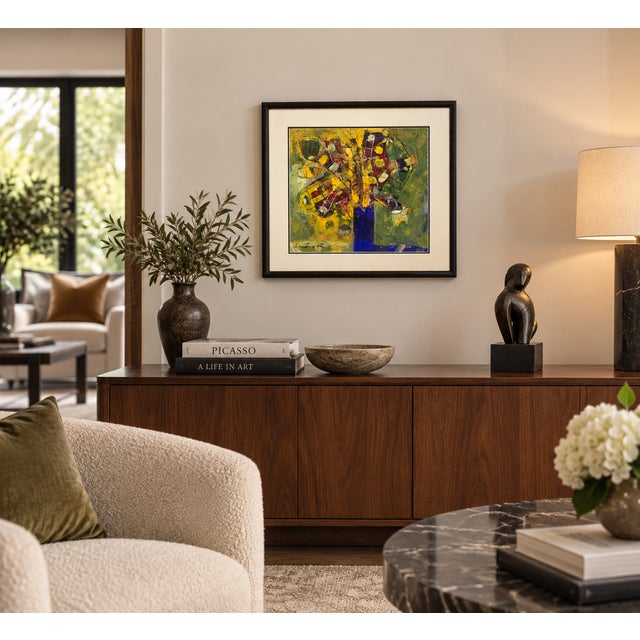
An exceptional and visually compelling abstract Expressionist still life attributed to the celebrated contemporary Vietnamese artist Lê Quảng Hà (b. 1963). This richly layered composition transforms the traditional subject of flowers arranged in a vase into an energetic and psychologically suggestive exploration of form, color, and human symbolism.At the center of the composition stands a commanding, rectangular vase rendered in deep cobalt blue, providing a strong architectural anchor for an exuberant arrangement of abstracted botanical forms. Surrounding this central element is a dense network of intersecting lines, fragmented shapes, and vigorously applied pigments in brilliant canary yellow, crimson red, burgundy, olive green, and earthy ochre.The artist's expressive handling of paint creates an animated interplay between structured geometric forms and spontaneous gestural marks. Bold black contours define and disrupt the composition, while fine white linear accents weave throughout the surface, creating an intricate visual rhythm. The richly worked surface, with its overlapping passages of color and contrasting textures, lends the painting a remarkable sense of movement and vitality.
Symbolism and Psychological Interpretation
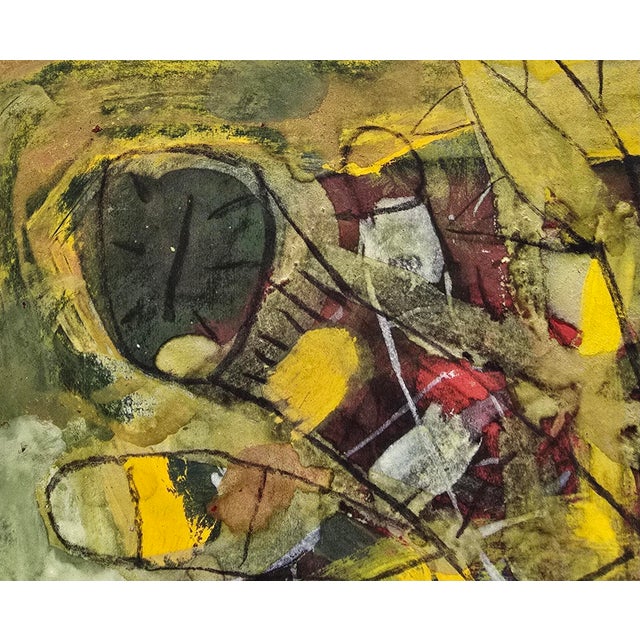
Beyond its immediate appearance as an exuberant abstract floral still life, the composition reveals a provocative undercurrent of figurative and sexual symbolism.A small, enigmatic, mask-like human face emerges from the upper-left portion of the painting, partially concealed within the surrounding abstract forms. Its simplified features introduce an unexpected human presence into the composition, inviting questions about identity, observation, and the relationship between the human figure and the natural world.Throughout the arrangement, numerous elongated, rounded, and distinctly phallic-looking shapes protrude in different directions, their suggestive anatomical silhouettes appearing in place of conventional flower blossoms and buds. Rendered in vivid yellows, muted flesh tones, and contrasting dark outlines, these ambiguous forms blur the boundaries between botanical imagery and human anatomy.This intriguing fusion of floral and phallic imagery introduces a sensual and psychologically charged dimension to the composition. The repeated anatomical suggestions invite interpretations involving sexuality, fertility, desire, and human instinct, transforming the familiar domestic still life into something considerably more provocative.Such visual ambiguity resonates with Lê Quảng Hà's broader artistic exploration of human psychology, sexuality, and the tensions between outward appearances and underlying emotions.
Artistic Influences and Modernist Connections
The painting reveals compelling stylistic affinities with the Cubist and Surrealist vocabulary of Pablo Picasso, particularly in its fragmented forms, emphatic black contours, unconventional spatial relationships, and playful transformation of familiar objects into suggestive anatomical imagery.The small mask-like face embedded within the composition, together with the repeated phallic forms, recalls the broader modernist fascination with sexuality, metamorphosis, and the subconscious. These characteristics invite comparisons with Picasso's more experimental figurative compositions of the late 1920s through the 1940s, in which human anatomy and recognizable objects frequently merge into unexpected, psychologically suggestive forms.The painting also recalls the biomorphic abstraction of Joan Miró and André Masson, whose Surrealist compositions often blurred distinctions between organic life, human anatomy, and imagined forms.A further art-historical parallel may be found in Georgia O'Keeffe's celebrated floral imagery, particularly her Jack-in-the-Pulpit series, whose botanical forms have historically attracted interpretations involving sexual anatomy.These comparisons illuminate the painting's relationship to broader 20th-century modernist traditions without necessarily implying direct artistic influence.While sharing certain visual characteristics with European Cubism and Surrealism, Lê Quảng Hà's expressive language remains distinctly personal. His vigorous brushwork, emotionally charged palette, and layered surface textures introduce an immediacy and intensity that distinguish the composition from the more formally structured approaches of earlier modernist painters.
Artist Biography: Lê Quảng Hà (Vietnamese, b. 1963)
Born in Hanoi in 1963, Lê Quảng Hà is an important figure in contemporary Vietnamese art, internationally recognized for his bold Expressionist style, provocative imagery, and distinctive exploration of modern Vietnamese society.After graduating from the Hanoi Industrial College of Fine Arts in 1992, Hà emerged as a significant artistic voice during Vietnam's post-Đổi Mới period of economic and cultural transformation.Departing from the romanticized rural imagery favored by many of his contemporaries, he developed a highly individual visual language characterized by expressive brushwork, vivid color, distorted figures, and psychologically charged compositions.Working across oil painting, traditional Vietnamese lacquer, sculpture, and mixed media, Hà frequently explores the tensions between tradition and modernization, individual identity and social authority, and the complexities of human psychology.His artistic practice combines elements of Expressionism, abstraction, satire, and social commentary, reflecting an uncompromising approach to both artistic expression and contemporary life.His work has been exhibited internationally, including participation in the Singapore Biennale in 2019, and is represented in institutional collections including the Singapore Art Museum and Fukuoka Asian Art Museum in Japan.Today, Lê Quảng Hà is recognized as one of the distinctive voices of his generation, whose work has contributed to the growing international appreciation of contemporary Vietnamese art.
See less
- Dimensions
- 28ʺW × 1ʺD × 27ʺH
- Styles
- Expressionism
- Frame Type
- Framed
- Art Subjects
- Still Life
- Abstract
- Period
- 1990s
- Country of Origin
- Viet Nam
- Item Type
- Vintage, Antique or Pre-owned
- Materials
- Oil Paint
- Paper
- Condition
- Good Condition, Original Condition Unaltered, Some Imperfections
- Color
- Canary Yellow
- Condition Notes
- Excellent - Minor wear consistent with age and history Excellent - Minor wear consistent with age and history less
Questions about the item?
Returns & Cancellations
Return Policy - All sales are final 48 hours after delivery, unless otherwise specified in the description of the product.
Cancellation Policy - Prior to shipping or local pickup, buyers may cancel an order for up to 48 hours, unless otherwise specified.
Related Collections
- Photorealism Canvas Paintings
- Photorealism Paintings in New York
- Ed Ruscha Paintings
- Richard Serra Paintings
- Herman Miller Paintings
- Jo Baskerville Paintings
- Louise Nevelson Paintings
- Karen Offutt Paintings
- Nicola Simbari Paintings
- BDDW Paintings
- James McCray Paintings
- Jaanika Peerna Paintings
- Leroy Neiman Paintings
- Black Photorealism Paintings
- Jeff Slemmons Paintings
- Gold-filled Paintings
- Milton Avery Paintings
- Soicher Marin Paintings
- Vienna Secession Paintings
- Johannes Andersen Paintings
- Pedro Friedeberg Paintings
- Peter Behrens Paintings
- Piet Hein Eek Paintings
- Raphael Paintings
- Photorealism Paintings in Los Angeles