



Details
Description
Voldemar Boberman –Paris Montmartre & Sacré-Cœur–1930s French École de Paris Oil Painting
French Post Impressionist - Oil Painting on canvas …
Read more
Voldemar Boberman –Paris Montmartre & Sacré-Cœur–1930s French École de Paris Oil Painting
French Post Impressionist - Oil Painting on canvas - Signed
canvas 13x18" - Frame size 18x23x1.5"
Description
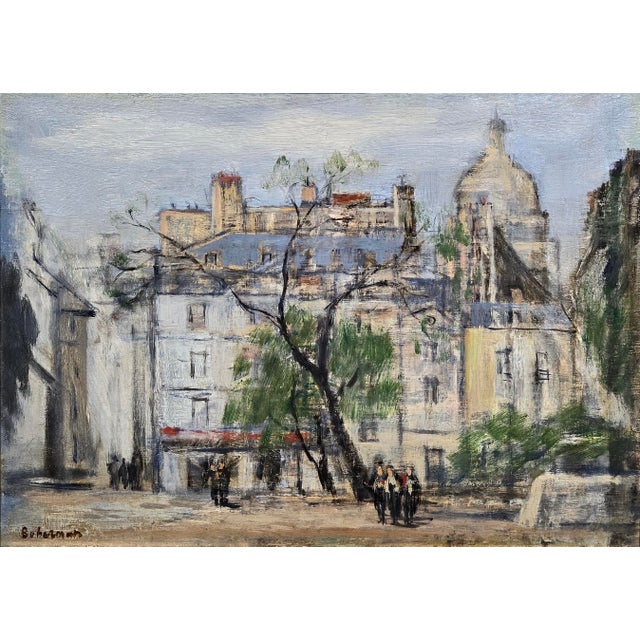
An evocative and beautifully atmospheric oil painting by Voldemar Boberman (1897–1987), the Russian-born French painter and decorative artist associated with the celebrated École de Paris. Depicting a picturesque Parisian street scene, apparently in the historic Montmartre district, the composition captures the romantic architectural character and everyday life of the French capital, with what appears to be the distinctive dome of the Basilica of Sacré-Cœur rising gracefully above the surrounding rooftops.Executed with expressive brushwork, sophisticated tonal harmonies, and a distinctly Post-Impressionist sensibility, this charming cityscape reflects the artistic spirit of Paris during the first half of the 20th century.
Composition and Artistic Details
Subject Matter and Spatial Depth
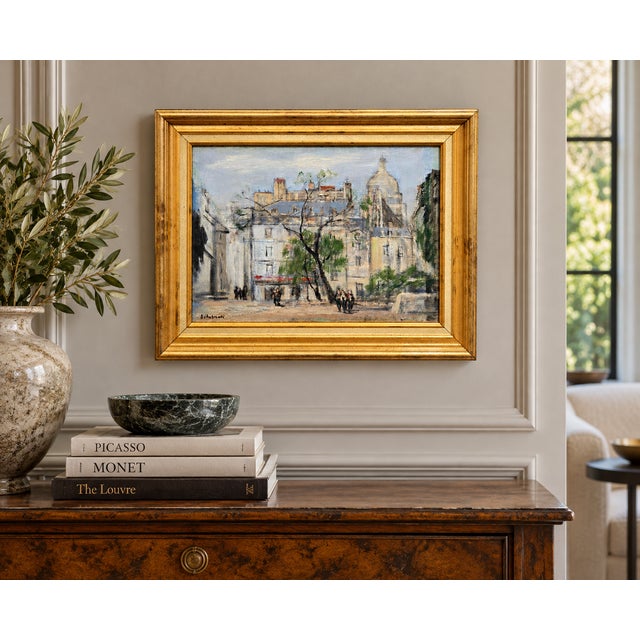
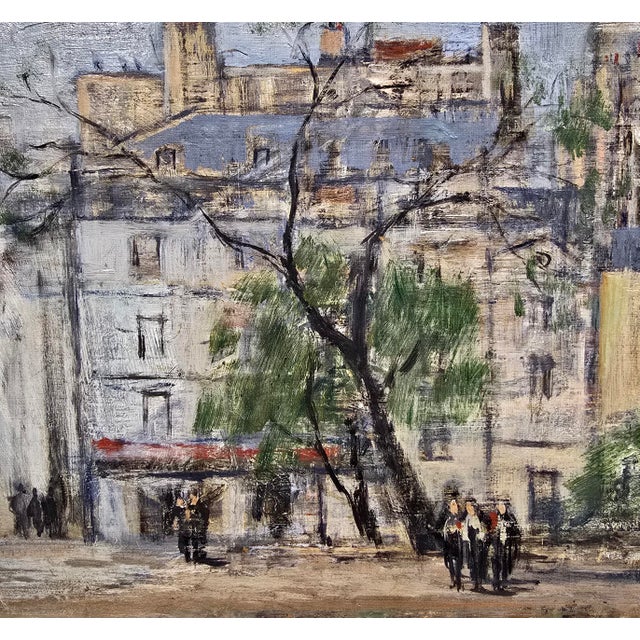
The composition unfolds across an intimate Parisian square, where small groups of pedestrians stroll beneath the silhouettes of mature trees, surrounded by the elegant architecture of old Paris.A prominent, gracefully leaning deciduous tree anchors the central foreground, its dark, twisting trunk and delicate branches providing a striking organic counterpoint to the geometric arrangement of the surrounding buildings.In the middle distance, traditional Parisian apartment buildings rise in overlapping layers, their pale stone façades, slate-blue Mansard rooftops, tall chimneys, and shuttered windows suggested through confident, spontaneous brushstrokes. The loosely articulated architectural details lend the scene a sense of immediacy, as though observed directly from life.Beyond the rooftops, the pale dome of what appears to be Sacré-Cœur emerges against a softly illuminated sky, introducing an atmospheric focal point and reinforcing the composition's distinctly Parisian character.
Color Palette and Atmosphere
Boberman employs a particularly refined palette of silvery blues, soft grays, muted ochres, warm ivory, and delicate earth tones. These restrained colors are enlivened by touches of moss green in the foliage and subtle flashes of crimson along the storefront awnings.The interplay of cool architectural tones and warmer foreground passages creates a harmonious sense of depth and luminosity, beautifully suggesting the diffused light of an overcast Parisian afternoon.Rather than relying on strong contrasts or rigid outlines, the artist builds atmosphere through subtle tonal transitions, allowing the buildings, trees, and distant skyline to merge naturally into the surrounding light.
Brushwork and Artistic Technique
The painting is executed with lively, expressive brushwork, combining textured passages of pigment with delicate dry-brush applications and loosely defined architectural forms.Windows, cornices, rooftops, and branches are articulated through spontaneous, almost calligraphic strokes of charcoal gray and black, revealing the artist's confident and economical approach to representation.The small figures scattered throughout the square are rendered with quick, rhythmic touches of dark pigment, suggesting movement and human activity without distracting from the composition's overall tranquility.This balance between recognizable subject matter and expressive painterly freedom is characteristic of the figurative traditions associated with the École de Paris, where atmosphere, color, and individual artistic expression frequently took precedence over precise architectural representation.The painting is housed in an attractive, wide-profile gilded frame, whose warm gold finish complements the restrained palette and period character of the work.
Signature: Signed Boberman in the lower-left corner.
Provenance – Galleria Annunciata, Milan, Italy
Of particular interest is the reported original ink stamp on the reverse of the canvas from Galleria Annunciata, the historic modern art gallery in Milan, Italy, accompanied by inventory reference No. 01479.Founded in 1939 by the Italian art dealer Bruno Grossetti, Galleria Annunciata became an important participant in Milan's modern art scene, developing a reputation for exhibiting and promoting significant Italian and international artists.The gallery was associated with the broader European modernist movement and played a role in introducing collectors to important developments in 20th-century painting.The presence of its stamp offers an intriguing connection to the Italian art market and suggests that the painting was at some point recorded or handled within the gallery's commercial inventory.Although the precise date and circumstances of the painting's association with Galleria Annunciata have not yet been established, this historical marking represents an interesting element of its provenance and collecting history.
Artist Biography – Voldemar Boberman (1897–1987)
Voldemar Boberman, also known as Vladimir Abramovich Boberman, was a Russian-born French painter, decorative artist, and influential Art Deco designer whose career bridged the artistic innovations of interwar Paris and the expressive figurative traditions of postwar European painting.Born in Yerevan, Armenia, in 1897, then part of the Russian Empire, Boberman pursued his early artistic education in Moscow. The political upheavals surrounding the Russian Revolution prompted his departure from Russia, and following a period of travel through Italy, he eventually settled in Paris.
The École de Paris and the Interwar Years
Arriving in the French capital during one of its most dynamic artistic periods, Boberman became associated with the cosmopolitan community of painters, sculptors, and designers collectively known as the École de Paris.This remarkable artistic environment brought together artists from across Europe and beyond, many of whom had settled in the neighborhoods of Montparnasse and Montmartre. Although diverse in their individual styles, these artists shared an interest in modern approaches to color, composition, and artistic expression.Boberman developed an independent artistic language rooted in figurative painting, combining the observational traditions of Impressionism with the expressive freedom of Post-Impressionism and early modernism.He became a French citizen in 1925, establishing his professional career in the country that would remain central to his artistic identity.
Art Deco Design and Decorative Arts
In addition to his achievements as a painter, Boberman distinguished himself as an accomplished decorative designer during the flourishing Art Deco period.He was associated with the influential French interior design firm DIM (Décoration Intérieure Moderne), contributing to the development of modern decorative schemes, textiles, carpets, and furnishings.His work in the decorative arts reflected a sophisticated understanding of geometric composition, color relationships, and modern design principles.In 1929, he published the notable portfolio Tapis: Idées Décoratives Nouvelles, a collection of 24 striking carpet designs reproduced using the refined pochoir stencil technique by Daniel Jacomet.These designs, characterized by bold geometric patterns and inventive color combinations, remain representative of the elegance and artistic experimentation of French Art Deco.
Painting and International Exhibitions
Throughout his career, Boberman maintained an active practice as a painter, producing an extensive body of figurative works that included atmospheric European cityscapes, landscapes, harbor scenes, still lifes, and studies of the human figure.His paintings frequently depict the architectural character and changing light of European cities, including Paris, Venice, London, and Amsterdam.Rather than pursuing strict academic realism, Boberman favored expressive brushwork, harmonious color relationships, and an intuitive treatment of light and atmosphere.His work was presented in numerous exhibitions across Europe and internationally, including Paris, Milan, London, and New York, reflecting his participation in the broader artistic culture of the 20th century.
Postwar Years and the Mediterranean Period
Following World War II, Boberman continued to paint and exhibit, developing an increasingly personal interpretation of European landscapes and urban subjects.His travels through Italy and the Mediterranean introduced new subjects and a brighter, more luminous palette to his work.In 1969, Boberman and his wife settled on the Spanish island of Ibiza, where the picturesque villages, coastal landscapes, and distinctive Mediterranean light became important sources of inspiration.During this later period, his paintings often combined the spontaneous handling of his earlier Parisian work with the warmth and clarity of the Balearic environment.Boberman died in 1987, leaving behind a varied artistic legacy encompassing painting, textile design, and decorative arts.
Artistic Legacy
Today, Voldemar Boberman is recognized for his dual contributions to 20th-century European figurative painting and French Art Deco design.His decorative works are particularly appreciated for their inventive geometric compositions, while his paintings offer an engaging visual record of European city life and landscapes during a period of remarkable artistic transformation.The present Parisian street scene is an appealing example of the painterly qualities associated with his work, combining expressive handling, atmospheric color, and an intimate appreciation of the architectural beauty of old Paris.Its handsome gilded frame and reported historical association with Milan's Galleria Annunciata further contribute to its interest as a collectible work of 20th-century European art.
See less
- Dimensions
- 23ʺW × 1.5ʺD × 18ʺH
- Styles
- French
- Post Impressionist
- Art Subjects
- Architecture
- Cityscape
- Frame Type
- Framed
- Period
- 1930s
- Country of Origin
- France
- Item Type
- Vintage, Antique or Pre-owned
- Materials
- Canvas
- Oil Paint
- Condition
- Good Condition, Original Condition Unaltered, Some Imperfections
- Color
- Slate Gray
- Condition Notes
- Excellent - Minor wear consistent with age and history Excellent - Minor wear consistent with age and history less
Questions about the item?
Returns & Cancellations
Return Policy - All sales are final 48 hours after delivery, unless otherwise specified in the description of the product.
Cancellation Policy - Prior to shipping or local pickup, buyers may cancel an order for up to 48 hours, unless otherwise specified.
Related Collections
- Photorealism Canvas Paintings
- Ed Ruscha Paintings
- Photorealism Paintings in New York
- Richard Serra Paintings
- Herman Miller Paintings
- BDDW Paintings
- Jo Baskerville Paintings
- Louise Nevelson Paintings
- Karen Offutt Paintings
- Nicola Simbari Paintings
- Carl-Axel Acking Paintings
- Joseph Stella Paintings
- Karl-Erik Ekselius Paintings
- James McCray Paintings
- Jaanika Peerna Paintings
- Leroy Neiman Paintings
- Cassina Paintings
- Black Photorealism Paintings
- Lawson-Fenning Paintings
- Vienna Secession Paintings
- Jean-Paul Barray Paintings
- Hans Andersen Paintings
- Johannes Andersen Paintings
- Pedro Friedeberg Paintings
- Peter Behrens Paintings