

Details
Description
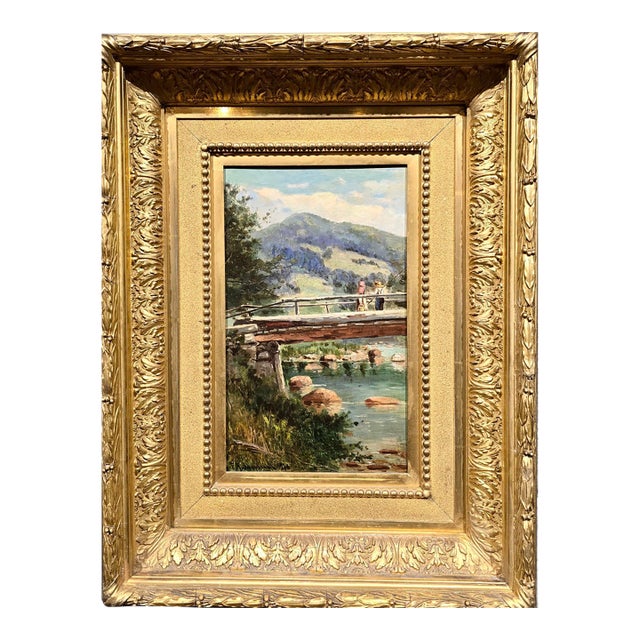
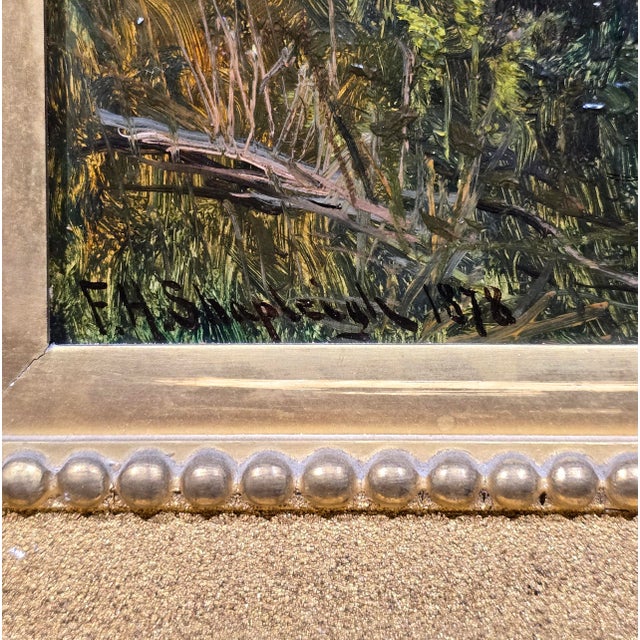
Frank Henry Shapleigh — Fishing from the Bridge at Jackson, New Hampshire — 1878 American Oil Painting
American Impressionist / …
Read more
Frank Henry Shapleigh — Fishing from the Bridge at Jackson, New Hampshire — 1878 American Oil Painting
American Impressionist / White Mountain School / Hudson River School Tradition-
Oil painting on board - Signed and dated 1878
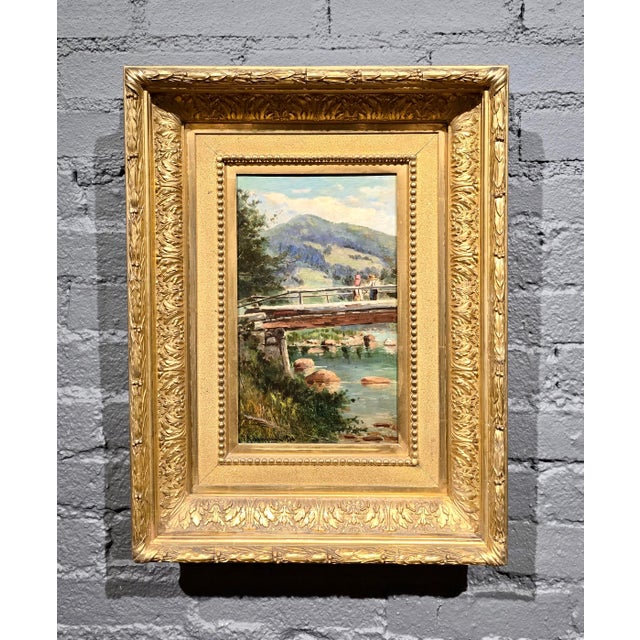
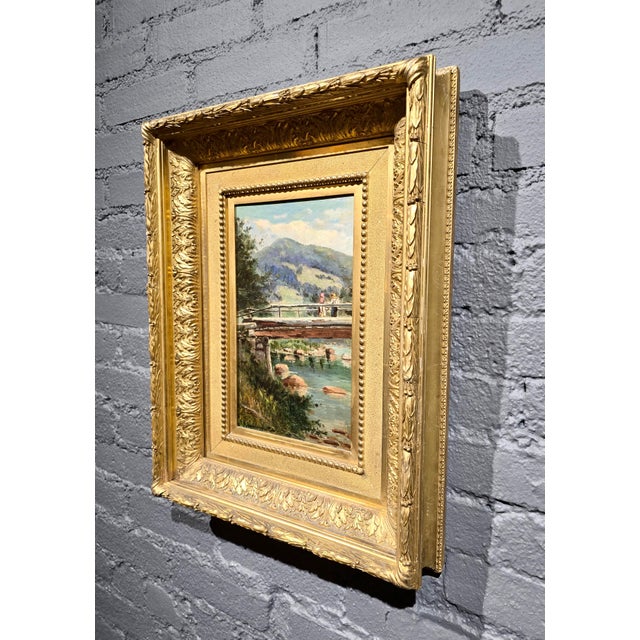
Board size: 12 × 8" - Frame size: 21 × 16 × 3" Frame: Ornate 19th-century carved and gilded frame
Description
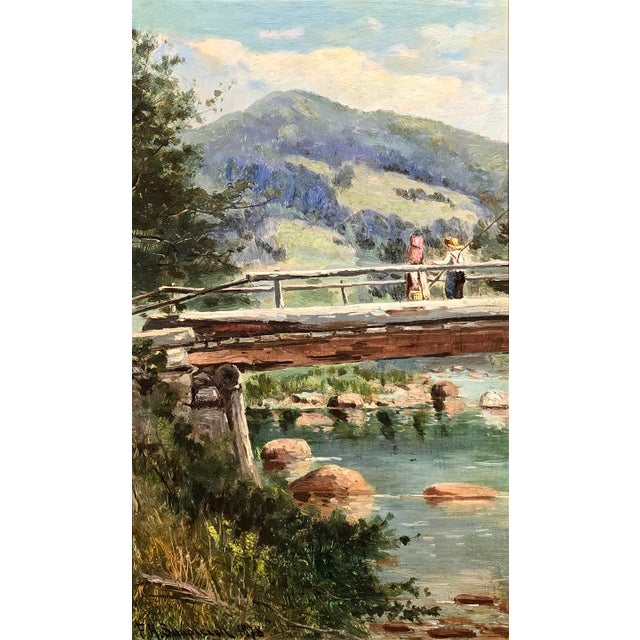
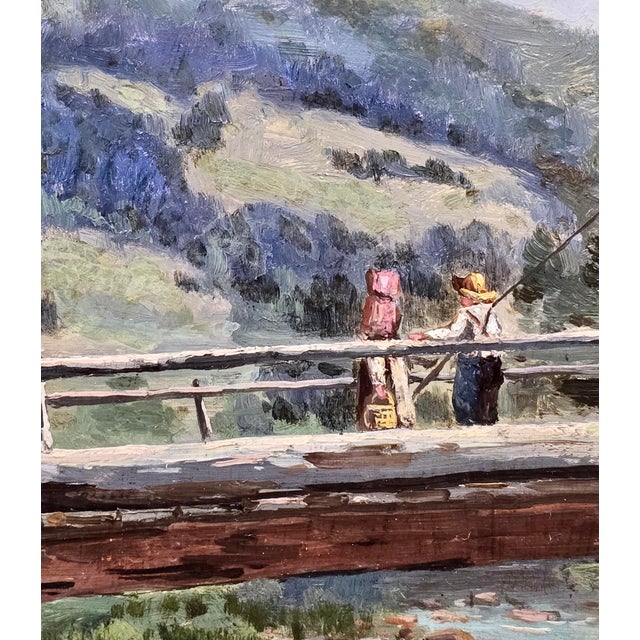
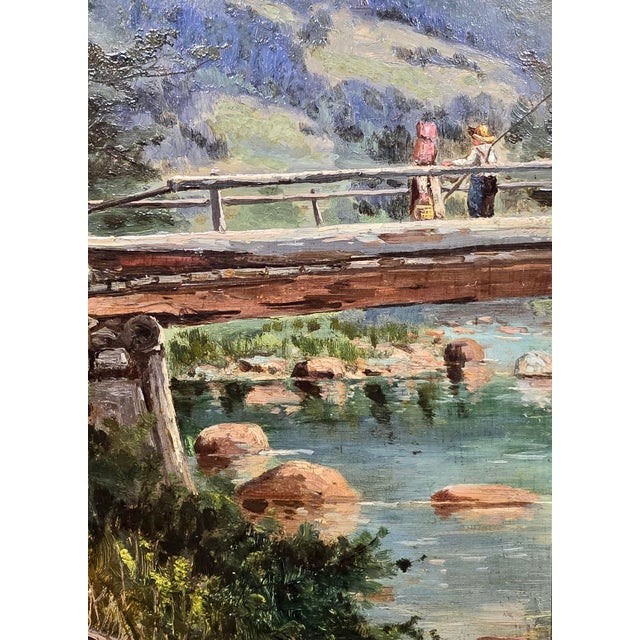
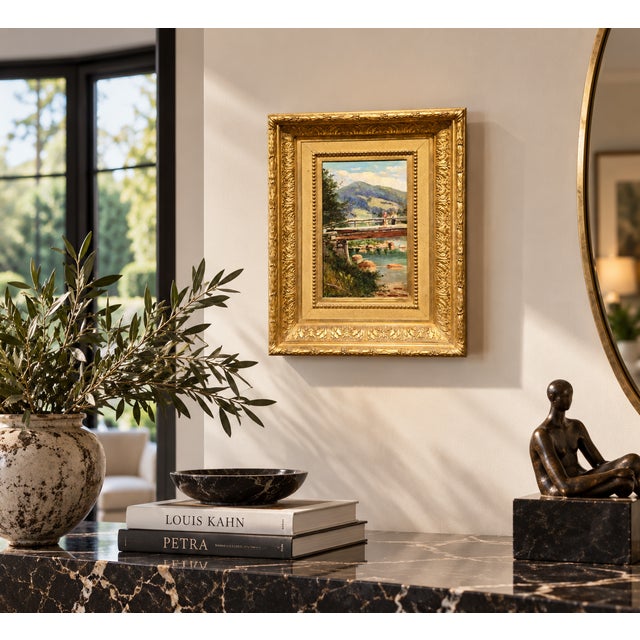
This exceptional 1878 oil painting by celebrated American landscape artist Frank Henry Shapleigh (1842–1906) captures an idyllic summer scene in Jackson, New Hampshire, nestled within the picturesque White Mountains. An accomplished painter closely associated with the renowned White Mountain School, Shapleigh was particularly admired for his ability to translate the quiet beauty of New England's rural landscapes into intimate, atmospheric compositions.Titled The Bridge at Jackson, New Hampshire, this beautifully executed work presents a charming rustic footbridge spanning a crystalline mountain stream, with two figures enjoying a peaceful moment amid the grandeur of the surrounding countryside.Painted in a distinctive vertical format, the composition demonstrates Shapleigh's refined understanding of perspective, natural light, and atmospheric depth. The viewer's eye travels effortlessly from the richly detailed foreground through the sunlit bridge and toward the softly illuminated mountains rising in the distance.
Composition, Color, and Technique
The Foreground — A Mountain Stream
The lower portion of the painting is dominated by a tranquil mountain stream, its clear, gently flowing waters rendered in a luminous palette of turquoise, muted emerald green, and delicate blue-gray tones.Scattered throughout the shallow water are rounded, sun-warmed boulders painted in soft ochres, pale rose, and warm earth tones. Their irregular forms introduce a pleasing natural rhythm to the composition, while subtle reflections and delicate highlights suggest the movement of water around the rocks.Along the left bank, lush vegetation emerges in a rich tapestry of deep forest greens, olive, golden yellow, and earthy browns. Shapleigh's confident, textured brushwork gives the foliage remarkable vitality, contrasting beautifully with the smooth, reflective surface of the stream.
The Midground — The Rustic Wooden Bridge
The central focal point is a weathered wooden footbridge stretching horizontally across the composition.Constructed from rustic timber planks and supported by substantial wooden pilings, the bridge introduces a strong architectural element that contrasts with the organic forms of the surrounding landscape.Two small figures, dressed in softly colored period attire, stand upon the bridge overlooking the stream. Their presence introduces an engaging human narrative, evoking the leisurely outdoor pursuits and peaceful rural pleasures associated with New England summers during the late 19th century.The figures are rendered with remarkable economy and delicacy, their subtle accents of warm red, cream, and yellow enlivening the surrounding landscape without disturbing its serenity.The long, slender lines extending from the bridge reinforce the work's historical identification as Fishing Scene.
The Background — The White Mountains
Beyond the bridge, the landscape opens toward the rolling hills and distant mountain ridges characteristic of Jackson and the surrounding White Mountain region.The mountains are depicted in a harmonious arrangement of soft blue-violet, muted lavender, sage green, and pale golden tones, suggesting the atmospheric effects of warm summer sunlight.Above the distant peaks stretches a luminous sky, animated by delicate passages of pale blue, creamy white, and soft golden clouds.Shapleigh's skillful handling of color and atmospheric perspective creates a convincing sense of distance, allowing the relatively intimate composition to convey the expansive beauty of the New Hampshire countryside.Throughout the painting, his painterly technique combines carefully observed natural detail with expressive, confident brushwork, reflecting the influence of 19th-century American landscape painting and the European naturalistic tradition.
Original 19th-Century Gilded Frame
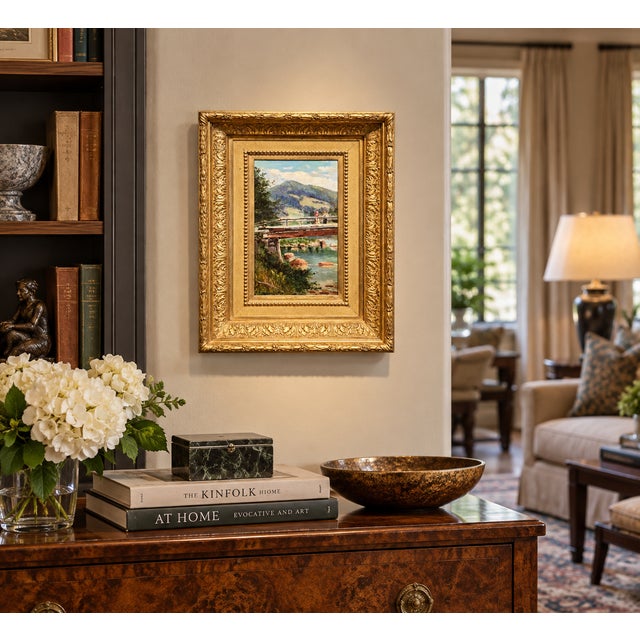
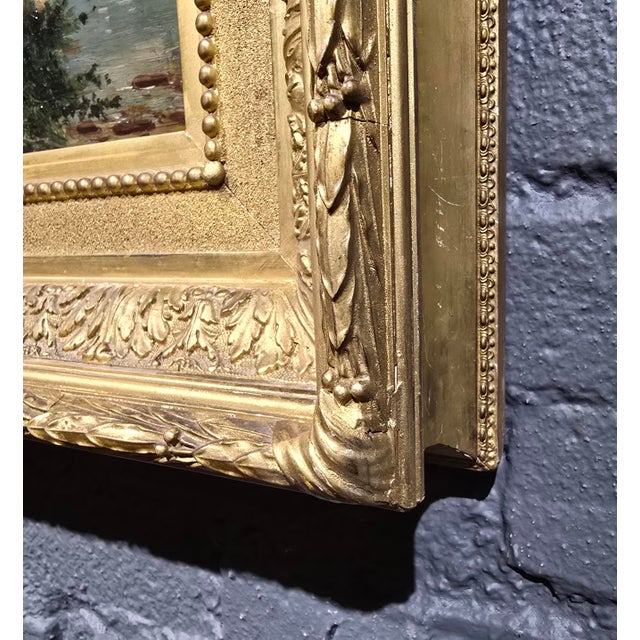
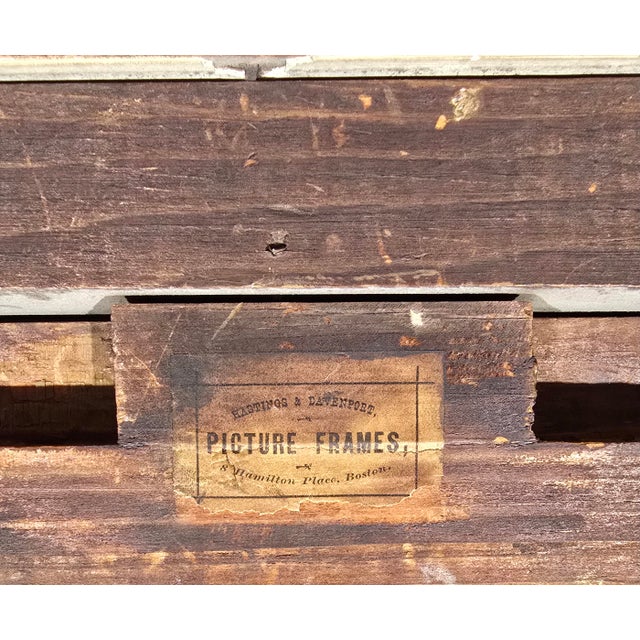
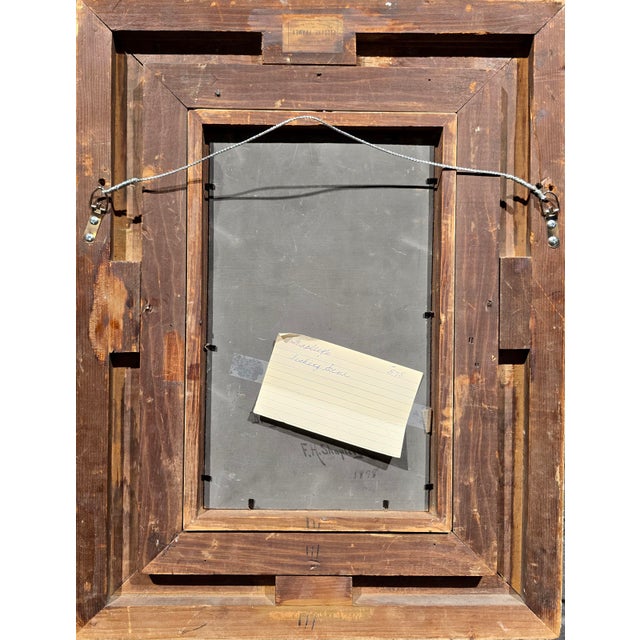
An especially distinguished feature of this painting is its magnificent, deeply molded 19th-century gilded frame, which beautifully complements the historical character of the artwork.The substantial frame features elaborate floral and acanthus-leaf ornamentation, deeply sculpted decorative moldings, and a refined inner border accented by a continuous pattern of raised gilded beads.Its warm golden finish creates an elegant contrast with the painting's cool mountain blues and verdant greens, enhancing the composition's luminosity and visual depth.The frame retains a historic framer's label identifying Hastings & Davenport Picture Frames, 8 Hamilton Place, Boston, an interesting connection to the Boston art market in which Shapleigh maintained his professional presence.The combination of the finely executed landscape and its impressive period frame creates a particularly handsome presentation, well suited to a distinguished collection of American paintings or an elegant traditional or contemporary interior.
Artist Biography —
Frank Henry Shapleigh (1842–1906) was a distinguished American landscape painter and an important figure associated with the White Mountain School, a celebrated group of 19th-century artists who documented the dramatic scenery and picturesque rural communities of New Hampshire's White Mountains.Born in Boston, Massachusetts, in 1842, Shapleigh developed an early interest in art and received instruction at the Lowell Institute of Drawing.Following his service during the American Civil War, he traveled to Europe, where he studied with the French landscape painter Émile Lambinet, whose naturalistic approach to landscape painting influenced Shapleigh's artistic development.Upon returning to the United States, Shapleigh established himself as a professional artist in Boston while developing a lasting association with the mountains and rural communities of northern New England. From 1877 to 1893, he served as artist-in-residence at the prestigious Crawford House hotel in New Hampshire's White Mountains, where his paintings attracted the attention of affluent travelers and collectors visiting the region.He also maintained a particularly close connection with Jackson, New Hampshire, eventually establishing a summer residence known as Maple Knoll.The surrounding countryside, with its rustic bridges, mountain streams, winding roads, traditional farmhouses, and distant mountain vistas, provided a rich source of inspiration throughout his career.Shapleigh's artistic repertoire extended beyond the White Mountains to include New England coastal landscapes, historic interiors, architectural subjects, and picturesque scenes of St. Augustine, Florida.During his later years, he became closely associated with St. Augustine's celebrated Ponce de Leon Hotel, where he produced numerous paintings documenting the city's distinctive Spanish Colonial architecture and historic character.His paintings remain appreciated for their carefully observed detail, atmospheric qualities, and evocative portrayal of 19th-century American life and landscape.Works by Frank Henry Shapleigh are represented in important public collections, including the Farnsworth Art Museum, New Britain Museum of American Art, Portland Museum of Art, and New Hampshire Historical Society.
Collector's Perspective
Executed in 1878, during the early years of Shapleigh's association with the Crawford House and the White Mountains, The Bridge at Jackson, New Hampshire offers an intimate and beautifully preserved visual record of one of America's most celebrated 19th-century landscape destinations.Its appealing combination of mountain scenery, rustic architecture, delicately rendered figures, and luminous summer atmosphere exemplifies the qualities that continue to attract collectors to the White Mountain School.The painting's intimate scale is particularly appealing, allowing it to be displayed in a library, study, private sitting room, or as part of a thoughtfully curated collection of American landscape paintings.Enhanced by its magnificent period gilded frame, this charming and historically documented work represents an attractive opportunity to acquire an original 19th-century American landscape by an established New England artist.
See less
- Dimensions
- 16ʺW × 3ʺD × 21ʺH
- Styles
- American
- Impressionist
- Frame Type
- Framed
- Art Subjects
- Landscape
- Period
- Late 19th Century
- Country of Origin
- United States
- Item Type
- Vintage, Antique or Pre-owned
- Materials
- Oil Paint
- Wood
- Condition
- Good Condition, Original Condition Unaltered, Some Imperfections
- Color
- Sky Blue
- Condition Notes
- Excellent - Minor wear consistent with age and history Excellent - Minor wear consistent with age and history less
Questions about the item?
Returns & Cancellations
Return Policy - All sales are final 48 hours after delivery, unless otherwise specified in the description of the product.
Cancellation Policy - Prior to shipping or local pickup, buyers may cancel an order for up to 48 hours, unless otherwise specified.
Related Collections
- Photorealism Canvas Paintings
- Ed Ruscha Paintings
- Photorealism Paintings in New York
- Richard Serra Paintings
- Louise Nevelson Paintings
- Silk Velvet Paintings
- Herman Miller Paintings
- BDDW Paintings
- Carl-Axel Acking Paintings
- Joseph Stella Paintings
- Karl-Erik Ekselius Paintings
- James McCray Paintings
- Milton Avery Paintings
- Jaanika Peerna Paintings
- Photorealism Paintings in Los Angeles
- Leroy Neiman Paintings
- Jo Baskerville Paintings
- Nicola Simbari Paintings
- Soicher Marin Paintings
- Cassina Paintings
- Black Photorealism Paintings
- Lawson-Fenning Paintings
- White Abstract Paintings
- Vienna Secession Paintings
- Red Abstract Paintings