


Details
Description
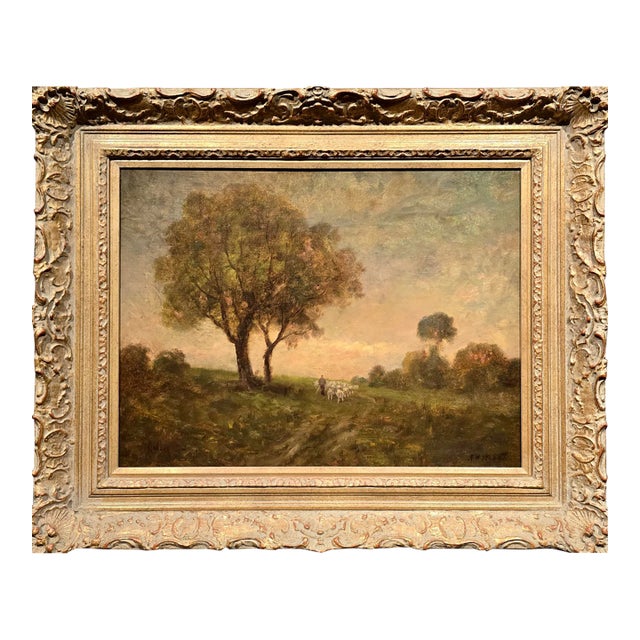
Alexander Helwig Wyant–Dusk Pastoral Meadow w/Sheep–19th century American Tonalist Oil Painting
American Impressionist - Oil painting on Canvas - Signed
…
Read more
Alexander Helwig Wyant–Dusk Pastoral Meadow w/Sheep–19th century American Tonalist Oil Painting
American Impressionist - Oil painting on Canvas - Signed
Dimensions: canvas :24" x 18" | Framed: 32" x 26" x 2"
Description
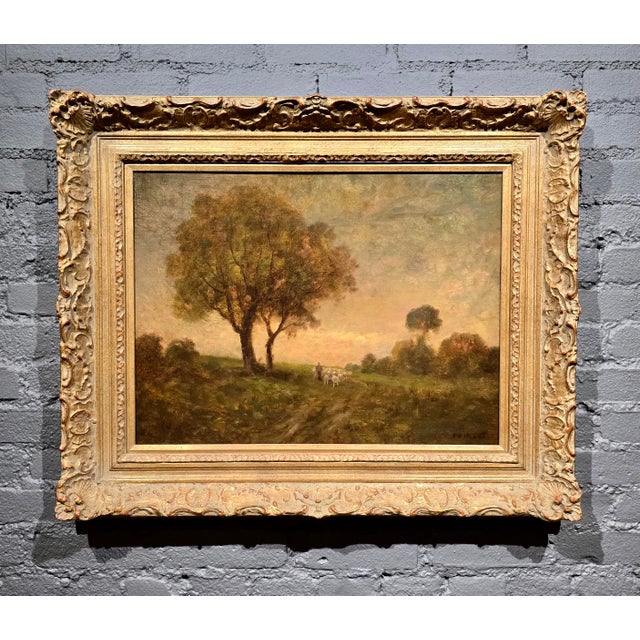
This exquisite late nineteenth-century oil on canvas stands as a masterful embodiment of American Tonalism and French-influenced Barbizon naturalism. The left side of the composition is anchored by a stately, intertwined pair of ancient deciduous trees rising from a gentle knoll. Their dark, weathered trunks grow in close tandem before branching outward, their sweeping canopies blending into a singular, magnificent mass of deep forest greens, warm ochres, and sun-dappled ambers. Balanced against a more sparse, low-lying cluster of foliage on the far right, the composition utilizes a traditional landscape perspective to draw the eye deep into a serene valley where a lone shepherd guides a quiet flock of sheep along an earthen path.The true triumph of the work lies in Wyant's delicate treatment of the atmosphere. He handles the twilight sky with exceptional subtlety, introducing gentle washes of pale pink and lavender glazes that break through low-lying clouds near the horizon, capturing the exact, fleeting moments of a sunset. The diffuse, low-angle light filters through the dense twin canopies, casting a soft, poetic glow across the sweeping grasses of the valley floor. Wyant beautifully pairs this atmospheric fluid brushwork with thick, sculptural impasto on the backs of the sheep; these bold dabs of creamy white paint catch the remaining light, creating a tactile contrast against the earthy, loose gestures of the dirt path. Executed with a lyrical touch characteristic of his celebrated post-1873 left-handed period, the work evokes a profound sense of solitude, peace, and spiritual communion with the natural world.
The canvas is housed in its magnificent, period-appropriate giltwood gesso frame. Adorned with deep, high-relief carvings of scrolling acanthus leaves, classical corner shell cartouches, and a textured linen liner, the frame adds remarkable architectural weight and historical importance to the composition.
The physical reverse of the artwork provides a highly documented, physically sound record that validates its late nineteenth-century origin and formal twentieth-century preservation history:
Canvas Support: The painting is supported by its original, unlined brown linen canvas. The textile exhibits a tightly woven, uniform weave structure with rich, natural oxidation consistent with high-quality art supplies distributed to New York studios in the late 1800s.
Conservation History: Centered on the upper wooden stretcher bar is a clean, crisp archival ink stencil that reads: "RESTORED 5/68". This stamp definitively marks a professional cleaning and conservation intervention undertaken in May 1968 to stabilize the painting's structural integrity, clean yellowed varnish, and preserve the canvas layers.
Archival Inscriptions: The lower rail of the raw wood outer frame features several faint, historical handwritten pencil inscriptions. These include the artwork’s physical image dimensions (24x18) alongside faint inventory or stock numbers from past estate catalogs or fine art framing galleries.
Artist Biography
Alexander Helwig Wyant (1836–1892) was a preeminent figure in nineteenth-century American landscape painting, celebrated for shifting the trajectory of American art from the literal, topographical descriptions of the Hudson River School toward the moody, evocative realms of Tonalism.
Born in Evans Creek, Ohio, Wyant began his creative life as a teenage sign painter before discovering the landscape work of George Inness at an exhibition in Cincinnati. Profoundly moved, he traveled to New York in 1857 to seek Inness’s advice. Recognizing the young man's raw potential, Inness helped introduce him to the legendary Cincinnati arts patron Nicholas Longworth, who generously funded Wyant's education. Wyant enrolled at the National Academy of Design before traveling to Europe in 1865. He spent a brief period at the Düsseldorf Academy under Hans Gude but found its rigid Academic structure restrictive. It was a subsequent journey through England and Ireland that truly unlocked his artistic vision; there, the fluid brushwork and light-filled landscapes of John Constable and J.M.W. Turner permanently reshaped his aesthetic philosophy.Upon returning to New York City, Wyant plugged directly into the local arts scene, establishing a successful studio and traveling frequently into the untamed wilderness of the Adirondack and Catskill Mountains. However, his life took a dramatic turn in 1873. While participating in a grueling government mapping expedition across Arizona and New Mexico, the severe physical conditions triggered a paralytic stroke that left his right arm completely useless.
Faced with a career-ending injury, Wyant displayed extraordinary resilience. He spent the next several years in absolute seclusion, teaching himself to paint exclusively with his left hand. Paradoxically, this physical limitation transformed his style into something far greater. No longer capable of rendering the tight, meticulous details of his youth, his left-handed brushwork became looser, broader, and infinitely more expressive. He traded vast topographical views for deeply personal, intimate woodland interiors filled with misty light and atmospheric depth.
Wyant spent his later years working among close-knit artistic communities in Keene Valley and Arkville, New York. By the time of his death in 1892, he was a full member of the National Academy of Design and recognized as a leading pioneer of the American American Barbizon movement. Today, his masterpieces are preserved in the permanent collections of the world's most prestigious institutions, including the Metropolitan Museum of Art, the Smithsonian American Art Museum, and the National Gallery of Art.
See less
- Dimensions
- 32ʺW × 2ʺD × 26ʺH
- Styles
- American
- Impressionist
- Frame Type
- Framed
- Period
- 19th Century
- Country of Origin
- United States
- Item Type
- Vintage, Antique or Pre-owned
- Materials
- Canvas
- Oil Paint
- Condition
- Good Condition, Original Condition Unaltered, Some Imperfections
- Color
- Sky Blue
- Condition Notes
- Excellent - Minor wear consistent with age and history Excellent - Minor wear consistent with age and history less
Questions about the item?
Returns & Cancellations
Return Policy - All sales are final 48 hours after delivery, unless otherwise specified in the description of the product.
Cancellation Policy - Prior to shipping or local pickup, buyers may cancel an order for up to 48 hours, unless otherwise specified.
Related Collections
- Ed Ruscha Paintings
- Photorealism Canvas Paintings
- Ralph Lauren Paintings
- Photorealism Paintings in New York
- Louise Nevelson Paintings
- Richard Serra Paintings
- Silk Velvet Paintings
- Herman Miller Paintings
- BDDW Paintings
- Jo Baskerville Paintings
- Jean-Paul Barray Paintings
- Johannes Andersen Paintings
- Peter Behrens Paintings
- Black Photorealism Paintings
- James McCray Paintings
- Lawson-Fenning Paintings
- Milton Avery Paintings
- Carl-Axel Acking Paintings
- Joseph Stella Paintings
- Karl-Erik Ekselius Paintings
- Pedro Friedeberg Paintings
- Piet Hein Eek Paintings
- Raphael Paintings
- Hans Andersen Paintings
- Leroy Neiman Paintings