

Details
Description
English Pearlware Blue Slip Teapot & Cover with Engine-Turned Fluting,
English, probably Staffordshire or Yorkshire, Circa 1790
This English pearlware …
Read more
English Pearlware Blue Slip Teapot & Cover with Engine-Turned Fluting,
English, probably Staffordshire or Yorkshire, Circa 1790
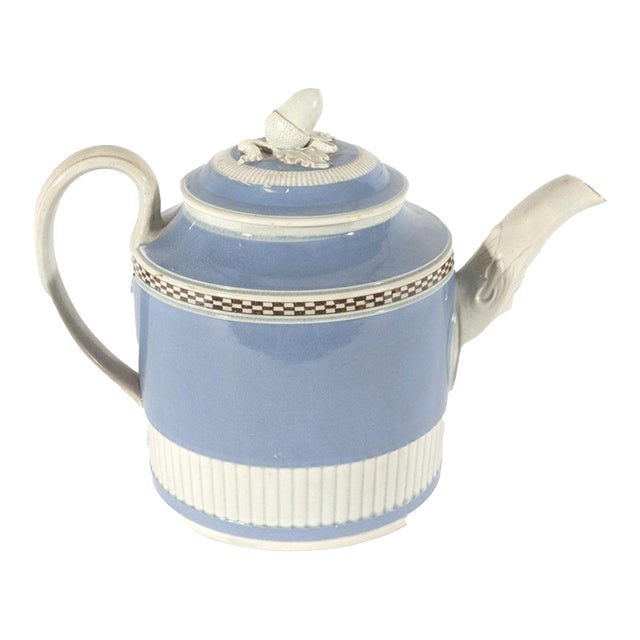
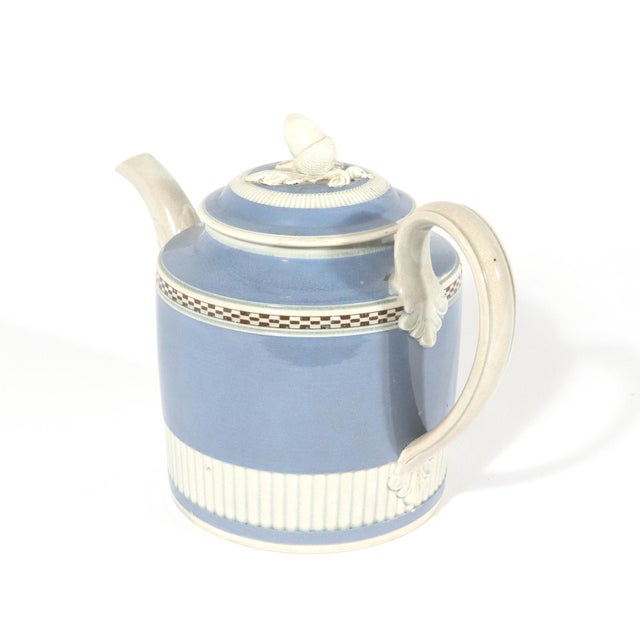
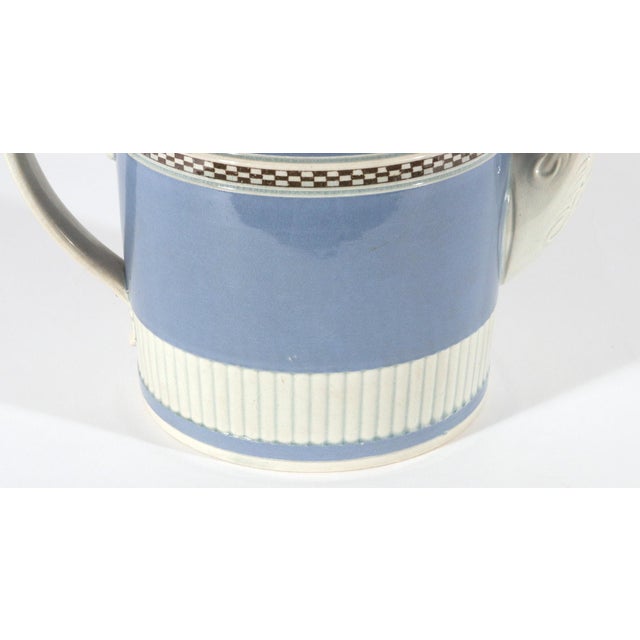
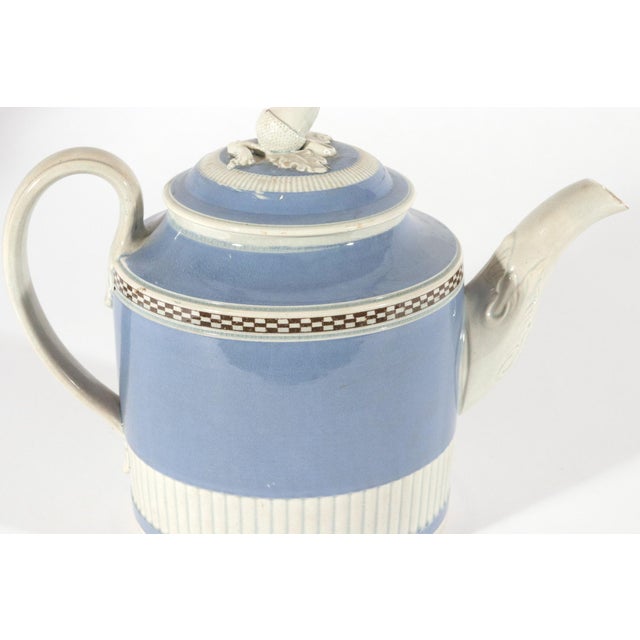
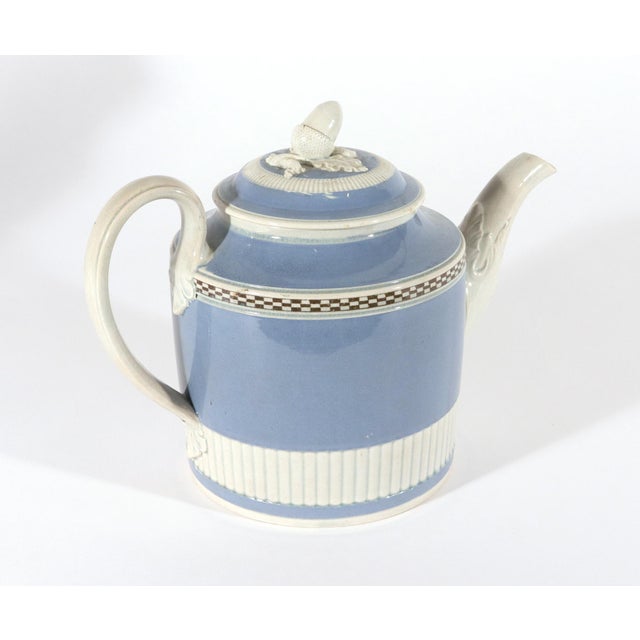
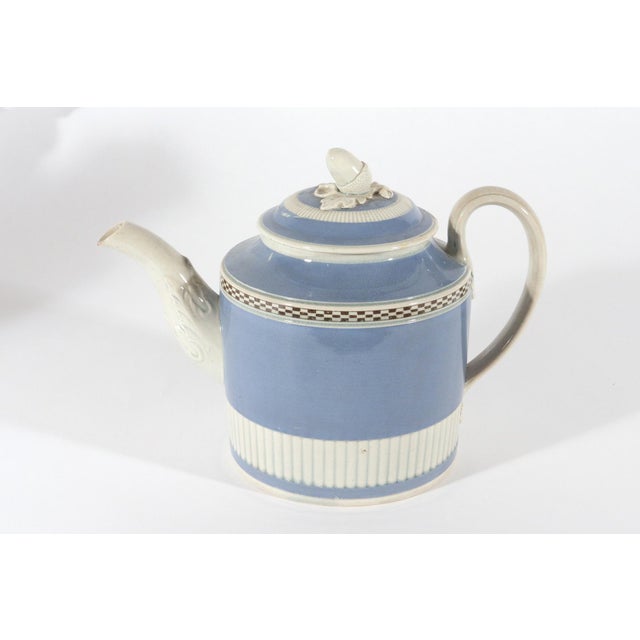
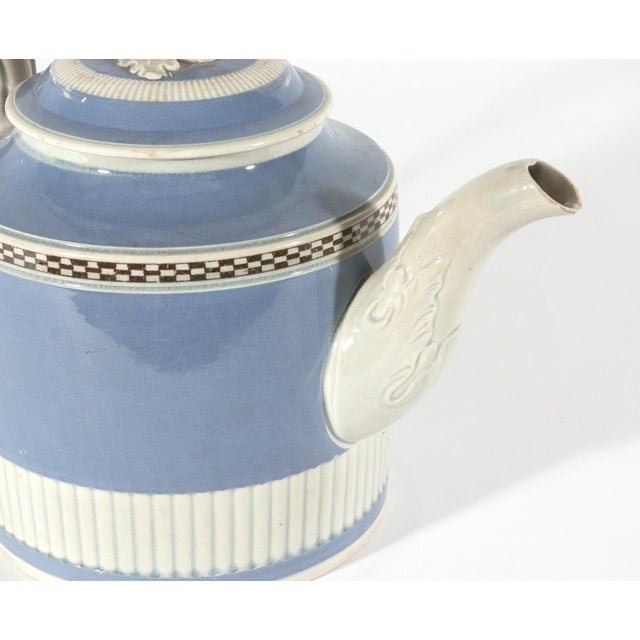
This English pearlware teapot of restrained neoclassical form has a straight-sided cylindrical, or drum-shaped, body covered in a light blue slip ground, its broad upper section unadorned save for the decorative band encircling the shoulder: a checkered band of rouletting inlaid with dark brown slip, flanked by fine raised turned fillets. The lower section is distinguished by a broad band of closely spaced vertical fluting, cut on the engine-turning lathe through the blue slip to expose the pale body beneath, the flutes stopping in a neat scalloped edge against the blue above and below. The fluting is a crisp textural counterpoint to the smooth blue-slipped upper body and a quality of workmanship that speaks to the more refined end of English earthenware production of the period.
Engine-turning was carried out before firing, while the clay was leather-hard, on a lathe whose cams rocked the revolving pot against a fixed cutting tool, so that a repeated pattern could be cut with mechanical regularity; where the pot had first been dipped or banded in colored slip, as here, the cut revealed the contrasting color of the body. It is a characteristic feature of the more accomplished Staffordshire and Yorkshire manufactories, among them the Leeds Pottery.
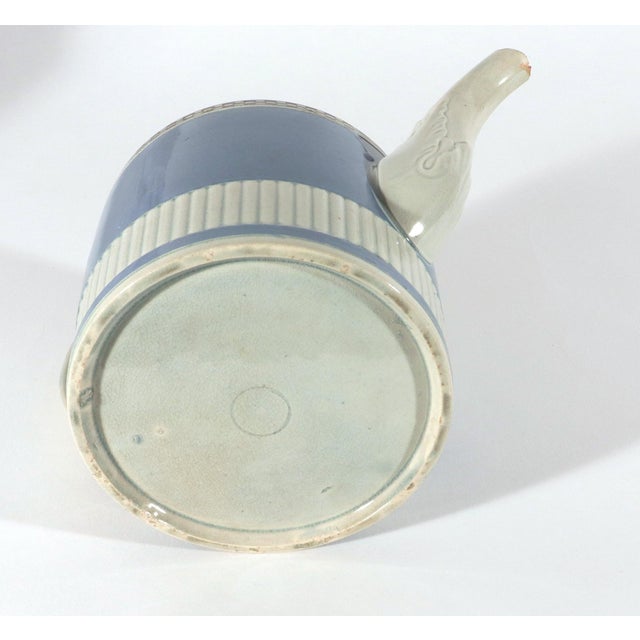
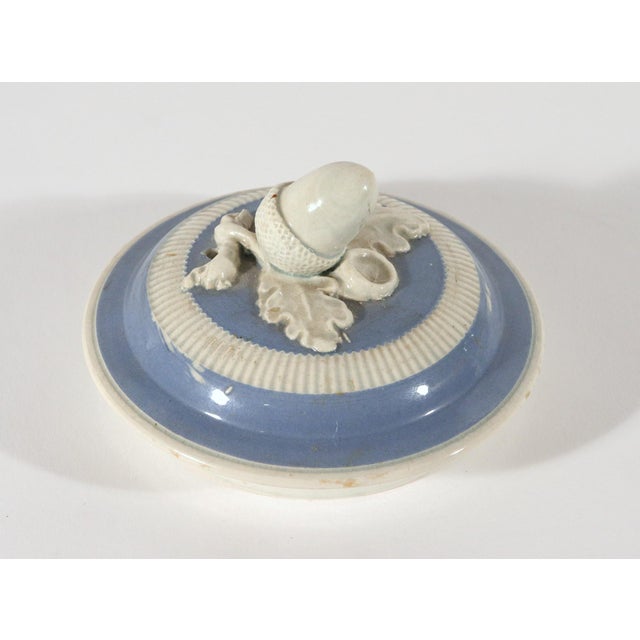
The domed cover, with its broad stepped rim, repeats the engine-turned reeding in a concentric ring at the crown and is surmounted by a finely modeled applied finial in the form of a white pearlware acorn in its textured cup, resting upon naturalistic oak leaves with a twig and an empty acorn cup beside it, a motif of considerable delicacy widely employed in English ceramics of the 1780s and 1790s. The curved spout, in uncolored pearlware, is press-molded at its base with leafage in low relief, and the reeded loop handle ends in press-molded foliate terminals at both its upper and lower junctions, reinforcing the neoclassical character of the design. The flat glazed base shows the blue-green pooling characteristic of the pearlware glaze.
The soft blue and white suit a pale-blue or gray-painted room, and the teapot sits well on a tea table, a bookcase shelf or among blue-and-white ceramics, where the fluting and the acorn finial reward a closer look.
Dimensions:
Height: 6½ inches (16.5 cm)
Width, handle to spout: 8½ inches (21.6 cm)
Depth: 4¾ inches (12.1 cm)
Marks:
Unmarked.
Provenance:
Earle D. Vandekar of Knightsbridge
Condition:
Good condition, with a chip to the tip of the spout, visible in the photographs.
References:
T. A. Lockett and P. A. Halfpenny, eds., Creamware and Pearlware, Stoke-on-Trent: City Museum and Art Gallery, 1986.
Donald Towner, Creamware, London: Faber & Faber, 1978.
Peter Walton, Creamware and Other English Pottery at Temple Newsam House, Leeds, Bradford and London: Manningham Press, 1976, p. 246, pls. 1071–1072.
Geoffrey A. Godden, British Pottery: An Illustrated Guide, London: Barrie & Jenkins, 1974.
Philip Miller and Michael Berthoud, An Anthology of British Teapots, Broseley, Shropshire: Micawber Publications, 1985.
Donald Carpentier and Jonathan Rickard, “Slip Decoration in the Age of Industrialization,” Ceramics in America 2001, Milwaukee: Chipstone Foundation, 2001, pp. 115–134.
Jonathan Rickard and Donald Carpentier, “The Little Engine That Could: Adaptation of the Engine-Turning Lathe in the Pottery Industry,” Ceramics in America 2004, Milwaukee: Chipstone Foundation, 2004, pp. 78–99.
Bonhams, London, 18 May 2011, lot 96: a Leeds pearlware coffee pot, sucrier and teapot with light blue slip bands, fluting, brown and white checkered borders and acorn finials, the teapot with traces of gilt lettering including the date 1790.
Historical Context
The straight-sided cylindrical, or drum-shaped, teapot was made in English creamware from about 1770 and remained in production through the 1790s alongside the newer oval forms borrowed from silver; its simple geometry suited neoclassical taste and lent itself readily to lathe work. Engine-turning, long practiced in the ornamental turning of ivory, wood and metal, was introduced into the Staffordshire potteries by Josiah Wedgwood in 1763, who developed a lathe for pottery with the Birmingham machine maker John Taylor, guided by Charles Plumier’s treatise L’Art de tourner (1701), and the technique was quickly taken up by other potteries. Wedgwood introduced his “Pearl White” in 1779, although a cobalt-tinted china glaze was already in use by other Staffordshire potters in the mid-1770s; the cobalt gives pearlware its cool, blue-tinged cast.
Blue-slip tea wares with inlaid checkered bands are unusually well dated by archaeology. A pearlware bowl with a black inlaid checkered rim above a powder-blue slip field was excavated at the British post of Fort Watson, South Carolina, which stood only from December 1780 to April 1781, and tea wares with inlaid checkered rims, reeded handles with foliate terminals and bands cut through the slip were recovered from the wreck of the American ship Washington, said to have been lost off the Îles de Glénan, Brittany, in 1787, the impressed mark “heath” occurring among the sherds. A closely related Leeds group, a coffee pot, sucrier and teapot with light blue slip, fluting, checkered borders and acorn finials, the teapot bearing traces of a gilt date of 1790, was sold at Bonhams in 2011, and comparable shapes and decoration are illustrated from the Leeds collection at Temple Newsam House.
(Ref: NY11139-Lrrrx)
See less
- Dimensions
- 8.5ʺW × 4.75ʺD × 6.5ʺH
- Styles
- English Traditional
- Period
- Late 18th Century
- Country of Origin
- United Kingdom
- Item Type
- Vintage, Antique or Pre-owned
- Materials
- Pottery
- Condition
- Good Condition, Original Condition Unaltered, Some Imperfections
- Color
- Blue
- Condition Notes
- Good condition Good condition less
Questions about the item?
Returns & Cancellations
Return Policy - All sales are final 48 hours after delivery, unless otherwise specified in the description of the product.
Cancellation Policy - Prior to shipping or local pickup, buyers may cancel an order for up to 48 hours, unless otherwise specified.
Related Collections
- Tea Pots in Greenville, SC
- Pop Art Tea Pots
- Gold Leaf Tea Pots
- Tea Pots in Cincinnati
- Tea Pots in Savannah
- Tea Pots in Mobile
- Teal Tea Pots
- Ebony Tea Pots
- Silverplate Tea Pots
- Antique Teapots
- French Tea Pots
- Regency Tea Pots
- Early American Tea Pots
- Villeroy and Boch Tea Pots
- Tea Pots in Louisville
- Bordallo Pinheiro Tea Pots
- Majolica Tea Pots
- Tea Pots in Jacksonville, FL
- Industrial Tea Pots
- Noritake Tea Pots