

Details
Description
English Pearlware Blue Slip Coffee Pot & Cover, Staffordshire or Yorkshire
Circa 1790
This handsome English pearlware coffee pot and …
Read more
English Pearlware Blue Slip Coffee Pot & Cover, Staffordshire or Yorkshire
Circa 1790
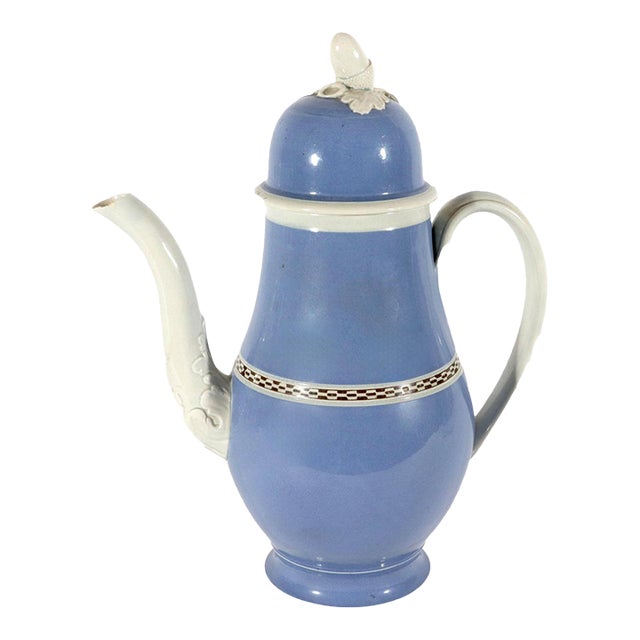
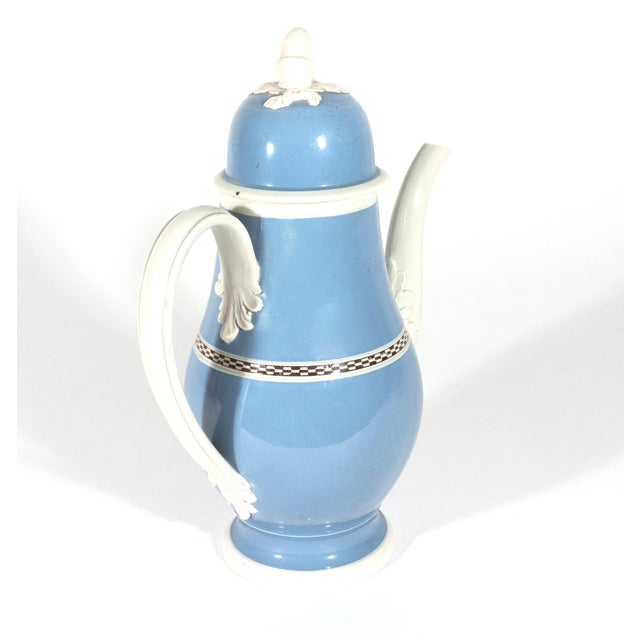
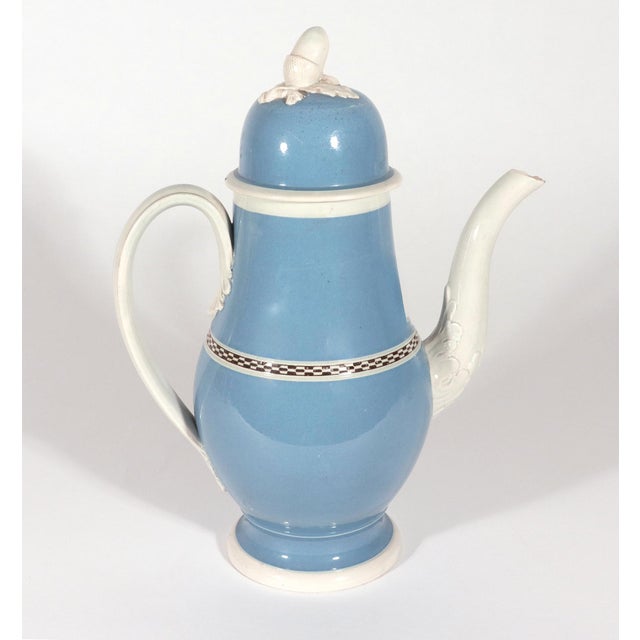
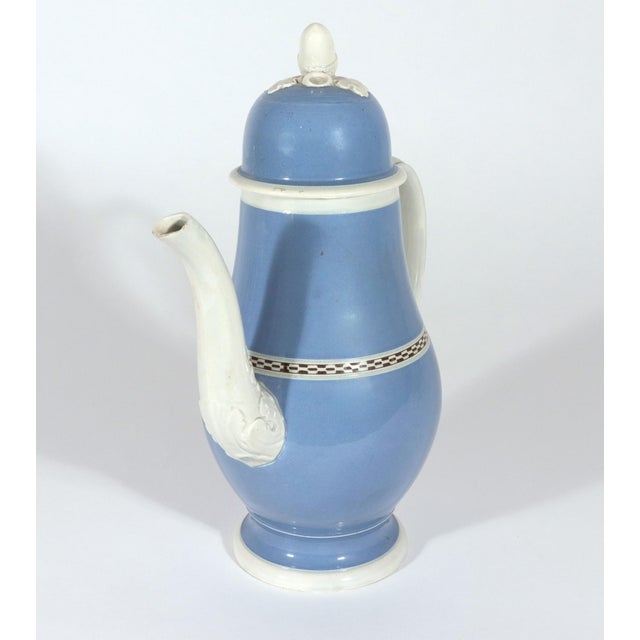
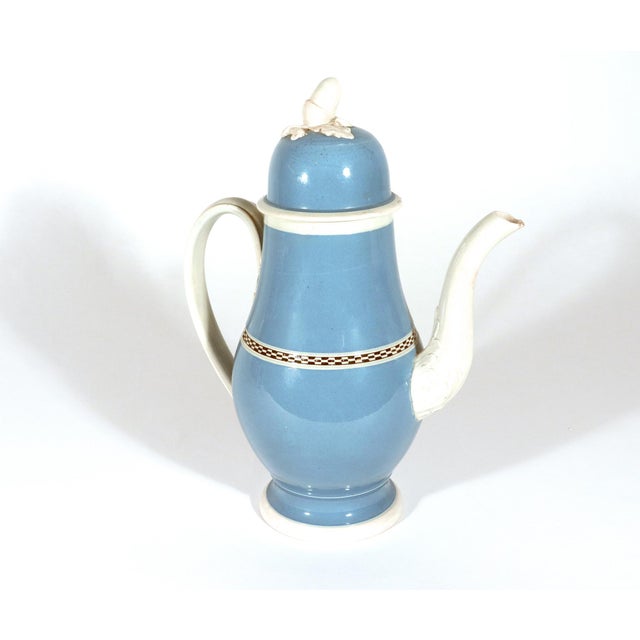
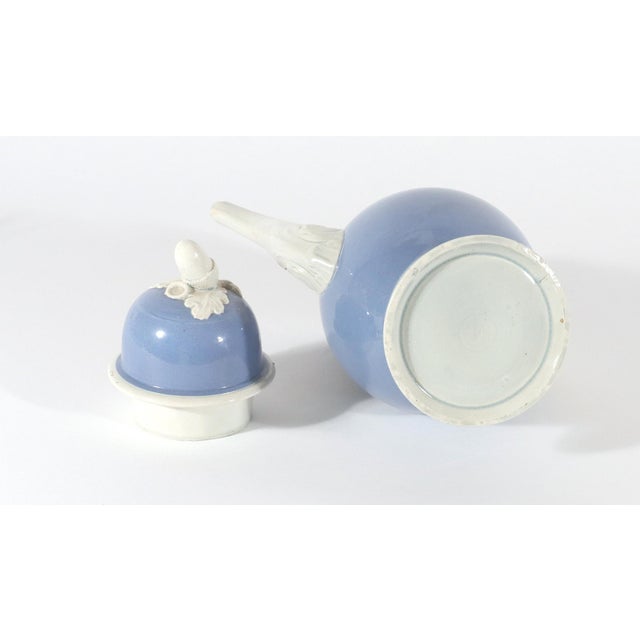
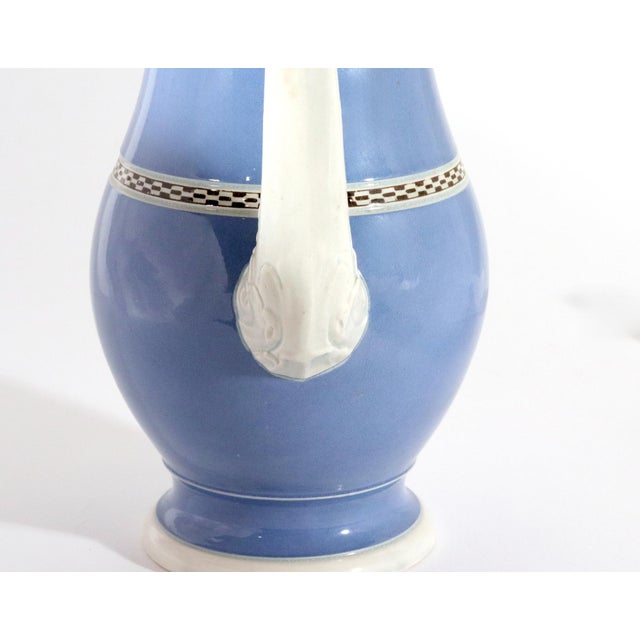
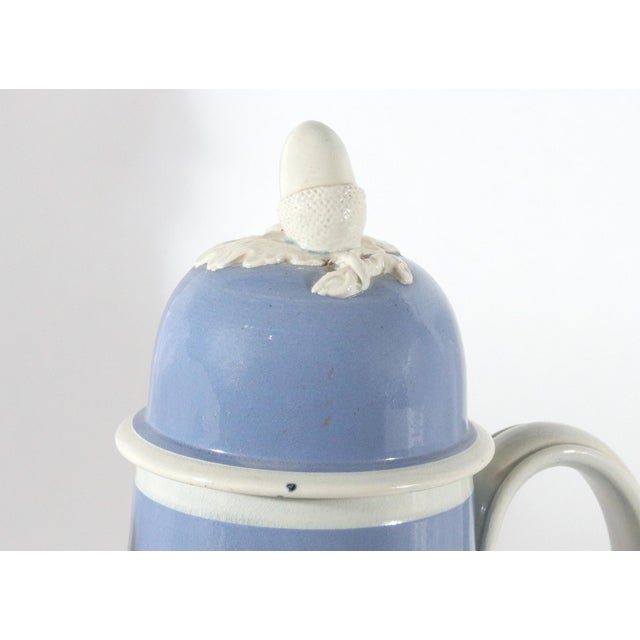
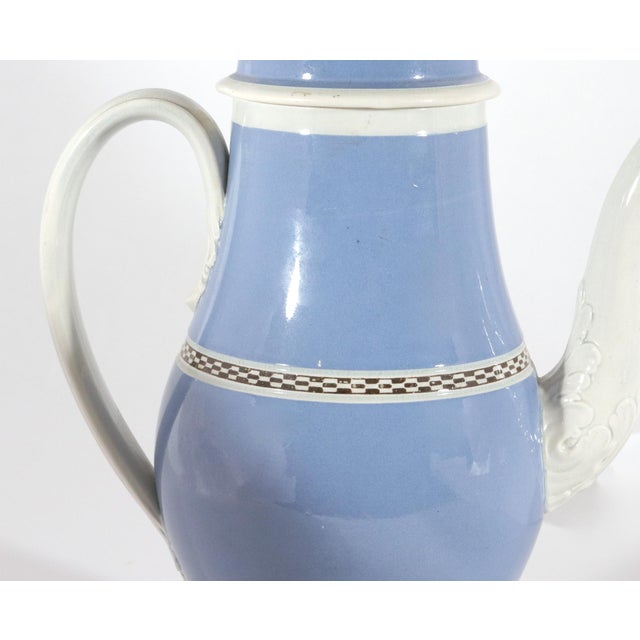
This handsome English pearlware coffee pot and cover, of baluster form and pleasing neoclassical proportion, is covered in a pale powder-blue slip ground, applied as the pot turned on the lathe, that gives it a distinctive cool, atmospheric presence. The ovoid body, gently waisted at the shoulder and swelling to a rounded lower section, rises to a tapering neck banded in white at the rim and fitted with a high-domed cover, and stands on a spreading foot edged in white, the underside left uncolored to show the pale, faintly blue-tinged glaze characteristic of pearlware.
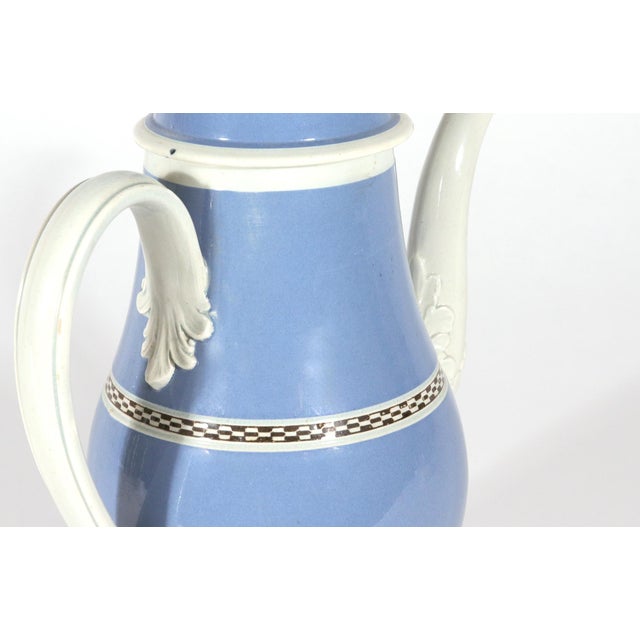
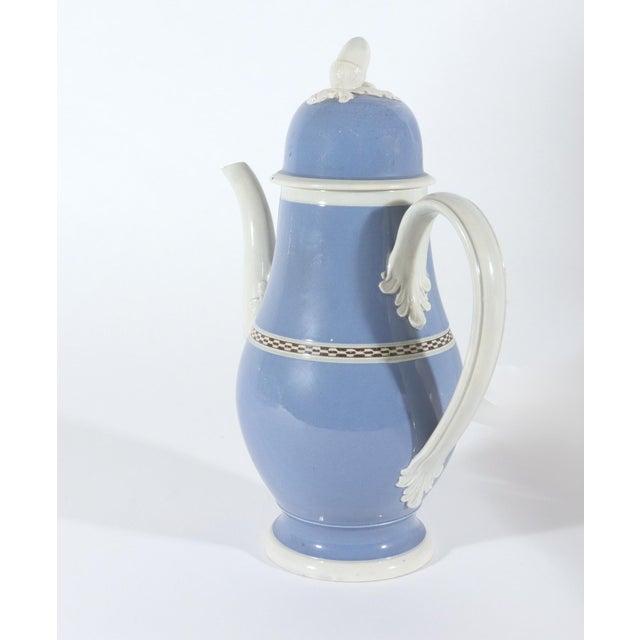
A bold decorative band encircles the body: a checkered, or dicing, pattern in dark brown on white, of the rouletted and slip-inlaid type, flanked by narrow white bands. Inlaid checkered bands of this kind were used by English potters on slip-decorated wares from the 1780s, and here provide sharp visual punctuation between the upper and lower body.
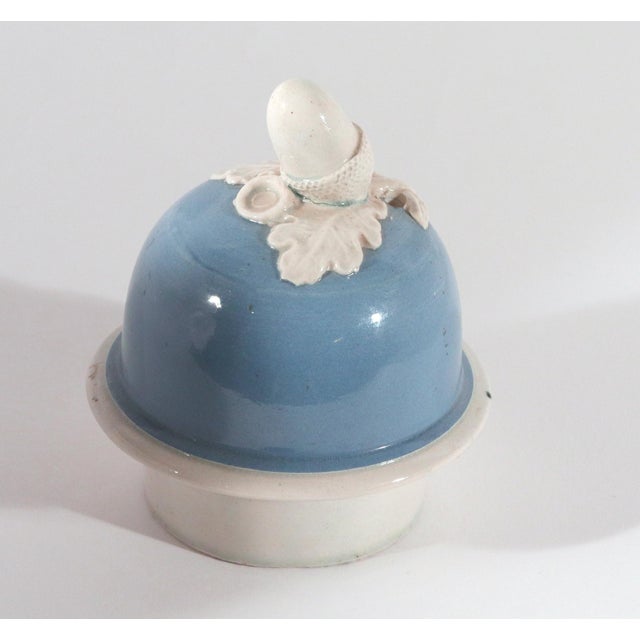
The gracefully curved spout and the strap handle are left in uncolored pearlware, their creamy white an effective contrast against the blue ground. The press-molded spout is ornamented at its base with bold acanthus scrolls, and the handle has molded foliate terminals, the upper one an acanthus scroll. The high-domed cover is surmounted by a modeled acorn knop, its cup finely textured, rising from applied oak leaves and a curled twig, a naturalistic flourish animating an otherwise restrained composition.
The overall form, with its generous baluster body, high-domed cover, and curved molded spout, is among the more accomplished coffee pot types produced by English earthenware manufacturers of the late eighteenth century, reflecting an awareness of contemporary silver and porcelain forms while retaining a robustness entirely characteristic of the earthenware tradition.
The soft blue ground and crisp white spout, handle, and finial sit comfortably on a sideboard or in a glazed cabinet alongside creamware or blue and white, and the pot reads equally well as a single sculptural accent on a library table or mantel in a traditional or pared-back interior.
Dimensions:
Height: 10 inches (25.4 cm)
Width, handle to spout: 7¾ inches (19.7 cm)
Depth: 4 inches (10.2 cm)
Provenance:
Earle D. Vandekar of Knightsbridge
Condition:
Good condition, with a tiny pinprick frit to the rim of the cover.
References:
Donald Carpentier and Jonathan Rickard, “Slip Decoration in the Age of Industrialization,” Ceramics in America (2001), fig. 8, a closely related pearlware coffee pot, circa 1785, with a slip-inlaid checkered band, press-molded spout, foliate handle terminals, and acorn knop.
Peter Walton, Creamware and Other English Pottery at Temple Newsam House, Leeds, Leeds: W. S. Maney & Son, 1976, p. 246, pls. 1071–1072, for comparable shapes and decoration.
T. A. Lockett and P. A. Halfpenny, eds., Creamware and Pearlware, Stoke-on-Trent: City Museum and Art Gallery, 1986.
Donald Towner, Creamware, London: Faber & Faber, 1978.
George L. Miller and Robert R. Hunter, “How Creamware Got the Blues: The Origins of China Glaze Ware,” Ceramics in America (2001).
Robin Hildyard, English Pottery 1620–1840, London: V&A Publications, 2005.
Geoffrey A. Godden, British Pottery: An Illustrated Guide, London: Barrie & Jenkins, 1974.
Historical Context
Pearlware, the later collectors’ name for the refined earthenware that succeeded creamware, takes its cooler, whiter appearance from a little cobalt in the lead glaze. Josiah Wedgwood introduced his “Pearl White” in 1779, other Staffordshire potters having used a similar cobalt-tinted “china glaze” since the mid-1770s, and the ware was soon made throughout Staffordshire and Yorkshire. Colored slip grounds applied on the lathe, the “dipt” or “dipped” wares of the period, were fashionable in the 1780s and 1790s and well suited to the neoclassical taste of Robert Adam and his contemporaries; coffee pots of this type are among the more refined English earthenware productions of the era.
(Ref: NY11138-lrrx)
See less
- Dimensions
- 7.75ʺW × 4ʺD × 10ʺH
- Styles
- English
- Period
- Late 18th Century
- Country of Origin
- United Kingdom
- Item Type
- Vintage, Antique or Pre-owned
- Materials
- Earthenware
- Pottery
- Condition
- Good Condition, Original Condition Unaltered, Some Imperfections
- Color
- Blue
- Condition Notes
- Good condition Good condition less
Questions about the item?
Returns & Cancellations
Return Policy - All sales are final 48 hours after delivery, unless otherwise specified in the description of the product.
Cancellation Policy - Prior to shipping or local pickup, buyers may cancel an order for up to 48 hours, unless otherwise specified.