

Details
Description
Possibly M. & H. Schrenkeisen, New York.
or John Jelliff & Co., Newark, New Jersey.
Walnut and burl walnut veneer …
Read more
Possibly M. & H. Schrenkeisen, New York.
or John Jelliff & Co., Newark, New Jersey.
Walnut and burl walnut veneer with carved, incised, and parcel-gilt decoration; upholstered seating; metal casters.
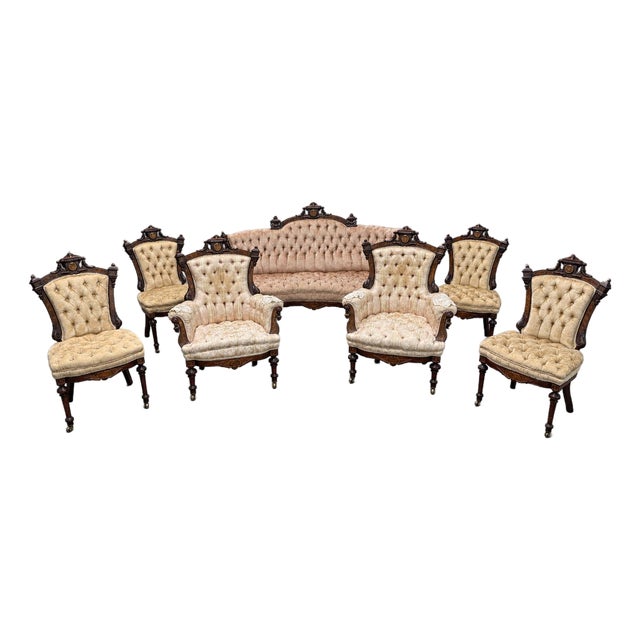
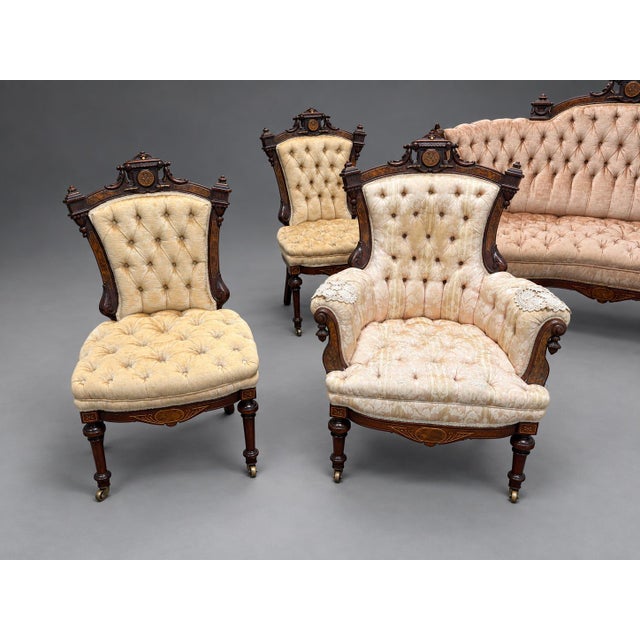
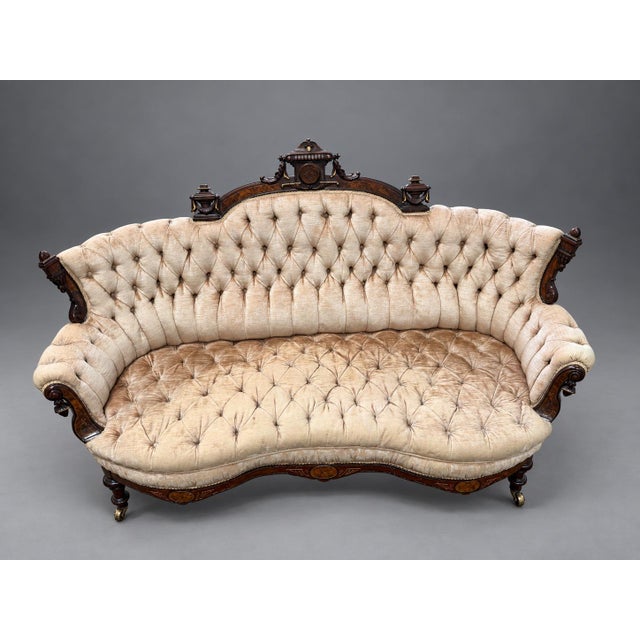
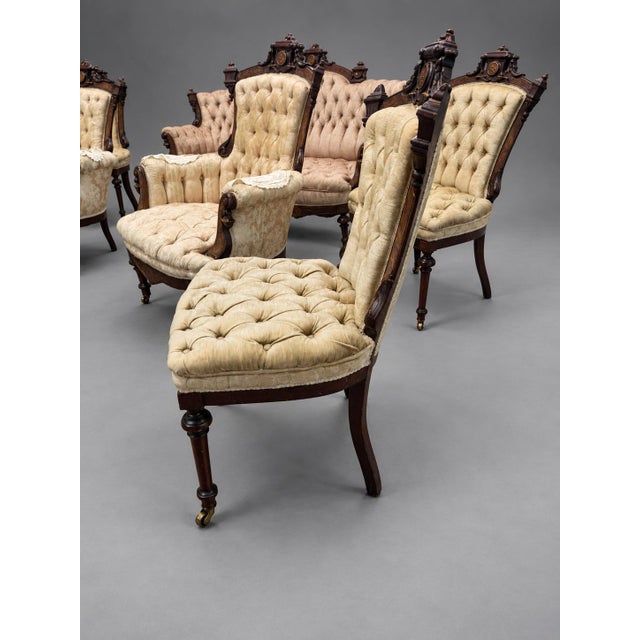
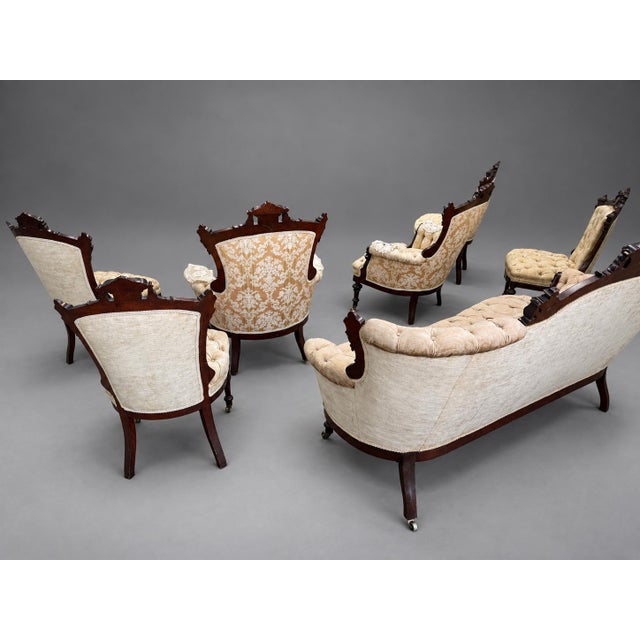
This imposing matched parlor suite comprises a sofa, two armchairs, and four side chairs, all conceived within a unified program of American Renaissance Revival ornament. The frames are constructed principally of walnut, enriched with figured burl walnut veneers and selectively applied gilding that emphasizes the incised lines, carved terminals, and architectural divisions. The suite’s completeness is particularly significant: rather than representing a collection of approximately related pieces, the seven elements preserve the graduated hierarchy intended for a formal nineteenth-century parlor, with the sofa serving as the principal object, the armchairs as substantial companion forms, and the four side chairs as lighter repetitions of the same design.
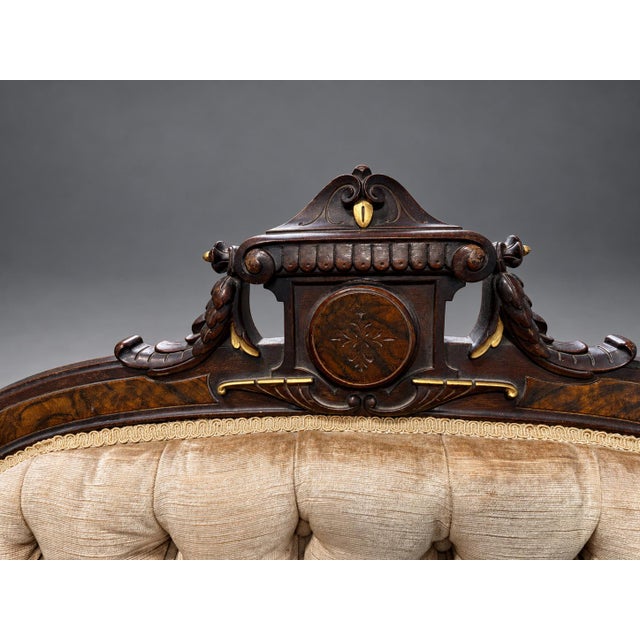
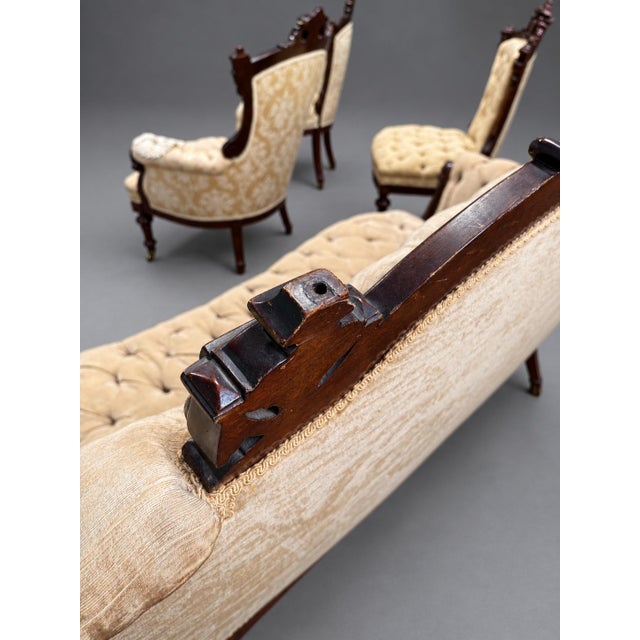
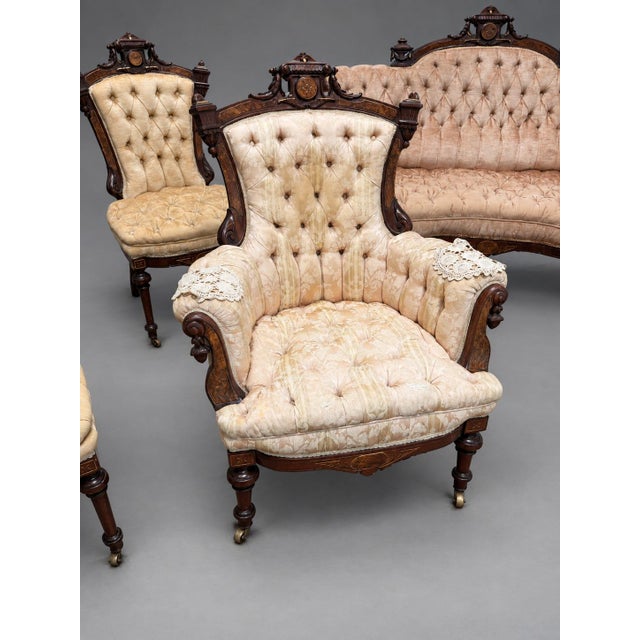
The sofa is organized around a broad, continuously upholstered back of gently undulating outline, deeply button-tufted and framed by exposed walnut. Rising above its center is an architectonic crest resembling a miniature pedimented pavilion. A circular medallion carved with a radiating flowerhead occupies the central panel, above which appears a compressed gadrooned or lobed frieze and a low triangular pediment. Open foliate scrolls extend from either side of the medallion, their carved leaves and selectively gilded details joining the crest to the bowed upper rail. The outer uprights are treated as diminutive architectural piers, capped by pointed finials and embellished with stylized leafage and pendant ornament. This alternation of upholstered expanses with sharply articulated carved elements gives the sofa both visual breadth and a pronounced vertical emphasis.
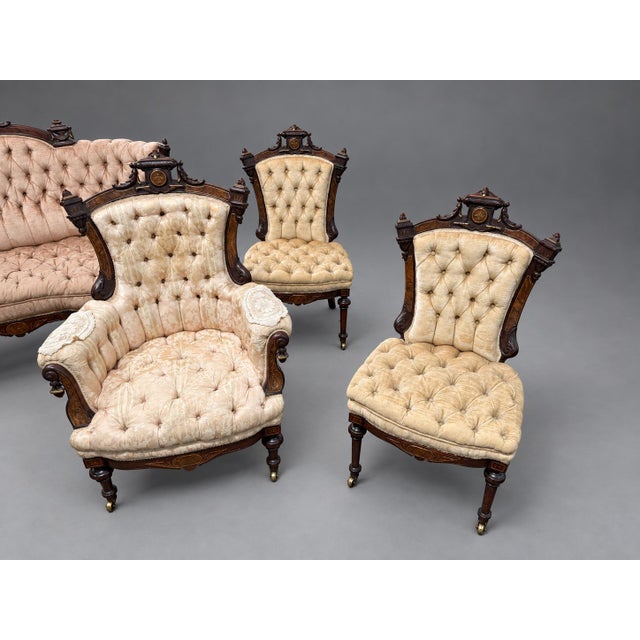
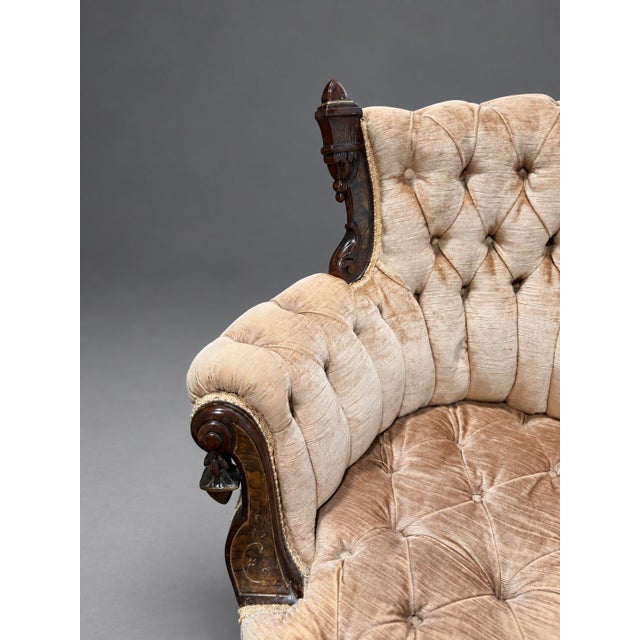
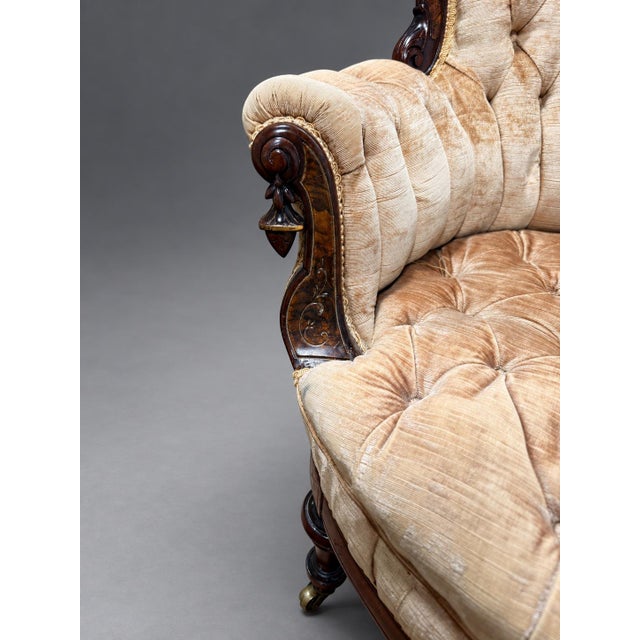
The armchairs repeat the principal ornamental vocabulary on a more concentrated scale. Their high, shaped backs are bordered by burl-veneered stiles and surmounted by the same flowerhead medallions, scrolling foliage, miniature pediments, and block-like architectural terminals. Broad padded arms descend in generous curves toward prominent wooden volutes, beneath which appear carved pendant leaves or drops. The exposed arm supports are veneered in richly figured burl walnut and enlivened with restrained incised ornament. Their sweeping profiles balance the substantial upholstery and create a more enveloping form than that of the accompanying side chairs.
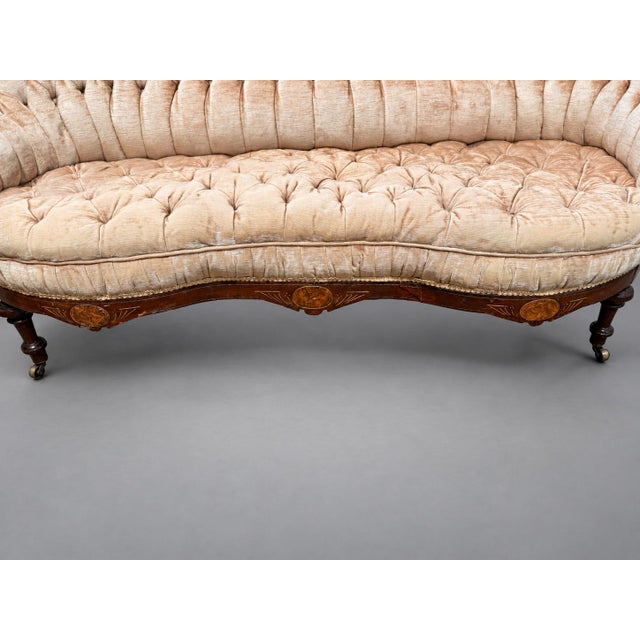
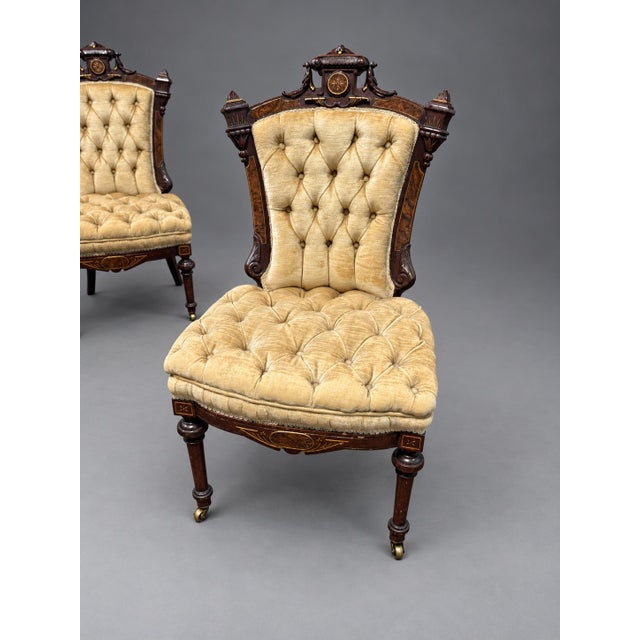
Each side chair employs a narrower version of the crest and back frame, with the vertical stiles terminating in curled volutes immediately above the seat. The deeply tufted backs and sprung seats provide the visual richness and comfort expected of formal parlor furniture of the 1870s, while the more open lower structure prevents the chairs from appearing excessively massive. Across the entire suite, bowed and serpentine seat rails are centered by oval burl-walnut reserves framed by delicate gilt-incised scrollwork. Small square corner blocks are ornamented with geometric crossed lines, establishing a measured transition between the curved rails and the turned legs.
The front legs are ring-turned and taper toward metal casters, while the rear legs are more simply shaped and swept to accommodate the rake of the upholstered backs. Casters were both a practical and socially meaningful feature of parlor furniture: they allowed the suite to be rearranged for conversation, music, visiting, or larger domestic gatherings without diminishing the refinement of the forms. Here, the glint of the caster hardware also complements the restrained parcel-gilt accents distributed across the crests, uprights, arms, and seat rails.
Stylistically, the suite belongs to the American Renaissance Revival while incorporating the increasingly disciplined ornamental language associated with the Neo-Grec taste of the 1870s. Its pedimented crests, circular flowerhead roundels, gadrooned moldings, pendant foliage, urn-like terminals, and carefully ordered symmetry derive broadly from Renaissance and classical architectural sources. At the same time, the shallow incised lines, geometric corner panels, contrasting burl veneers, and separation of the ornament into discrete applied passages anticipate the more linear character of later Aesthetic and Eastlake furniture. The suite is therefore best understood not as strictly Eastlake, but as a mature Renaissance Revival design responding to the emerging Neo-Grec fashion.
The present pale blush and cream upholstery emphasizes the exceptionally deep buttoning of the backs and seats and preserves the intended contrast between soft, reflective textile surfaces and the dark architectural framework. Although upholstery is inherently renewable and should not be used as evidence of authorship, the extensive tufting remains integral to the historical design. In the nineteenth-century parlor, such upholstery communicated comfort and abundance while the exposed carved wood demonstrated the manufacturer’s command of veneering, turning, incising, and sculptural ornament.
The suite’s use of a repeated carved flowerhead rather than a named or allegorical portrait gives the decorative program an unusual unity. The medallion functions almost as an identifying emblem, appearing above each upholstered back and visually binding the seven pieces together. Its repetition, together with the standardized leg turnings, corner blocks, crest components, and seat-rail decoration, is consistent with the sophisticated serial-production methods employed by major New York furniture factories such as M. & H. Schrenkeisen. Period accounts describe such manufacturers developing a parlor-suite design and producing it in substantial numbers while varying its carving, upholstery, and surface decoration for different markets.
While the ensemble is closely related to furniture long associated with John Jelliff & Co., its present attribution must remain qualified. The suite lacks the figural busts and pearl portrait medallions that characterize Jelliff’s most securely documented parlor furniture, and no visible maker’s mark or documentary history has yet been identified. Nevertheless, its complete seven-piece composition, burled walnut panels, gilt-incised ornament, architectural cresting, deeply tufted upholstery, turned legs, and casters place it firmly within the same high-quality New York–New Jersey production tradition. It is an accomplished and unusually complete example of American Renaissance Revival parlor furniture from the decade following the Civil War.
See less
- Dimensions
- 67ʺW × 31ʺD × 45ʺH
- Styles
- Renaissance Revival
- Seat Interior Depth
- 1.0 in
- Number of Seats
- 9
- Seat Interior Width
- 1.0 in
- Seat Height
- 1.0 in
- Arm Height
- 1.0 in
- Brand
- John Jelliff
- Period
- Late 19th Century
- Country of Origin
- United States
- Item Type
- Vintage, Antique or Pre-owned
- Materials
- Giltwood
- Upholstery
- Walnut
- Condition
- Good Condition, Original Condition Unaltered, Some Imperfections
- Color
- Brown
- Condition Notes
- In overall good condition, all pieces are usable and sturdy. Some wear to upholstery including small areas of staining and … moreIn overall good condition, all pieces are usable and sturdy. Some wear to upholstery including small areas of staining and discoloration. Possible small areas of rips to backs. Small scuffing to wood surfaces. 2 finials and castors missing from sofa. less
Questions about the item?
Returns & Cancellations
Return Policy - All sales are final 48 hours after delivery, unless otherwise specified in the description of the product.
Cancellation Policy - Prior to shipping or local pickup, buyers may cancel an order for up to 48 hours, unless otherwise specified.