

Details
Description
František Pazourek Art Deco Malachite Glass Vase, Czechoslovakia, 1930s
An exceptional Art Deco vase designed by František Pazourek in Czechoslovakia …
Read more
František Pazourek Art Deco Malachite Glass Vase, Czechoslovakia, 1930s
An exceptional Art Deco vase designed by František Pazourek in Czechoslovakia during one of the most remarkable periods of Bohemian glass production.
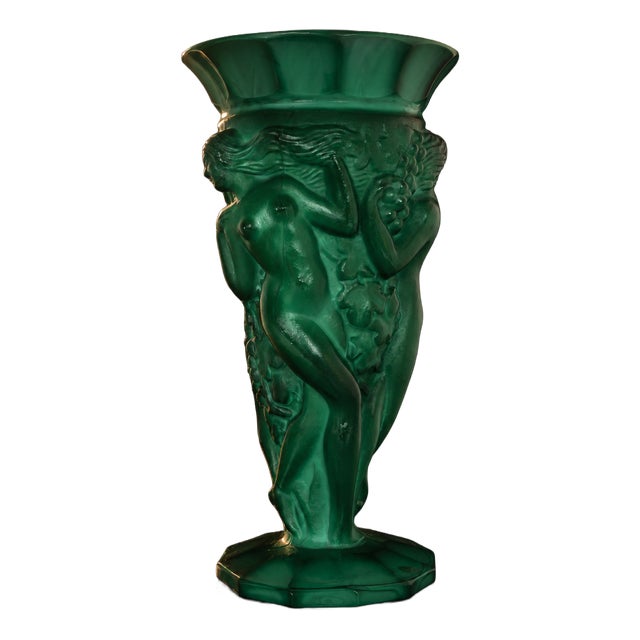
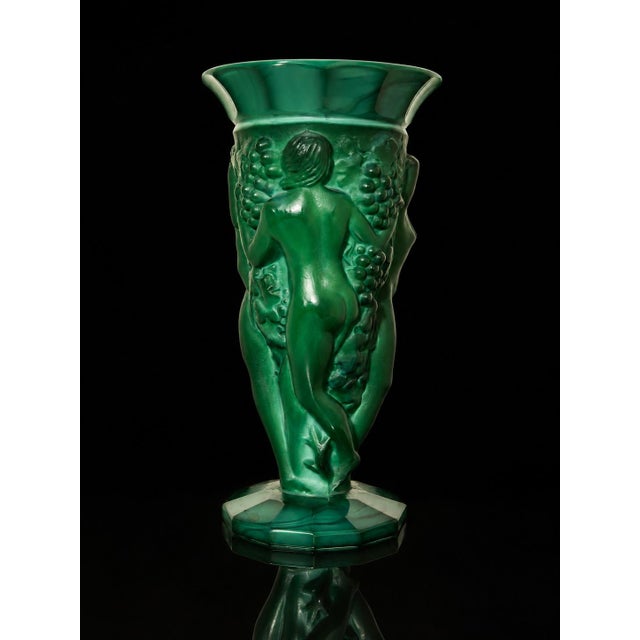
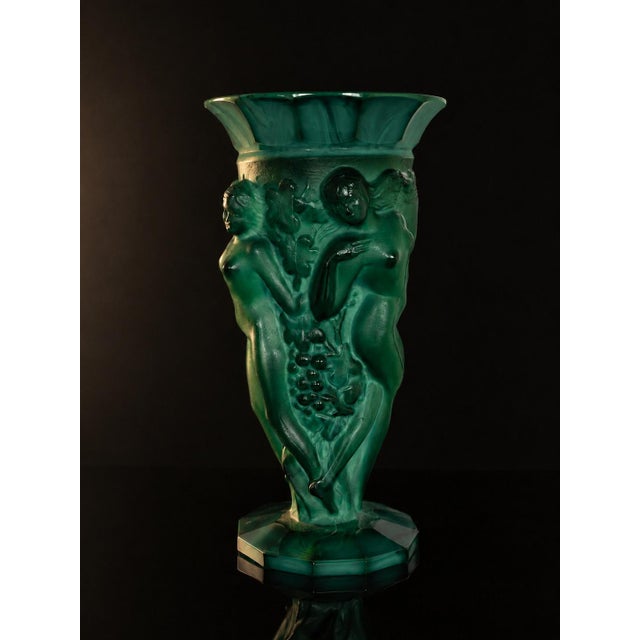
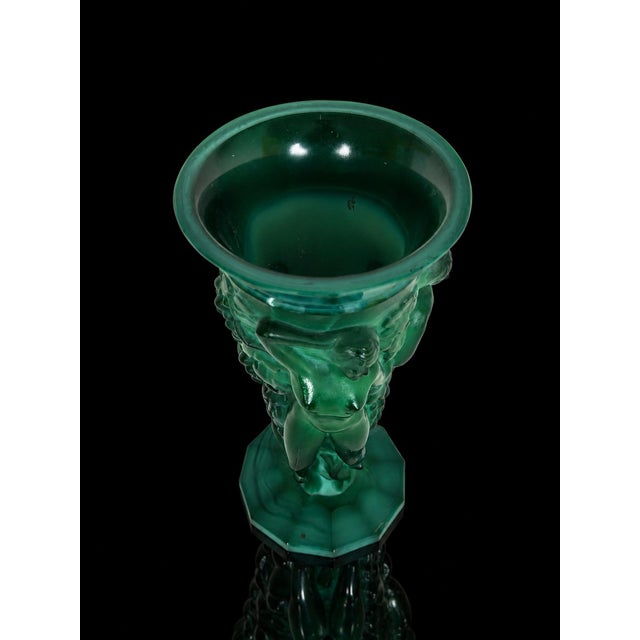
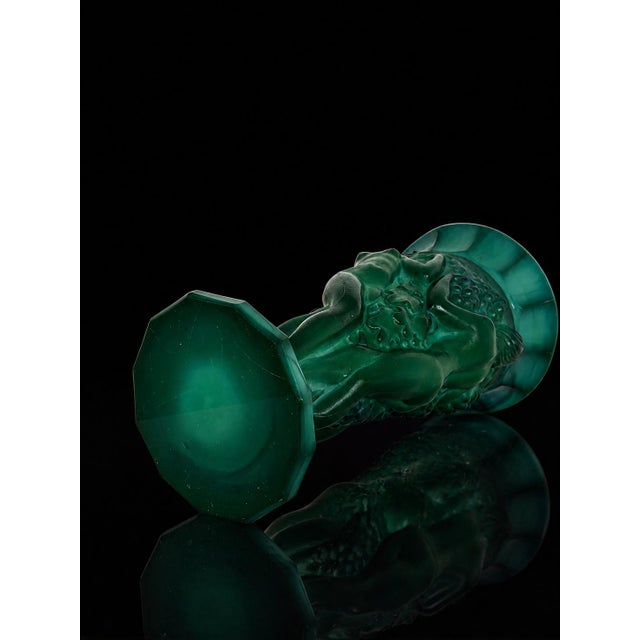
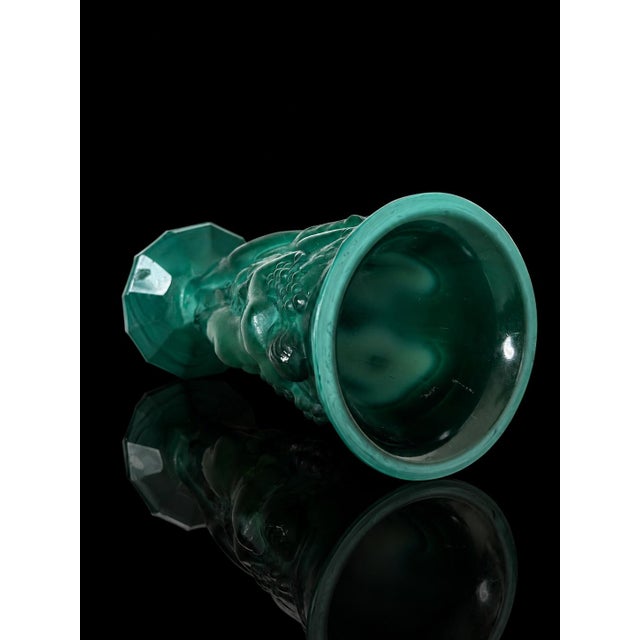
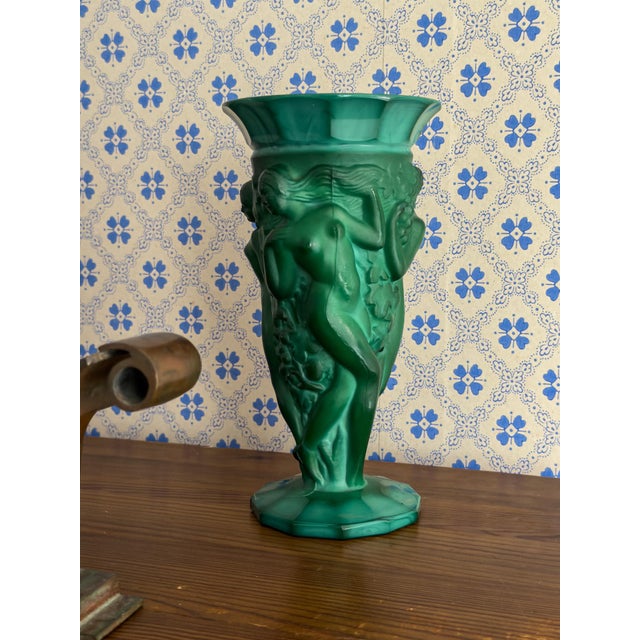
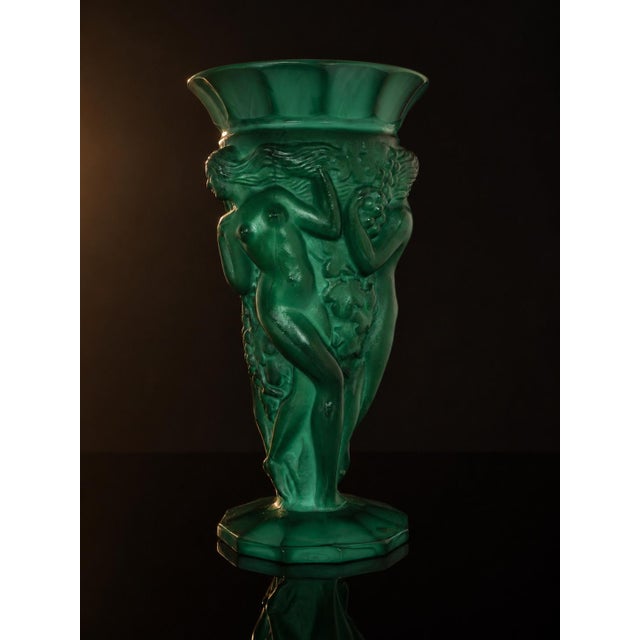
Executed in richly marbled green glass, commonly referred to as malachite glass, the vase was created to evoke the appearance and depth of natural malachite. The swirling variations of deep and lighter greens give the material an extraordinary stone-like character, while allowing light to interact with the sculptural relief across its surface.
Malachite glass became particularly associated with the sophisticated pressed-glass production of the Gablonz region of Czechoslovakia during the interwar period. Glassmakers in the region developed increasingly elaborate techniques that allowed moulded glass to take on the appearance and presence of carved semi-precious stone.
František Pazourek was an important figure within this remarkable period of glass design.
Trained in the celebrated Bohemian glassmaking tradition, Pazourek continued his artistic education in Prague under the sculptor and glass artist Josef Drahoňovský. His background in sculpture became fundamental to his approach to glass, and the human figure would become one of the defining elements of his work.
In 1929, Pazourek joined Heinrich Hoffmann in Gablonz, one of the leading manufacturers of luxury artistic pressed glass. Working as an in-house designer, he developed a distinctive sculptural vocabulary particularly suited to the possibilities of moulded glass.
His designs frequently incorporated female figures, grapes, vines, leaves and other natural forms directly into the architecture of the object. Decoration was no longer simply applied to the surface; figure, ornament and vessel became a single sculptural composition.
This vase is a particularly striking expression of that approach.
Female figures emerge in pronounced relief from a luxuriant composition of vines and clusters of grapes. The figures appear almost carved from the green material itself, while the irregular marbling of the glass creates constantly changing areas of light and shadow.
The combination gives the vase an unusual visual ambiguity. from a distance it can resemble an object carved from a block of malachite or jade; viewed more closely, the remarkable precision of the moulded glass and the complexity of Pazourek’s composition become apparent.
The history of Pazourek’s work is closely connected with two of the most important names in interwar Bohemian decorative glass: Heinrich Hoffmann and Curt Schlevogt.
Hoffmann was among the pioneers of sophisticated moulded art glass in Gablonz. Curt Schlevogt subsequently developed this tradition further through his celebrated Ingrid collection, combining highly sculptural designs with extraordinary glass colours intended to evoke luxurious natural materials such as jade, lapis lazuli and malachite.
These objects represented an intriguing meeting point between art and industry. Complex moulds made it possible to reproduce extraordinarily detailed sculptural compositions, while careful finishing gave the finest examples a quality far removed from ordinary industrial pressed glass.
Pazourek’s artistic language was particularly well suited to this new medium. His training allowed him to treat the entire surface of a vessel as a sculptural field, with bodies, vegetation and ornament flowing continuously around the form.
The rich green malachite-effect glass further enhances this quality. Variations within the material accentuate the depth of the relief and ensure that no two castings have precisely the same visual character.
The result is an object that occupies a fascinating position between vessel and sculpture.
It also represents an extraordinary chapter in European Art Deco design, when the centuries-old glassmaking traditions of northern Bohemia encountered modern industrial techniques and the luxurious visual language of the interwar period.
Today, Pazourek’s work is appreciated not simply as decorative glass but as sculptural design in its own right. The combination of the monumental female figures, abundant natural imagery and richly marbled green glass gives this vase a particularly strong presence.
A remarkable example of Czechoslovakian Art Deco glass, combining František Pazourek’s sculptural imagination with the technical sophistication and extraordinary material effects for which the great Gablonz glassmakers became internationally renowned.
See less
- Dimensions
- 4.72ʺW × 4.72ʺD × 9.06ʺH
- Period
- 1930s
- Country of Origin
- Czechia
- Item Type
- Vintage, Antique or Pre-owned
- Materials
- Glass
- Condition
- Good Condition, Unknown, Some Imperfections
- Color
- Green
- Condition Notes
- Very Good — This vintage item has no defects, but it may show slight traces of use. Very Good — This vintage item has no defects, but it may show slight traces of use. less
Returns & Cancellations
Return Policy - All sales are final 48 hours after delivery, unless otherwise specified in the description of the product.
Cancellation Policy - Prior to shipping or local pickup, buyers may cancel an order for up to 48 hours, unless otherwise specified.
Related Collections
- Clarice Cliff Vases
- Franco Bucci Vases
- Dorothy Draper Vases
- Karl Springer Vases
- Cristalleries De Sevres Vases
- Southeast Asia Vases
- From Vienna Vases
- Workaday Handmade Vases
- St. Louis Crystal Vases
- Arcore Ceramica Vases
- Poltronova Vases
- Surface Ceramics Vases
- Graphite Vases
- Liz Marsh Vases
- Ralph Lauren Home Vases
- The American School Vases
- Bimini Glass Vases
- Libbey Glass Co. Vases
- Raymor Import Vases
- Lenox Vases
- Blenko Vases
- Swung Vases
- Fenton Art Glass Company Vases
- Viking Glass Company Vases
- Haeger Vases