




Details
Description
A beautifully preserved matched pair of antique Chinese silk sleeve bands from the late Qing dynasty, presented together as a …
Read more
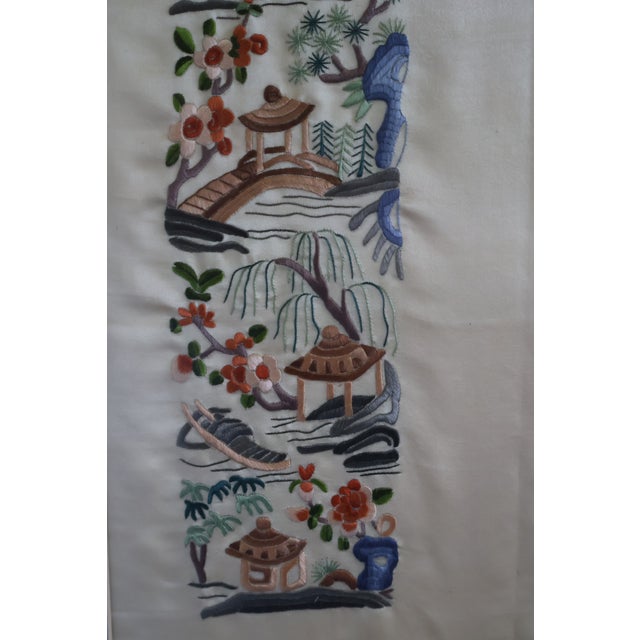
A beautifully preserved matched pair of antique Chinese silk sleeve bands from the late Qing dynasty, presented together as a single framed textile artwork. Hand-embroidered on a softly luminous ivory silk ground, the slender panels depict complementary garden landscapes filled with pavilions, arched bridges, small boats, flowering trees, cascading willows, pine branches, stylized mountains and blue scholar’s rocks.
Originally created as decorative sleeve or cuff elements for a Chinese woman’s robe, the bands were designed to bring elaborate needlework into prominent view when the garment was worn. Their narrow vertical format encouraged compositions that unfold sequentially, and here each panel reads almost like a miniature handscroll turned upright.
Cloud-wrapped mountain peaks introduce the scenes at the top. Below, tiered pavilions appear among leafy trees and dark rocky terraces before the compositions descend through flowering garden passages, water, bridges and small boats. The landscapes conclude with further architecture, blossoms and scholar’s rocks, giving each band a complete visual rhythm from summit to water’s edge.
The embroidery is executed predominantly in lustrous shaded satin and long-and-short stitches. Changes in thread color and stitch direction model the flower petals, foliage, roofs, bridges, rocks and mountains, while finer stem and outline stitches describe clouds, rippling water, willow branches and architectural details. The dimensional blossoms, needle-like pine clusters and layered blue rocks are especially effective at close range.
Although conceived as a coordinated pair, the bands are not mechanically identical. Subtle differences in motif placement, shading and execution reveal their handmade character and give the compositions an appealing individuality.
The two historic textile fragments are mounted side by side beneath a broad pale blue-gray mat and glass. A dark reddish-brown wood frame gives the work a restrained architectural presence and allows its coral, celadon, teal and cobalt embroidery to remain the focus.
For a designer, the unusually generous framed scale makes this pair more substantial than a single narrow textile fragment. It would provide an elegant vertical accent above a console, commode or writing desk, between windows or bookcases, or as part of a collected Chinoiserie gallery wall.
The softly aged ivory ground and nuanced palette coordinate beautifully with blue-and-white porcelain, lacquerware, antique brass, dark woods, botanical prints and time-softened textiles. The work would be equally compelling in an English Country drawing room, Grandmillennial bedroom, paneled library, traditional entry, jewel-box powder room or globally collected interior.
Preserved outside their original garment context, the sleeve bands now offer both historic textile interest and considerable decorative presence. Their paired symmetry, extensive handwork and lyrical garden imagery make them particularly effective as framed wall art.
A distinctive and highly decorative example of late-Qing Chinese textile artistry, combining extensive hand embroidery, classical garden imagery and an elegant ready-to-hang presentation.
IDENTIFICATION AND DATING
The estate cataloged the textiles as antique Chinese hand-embroidered silk panels, likely sleeve bands. Their matched narrow format, paired landscape compositions, ivory silk ground and polychrome embroidery correspond closely with Qing-dynasty decorative over-sleeves preserved in institutional collections.
Tsinghua University Art Museum identifies comparable Qing examples as decorative over-sleeves and describes over-sleeves as common decorations for women’s garments, characteristically narrow and long. The Metropolitan Museum of Art holds numerous Chinese embroidered sleeve bands from the 19th century in similarly elongated formats.
The probable circa-1880–1910 date is a conservative visual estimate based on the format, materials, palette, imagery and comparison with documented late-Qing examples. No inscription, dated label or original garment survives to establish an exact production year.
The visible embroidery supports identification of shaded satin, long-and-short, stem and outline stitches. Because the textiles have not been removed from the frame and their reverse sides remain concealed, no claim is made for split-thread work, Peking knot, forbidden stitch, Suzhou manufacture or another named regional embroidery school.
PROVENANCE
Private collection
Acquired from an estate collection
AUCTION MARKET COMPARISON
In a documented Christie’s sale, a group of seven framed embroidered silk sleeve bands cataloged as late Qing dynasty was offered with an auction estimate of $2,000–$3,000 and realized $2,500. The Christie’s group included three coordinated sets depicting horses, figures in a landscape and precious objects.
That result provides useful market context for the continuing collectibility of framed late-Qing sleeve bands. It should not be interpreted as a direct per-piece valuation, as the seven textiles were sold together in one lot and differed from the present pair in subject, embroidery, condition, presentation and provenance.
RESEARCH SOURCES
Tsinghua University Art Museum, Qing-dynasty embroidery and decorative over-sleeve collection
The Metropolitan Museum of Art, 19th-century Chinese embroidered sleeve-band collection
Christie’s, “Collecting Guide: Chinese Robes”
Christie’s, “Seven Framed Embroidered Silk Sleeve Bands,” Late Qing Dynasty
KEYWORDS
antique Chinese sleeve bands, Qing dynasty sleeve bands, Chinese embroidered silk panels, late Qing textile art, framed Chinese embroidery, Chinese landscape embroidery, antique silk sleeve panels, hand embroidered Chinese silk, Chinese pavilion landscape, Chinoiserie textile art, paired Chinese sleeve bands, Chinese robe embroidery, ivory silk embroidery, scholar’s rock embroidery, Chinese garden textile, pavilion and bridge embroidery, antique Asian wall art, framed Qing dynasty textile, Grandmillennial wall decor, traditional Chinese embroidery, designer Chinoiserie art, blue-and-white porcelain decor, English Country Asian art, collected traditional interior, Chinese silk wall hanging, antique textile fragment, paired embroidered panels, ready to hang Asian art
See less
- Dimensions
- 19ʺW × 1ʺD × 29.5ʺH
- Period
- Late 19th Century
- Country of Origin
- China
- Item Type
- Vintage, Antique or Pre-owned
- Materials
- Silk
- Wood
- Condition
- Good Condition, Unknown, Some Imperfections
- Color
- Ivory
- Condition Notes
- Good antique condition with remarkably strong embroidery retention and an attractive overall presentation. The polychrome silk threads remain lustrous, richly … moreGood antique condition with remarkably strong embroidery retention and an attractive overall presentation. The polychrome silk threads remain lustrous, richly colored and well defined, preserving a sophisticated palette of cobalt and slate blue, celadon, deep teal, coral, ivory, russet, taupe, lavender-brown and charcoal. No widespread unraveling, large open losses, holes or shattered areas of silk are visible in the photographed portions of either panel. A few isolated thread irregularities, slightly relaxed stitches and minor inconsistencies in tension are present, particularly within certain flower centers and finely outlined passages, but the embroidered landscapes remain substantially complete and visually cohesive. The ivory silk ground exhibits age-related tonal variation, scattered faint marks, gentle rippling, soft horizontal and vertical creases and localized puckering around embroidered passages. These characteristics are consistent with the textiles’ age, former garment function and later mounting. The bands have been mounted together beneath a pale blue-gray mat and glass. Because the textiles remain enclosed within the frame, their complete edges, reverse sides, mounting method and portions concealed beneath the mat have not been examined. The dark reddish-brown wood frame displays age-appropriate surface marks, rubbing and localized finish loss, particularly along the reverse edges. The rear is fitted with a plywood backing board secured by metal brads. Broad uneven marks and adhesive residue remain around the backing board’s perimeter where earlier duct tape was removed. According to the owner, these marks are remnants of the former tape application rather than water damage. Clear tape was subsequently applied around portions of the backing and frame to help secure the assembly. The framing glass is intact, and an attached hanging wire allows the piece to be displayed upon receipt. No maker’s, framer’s or provenance label is visible on the reverse. Please review all photographs closely, particularly the silk ground, embroidery, creases, frame edges, backing board, adhesive residue and later tape. less
Questions about the item?
Returns & Cancellations
Return Policy - All sales are final 48 hours after delivery, unless otherwise specified in the description of the product.
Cancellation Policy - Prior to shipping or local pickup, buyers may cancel an order for up to 48 hours, unless otherwise specified.
Related Collections
- Loloi Rugs Textile Art
- Louis XIII Textile Art
- Resin Textile Art
- Workaday Handmade Textile Art
- Antique Gold Finish Textile Art
- Kenneth Ludwig Chicago Textile Art
- Chanel Textile Art
- Mid-Century Modern Textile Art
- Chinese Textile Art
- Japanese Textile Art
- Tapestry
- Framed Scarves
- Scandinavian Textile Art
- Aubusson Tapestry
- Edwardian Textile Art
- Cardboard Textile Art
- Märta Måås-Fjetterström Textile Art
- Ralph Lauren Textile Art
- Surrealism Textile Art
- Space Age Textile Art
- Pablo Picasso Textile Art