




Details
Description
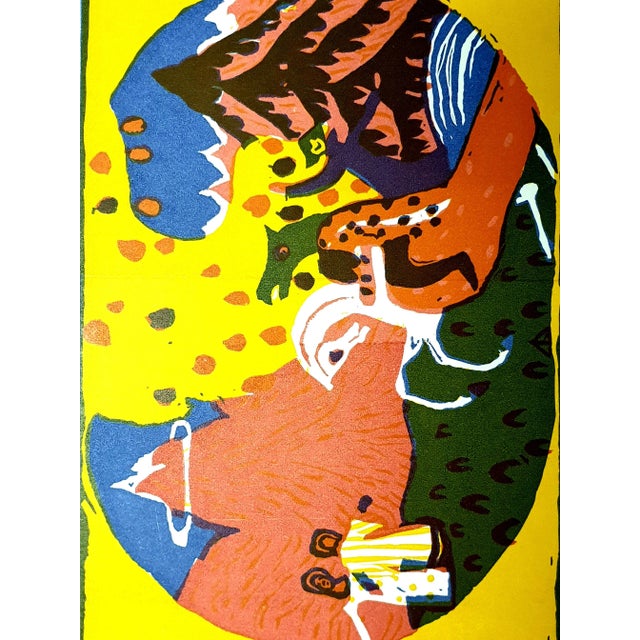
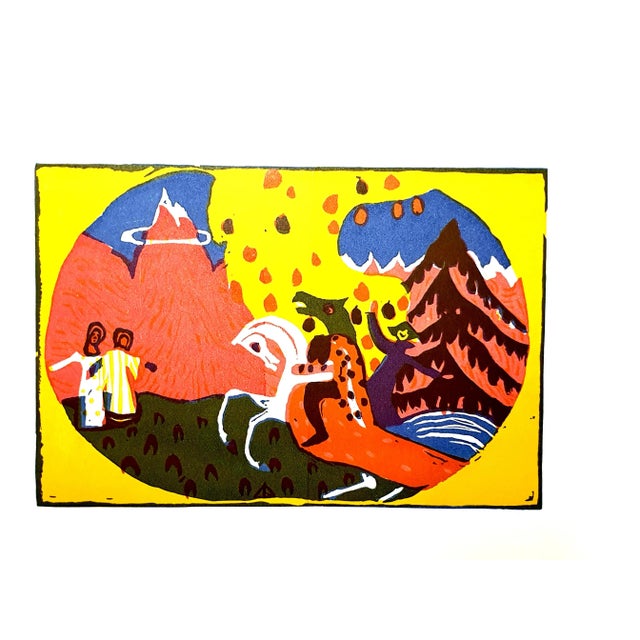
Wassily Kandinsky - Horse Knight - Original Etching Conditions: excellent 32 x 24 cm 1966 XXe siècle, San Lazzaro Of … Read more Wassily Kandinsky - Horse Knight - Original Etching Conditions: excellent 32 x 24 cm 1966 XXe siècle, San Lazzaro Of a well-to-do and cultivated family, Vassily Kandinsky was born in Moscow in 1866. He followed studies of law and economics at the University of Moscow entering in the studio of Anton Azbé, then at the Academy of Fine Arts of Munich in 1896. His first solo exhibition takes place in 1903. Wassily Kandinsky is co-founder, in 1901, of the group Die Phalanx, of the New Association of the artists of Munich (1909-1911), and the Blaue Reiter (Cavalier bleu, 1911-1914, with Franz Marc and the German expressionists). From 1902 to 1915, he lives with the painter Bariele Munter. Until 1909, Kandinsky paints the countryside, views of Moscow, producing wood etchings. His first works are of a naturalist essence, however through his different trips to Europe and his stay in Paris from 1906-1907; he discovers other avenues through the work of Cézanne, Matisse and Picasso. From 1909, the artist works with color through its own power of expression, and makes objects disappear on the canvas; he produces, in 1910, his first ‘Abstract Watercolors’, then, the following year, his first abstract paintings. He thus becomes a great initator and theorist of abstractions, utilizing forms that painting borrows from nature. Returning to Moscow in 1914, Kandinsky becomes a member, after the October Revolution, of the Commissary of the People of Instruction of the Section of Plastic Arts, teaching art at the free studios (Svomas), before becoming director at the Inkhouk and the museum of Pictorial Culture (1920-1921). In disagreement with the constructivists, Kandinsky leaves to teach at the Bauhaus in 1922. The Bauhaus made it possible, in Kandinsky’s eyes, to render his utopian project to reconstruct the world under a spiritual sign. From 1922, Kandinsky is said to have penetrated into the interior of form, not borrowing from nature and representing ‘not only exterior aspects of an object, but constructive elements, laws of tension’. Kandinsky introduces into his work a ‘lyrical geometric’ where signs become symbols. In 1924, he is co-founder of the ‘Quatre Bleus’ group. He immigrates to Paris in 1933, on the arrival of the Nazi’s and acquires French nationality in 1939. His canvases are removed from German museums in 1937. Wassily Kandinsky, father of abstraction and for-runner of abstract expressionism, died in Neuilly-sur-Seine in 1944. See less
- Dimensions
- 9.45ʺW × 0.39ʺD × 12.6ʺH
- Art Subjects
- Nude
- Period
- Early 21st Century
- Item Type
- Vintage, Antique or Pre-owned
- Materials
- Canvas
- Wood
- Condition
- Good Condition, Some Imperfections
- Color
- Yellow
- Condition Notes
- Very Good — This vintage item has no defects, but it may show slight traces of use. Very Good — This vintage item has no defects, but it may show slight traces of use. less
Returns & Cancellations
Return Policy - All sales are final 48 hours after delivery, unless otherwise specified in the description of the product.
Cancellation Policy - Prior to shipping or local pickup, buyers may cancel an order for up to 48 hours, unless otherwise specified.
Related Collections
- Soicher Marin Original Prints
- Rattan Original Prints
- Medium-Density Fibreboard Original Prints
- Ralph Lauren Original Prints
- Sam Francis Original Prints
- Silver Finish Original Prints
- Johannes Kip Original Prints
- Dye Transfer Original Prints
- Donald Sultan Original Prints
- Original Prints in Lexington, KY
- Original Prints in Panama City, FL
- Original Prints in Salt Lake City
- Damien Hirst Original Prints
- Botanical Prints
- Framed Prints
- Bird Prints
- Woodblock Prints
- Screen Prints
- Japanese Woodblock Prints
- Thomas McKnight Original Prints
- George Barbier Original Prints
- Frank Stella Original Prints
- Gustave Baumann Original Prints
- Teak Original Prints
- Clay Original Prints