



Details
Description
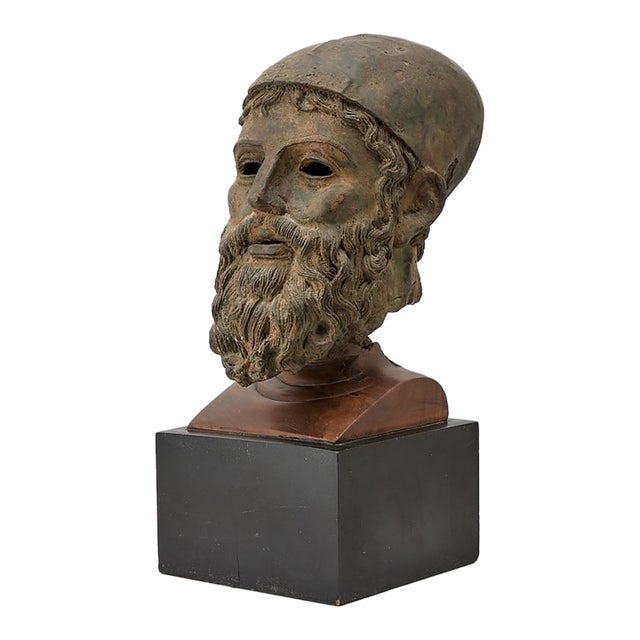
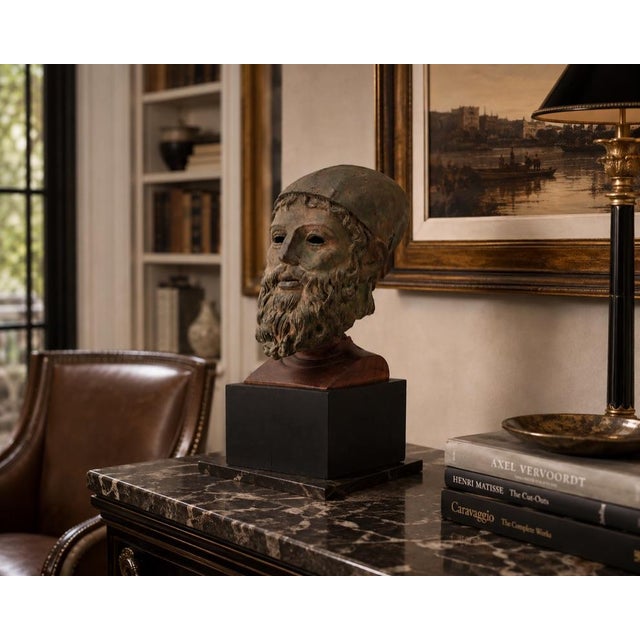
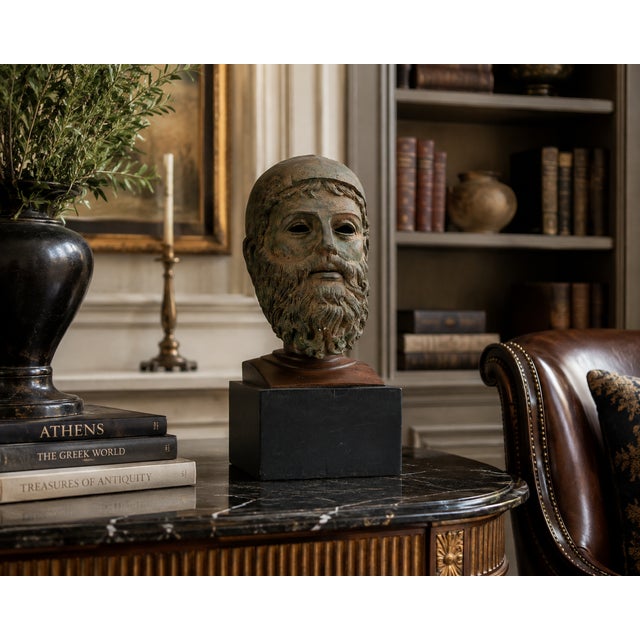
19th Century Grand Tour Patinated Bronze Head of a Classical Bearded Deity, Poseidon
Bronze head: 14 in. high (35.5 cm)
…
Read more
19th Century Grand Tour Patinated Bronze Head of a Classical Bearded Deity, Poseidon
Bronze head: 14 in. high (35.5 cm)
Overall height including pedestal: 22 1/2 in. (57 cm)
Date: 19th century
Period / Style: Grand Tour / Neoclassical / Greek Revival / Archaizing
Material: Hollow-cast patinated bronze, carved wood, metal support and ebonized pedestal
Subject: Traditionally identified as Poseidon / Neptune; possibly after an ancient Greek prototype
Origin: Continental European, possibly Italian
Description:
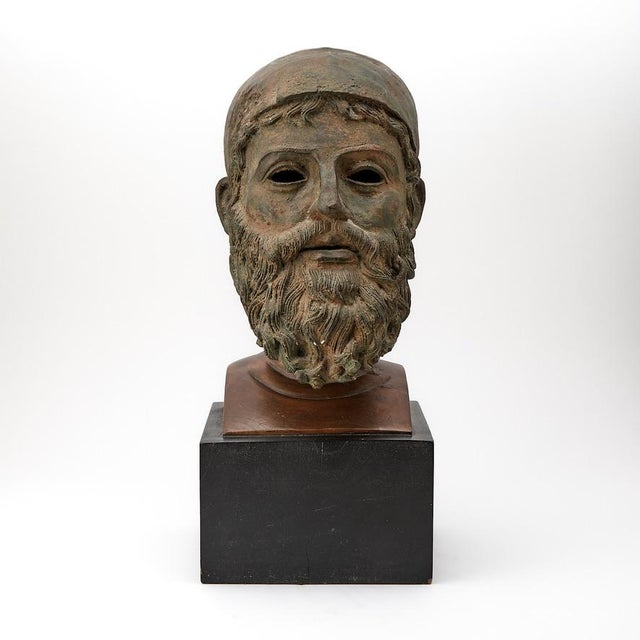
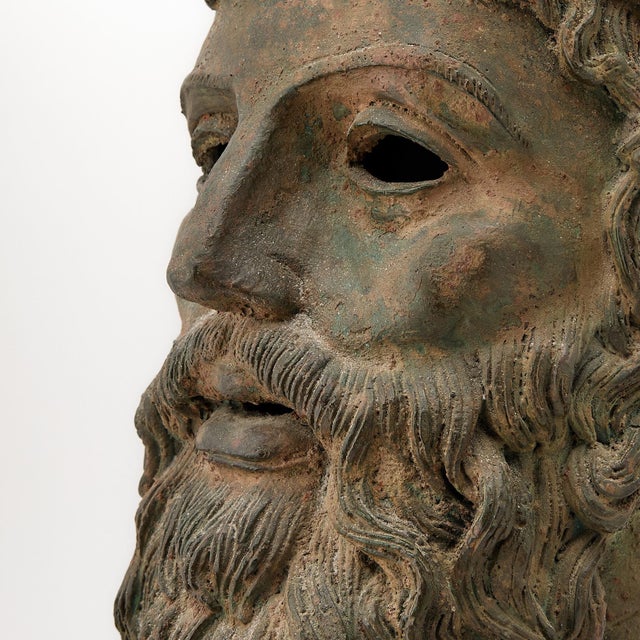
An impressive and unusually evocative 19th-century Grand Tour bronze head in the Archaic Greek taste, traditionally identified as Poseidon (Neptune), the ancient Greek god of the sea.Measuring an imposing 22 1/2 inches overall, the sculpture is conceived in the manner of an archaeological fragment, with hollow inset-style eyes, a richly articulated beard, distinctive close-fitting pilos-type cap, and a deeply variegated green and brown patina intended to evoke the surface character of an excavated ancient bronze.The combination of these distinctive features suggests that the sculpture may have been inspired by, or adapted from, a specific ancient Greek sculptural prototype or established Archaic iconographic type, rather than being simply a generalized 19th-century representation of Neptune.
Facial Modeling
The mature male figure possesses a powerful, almost hieratic presence. The broad, strongly symmetrical face is characterized by a long straight nose, pronounced brow, high cheekbones, almond-shaped eye openings and slightly parted lips.Particularly striking are the deeply recessed hollow eye sockets. Ancient Greek and Roman bronzes were frequently constructed with separately fashioned eyes of contrasting materials inserted into the cast head. The open sockets of the present sculpture deliberately recall that ancient technique and contribute substantially to its archaeological appearance.The restrained expression, frontal symmetry and highly ordered treatment of the facial hair impart a distinctly Archaizing character, recalling sculptural conventions developed in Greece during the late Archaic and early Classical periods.
Remarkably Detailed Beard and Hair
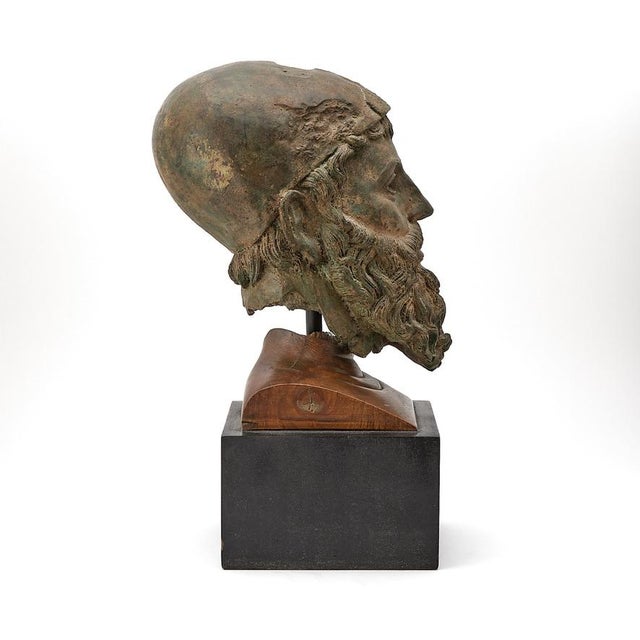
The treatment of the beard is among the sculpture's most compelling features.A substantial moustache sweeps outward from beneath the nose and merges into a luxuriant full beard composed of numerous overlapping locks. Each section is individually articulated with deeply incised parallel striations, producing an intricate rhythm of curling and S-shaped strands.Longer locks cascade along the cheeks and jaw before converging beneath the chin, while shorter, more tightly arranged sections articulate the moustache and upper beard.The considerable undercutting and variation in depth create strong contrasts of light and shadow, giving the beard a sculptural richness that becomes especially apparent when the head is viewed in profile.Short locks of similarly striated hair emerge beneath the head covering around the forehead, temples and back of the neck.
Pilos-Type Cap and Possible Ancient Prototype
One of the sculpture's most distinctive features is the smooth, rounded cap fitted closely to the skull. Its clearly defined lower edge sits immediately above the forehead, with locks of hair emerging naturally beneath it.The form recalls the ancient Greek pilos, a close-fitting cap encountered in Greek sculpture and iconography.The combination of a mature bearded male, pilos-type head covering and strongly stylized facial hair has precedents within ancient Greek art. Archaeological literature records comparable bearded, pilos-wearing male types and has associated related Archaic examples with representations including Poseidon.The present bronze should nevertheless not be considered an exact reproduction of a particular ancient sculpture without further documentary evidence. More cautiously, its distinctive iconography suggests that the 19th-century sculptor or foundry was likely drawing upon an ancient or archaeologically inspired Greek prototype.The traditional identification as Poseidon / Neptune is therefore compelling, though not definitive.
Hollow-Cast Construction
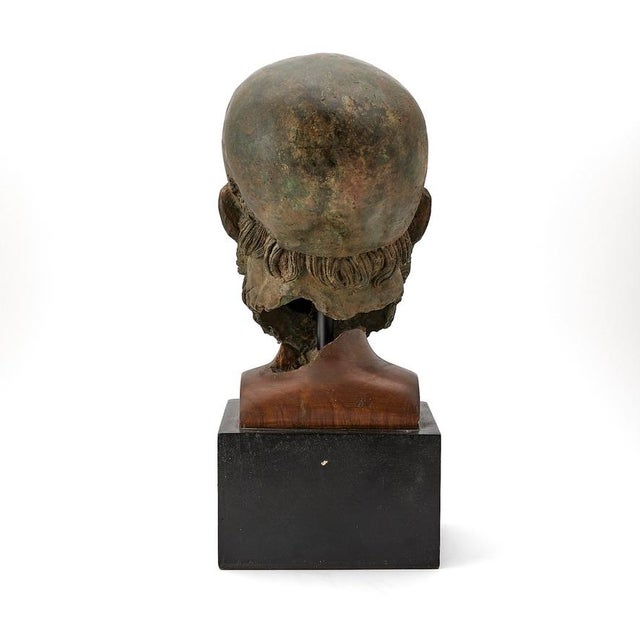
The head is hollow cast in bronze, with its construction particularly evident from the reverse, where the irregular open lower portion of the casting remains visible.Rather than disguising this fragmentary character, the later mounting deliberately presents the head in the manner of an excavated museum object.A discreet metal support secures the bronze to its custom wooden mount while allowing the irregular lower edge of the casting to remain visible from behind.
Exceptional Archaeological-Style Patina
The bronze possesses an especially attractive and complex surface, with a richly mottled combination of olive green, verdigris, deep brown, reddish-brown, ochre and nearly black tones.Areas of pitting, oxidation and irregular mineral-like surface accretion further enhance its archaeological character.The patination is particularly effective across the broad smooth surface of the cap, where subtle tonal variations are readily visible, while darker deposits within the recesses of the beard accentuate the individual curls and deeply incised strands.Rather than appearing uniformly decorative, the complex surface gives the sculpture the compelling appearance of an ancient bronze transformed through centuries of oxidation and burial.
Custom Museum-Style Mounting
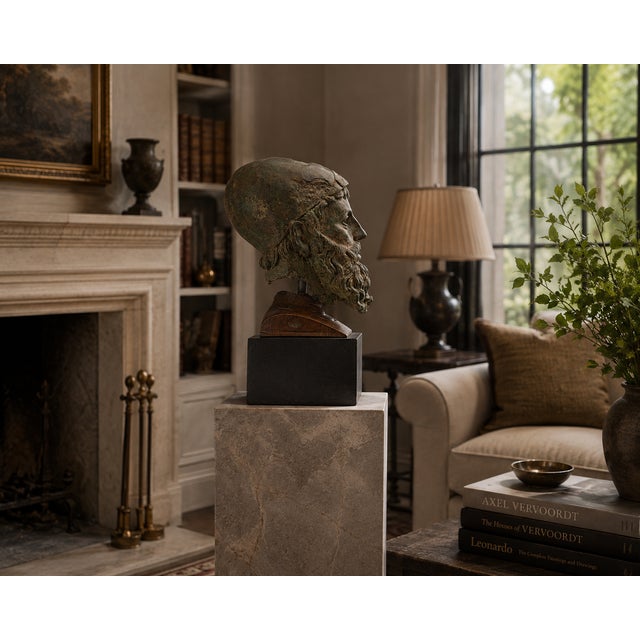
The bronze is mounted upon a handsome warm-toned carved wooden socle, carefully shaped to accommodate the fragmentary lower portion of the head.The wooden mount rests upon a substantial rectangular ebonized black pedestal, producing an elegant museum-style presentation.The juxtaposition of richly patinated bronze, warm wood and restrained black base is particularly successful, giving the object a sophisticated architectural presence while allowing it to be appreciated from every angle.
Grand Tour Context
During the 18th and 19th centuries, the Grand Tour introduced generations of European and American travelers, collectors, scholars and artists to the archaeological sites and great collections of Italy, Greece and the Mediterranean.Classical antiquity became synonymous with education, cultivation and connoisseurship, creating a flourishing market for bronze reductions, casts and interpretations of ancient sculpture.Some reproduced celebrated masterpieces with considerable accuracy, while others adapted ancient sculptural types and archaeological discoveries into new objects intended for collectors' libraries, studies and cabinets.This bronze belongs convincingly to that tradition. Its unusual combination of Archaizing facial modeling, hollow inset-style eyes, pilos-type cap, elaborate beard and deliberately archaeological surface distinguishes it from the more conventional Classical Revival busts produced purely for decorative purposes.Its precise ancient source remains unidentified, but the specificity of the sculptural vocabulary raises the intriguing possibility that the bronze preserves or interprets a recognizable ancient model.
Dimensions
Bronze head: 14 in. high (35.5 cm)
Overall height including pedestal: 22 1/2 in. (57 cm)
Date: 19th century
Period / Style: Grand Tour / Neoclassical / Greek Revival / Archaizing
Material: Hollow-cast patinated bronze, carved wood, metal support and ebonized pedestal
Subject: Traditionally identified as Poseidon / Neptune; possibly after an ancient Greek prototype
Origin: Continental European, possibly Italian
See less
- Dimensions
- 12ʺW × 10ʺD × 22.5ʺH
- Styles
- Neoclassical
- Art Subjects
- Mythology
- Period
- Early 19th Century
- Country of Origin
- Italy
- Item Type
- Vintage, Antique or Pre-owned
- Materials
- Bronze
- Sculpture Materials
- Wood
- Condition
- Good Condition, Original Condition Unaltered, Some Imperfections
- Color
- Bronze
- Condition Notes
- Excellent - Minor wear consistent with age and history Excellent - Minor wear consistent with age and history less
Questions about the item?
Returns & Cancellations
Return Policy - All sales are final 48 hours after delivery, unless otherwise specified in the description of the product.
Cancellation Policy - Prior to shipping or local pickup, buyers may cancel an order for up to 48 hours, unless otherwise specified.
Related Collections
- Straw Sculpture
- Roman Bronze Works Sculpture
- Constantin Brancusi Sculpture
- Fernando Botero Sculpture
- Louis XIV Sculpture
- Medium-Density Fibreboard Sculpture
- Polished Brass Finish Sculpture
- Recycled/Repurposed Sculpture
- Gourd Sculpture
- Sculpture in Panama City, FL
- Albert Ernest Carrier-Belleuse Sculpture
- Flavio Poli Sculpture
- Maison Jansen Sculpture
- Georgian Sculpture
- Sculpture in Columbus
- Barovier and Toso Sculpture
- Far Pavilions Sculpture
- Emmanuel Villanis Sculpture
- Geode Sculpture
- Antique Iron Finish Sculpture
- René Lalique Sculpture
- Worlds Away Sculpture
- Photography Sculpture
- Gold-Plate Sculpture
- Jute Sculpture