


Details
Description
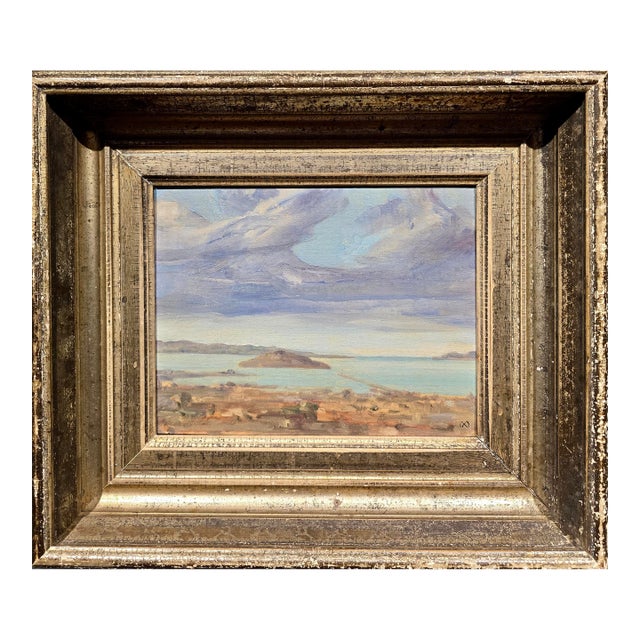
Xavier Martínez –Alcatraz Island, San Francisco Bay at Sunset – c. 1901 Oil Painting
California Impressionist - Oil painting on …
Read more
Xavier Martínez –Alcatraz Island, San Francisco Bay at Sunset – c. 1901 Oil Painting
California Impressionist - Oil painting on canvas board - Signed
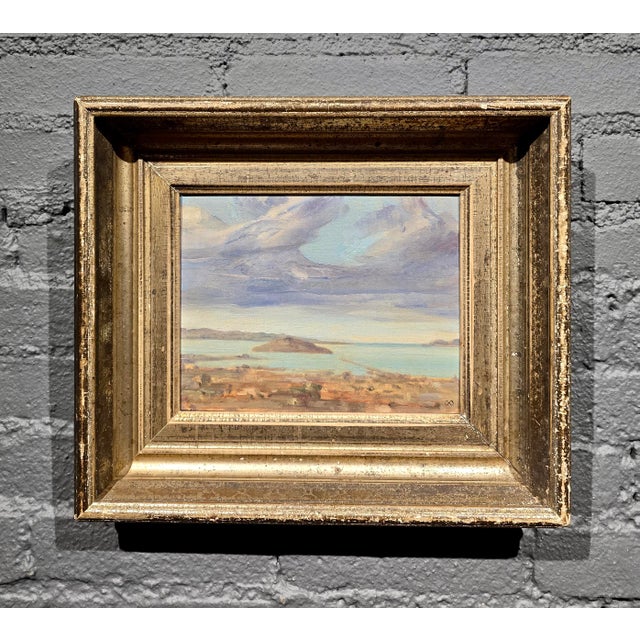
Canvas size: 8x10" - Frame size : 15x17x3"
Artist: Xavier Martínez (Mexican-American, 1869–1943)
Title: Alcatraz Island, San Francisco Bay at Sunset
Date: Early 20th century
Medium: Oil on canvas
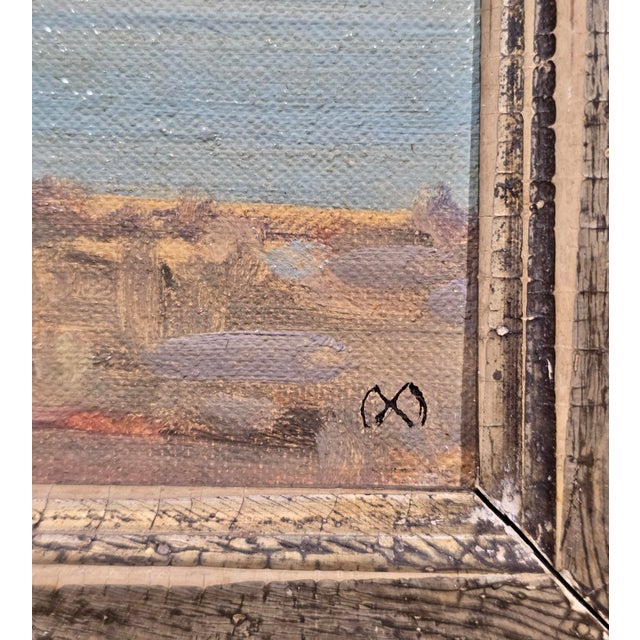
Signature: Monogrammed “XM” lower right
Subject: San Francisco Bay with Alcatraz Island
Frame: Period giltwood frame
Visual Overview and Composition
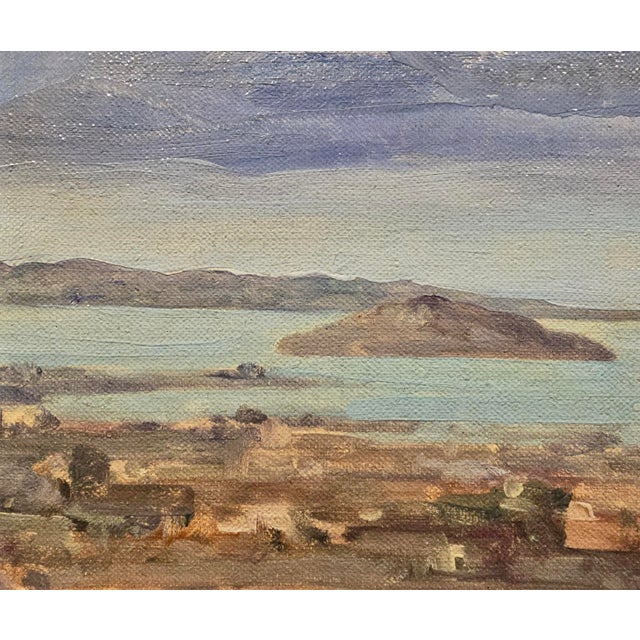
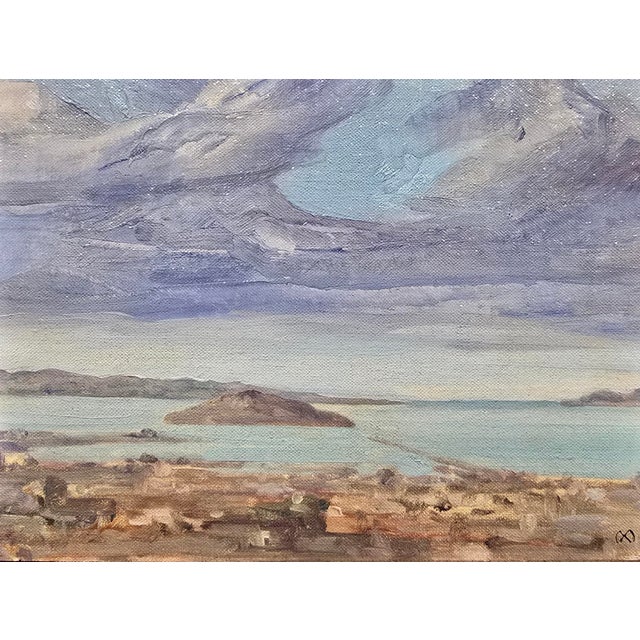
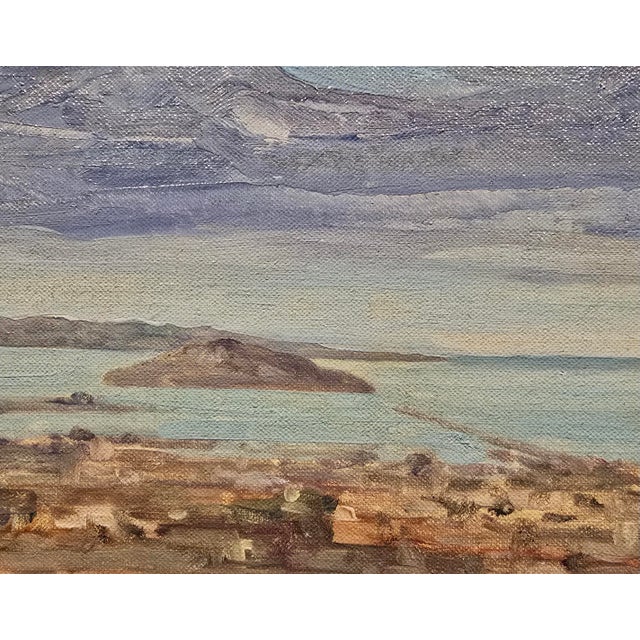
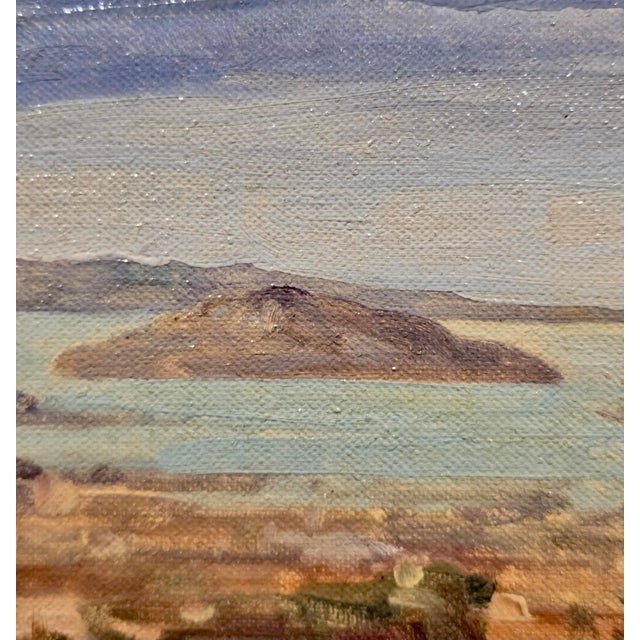
This atmospheric early 20th-century oil painting by Xavier Martínez presents a tranquil view across San Francisco Bay, with the distinctive low profile of Alcatraz Island occupying the middle distance beneath an expansive, dramatically illuminated sky.
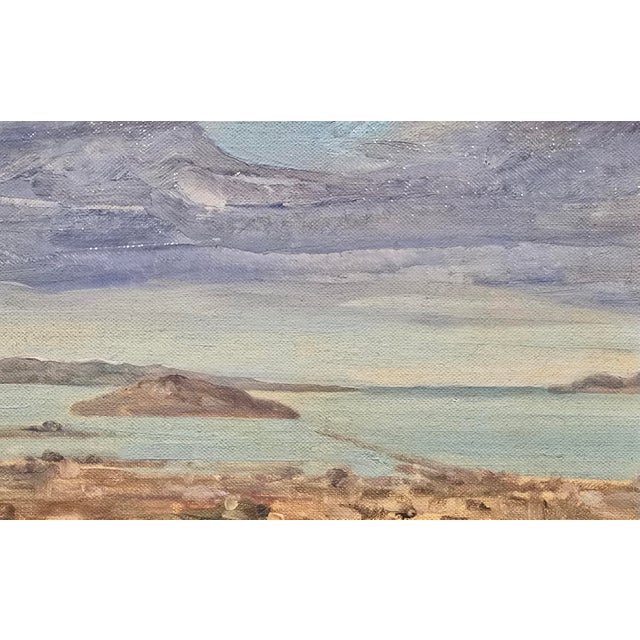
The composition is constructed in broad horizontal bands that lead the eye gradually from the foreground shoreline across the luminous waters of the Bay and toward the distant horizon. The lower portion of the canvas is rendered in warm, earthy passages of ochre, sienna, muted green, and umber. Martínez describes the foreground with abbreviated, painterly strokes rather than precise detail, allowing individual forms to dissolve into an overall impression of the historic Bay shoreline.Beyond this foreground, the water opens into a broad expanse of delicate turquoise, blue-green, and silvery gray. Near the center rises the compact form of Alcatraz Island, its warm earthen tones contrasting gently against the cooler water surrounding it. Farther in the distance, additional landforms appear as muted silhouettes, softened almost to abstraction by the atmospheric haze.A slender shoreline feature, pier, jetty, or spit of land extends diagonally from the right toward the open water. This subtle linear element draws the viewer's gaze into the composition and provides a counterpoint to the otherwise predominantly horizontal arrangement of land, island, and horizon.Yet the true protagonist of the painting is arguably the sky.Occupying more than half of the composition, great masses of windswept clouds unfold above the Bay in sweeping passages of lavender, violet-gray, pale blue, cream, and touches of turquoise. Martínez captures the transient illumination of late afternoon or approaching twilight, when the final light of the day transforms both water and atmosphere into closely related veils of color.Rather than documenting San Francisco Bay with strict topographical precision, Martínez transforms the familiar landscape into a meditation on light, distance, atmosphere, and stillness.
Artistic Style and Technique
The painting is closely aligned with the principles of Northern California Tonalism, an important aesthetic current in Bay Area painting during the late 19th and early 20th centuries. Tonalist artists sought not merely to reproduce the physical appearance of a landscape, but to communicate its emotional and atmospheric character through restrained color, softened contours, and carefully modulated relationships of light and shadow.Here, Martínez avoids the brilliant, high-key palette and sharply broken sunlight associated with much Impressionist painting. Instead, he employs a sophisticated range of closely related colors—cool blue-grays, lavender, turquoise, cream, ochre, and muted earth tones—to create a unified and contemplative atmosphere.His handling of paint changes according to the character of each passage. The foreground is established through loose, abbreviated touches of color, while the Bay itself is painted more quietly, creating the sensation of calm water reflecting the changing sky. The clouds are considerably more animated, formed through broad, fluid strokes that give the upper portion of the painting a sense of movement and grandeur.Particularly effective is Martínez's treatment of atmospheric perspective. Forms become progressively softer as they recede: the foreground shoreline gives way to the island, the island to distant landforms, and finally land and water seem almost to disappear into the luminous horizon.The effect is both intimate and expansive. Despite the painting's relatively small scale, Martínez creates a remarkable sensation of distance and open space.In the lower right corner appears the artist's characteristic “XM” monogram, discreetly incorporated into the painted surface.
Alcatraz and the Historic San Francisco Bay
The identification of the central landform as Alcatraz Island gives the painting an additional historical dimension.Long before Alcatraz became internationally famous for the federal penitentiary established there in 1934, the island was already one of the most recognizable landmarks of San Francisco Bay. During the second half of the 19th century and into the early 20th century, it was principally associated with military installations and fortifications protecting the entrance to the Bay.Martínez therefore depicts an Alcatraz belonging to an earlier chapter of San Francisco history—before the island acquired the imposing prison architecture and cultural associations by which it is known today.Rather than emphasizing buildings or military structures, however, the artist reduces Alcatraz to its essential geographic form. Seen across the expanse of water and beneath the immense evening sky, the island becomes part of the larger natural rhythm of the Bay.This restrained treatment is entirely consistent with Martínez's approach to landscape: place is recognizable, but atmosphere remains paramount.
The Frame
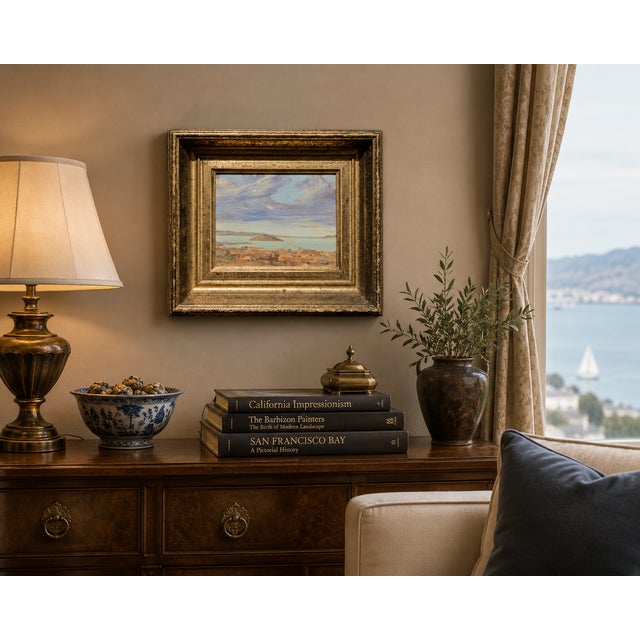
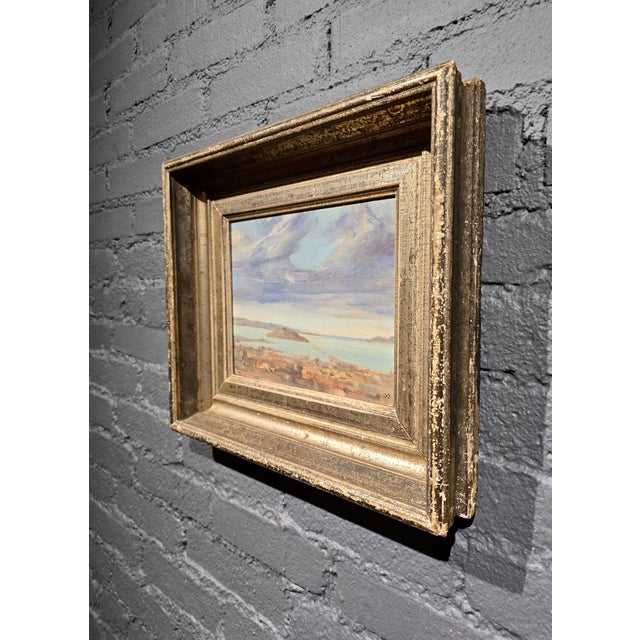
The painting is housed in a substantial period giltwood frame whose broad, deeply molded profile gives the small-scale composition considerable architectural presence.The aged gilded surface, with its naturally distressed patina and areas of wear, complements the muted earth tones and softly modulated colors of the painting. Rather than appearing overly polished, the frame retains the character accumulated through age and provides an especially sympathetic presentation for this historic California landscape.
Artist Biography: Xavier Martínez (1869–1943)
Xavier Timoteo Martínez Orozco was a Mexican-born American painter, educator, and influential figure in the development of California art during the late 19th and early 20th centuries.Born in Guadalajara, Mexico, in 1869, Martínez demonstrated artistic ability from an early age. As a young man he relocated to San Francisco, where he entered the city's rapidly developing artistic community and enrolled at the California School of Design at the Mark Hopkins Institute of Art.There he studied under Arthur Mathews, one of the leading figures in turn-of-the-century California painting and decorative arts. Martínez distinguished himself as an exceptionally talented student and soon pursued the advanced European training considered essential to ambitious American artists of his generation.In 1897, he traveled to Paris and continued his studies at the prestigious École des Beaux-Arts, working in the atelier of celebrated French painter Jean-Léon Gérôme. His years in Europe exposed him to academic traditions as well as newer aesthetic movements emphasizing mood, tonal harmony, and atmospheric effect.Of particular importance was the example of James McNeill Whistler, whose subtle tonal relationships and evocative treatment of atmosphere had a lasting influence on Martínez's artistic development.Martínez returned to San Francisco in 1901 and quickly became an important presence within the city's artistic and literary circles. Known affectionately as “Marty,” he was associated with the Bohemian Club and moved among many of the writers, poets, artists, and intellectuals who contributed to Northern California's distinctive cultural identity during the period.The San Francisco earthquake and fire of 1906 proved a major turning point. Martínez lost his San Francisco studio in the disaster and subsequently established himself more permanently in the East Bay, eventually settling in Piedmont.The landscape surrounding San Francisco Bay became an enduring source of inspiration. Its rolling hills, eucalyptus groves, changing fog, expansive skies, and constantly shifting coastal light were ideally suited to Martínez's increasingly atmospheric approach to painting.Rather than producing strictly descriptive landscapes, he sought to capture the emotional character of Northern California through subdued color, softened forms, mist, changing light, and tonal harmony.Martínez was equally important as an educator. He taught for decades at what became the California College of Arts and Crafts, influencing successive generations of artists and contributing substantially to the development of the Bay Area's artistic community.Today, Xavier Martínez is recognized as an important figure in early California painting and as a significant Mexican-American artist whose career formed a bridge between the artistic cultures of Mexico, Europe, and the American West. His paintings are preserved in important institutional collections, particularly those devoted to California and American art.
Significance of the Work
Alcatraz Island, San Francisco Bay at Sunset brings together many of the qualities for which Martínez's landscapes are admired: a restrained and sophisticated palette, an emphasis on changing atmospheric conditions, softened distant forms, expressive skies, and a poetic interpretation of the Northern California landscape.The recognizable presence of Alcatraz Island gives the work an especially compelling sense of place and connects Martínez's atmospheric vision with the early history of San Francisco Bay.Rather than portraying the landmark as the famous prison of later popular culture, Martínez presents Alcatraz as it would have appeared during an earlier era—a solitary island surrounded by open water beneath the immense and changing California sky.The result is at once a historic San Francisco Bay view and a quietly contemplative example of early California Tonalist landscape painting.
See less
- Dimensions
- 17ʺW × 3ʺD × 15ʺH
- Styles
- American
- Impressionist
- Frame Type
- Framed
- Art Subjects
- Seascape
- Period
- 1900 - 1909
- Country of Origin
- United Kingdom
- Item Type
- Vintage, Antique or Pre-owned
- Materials
- Canvas
- Oil Paint
- Wood
- Condition
- Good Condition, Original Condition Unaltered, Some Imperfections
- Color
- Sky Blue
- Condition Notes
- Excellent - Minor wear consistent with age and history Excellent - Minor wear consistent with age and history less
Questions about the item?
Returns & Cancellations
Return Policy - All sales are final 48 hours after delivery, unless otherwise specified in the description of the product.
Cancellation Policy - Prior to shipping or local pickup, buyers may cancel an order for up to 48 hours, unless otherwise specified.
Related Collections
- Ralph Lauren Paintings
- Ed Ruscha Paintings
- Photorealism Canvas Paintings
- Photorealism Paintings in New York
- Silk Velvet Paintings
- Herman Miller Paintings
- Louise Nevelson Paintings
- Richard Serra Paintings
- Jaanika Peerna Paintings
- Jo Baskerville Paintings
- Jean-Paul Barray Paintings
- Hans Andersen Paintings
- Johannes Andersen Paintings
- Peter Behrens Paintings
- Raphael Paintings
- Photorealism Paintings in Los Angeles
- Carl-Axel Acking Paintings
- Joseph Stella Paintings
- Karl-Erik Ekselius Paintings
- Pedro Friedeberg Paintings
- Piet Hein Eek Paintings
- Black Photorealism Paintings
- Cassina Paintings
- BDDW Paintings
- Lee Reynolds Paintings