





Details
Description
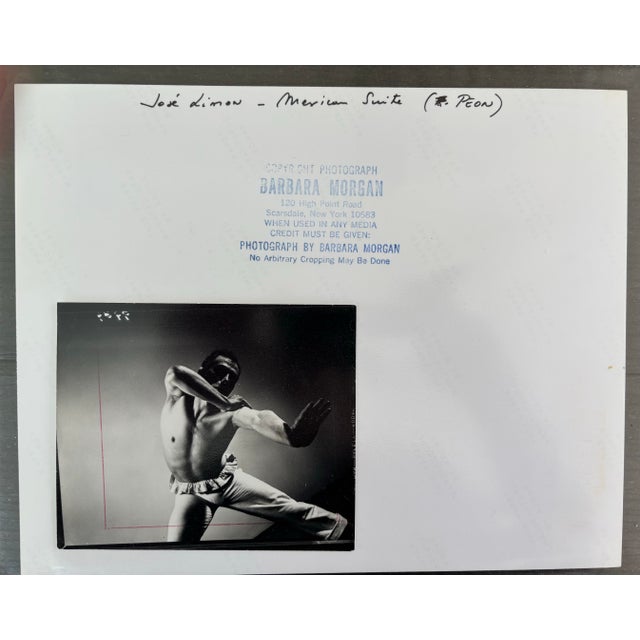
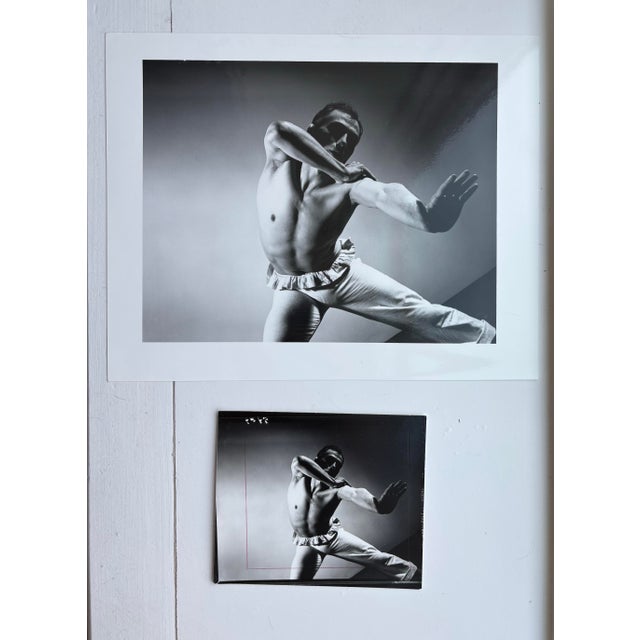
Set of two Original Photographs by Barbara Morgan “Jose Limon- Mexican Suite (Peon)” 1944 with Provenance.
This original silver gelatin …
Read more
Set of two Original Photographs by Barbara Morgan “Jose Limon- Mexican Suite (Peon)” 1944 with Provenance.
This original silver gelatin photograph “Jose Limon- Mexican Suite (Peon)”titled and dated by Morgan’s hand in pen, with copyright stamp on verso. Measurements are 8”H x 10”W. Morgan took the original photograph in 1944. This was printed later- most likely between 1972- 1980 based on the photo paper it is printed on.
Included with the silver gelatin photograph is the signed silver gelatin contact paper photograph from 1944 with margins marked by Morgan’s hand in red ink on the front, the following: 9969 Limón - Mexican Suite- Peon: and Barbara Morgan’s signature. Measurements are 4.1”H x 4.8”W.
The images—capture Limón in a stylized, dynamic pose rooted in his Mexican heritage and memories of the Mexican Revolution. These performance-style portraits highlight Limón’s dramatic, masculine dance style and his early choreographic explorations.
Barbara Morgan (American 1900-1992): Born in Buffalo, Kansas, She studied at the University of California at Los Angeles, then taught high school and college art courses after her graduation in 1923. In 1925 helped Edward Weston install an exhibition of his work at the UCLA Gallery. With her husband, the photographer Willard Morgan, she moved to New York City in 1930, and concentrated on painting until 1935, when the birth of a child brought her to photography, a medium that could be practiced quickly and efficiently. Her first book was Martha Graham: Sixteen Dances in Photographs. In the mid-1930s, her choice of abstract photographic styles set her apart from the preponderance of American documentary photographers. Along with Ansel Adams, Beaumont Newhall, Dorothea Lange, and five others, Morgan will be remembered as a co-founder of Aperture magazine in 1951, one of the few publications at the time to nurture a dialogue among photographers and treat photography as a fine art.
José Limón (1908–1972), influential Mexican-American dancer and choreographer who was born in Culiacán, Mexico. Jose Limon started his dancing career by dancing with the Humphrey-Weidman Company. He has also danced in many Broadway productions. Limon was introduced to modern dance when he moved to New York in 1928. He started his skills as a choreographer in the 1930’s. Limon taught at half a dozen colleges. In 1937 he created his first important piece of work called, Danzas Mexicanas. In 1940, he moved to the west coast, so that he could start his own solo career. Limon founded his own company in 1947. In 1952 Limon started working with Julliard School in New York, where he taught the rest of his life. His company was the first company to travel abroad on a cultural mission -under the auspices of the United States State Department when they had been sent to South America in 1954 to perform. Limons company was the first to perform at the New York Shakespeare Festival Theatre in Central Park in 1962. He gave the first dance performance at New York's Lincoln Center in 1963. Limon received many honors by Capezio Dance Award, Dance Magazine Award, and four honory doctorates. He would create a new piece every year throughout his life of being a choreographer. His last composition created before his death was "Carlota" which premiered in 1972. His company continues to thrive as the Limon Dance Company. His whole company is part of the Jose Limon Dance Foundation, which is a larger place where Limons methods are taught to new students. He is a huge figure in modern dance history. Limons powerful dancing changed the perspective of modern dance in male dancers. Limons' cheoreography made his company different in ways like it bringing a dramatic feel to the dance. Many of his dances were noticed and recognized by many other companies. Many of his masterpieces became a landmark of American dance. Limon was a very influential and advocate teacher to his students. In 1997 he was inducted into the Hall of Fame at the National Museum of Dance in Saratoga Springs, NY.
Provenance: I purchased this photograph set from the personal collection of Dr. Curtis L. Carter. Dr. Curtis Carter co-curated multiple exhibitions of Barbara Morgan’s photography throughout the years and was a close personal friend of hers. Curtis L. Carter is a professor of Philosophy at Marquette University, focusing on aesthetics. He received a PhD from the University of Boston. His greatest accomplishment at Marquette was the creation of the Patrick and Beatrice Haggerty Museum of Art. Carter was the founding director from 1984-2007. He teaches several classes on the philosophy of art. Carter serves as an associate professor at Marquette University's Les Aspin Center in Washington DC. At the Aspin Center, Carter teaches a class titled "Arts in a Democratic Society". Carter is the vice president of the International Association for Aesthetics.
See less
- Dimensions
- 10ʺW × 0.05ʺD × 8ʺH
- Art Subjects
- Figure
- Frame Type
- Unframed
- Period
- 1940s
- Country of Origin
- United States
- Item Type
- Vintage, Antique or Pre-owned
- Materials
- Black & White Photography
- Condition
- Good Condition, Original Condition Unaltered, Some Imperfections
- Color
- Silver
- Condition Notes
- Excellent condition. The larger archival photograph is in excellent condition. The 1944 silver gelatin contact paper photograph has signs of … moreExcellent condition. The larger archival photograph is in excellent condition. The 1944 silver gelatin contact paper photograph has signs of age on the recto and red ink margins drawn on the front by Morgan. less
Questions about the item?
Returns & Cancellations
Return Policy - All sales are final 48 hours after delivery, unless otherwise specified in the description of the product.
Cancellation Policy - Prior to shipping or local pickup, buyers may cancel an order for up to 48 hours, unless otherwise specified.