


Details
Description
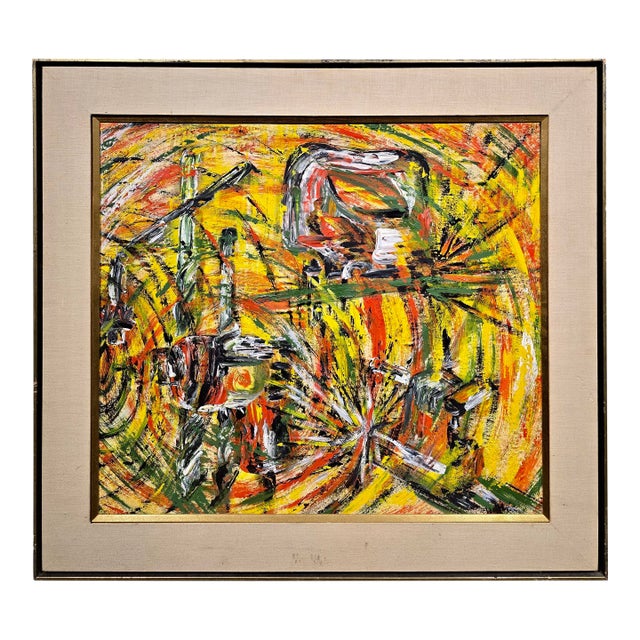
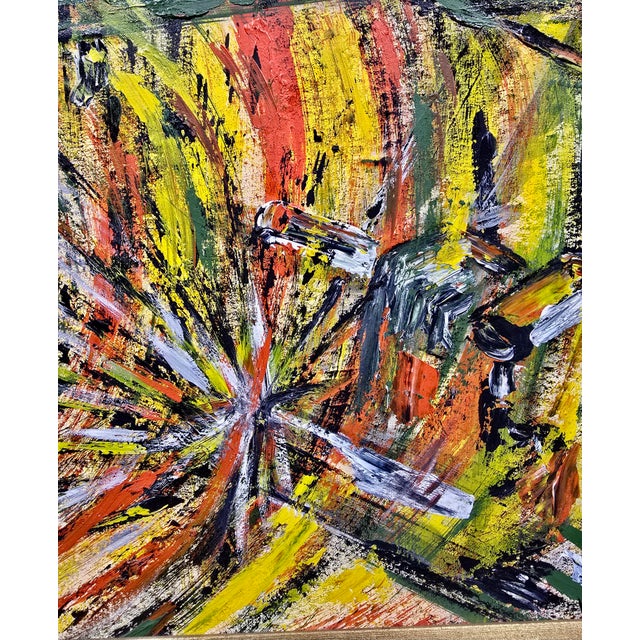
Paul Brach -1956 Abstract Vortex Composition - Oil Painting
American Expressionist - Oil painting on Canvas board - Signed and …
Read more
Paul Brach -1956 Abstract Vortex Composition - Oil Painting
American Expressionist - Oil painting on Canvas board - Signed and dated
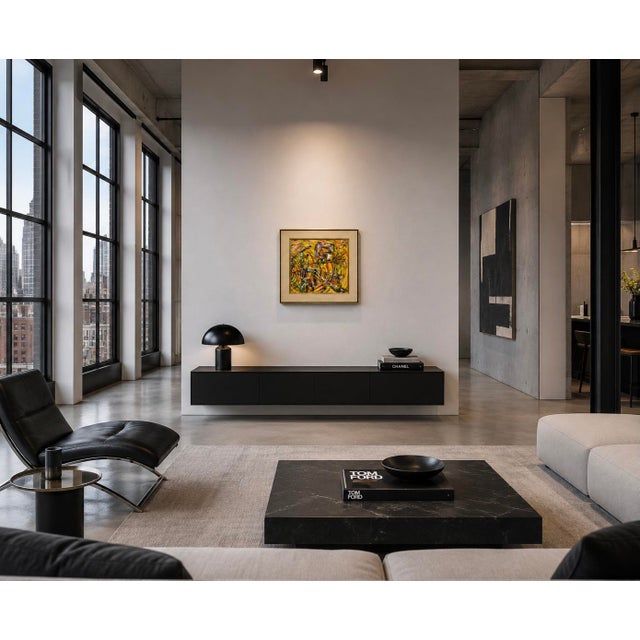
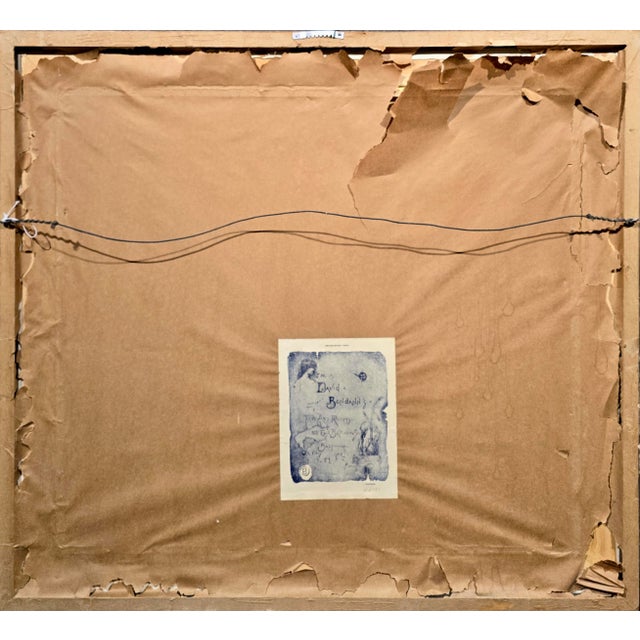
canvas size : 25x28" - Frame Size 35x38x1.5"
Visual Overview & Composition
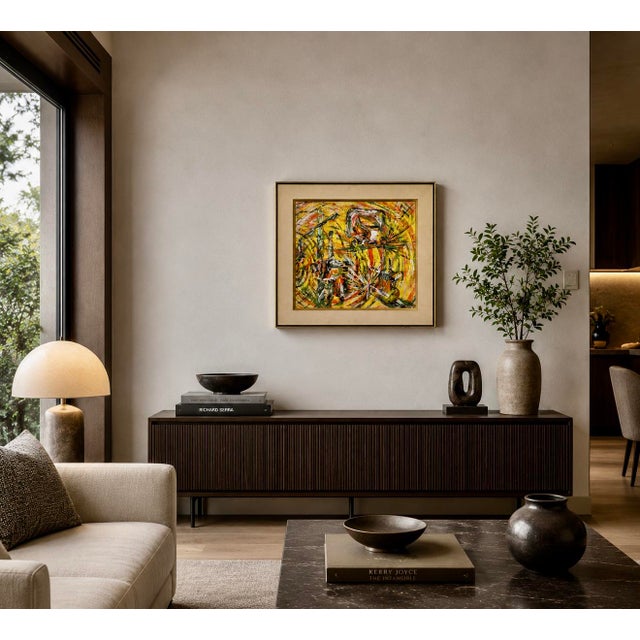
Painted in 1956, this dynamic Abstract Expressionist oil on canvas captures the explosive painterly energy that defined Paul Brach's early career and firmly situates the work within the vibrant artistic climate of postwar New York. Executed during the height of the New York School, the painting exemplifies the emotional intensity, physical immediacy, and sophisticated compositional rhythm that distinguished the second generation of Abstract Expressionist painters.
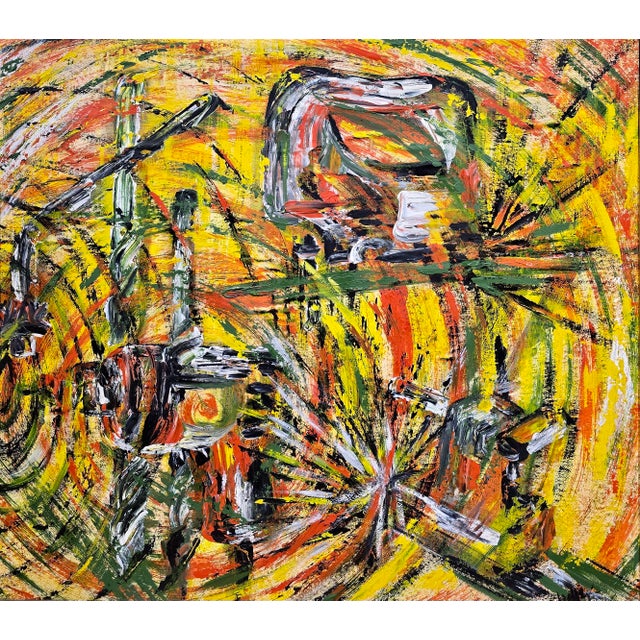
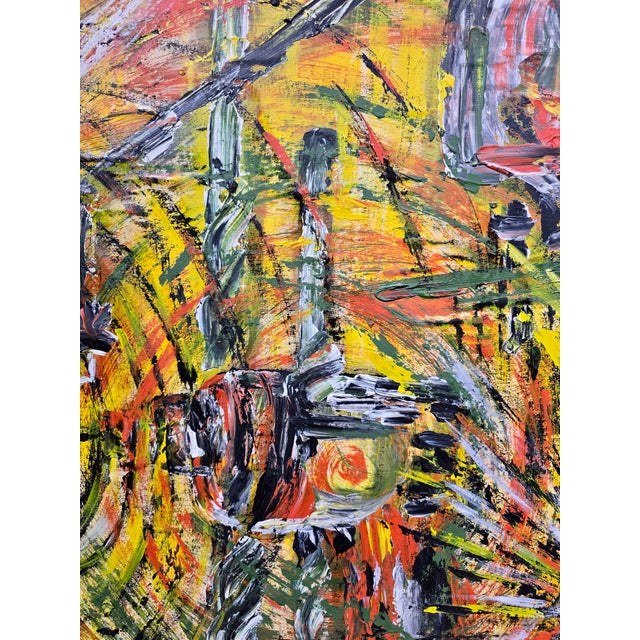
Rather than organizing the composition around a single focal point, Brach constructs an immersive "all-over" pictorial field in which every section of the canvas actively participates in the visual experience. The viewer's eye is carried continuously across the surface through sweeping circular movements, intersecting gestures, and rhythmic collisions of color and line. Despite its apparent spontaneity, the composition possesses a remarkable internal order, revealing the artist's careful orchestration of movement, balance, and visual tension.
The entire painting seems to rotate around an invisible center, creating the sensation of a powerful vortex that simultaneously pulls inward and expands outward, transforming the flat canvas into a dynamic field of perpetual motion.
Compositional Structure
Although highly gestural, the composition is carefully constructed through the interaction of several distinct visual elements.
Vortical Rhythm
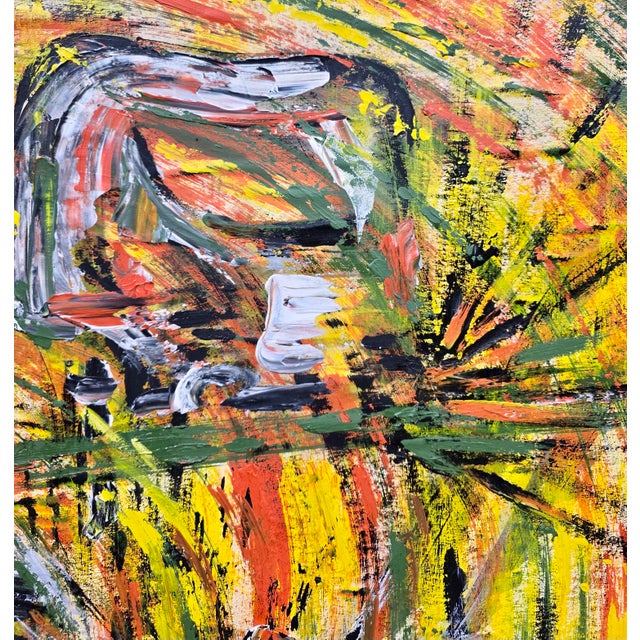
Broad, sweeping arcs of paint spiral across the surface, creating an underlying circular movement that unifies the composition. These energetic brushstrokes establish a powerful sense of centrifugal and centripetal motion, allowing the painting to feel simultaneously expansive and tightly compressed.
Structural Anchors
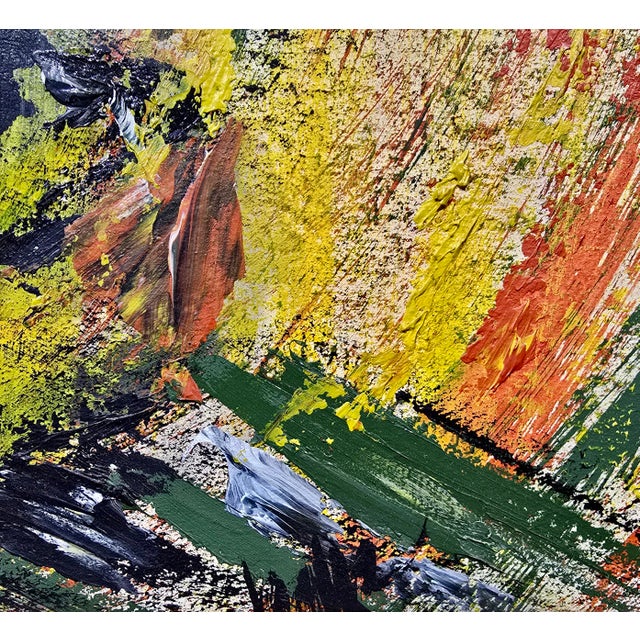
Within this swirling field, dense concentrations of black, charcoal gray, and deep forest green establish visual counterweights that stabilize the composition. These heavily worked passages suggest fractured architectural forms or abstract mechanical structures suspended within the surrounding turbulence.
Linear Intersections
Aggressive black diagonal strokes slice across the circular rhythms, introducing moments of sharp visual interruption. These angular gestures create structural friction against the flowing background while reinforcing the painting's remarkable spatial complexity.
The continual dialogue between curved movement and angular interruption generates a sophisticated compositional balance between freedom and control.
Color Palette
Color serves as the emotional engine of the composition.
The canvas is dominated by a brilliant field of canary yellow, golden ochre, and blazing orange, producing an extraordinary sense of internal luminosity. Rather than functioning merely as background, these radiant colors become active participants within the composition, amplifying the energy of every gesture.
Against this incandescent foundation, Brach introduces dramatic passages of black, charcoal gray, olive green, deep forest green, crimson, and flashes of brilliant white. These darker tonal masses create striking visual contrasts that heighten the sensation of movement while producing a remarkable optical vibration across the entire surface.
The resulting chromatic tension allows the painting to oscillate between warmth and darkness, order and chaos, creating an atmosphere of extraordinary visual intensity.
Technique & Surface
Brach's handling of oil paint is vigorous, physical, and unapologetically expressive, celebrating the act of painting itself.
The surface reveals a rich combination of heavily loaded brushwork, palette knife applications, scraping, dragging, and rapid directional strokes. Thick passages of impasto rise prominently from the canvas while thinner layers expose traces of earlier applications beneath, preserving the history of the artist's working process.
Paint has been pushed, pulled, layered, and reworked with exceptional confidence. The resulting surface possesses remarkable tactile richness, allowing light to interact differently with every ridge, scrape, and brushstroke.
This physicality is one of the defining strengths of the painting, transforming the canvas into an object that rewards close examination as much as distant viewing.
Artistic Context
Executed in 1956, this painting belongs to the most celebrated period of Paul Brach's Abstract Expressionist production.
During the 1950s Brach became an active participant in New York's thriving avant-garde community, associating with many of the leading figures of the second generation of Abstract Expressionism. Frequenting the legendary Cedar Tavern and the Artists' Club, he developed a highly personal painterly language that balanced spontaneous gesture with disciplined compositional organization.
Unlike many Action Painters who embraced complete improvisation, Brach consistently demonstrated a remarkable concern for underlying structure. His paintings combine the emotional immediacy of gestural abstraction with carefully orchestrated rhythms, resulting in compositions that appear both instinctive and meticulously controlled.
Works from this pivotal period are especially important because they document the artist before his gradual evolution toward the quieter monochromatic and geometric abstraction that would characterize much of his later career.
Frame
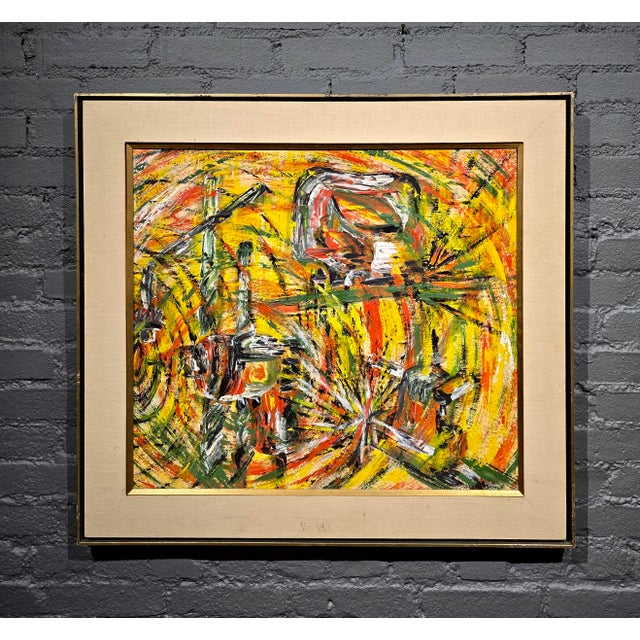
The painting is presented in an elegant period giltwood frame featuring a wide natural linen liner bordered by delicate gilt molding.
The understated sophistication of the frame provides an ideal architectural setting for the painting's explosive visual energy. Its warm neutral tones echo the luminous yellows of the composition while allowing the extraordinary color relationships within the canvas to remain the principal focus.
Artist Biography
Paul Brach (1924–2007)
Paul Brach was one of the most important yet often underappreciated figures of postwar American art, distinguished not only as an accomplished Abstract Expressionist painter but also as an influential educator, administrator, and architect of one of the nation's most progressive art schools.
Born in Brooklyn, New York, on March 13, 1924, Brach developed an early fascination with both painting and the American West, spending summers as a ranch hand in Arizona. Following military service as an infantryman in the European theater during World War II, he returned under the GI Bill to the University of Iowa, where he studied under the renowned printmaker Mauricio Lasansky. There he met fellow artist Miriam Schapiro, whom he married in 1946.
In 1951 Brach and Schapiro relocated to Manhattan, immersing themselves in the rapidly evolving downtown art scene. Brach became a regular at the Cedar Tavern and the Artists' Club, where he formed lasting relationships with fellow painters including Joan Mitchell, Larry Rivers, Michael Goldberg, and many of the leading voices of the emerging second generation of Abstract Expressionism.
His close friendship with the young art dealer Leo Castelli proved particularly significant. When Castelli opened his now legendary gallery in 1957, Brach helped prepare the gallery space and was rewarded with its third solo exhibition—an extraordinary distinction at what would become the most influential contemporary art gallery in America. Throughout the following decade, his work was exhibited alongside many of the defining artists of postwar American painting.
As his artistic language evolved during the 1960s, Brach gradually moved from energetic gestural abstraction toward quieter monochromatic and geometric compositions, exhibiting with prominent galleries including Cordier & Ekstrom and André Emmerich.
Seeking greater creative freedom, Brach accepted the position of Chair of the Art Department at the University of California, San Diego in 1967. Two years later he became the founding Dean of the School of Art at the newly established California Institute of the Arts (CalArts), where he played a pivotal role in shaping one of the most innovative art programs in the United States.
Rejecting traditional academic models, Brach assembled an extraordinary faculty that included John Baldessari, Allan Kaprow, Max Kozloff, and numerous other influential artists and thinkers. During this period he also supported the groundbreaking Feminist Art Program developed by Miriam Schapiro and Judy Chicago, helping establish CalArts as a center for experimental contemporary art.
After stepping down as dean in 1975, Brach devoted himself once again to painting, eventually returning to East Hampton, New York. His later works combined the clarity of Minimalism with memories of the American Southwest, producing highly distilled landscapes populated by silhouetted horses and expansive desert horizons.
Paul Brach died at his East Hampton home on November 16, 2007, leaving behind an enduring legacy as both a significant painter and one of the most influential educators of his generation.
Today his work is represented in the permanent collections of major institutions including the Museum of Modern Art (MoMA), the Whitney Museum of American Art, the Los Angeles County Museum of Art (LACMA), the Art Institute of Chicago, the Walker Art Center, and numerous other public and private collections.
Overall Assessment
This 1956 canvas represents an outstanding example of Paul Brach's early Abstract Expressionist period, painted at the precise moment when the energy of the New York School was reshaping the course of twentieth-century American art. Combining explosive gestural freedom with remarkable compositional sophistication, the painting embodies the optimism, experimentation, and creative ambition that made the postwar New York avant-garde one of the most influential artistic movements in modern history. As both a visually compelling work and an important document of Brach's formative years, it stands as a significant example of American Abstract Expressionism at its most confident and dynamic.
See less
- Dimensions
- 38ʺW × 1.5ʺD × 35ʺH
- Art Subjects
- Abstract
- Frame Type
- Framed
- Period
- 1950s
- Country of Origin
- United States
- Item Type
- Vintage, Antique or Pre-owned
- Materials
- Canvas
- Oil Paint
- Wood
- Condition
- Good Condition, Original Condition Unaltered, Some Imperfections
- Color
- Canary Yellow
- Condition Notes
- Excellent - Minor wear consistent with age and history Excellent - Minor wear consistent with age and history less
Questions about the item?
Returns & Cancellations
Return Policy - All sales are final 48 hours after delivery, unless otherwise specified in the description of the product.
Cancellation Policy - Prior to shipping or local pickup, buyers may cancel an order for up to 48 hours, unless otherwise specified.
Related Collections
- Ralph Lauren Paintings
- Ed Ruscha Paintings
- Photorealism Canvas Paintings
- Photorealism Paintings in New York
- Silk Velvet Paintings
- Louise Nevelson Paintings
- Herman Miller Paintings
- Richard Serra Paintings
- Jaanika Peerna Paintings
- Jo Baskerville Paintings
- Jean-Paul Barray Paintings
- Hans Andersen Paintings
- Johannes Andersen Paintings
- Peter Behrens Paintings
- Raphael Paintings
- Photorealism Paintings in Los Angeles
- Carl-Axel Acking Paintings
- Joseph Stella Paintings
- Karl-Erik Ekselius Paintings
- Pedro Friedeberg Paintings
- Piet Hein Eek Paintings
- Black Photorealism Paintings
- BDDW Paintings
- Cassina Paintings
- Lee Reynolds Paintings