

Details
Description
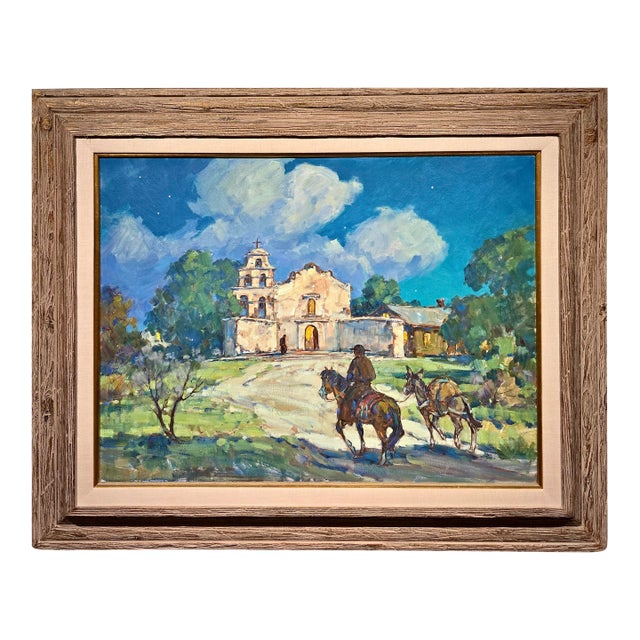
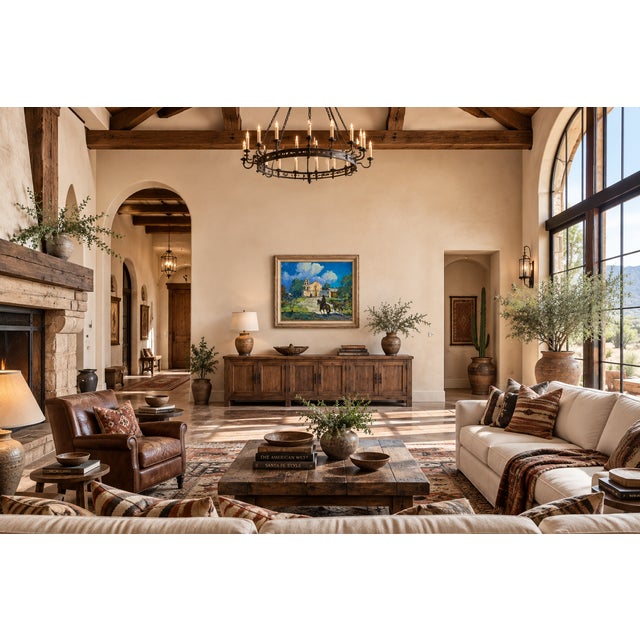
Marjorie Reed –Franciscan Rider Approaching Mission San Diego de Alcalá at Dusk-Oil Painting
California impressionist - Monumental Oil painting on …
Read more
Marjorie Reed –Franciscan Rider Approaching Mission San Diego de Alcalá at Dusk-Oil Painting
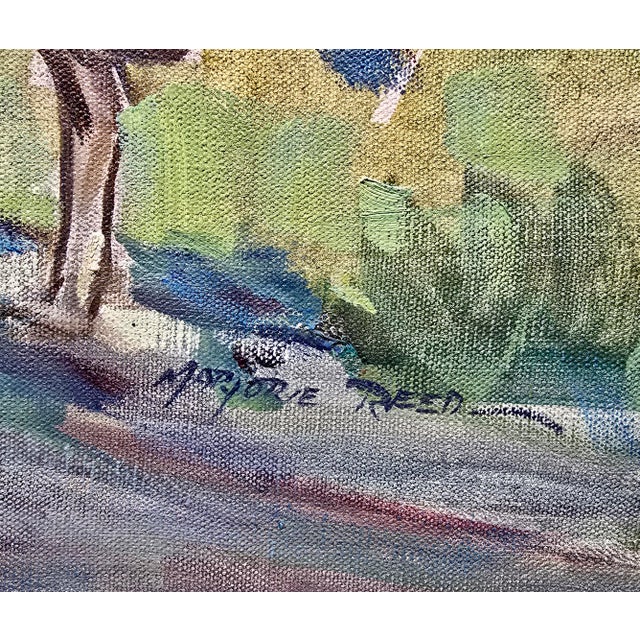
California impressionist - Monumental Oil painting on canvas - Signed - circa 1960/70s
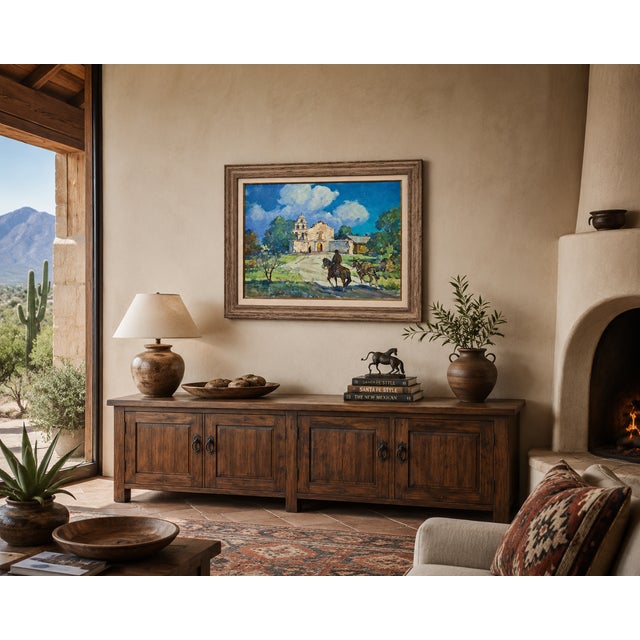
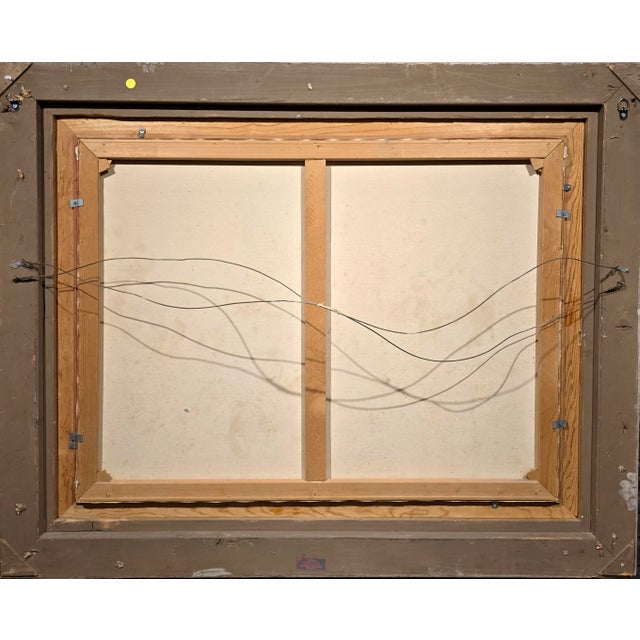
Canvas size 30x40" Frame Size 40x50x2"
Visual Analysis & Composition
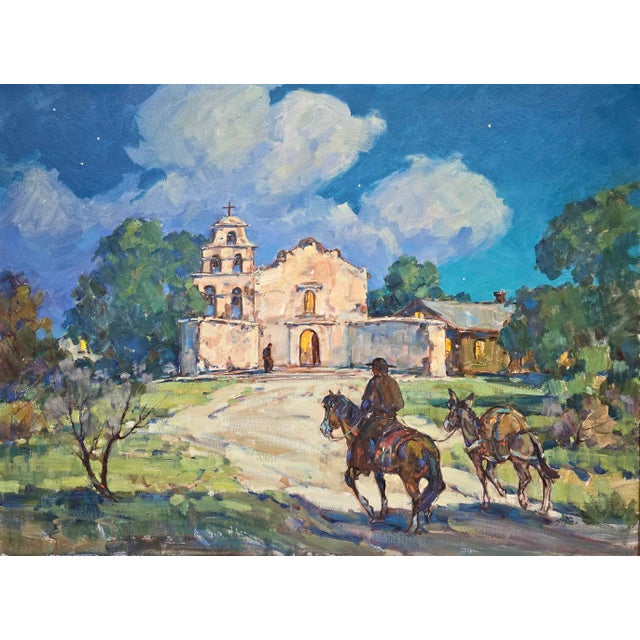
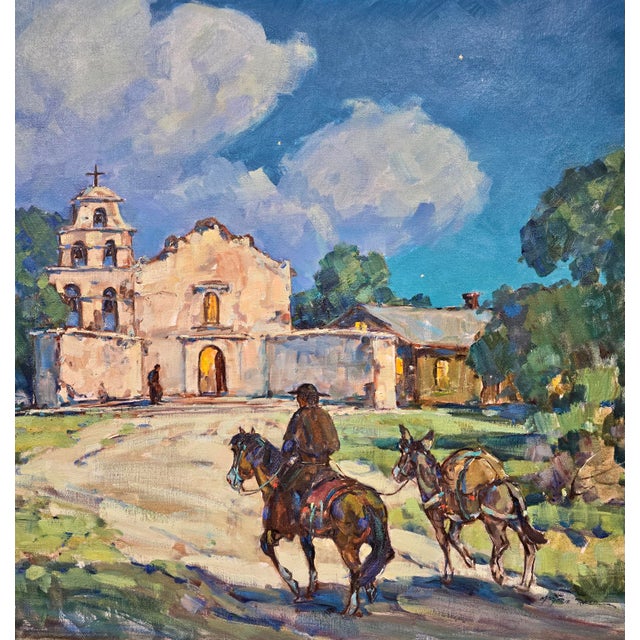
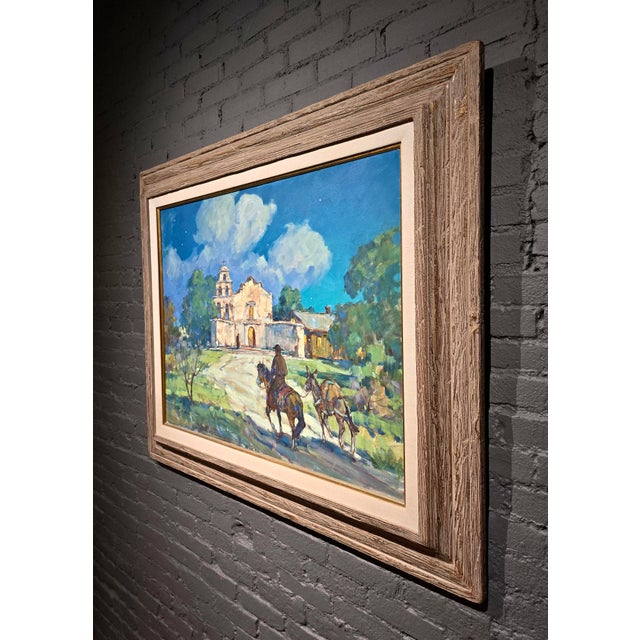
This luminous impressionistic oil painting by celebrated Western artist Marjorie Jane Reed depicts a tranquil evening arrival at Mission San Diego de Alcalá, the oldest and first of California's twenty-one Franciscan missions. Rather than portraying a dramatic historical event, Reed captures an intimate, contemplative moment that evokes the spiritual isolation and quiet dignity of California's early missionary era.
The Traveler
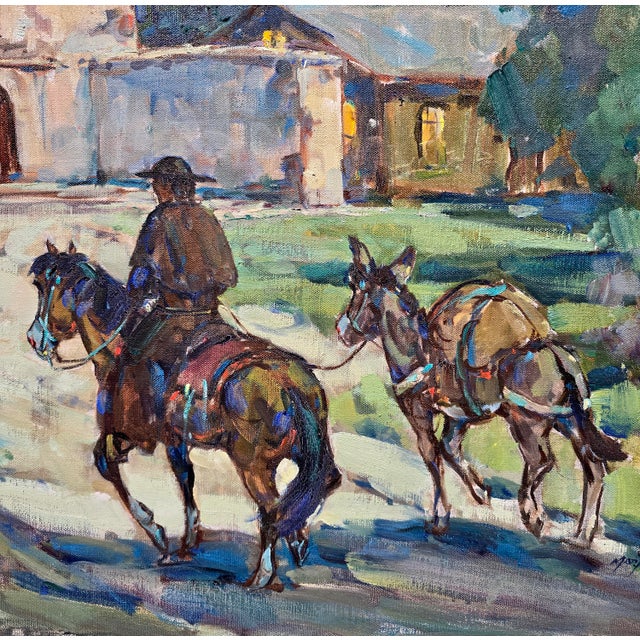
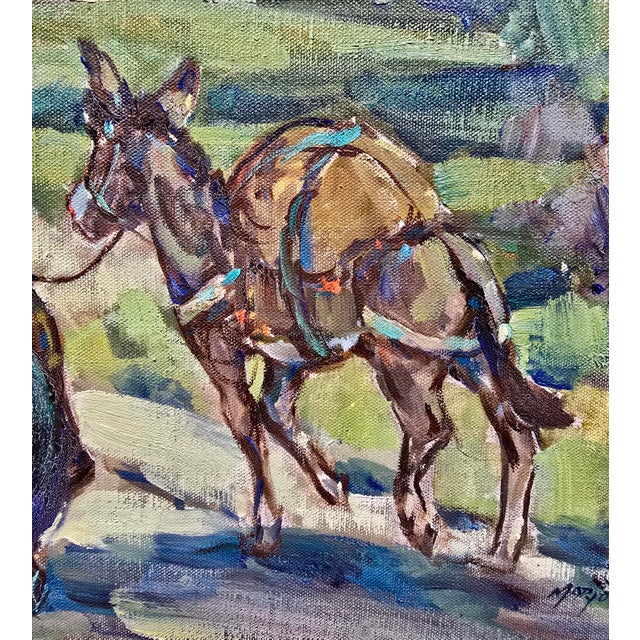
Dominating the foreground is a solitary Franciscan friar mounted upon a sturdy dark horse, accompanied by a heavily laden pack mule. Clad in a traditional brown habit and broad-brimmed travel hat, the rider slowly ascends the winding dirt road leading toward the mission.
Rather than emphasizing movement, Reed conveys the measured rhythm of frontier travel. The mule's burden suggests weeks—or perhaps months—spent traversing the rugged California landscape, while the rider's calm posture communicates perseverance, humility, and quiet devotion.
Mission San Diego de Alcalá
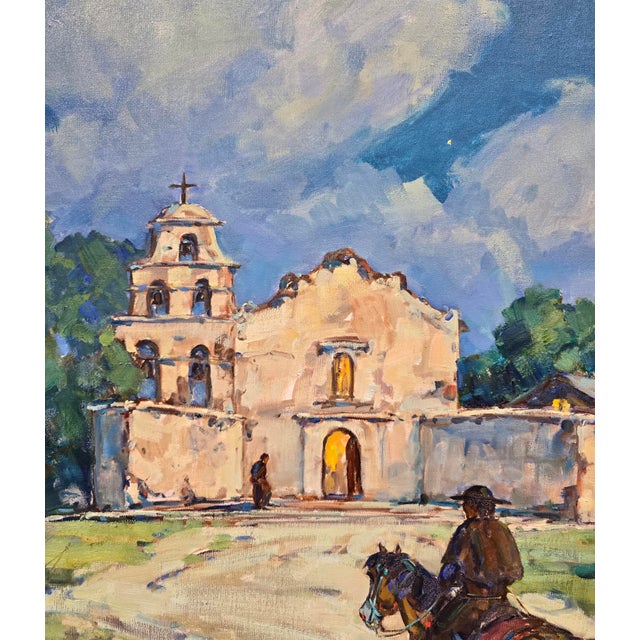
The painting's focal point is the beautifully simplified façade of Mission San Diego de Alcalá, its distinctive multi-tiered campanario rising above the surrounding trees beneath a modest cross.
Reed intentionally avoids excessive architectural detail. Instead, she relies on confident impressionistic brushwork to suggest the mission's weathered adobe walls and timeless character.
Warm golden light spills from the open doorway, immediately drawing the viewer's eye and creating an emotional destination within the composition. Tiny figures gathered near the entrance subtly reinforce the narrative, suggesting that the weary traveler has finally reached sanctuary after a long journey.
Landscape
The surrounding landscape is rendered with remarkable economy of brushwork.
Soft green grasses, low native shrubs, scattered trees, and a solitary foreground sapling establish an unmistakably Southern Californian environment. Rather than documenting the terrain with photographic precision, Reed paints its atmosphere—allowing loose passages of color to merge naturally into one another.
The broad winding roadway gently guides the eye from the foreground directly toward the illuminated mission, becoming both a physical path and a symbolic spiritual journey.
Sky & Atmosphere
Occupying nearly half of the composition is an expansive twilight sky filled with monumental cumulus clouds painted in broad, energetic strokes of cool whites, pale blues, and subtle lavender tones.
The rich turquoise-blue sky is punctuated by a handful of delicate stars, quietly indicating the transition between dusk and night.
The dramatic sky serves not merely as a backdrop but as an emotional counterweight to the intimate human narrative below, lending the scene a profound sense of peace, solitude, and reverence.
Color & Light
Reed masterfully balances warm and cool tonal relationships throughout the composition.
The cool blues of the evening sky contrast beautifully against the warm cream-colored adobe walls, while subtle oranges and yellows radiating from the mission entrance create a welcoming focal point.
Rich greens, earthy browns, muted violets, and deep ultramarines unify the landscape while preserving the freshness and spontaneity characteristic of California Impressionism.
Technique
The painting is executed with Reed's signature confident brushwork.
Individual strokes remain clearly visible across the surface, particularly within the clouds, foliage, and roadway, creating movement, texture, and remarkable visual vitality.
Rather than blending colors into smooth transitions, Reed allows adjacent brushstrokes to optically mix in the viewer's eye—a hallmark of Impressionist painting that gives the work exceptional luminosity.
Frame
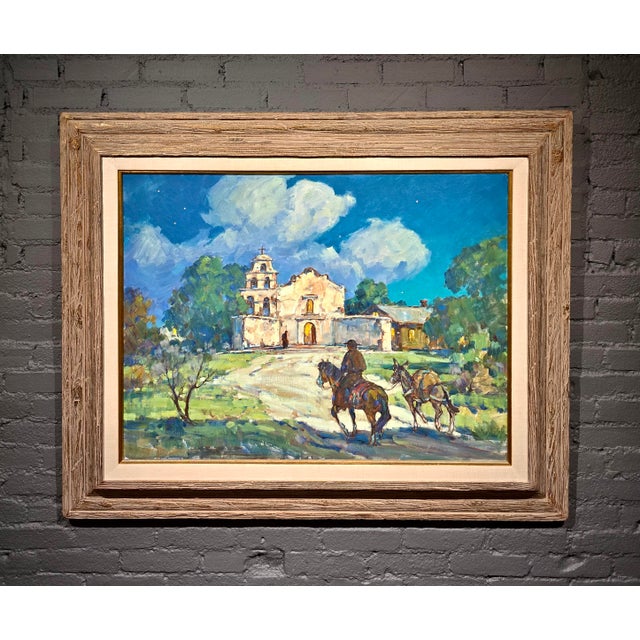
The painting is presented in an elegant rustic multi-layered wooden frame featuring beautifully weathered natural wood grain complemented by a warm linen liner that subtly enhances the painting's earthy palette without competing with the artwork itself.
Artist Biography
Marjorie Jane Reed (1915–1996)
Marjorie Jane Reed ranks among the most respected interpreters of the American West during the twentieth century. Over a career spanning more than six decades, she established an enduring reputation for her historically informed yet deeply romantic depictions of California, Arizona, and the desert Southwest, becoming one of the few women to achieve national prominence within a field traditionally dominated by male artists.
Early Life
Born in Springfield, Illinois, in 1915, Reed displayed extraordinary artistic ability from an exceptionally young age. Her father, Walter Stephen Reed, a successful commercial artist, recognized her talent early and began giving her formal instruction when she was only three years old.
After relocating to Southern California during her teenage years, Reed continued developing her artistic abilities and eventually accepted commercial illustration work associated with Walt Disney Studios, contributing artwork for early Mickey Mouse merchandise and animation-related projects. Although commercially successful, she soon discovered that the regimented environment of studio work did not suit her independent spirit.
Artistic Training
Determined to become a fine artist, Reed studied at both the Chouinard Art Institute and the Art Center School in Los Angeles before continuing her education under noted California Impressionist Jack Wilkinson Smith.
Smith immediately recognized her unusual ability to paint horses and desert landscapes, encouraging her to leave the studio and immerse herself directly in the Western landscape. His influence would permanently shape her expressive brushwork and atmospheric approach to landscape painting.
Because female Western artists often struggled for recognition during the 1930s and 1940s, Reed occasionally signed commercial work using masculine pseudonyms such as Harvey Day and Fred Day, allowing her paintings to be judged without gender bias.
The Butterfield Overland Mail Project
Perhaps no project better defines Reed's legacy than her monumental documentation of the historic Butterfield Overland Mail Route.
Inspired by conversations with former stagecoach driver Captain William Banning, Reed became determined to preserve visually one of the most important transportation routes in early California history.
Over many years she traveled the rugged trail—often accompanied only by her Alaskan Husky—in a Model T Ford, camping beside abandoned stage stations and painting directly from life. Her commitment to historical authenticity became legendary among Western historians and collectors alike.
The resulting series of twenty paintings was published in 1957 as The Colorful Overland Stage and was ultimately acquired by newspaper publisher James S. Copley, becoming one of the defining achievements of twentieth-century Western American art.
Later Life
Reed lived much as she painted—restlessly, independently, and deeply connected to the landscapes she loved.
She spent much of her later life moving throughout the California deserts and southern Arizona, often choosing remote cabins over urban comfort. Friends described her as intensely private, fiercely independent, and profoundly spiritual.
Near the end of her life she remarked that she believed she had moved approximately once for every year she had lived—a fitting reflection of her lifelong search for new horizons.
Deeply religious, Reed remained remarkably humble regarding her artistic accomplishments, once writing to a friend:
"I never painted anything. I just held the brush and God did the work."
She passed away in 1996 near one of the historic California stage stations she had devoted much of her life to documenting.
Legacy
Today Marjorie Jane Reed is widely regarded as one of the foremost painters of the historic American West. Her works reside in important private collections and museums and are especially admired for their rare combination of historical accuracy, expressive Impressionist technique, and poetic storytelling.
Her paintings preserve not only the appearance of California's missions, deserts, and stage routes, but also the enduring spirit of the frontier itself.
See less
- Dimensions
- 50ʺW × 2ʺD × 40ʺH
- Styles
- American
- Impressionist
- Frame Type
- Framed
- Art Subjects
- Animals
- Architecture
- Figure
- Landscape
- Period
- 1960s
- Country of Origin
- United States
- Item Type
- Vintage, Antique or Pre-owned
- Materials
- Canvas
- Oil Paint
- Condition
- Good Condition, Original Condition Unaltered, Some Imperfections
- Color
- Sky Blue
- Condition Notes
- Excellent - Minor wear consistent with age and history Excellent - Minor wear consistent with age and history less
Questions about the item?
Returns & Cancellations
Return Policy - All sales are final 48 hours after delivery, unless otherwise specified in the description of the product.
Cancellation Policy - Prior to shipping or local pickup, buyers may cancel an order for up to 48 hours, unless otherwise specified.
Related Collections
- Ralph Lauren Paintings
- Photorealism Canvas Paintings
- Ed Ruscha Paintings
- Photorealism Paintings in New York
- Karen Offutt Paintings
- Richard Serra Paintings
- Laddie John Dill Paintings
- BandB Italia Paintings
- Jo Baskerville Paintings
- Vienna Secession Paintings
- Jeff Slemmons Paintings
- Michelle Arnold Paine Paintings
- Keith Haring Paintings
- Photorealism Paintings in Los Angeles
- BDDW Paintings
- FM Mobler Paintings
- René Magritte Paintings
- Black Photorealism Paintings
- Mark Lewis Art Paintings
- Mark Lewis Paintings
- Lee Reynolds Paintings
- Mid-Century Modern Paintings
- Abstract Paintings
- Nautical Paintings
- Velvet Paintings