


Details
Description
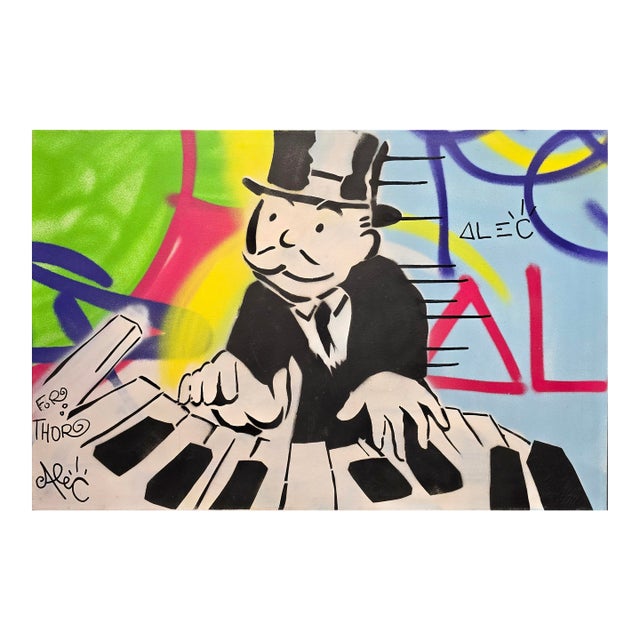
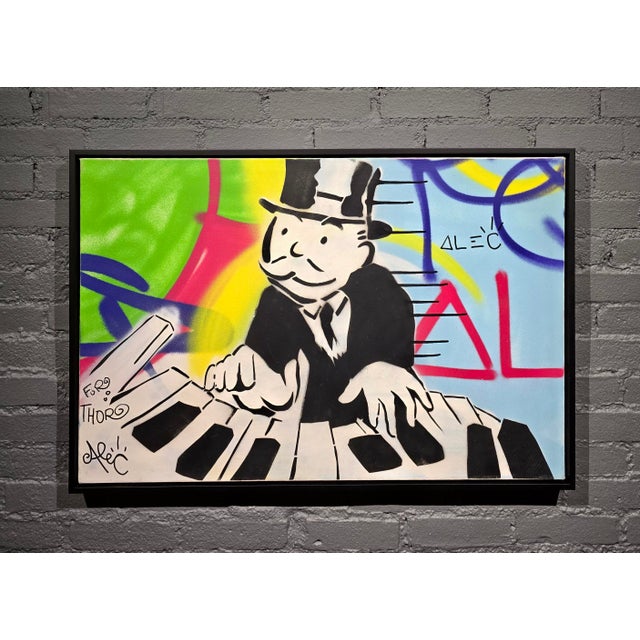
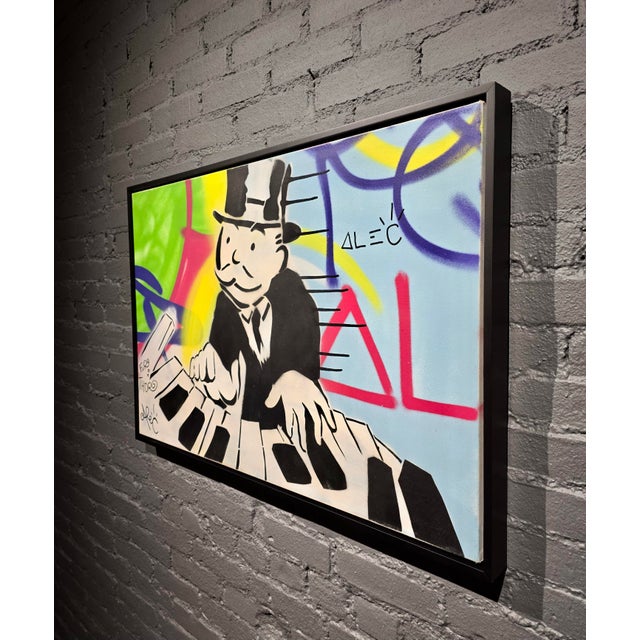
Alec Monopoly "Mr. Monopoly Playing the Piano" 2010 Painting on Canvas
American Neo Pop Art - Original Contemporary Acrylic & …
Read more
Alec Monopoly "Mr. Monopoly Playing the Piano" 2010 Painting on Canvas
American Neo Pop Art - Original Contemporary Acrylic & Mix Media on Canvas - Signed
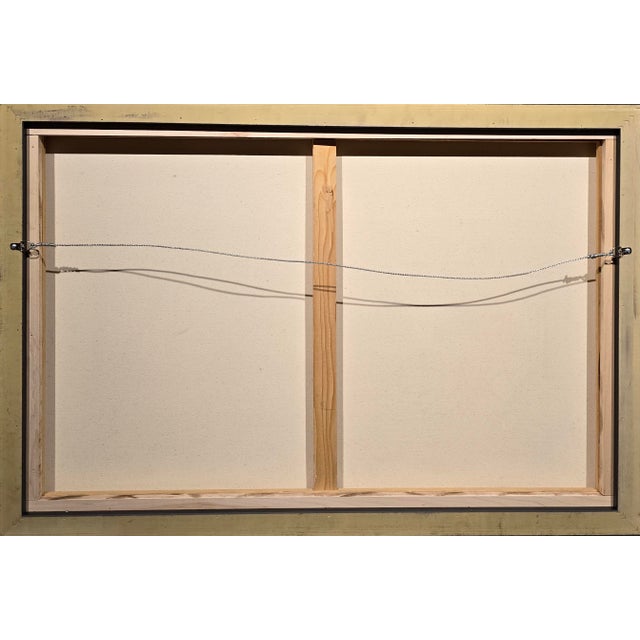
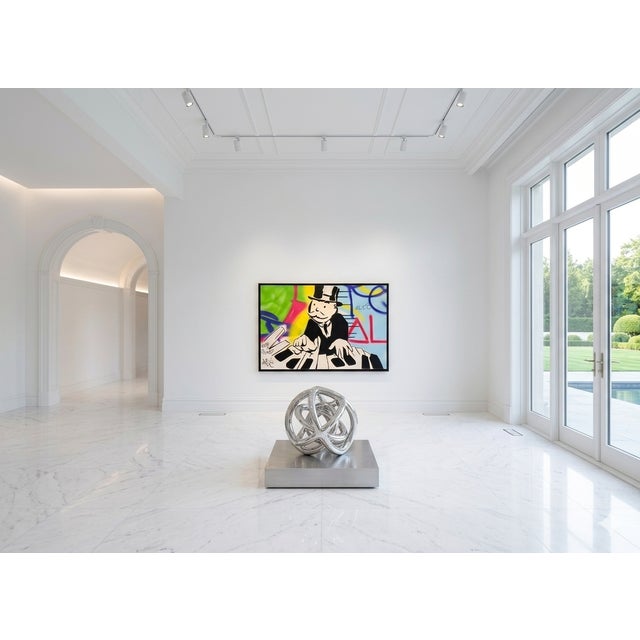
Canvas size: 24x36" - Frame size 26x38x2"
Description
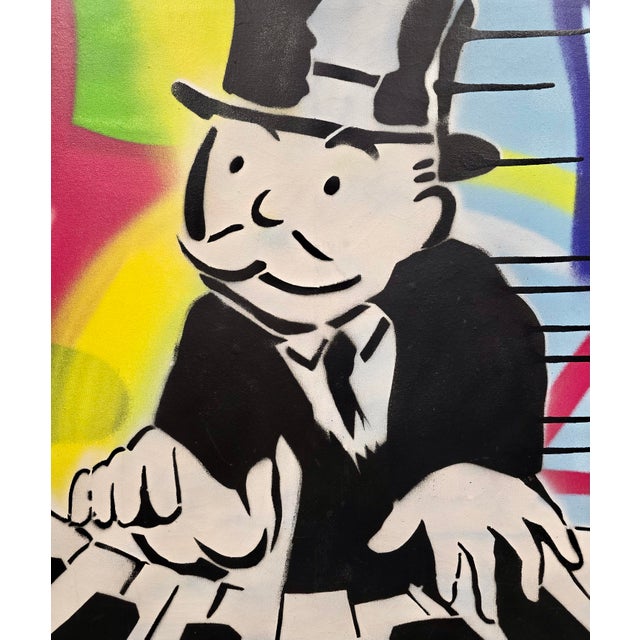
A dynamic and visually arresting original work by contemporary American street artist Alec Monopoly (Alec Andon, b. 1986), dating to 2010 and depicting the artist's celebrated recurring character, the Monopoly Man, animatedly playing a piano against an exuberant graffiti-inspired backdrop.
Executed in acrylic and aerosol spray paint on canvas, the composition brings together the visual vocabulary of Pop Art with the immediacy and spontaneity of contemporary street art. Crisp black-and-white figurative elements are dramatically juxtaposed against luminous passages of electric green, vivid pink, yellow, pale blue, and deep blue-violet, creating an energetic composition characteristic of the artist's early work.
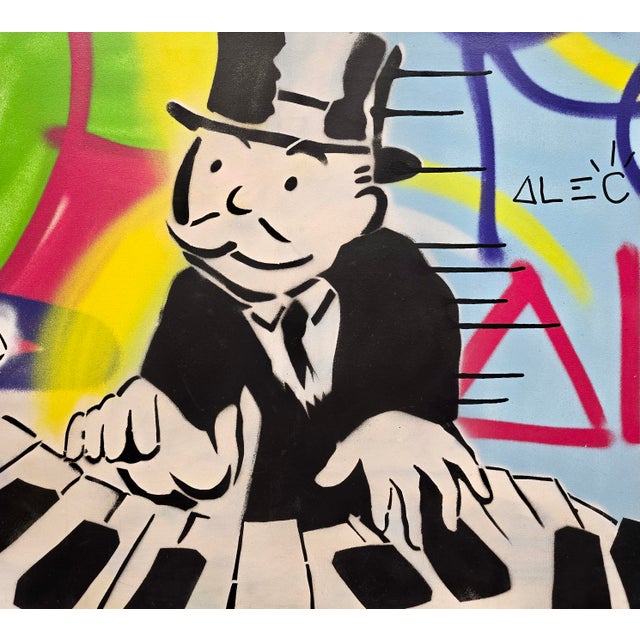
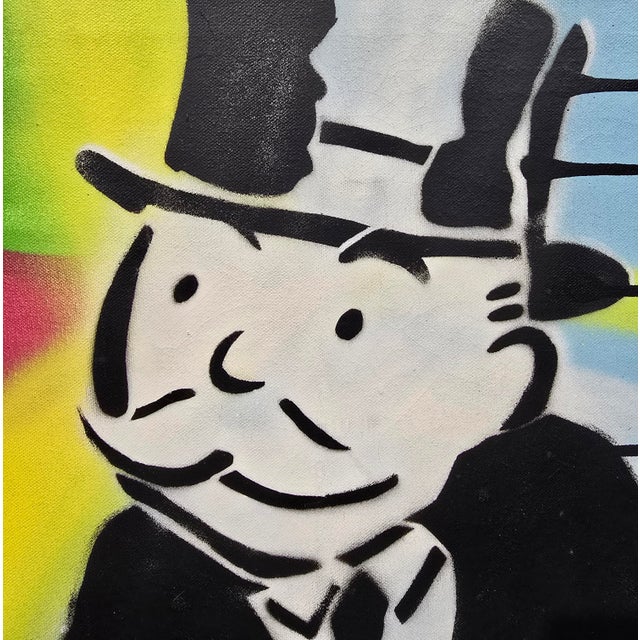
At the center of the painting appears Rich Uncle Pennybags, popularly known as the Monopoly Man, the familiar top-hatted figure associated with the classic Monopoly board game and the character that would become Alec Monopoly's defining artistic motif.
Rendered in bold black outlines, the smiling figure appears dressed in his familiar formal attire, complete with black jacket, white shirt, tie, and exaggerated top hat. His oversized hands stretch dramatically across the keys of a black-and-white piano occupying the lower portion of the composition.
The keyboard itself is deliberately distorted in perspective, expanding outward toward the viewer and lending the scene an almost theatrical sense of movement. The exaggerated proportions and sweeping arrangement of the keys create the impression that the character is enthusiastically performing rather than merely posing, reinforcing the humor, playfulness, and visual energy for which Alec Monopoly's imagery has become known.
Behind the central figure, the composition erupts into layers of brightly colored aerosol paint and freehand graffiti gestures. Electric green, hot pink, yellow, turquoise, and blue intersect through sweeping lines, curves, overspray, and partially transparent passages of color.
These loosely applied elements retain the immediacy of graffiti executed directly on an urban surface, providing a deliberate contrast to the sharply delineated, stencil-like treatment of the central character.
The result is a compelling collision between two seemingly opposing visual worlds: the polished imagery of wealth, privilege, and traditional success represented by the Monopoly Man, and the spontaneous, rebellious visual language of street culture.
Signatures, Tags & Personal Dedication
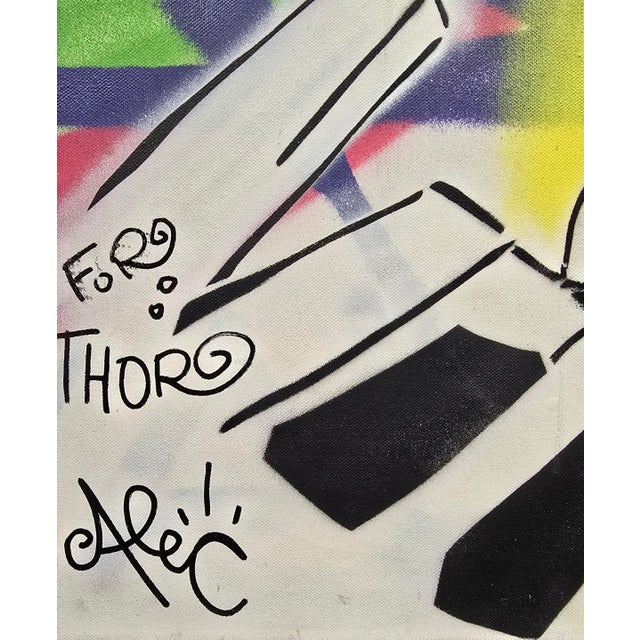
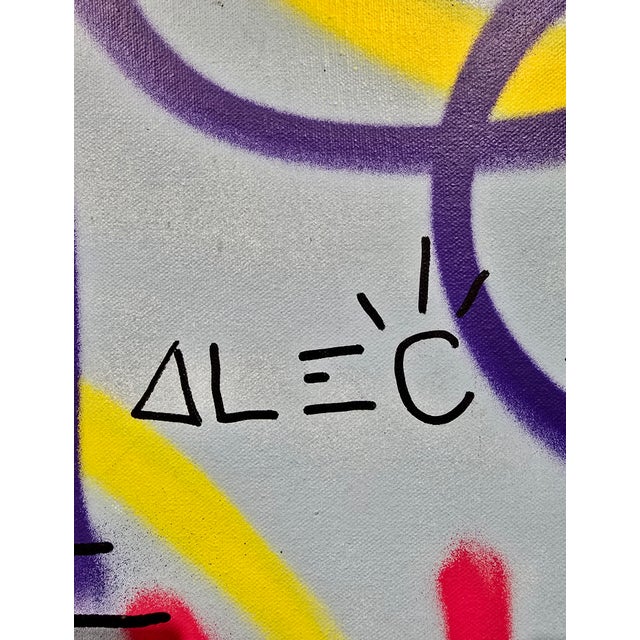
Particularly interesting are the multiple artist inscriptions incorporated directly into the composition.
A stylized "ALEC" tag appears within the upper-right portion of the painting, integrated into the surrounding graffiti imagery, while an additional cursive "Alec" signature appears prominently in the lower-left corner alongside the piano.
Immediately above this lower signature is the handwritten inscription:
"For Thor"
indicating that the painting was personally dedicated by the artist to its original recipient.
Rather than functioning merely as signatures applied after completion, these inscriptions become part of the visual vocabulary of the painting itself—a characteristic closely associated with graffiti and street-art traditions, where the artist's name, tag, and imagery frequently coexist within the composition.
Artistic Context
Alec Monopoly began developing the imagery that would ultimately define his career during the period surrounding the 2008 global financial crisis.
Against a backdrop of bank failures, government bailouts, Wall Street scandals, and widespread public debate concerning wealth and financial inequality, the artist adopted the Monopoly Man as a recurring visual metaphor for money, privilege, excess, capitalism, and corporate power.
Removed from the orderly world of the traditional board game and transplanted into graffiti-covered urban environments, the familiar character acquired an entirely different meaning.
Depending upon interpretation, Alec Monopoly's Monopoly Man can be viewed simultaneously as a satire of financial excess and as an ironic celebration of wealth, aspiration, and luxury. This deliberate ambiguity—the tension between criticizing material culture while simultaneously embracing its imagery—would eventually become one of the defining characteristics of the artist's career.
In the present work, that tension takes on an especially playful character.
Rather than presenting the Monopoly Man simply as a static symbol of wealth, the artist transforms him into an exuberant entertainer, enthusiastically playing a piano amid an explosion of brilliantly colored graffiti.
The result brings together wealth and rebellion, tradition and street culture, nostalgia and contemporary urban expression within a single energetic image.
An Early Example
Dating from 2010, this painting belongs to a relatively early period in Alec Monopoly's development, shortly after the financial crisis that helped inspire his most recognizable imagery and before the extraordinary international commercialization of his artistic persona during the following decade.
The painting already contains many of the elements that would become signatures of his mature practice: the Monopoly Man, stencil-derived imagery, vibrant aerosol color, handwritten graffiti tags, Pop Art references, cartoon iconography, and the juxtaposition of symbols of wealth against the visual language of the street.
The presence of multiple artist inscriptions together with the personal "For Thor" dedication gives the work an additional individualized character.
As such, the painting represents a particularly engaging example of the visual language Alec Monopoly was developing during the formative period of his career.
About the Artist
Alec Monopoly
American, born 1986
Alec Monopoly, born Alec Andon in New York City in 1986, is among the most recognizable and commercially successful contemporary artists to emerge from the international street-art movement of the late 2000s and early 21st century.
Known for his colorful reappropriation of familiar characters from popular culture, Monopoly developed an artistic vocabulary that combines elements of graffiti, Pop Art, stencil painting, cartoon imagery, aerosol techniques, and contemporary consumer culture.
Raised in New York, Andon was exposed to art from an early age, with his mother reportedly playing an important role in encouraging his interest in painting.
Rather than pursuing a conventional academic approach to art, however, he gravitated toward the immediacy of graffiti and New York's urban environment, gradually developing a style that combined recognizable popular imagery with the techniques and attitude of street painting.
The Financial Crisis and the Monopoly Man
The pivotal moment in the development of Alec Monopoly's artistic identity came around the time of the 2008 global financial crisis.
The collapse of major financial institutions, controversial bank bailouts, instability in global markets, and highly publicized financial scandals provided a remarkably fertile environment for an artist interested in exploring imagery associated with money and power.
Among the events capturing worldwide attention during this period was the exposure of financier Bernard Madoff's massive investment fraud, which further intensified public scrutiny surrounding Wall Street, wealth, privilege, and financial institutions.
Against this cultural backdrop, Andon began repeatedly using Rich Uncle Pennybags—the Monopoly Man—as his principal visual character.
The choice proved remarkably effective.
Immediately recognizable to audiences, the Monopoly Man represented wealth, property ownership, banking, money, and capitalism while simultaneously carrying the innocence and nostalgia of a childhood board game.
Alec Monopoly began placing this imagery onto walls and urban surfaces, initially through unauthorized street art and stencil work in cities including New York and Los Angeles, and subsequently in other international locations.
The juxtaposition of the cheerful, wealthy cartoon tycoon against gritty urban surroundings quickly attracted attention and ultimately became synonymous with the artist himself.
His repeated use of the character eventually inspired his professional pseudonym:
Alec Monopoly.
Anonymity and Public Persona
During his emergence as a street artist, Monopoly cultivated an intentionally mysterious public identity.
Because much of his early work was produced within the tradition of unauthorized graffiti, he frequently concealed his face during photographs and public appearances.
Masks, bandanas, and the distinctive gesture of covering the lower portion of his face with his hand gradually became recurring features of his public persona.
What initially served as a practical means of maintaining anonymity ultimately developed into an identifiable part of the Alec Monopoly image and brand.
Signature Style
As his career expanded from street painting into studios, galleries, international exhibitions, and art fairs, Alec Monopoly substantially broadened his artistic vocabulary while retaining the graffiti techniques of his beginnings.
His works frequently combine stenciled figures, aerosol spray paint, gestural marks, drips, handwritten tags, thick acrylic passages, and mixed-media collage.
Some compositions incorporate actual financial newspapers, headlines, currency, and other printed materials referencing markets and contemporary economic culture.
This combination allows his work to occupy a distinctive territory between Pop Art, graffiti, contemporary urban art, and popular culture.
Although the Monopoly Man remains his most recognizable character, Monopoly subsequently expanded his repertoire to incorporate other figures drawn from popular culture and nostalgic cartoon imagery, including Richie Rich, Scrooge McDuck, and the Pink Panther, among others.
The recurring theme connecting many of these figures is their association—whether directly or ironically—with money, luxury, consumption, aspiration, and popular ideas of success.
From Street Artist to Luxury-Culture Phenomenon
One of the more fascinating aspects of Alec Monopoly's career has been his transformation from an artist using imagery associated with anti-establishment street culture into an internationally recognized figure within the luxury marketplace.
Rather than distancing himself from commercialization, Monopoly has embraced the intersection between contemporary art, celebrity culture, fashion, entertainment, and luxury branding.
This trajectory has resulted in collaborations with internationally recognized companies and personalities.
In 2016, Swiss luxury watchmaker TAG Heuer appointed Alec Monopoly as an "Art Provocateur," a collaboration that included live painting performances, exhibitions, and specially produced watches incorporating his imagery.
He subsequently collaborated with luxury watch and jewelry house Jacob & Co., including work connected with its elaborate Astronomia watch collection.
His imagery has also crossed into fashion, entertainment, music, and sports, further expanding his presence beyond the conventional gallery environment.
Collectors and International Recognition
Alec Monopoly's immediately recognizable visual style has attracted collectors from the worlds of entertainment, music, film, fashion, and popular culture.
His work has been publicly associated with prominent collectors and cultural personalities and has achieved considerable visibility through galleries, international exhibitions, luxury collaborations, and major contemporary art events.
His paintings have appeared within the international art-market ecosystem surrounding events such as Art Basel Miami Beach and Miami Art Week, helping transform imagery that originated within street-art culture into a globally recognizable contemporary-art brand.
Today, Alec Monopoly continues to work internationally while maintaining strong associations with Los Angeles and New York. His creative activities have expanded beyond painting into live performances, music, fashion, and entertainment, including appearances as a DJ.
His career occupies an intriguing position within contemporary art: imagery initially inspired in part by the excesses and contradictions of financial culture has itself become highly sought after within the international luxury marketplace.
It is precisely this contradiction—between rebellion and success, graffiti and luxury, critique and celebration, the street and the gallery—that continues to make Alec Monopoly's work distinctive within contemporary urban art.
Significance of This Work
Created in 2010, Mr. Monopoly Playing the Piano captures this visual language at an important early stage in Alec Monopoly's career.
The combination of his signature Monopoly Man imagery, brilliantly colored aerosol background, expressive graffiti elements, multiple artist inscriptions, and unusually personal "For Thor" dedication creates a work that is both immediately recognizable and individually distinctive.
At once humorous, energetic, nostalgic, and irreverent, the painting encapsulates the central contradictions that would come to define Alec Monopoly's artistic identity: an icon of wealth rendered through the rebellious vocabulary of the street.
See less
- Dimensions
- 38ʺW × 2ʺD × 26ʺH
- Art Subjects
- Portrait
- Pop Culture
- Figure
- Frame Type
- Framed
- Period
- 2010s
- Country of Origin
- United States
- Item Type
- Vintage, Antique or Pre-owned
- Materials
- Acrylic Paint
- Canvas
- Condition
- Good Condition, Original Condition Unaltered, Some Imperfections
- Color
- White
- Condition Notes
- Excellent - Minor wear consistent with age and history Excellent - Minor wear consistent with age and history less
Questions about the item?
Returns & Cancellations
Return Policy - All sales are final 48 hours after delivery, unless otherwise specified in the description of the product.
Cancellation Policy - Prior to shipping or local pickup, buyers may cancel an order for up to 48 hours, unless otherwise specified.
Related Collections
- Photorealism Canvas Paintings
- Ed Ruscha Paintings
- Photorealism Paintings in New York
- Richard Serra Paintings
- Herman Miller Paintings
- BDDW Paintings
- Jo Baskerville Paintings
- Louise Nevelson Paintings
- Karen Offutt Paintings
- Nicola Simbari Paintings
- James McCray Paintings
- Leroy Neiman Paintings
- Jaanika Peerna Paintings
- Johannes Andersen Paintings
- Pedro Friedeberg Paintings
- Peter Behrens Paintings
- Piet Hein Eek Paintings
- Raphael Paintings
- Vienna Secession Paintings
- Photorealism Paintings in Los Angeles
- Carl-Axel Acking Paintings
- Karl-Erik Ekselius Paintings
- Joseph Stella Paintings
- Hans Andersen Paintings
- Jean-Paul Barray Paintings