

Details
Description
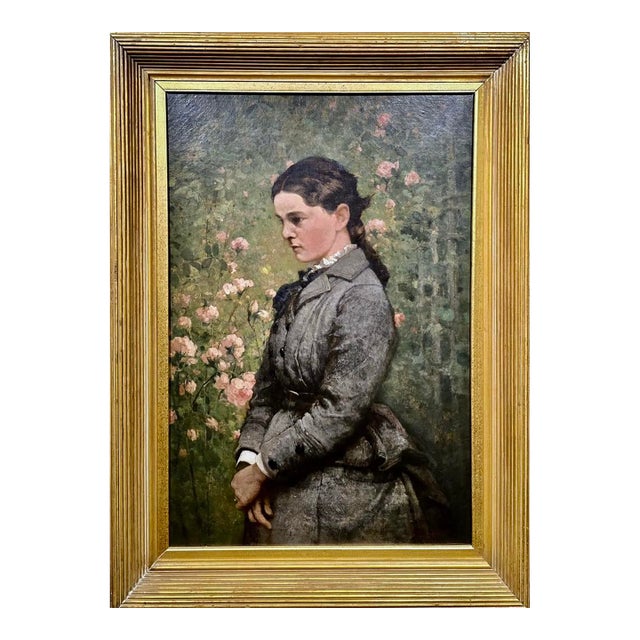
John Ferguson Weir-Portrait of Marion Eckford Harwood -19th century Oil painting
19th-century American Academic Realist - Oil painting on Canvas-Signed …
Read more
John Ferguson Weir-Portrait of Marion Eckford Harwood -19th century Oil painting
19th-century American Academic Realist - Oil painting on Canvas-Signed - circa 1875
Canvas size: 40x27' - Frame size :49x36x3"
Composition and Visual Presentation
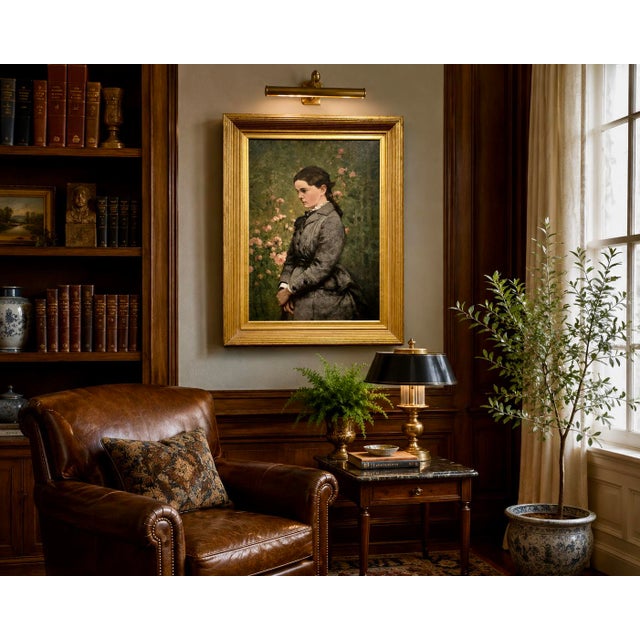
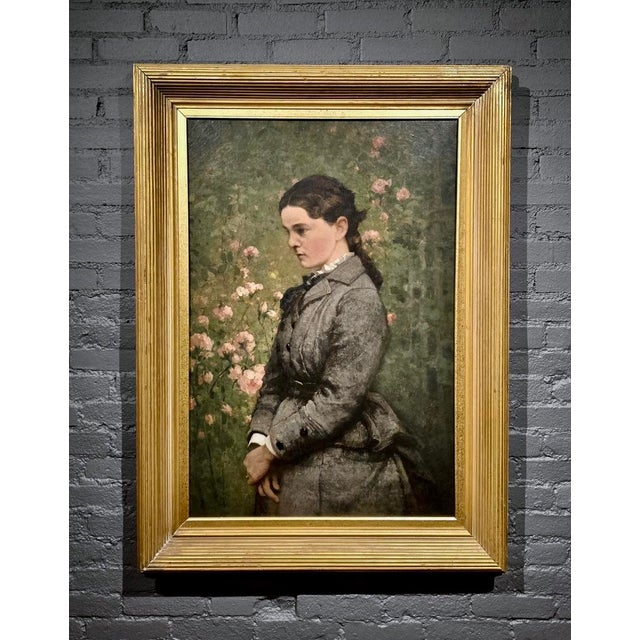
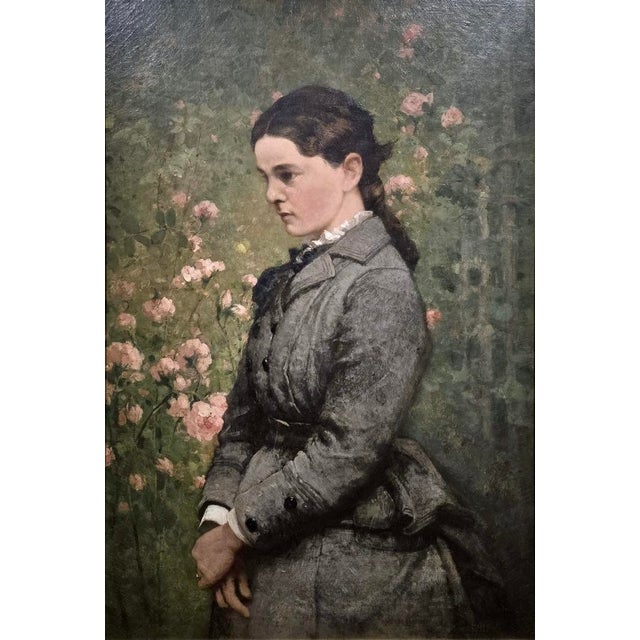
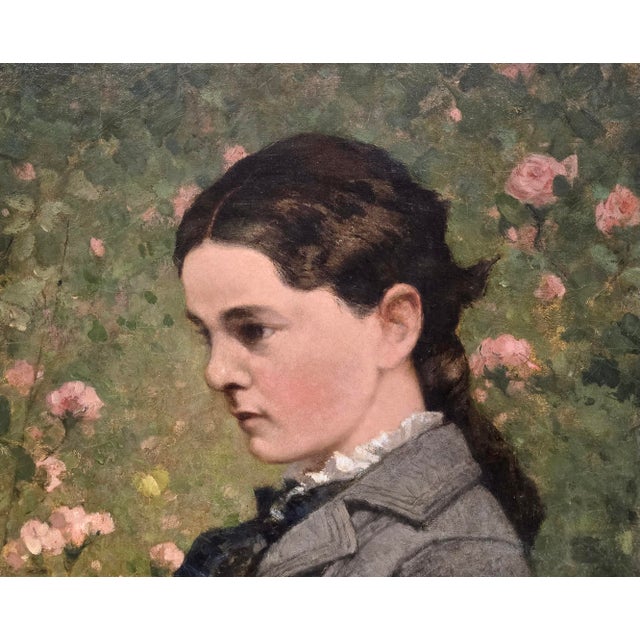
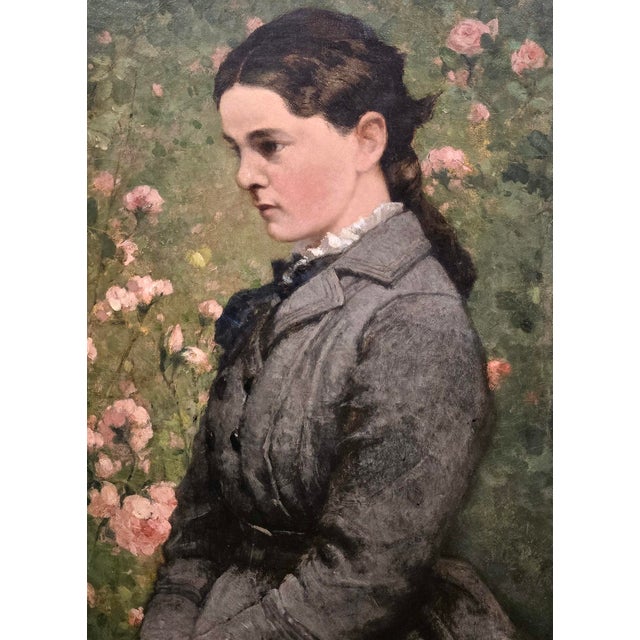
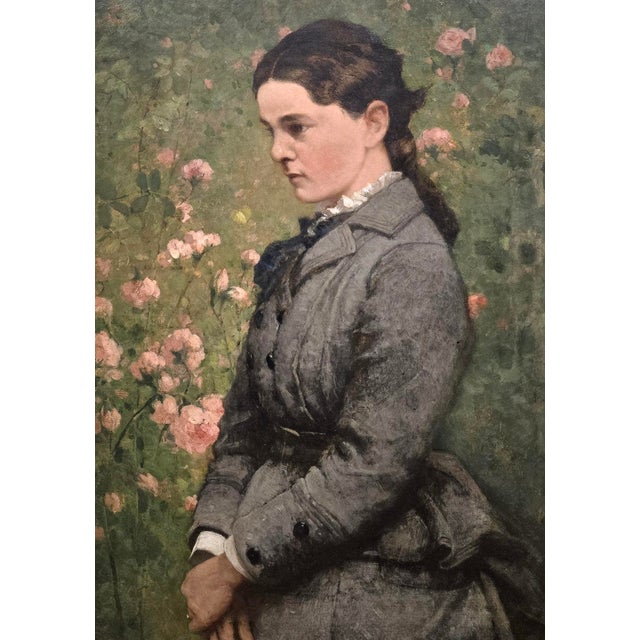
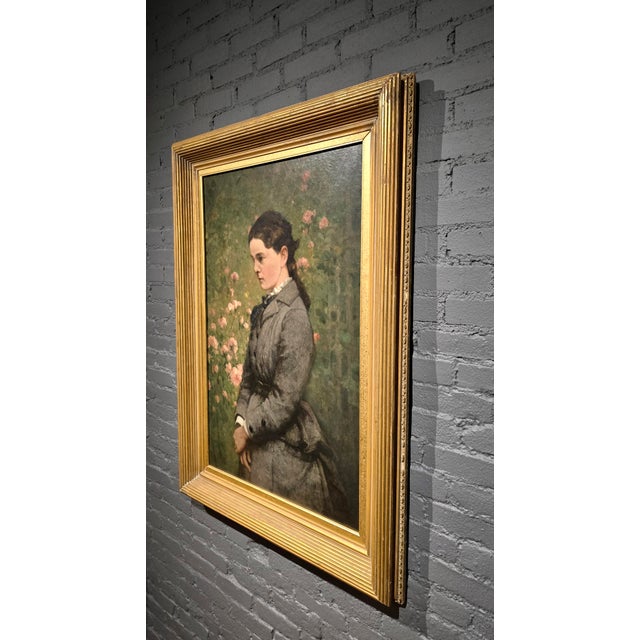
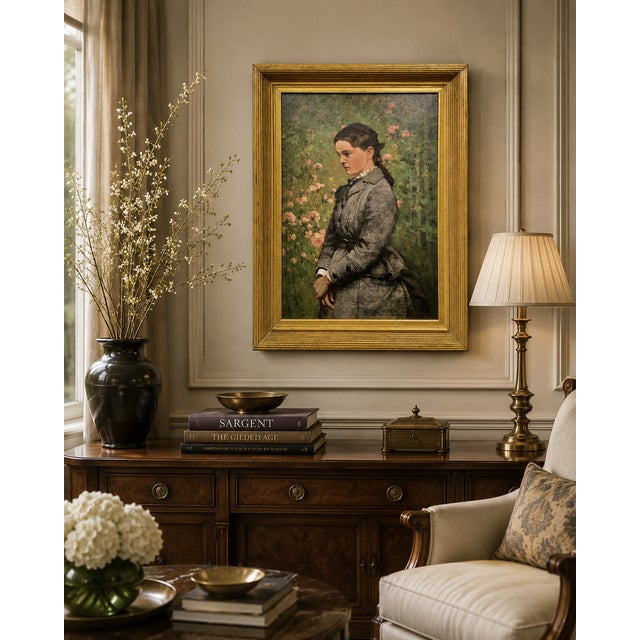
This impressive original oil on canvas by the celebrated American artist John Ferguson Weir presents an elegant three-quarter-length portrait of a young woman standing in quiet profile before a lush flowering garden. Measuring approximately 40 by 27 inches, the composition possesses the restrained dignity and refined naturalism that distinguish the finest examples of late nineteenth-century American portraiture.
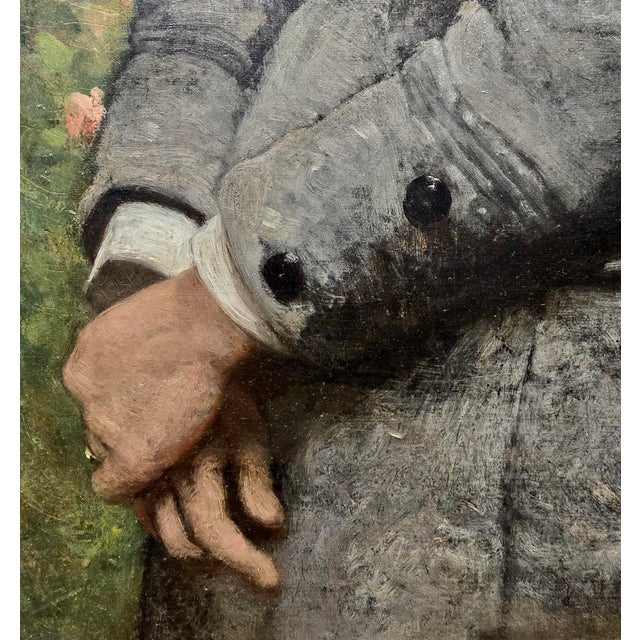
The sitter is portrayed with her hands gently clasped before her, her thoughtful expression and lowered gaze lending the work an air of introspection and quiet grace. Rather than emphasizing social grandeur, Weir captures a deeply human moment of contemplation, allowing subtle emotion to emerge through posture and expression.
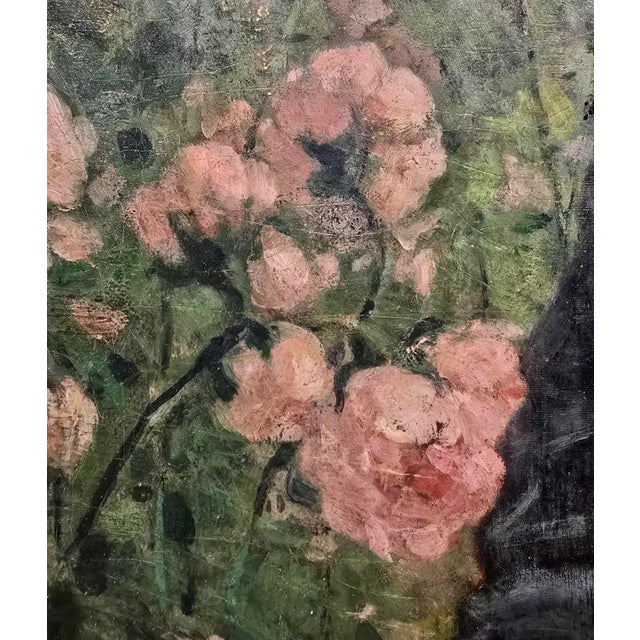
Behind her, a softly rendered garden of dense green foliage and delicate pink climbing roses creates an atmospheric setting that beautifully balances the restrained elegance of her attire. Warm natural light gently illuminates her face while dissolving softly into the surrounding vegetation, producing a harmonious interplay between figure and landscape.
Her tailored gray walking costume—fashionable for the mid-1870s—is rendered with exceptional sensitivity. Weir masterfully contrasts the crisp architectural structure of the garment with the softness of the sitter's complexion and the painterly richness of the surrounding foliage. The restrained palette of silvery grays, muted greens, and warm rose tones contributes to the painting's quiet sophistication while demonstrating the artist's remarkable command of color harmony.
The canvas is housed in an exceptional period fluted gilt frame whose architectural profile perfectly complements the refined character of the portrait while enhancing its distinguished nineteenth-century presentation.
Identification of the Sitter
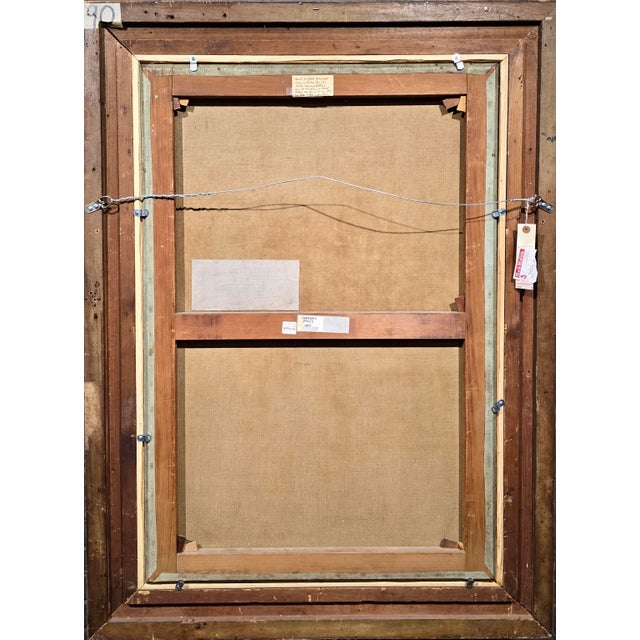
A handwritten period inscription preserved on the reverse identifies the sitter as Marion Eckford Harwood, born in Oyster Bay, New York, in 1854.
According to the accompanying family record, Marion married Robert Parrott Paulding at Trinity Rectory in New Haven, Connecticut, on November 24, 1875. The inscription further documents the birth of the couple's son, Robert, in 1877, providing valuable genealogical information that firmly connects the portrait to the Harwood and Paulding families.
Given both the documented date and the apparent age of the sitter, the portrait was almost certainly painted in conjunction with this important milestone in Marion Harwood's life, likely commemorating her marriage and transition into adulthood.
Signature and Date
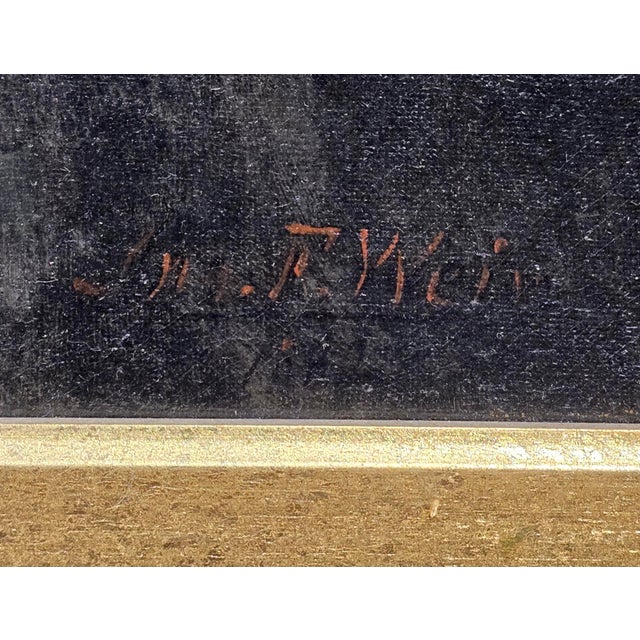
The painting bears the artist's original signature, "Jno. F. Weir," executed in reddish-brown pigment within the lower portion of the composition. The abbreviation "Jno." was the customary nineteenth-century form of "John" and appears on numerous authenticated works by the artist.
A faintly inscribed date of 1875 accompanies the signature, perfectly corresponding with the documented marriage of Marion Eckford Harwood that same year and reinforcing the portrait's historical context.
Provenance
The reverse retains several important labels documenting the painting's modern history.
Among them is an auction label recording Sale 1488, Lot 90, held on March 3, 2005, together with a Christie's inventory label bearing the collection designations "PP101/3" and "AMP." These surviving records document the painting's passage through the international fine art market and indicate its inclusion in a major Christie's New York sale devoted to American paintings, drawings, and sculpture.
Combined with the original family inscription identifying the sitter, the artist's signature and date, and the surviving auction documentation, the portrait enjoys an unusually well-documented history that significantly enhances both its scholarly interest and its desirability among collectors of important nineteenth-century American portraiture.
Artist Biography
John Ferguson Weir (1841–1926) occupies a distinguished place in the history of nineteenth-century American art as both an accomplished painter and one of the nation's most influential art educators. Celebrated for his portraits, landscapes, industrial subjects, and sculpture, Weir helped shape the course of American academic art during a career spanning more than six decades.Born at West Point, New York, on August 28, 1841, Weir grew up in an exceptionally artistic family. His father, Robert Walter Weir, served for many years as Professor of Drawing at the United States Military Academy and provided his son's earliest artistic instruction. The family's remarkable artistic legacy continued with John's younger half-brother, J. Alden Weir, who would later emerge as one of America's foremost Impressionist painters.Seeking to establish himself professionally, Weir moved to New York City in the early 1860s, where he maintained a studio in the celebrated Tenth Street Studio Building, then the center of America's artistic community. Surrounded by painters including Winslow Homer, Sanford Robinson Gifford, and many of the nation's leading artists, he quickly gained recognition for his exceptional technical ability and thoughtful realism.Although today admired for his refined portraits, Weir first achieved national prominence through his pioneering depictions of American industry. His celebrated paintings The Gun Foundry (1866) and Forging the Shaft (1868) rank among the earliest monumental portrayals of industrial labor in American art. Rather than treating factories as merely mechanical environments, Weir transformed scenes of molten iron, glowing furnaces, and working craftsmen into dramatic compositions of remarkable dignity and atmosphere, reflecting the nation's rapid industrial expansion following the Civil War.His reputation led Yale University to appoint him in 1869 as the founding Director of the Yale School of Fine Arts, the first university-affiliated school of art in the United States. Over the next forty-four years, Weir established a rigorous academic curriculum that combined traditional draftsmanship, painting, sculpture, and art theory, creating a model that profoundly influenced collegiate art education throughout America. During this period he also served as an art commissioner for the 1876 Centennial Exposition in Philadelphia, further cementing his national reputation.Throughout his long career, Weir continued to accept portrait commissions while producing landscapes, historical subjects, and sculpture. His portraits are especially admired for their psychological sensitivity, restrained elegance, and exceptional technical refinement, qualities beautifully demonstrated in the present portrait of Marion Eckford Harwood, painted in 1875.Following his retirement from Yale in 1913, Weir settled in Providence, Rhode Island, where he continued to paint despite declining eyesight. He died on April 8, 1926, leaving behind a legacy that extends far beyond his own artistic production. His paintings are represented today in many of America's foremost museum collections, including the Metropolitan Museum of Art, the National Gallery of Art, the Smithsonian American Art Museum, and the Yale University Art Gallery, where they continue to exemplify the highest achievements of nineteenth-century American academic art.
See less
- Dimensions
- 36ʺW × 3ʺD × 49ʺH
- Art Subjects
- Portrait
- Frame Type
- Framed
- Period
- Late 19th Century
- Country of Origin
- United States
- Item Type
- Vintage, Antique or Pre-owned
- Materials
- Canvas
- Oil Paint
- Condition
- Good Condition, Original Condition Unaltered, Some Imperfections
- Color
- Oyster Gray
- Condition Notes
- Excellent - Minor wear consistent with age and history Excellent - Minor wear consistent with age and history less
Questions about the item?
Returns & Cancellations
Return Policy - All sales are final 48 hours after delivery, unless otherwise specified in the description of the product.
Cancellation Policy - Prior to shipping or local pickup, buyers may cancel an order for up to 48 hours, unless otherwise specified.
Related Collections
- Photorealism Canvas Paintings
- Ed Ruscha Paintings
- Photorealism Paintings in New York
- Richard Serra Paintings
- Herman Miller Paintings
- BDDW Paintings
- Louise Nevelson Paintings
- Karen Offutt Paintings
- Jo Baskerville Paintings
- Nicola Simbari Paintings
- Karl-Erik Ekselius Paintings
- Carl-Axel Acking Paintings
- Joseph Stella Paintings
- James McCray Paintings
- Milton Avery Paintings
- Photorealism Paintings in Los Angeles
- Leroy Neiman Paintings
- Jaanika Peerna Paintings
- Vienna Secession Paintings
- Cassina Paintings
- Black Photorealism Paintings
- Lawson-Fenning Paintings
- Jean-Paul Barray Paintings
- Hans Andersen Paintings
- Johannes Andersen Paintings