

Details
Description
Clarkson Stanfield–Dramatic English Lighthouse Seascape w/ French Ship-19th Century Oil Painting
English Romanticism - Oil painting on Canvas - Signed …
Read more
Clarkson Stanfield–Dramatic English Lighthouse Seascape w/ French Ship-19th Century Oil Painting
English Romanticism - Oil painting on Canvas - Signed and dated /Period: Mid-19th Century (Romantic Era) circa 1830/40s
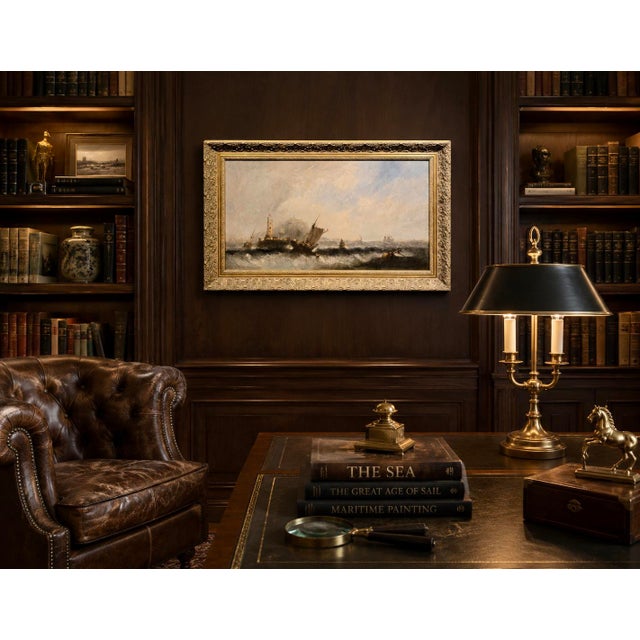
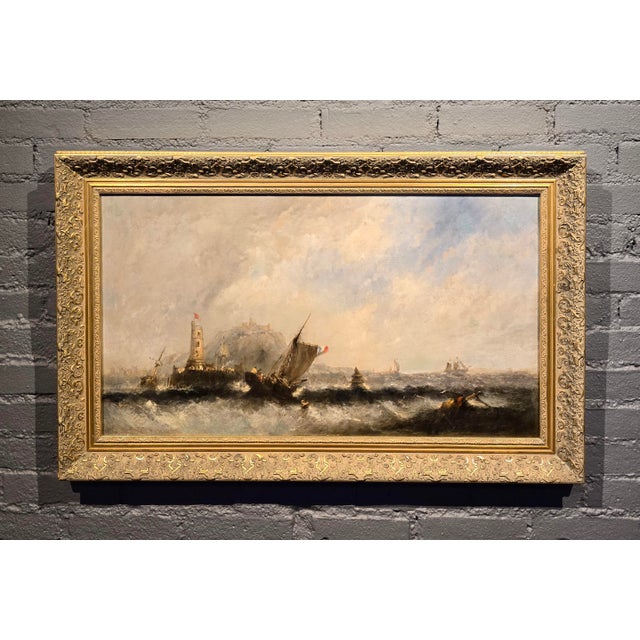
Canvas size: 18x32" - Frame size 24x28x3"
Subject
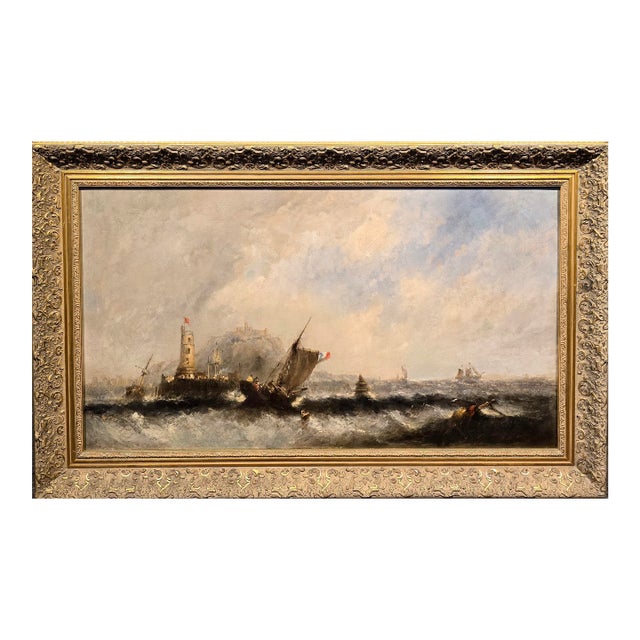
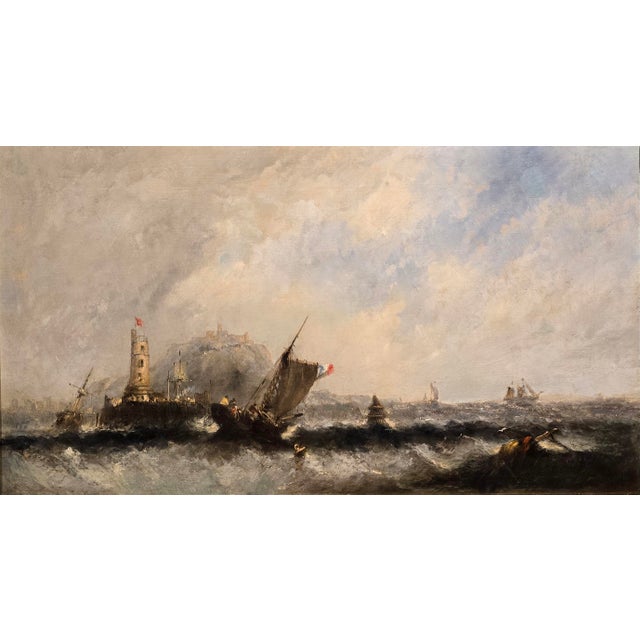
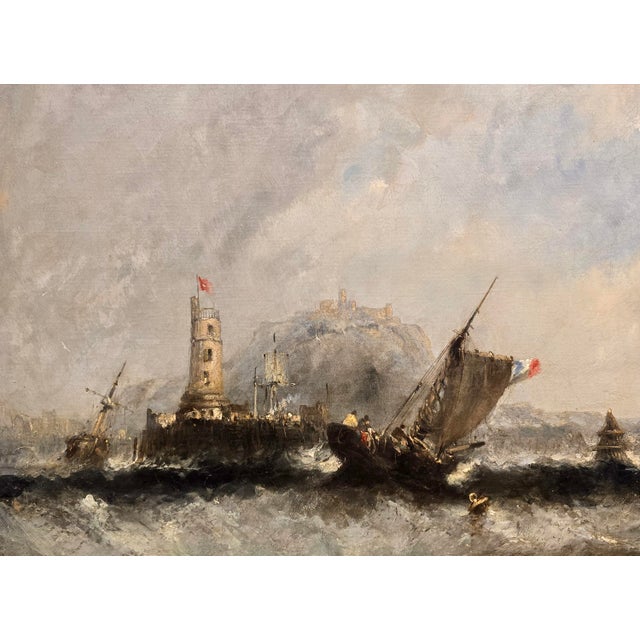
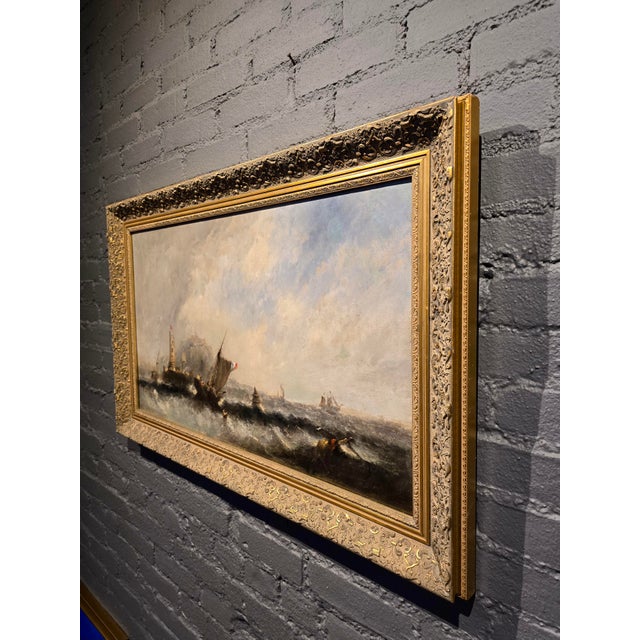
A dramatic Romantic marine painting depicting a storm-lashed European coastline, likely inspired by the rugged shores of Normandy or the English Channel. The composition masterfully combines architecture, shipping, and the raw power of nature into a scene of remarkable atmosphere and emotional intensity.
Visual Composition & Imagery
This powerful marine composition unfolds through sweeping diagonal movement, atmospheric depth, and an extraordinary balance between the permanence of stone fortifications and the relentless motion of the sea. Every element works together to create a compelling narrative of man's enduring struggle against nature.
The Foreground & The Churning Sea
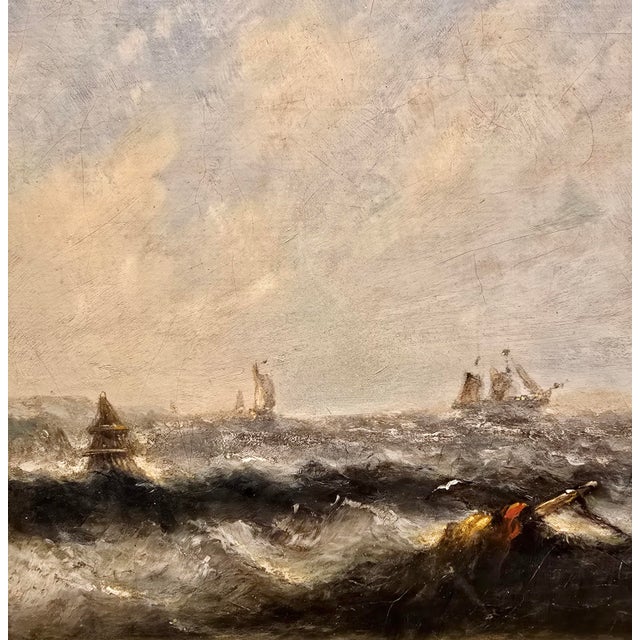
The lower portion of the canvas is dominated by an energetic, wind-driven sea. Towering breakers capped with luminous white foam surge across the foreground in vigorous rhythmic motion, their heavy swells rendered with remarkable confidence and fluidity.
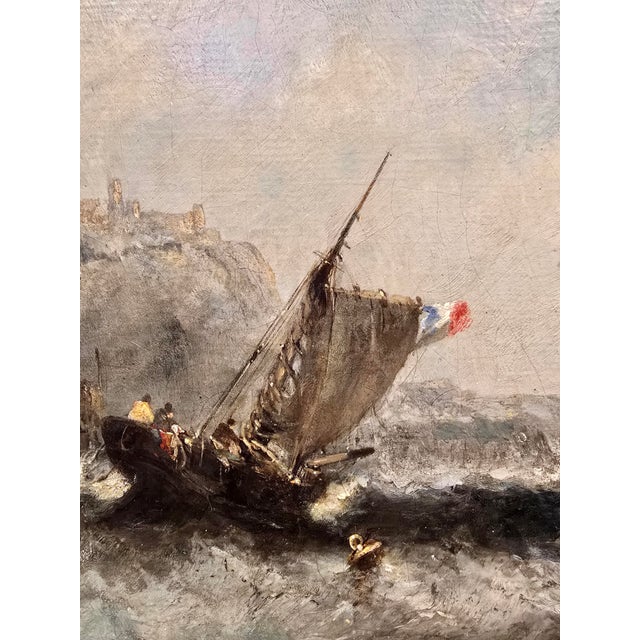
Just right of center, a single-masted fishing or merchant vessel heels dramatically to port as it struggles against the rough water. A French tricolor flies from its stern, introducing one of the painting's few vivid accents of color. Toward the far right, a dark, partially submerged form—possibly a small boat, exposed rock, or drifting wreckage—adds an additional note of uncertainty and danger within the turbulent waters.
The Midground & The Fortified Harbor
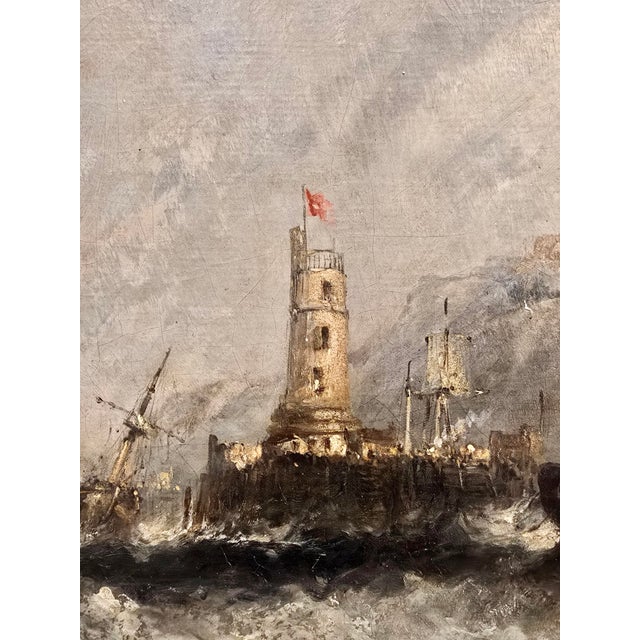
Anchoring the left side of the composition, a substantial stone breakwater projects confidently into the sea. Rising from its end is a commanding cylindrical lighthouse, crowned by a bright red signal flag that provides an elegant visual counterpoint to the muted tonal harmony of the surrounding landscape.
Beyond the harbor, several larger sailing vessels navigate the rough waters beneath partially furled sails, their distant silhouettes reinforcing both the scale of the composition and the hazardous maritime conditions.
The Background & The Citadel
Behind the lighthouse rises an imposing rocky promontory emerging gradually from layers of mist and sea spray. Crowning its summit is an expansive medieval fortress or citadel whose towers and defensive walls dissolve softly into the surrounding atmosphere.
Rather than rendering every architectural detail with precision, the artist allows the distant structures to merge naturally into the haze, creating a convincing illusion of depth while enhancing the painting's distinctly Romantic mood.
Palette, Light & Atmosphere
The composition employs a restrained Romantic palette that heightens both the emotional drama and atmospheric realism of the scene.
Deep charcoal greys, muted olive greens, rich umbers, and warm earth tones dominate the sea and shoreline, while brilliant passages of white sea foam create striking visual contrast against the darker waters.
Above, dense storm clouds gather across much of the sky. Yet a dramatic opening in the cloud cover allows warm cream and pale golden light to break through, illuminating the central portion of the sea, catching the stone lighthouse, and producing a powerful chiaroscuro effect that guides the viewer's eye across the composition.
Atmospheric Perspective
One of the painting's most compelling qualities is its remarkable handling of atmosphere. Rather than relying upon sharply defined detail, distant ships, cliffs, and architectural forms gradually dissolve into layers of mist and diffused light, creating an extraordinary sense of spatial depth. This subtle orchestration of atmosphere transforms the work from a straightforward marine view into a poetic meditation on weather, distance, and the ever-changing character of the sea.
Framing & Physical Presentation
The painting is presented in an exceptional nineteenth-century carved gilt wood and gesso gallery frame of considerable quality. Richly ornamented with scrolling acanthus foliage, decorative floral motifs, and finely executed geometric detailing surrounding the sight edge, the frame beautifully complements both the scale and historical character of the painting while contributing significantly to its overall presentation.
Signature & Surface
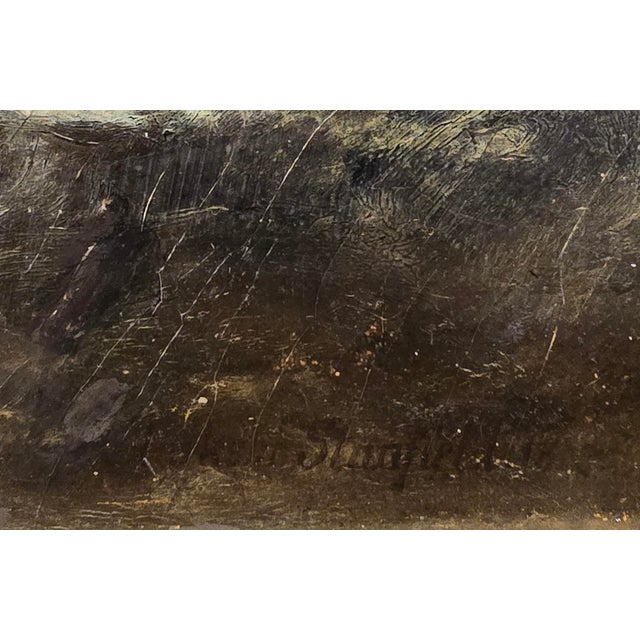
Within the lower-right foreground, subtly integrated into the dark passages of the breaking waves, appears the artist's cursive signature, "C. Stanfield," accompanied by a faint nineteenth-century date.
The paint surface exhibits an attractive, naturally developed network of fine craquelure consistent with the considerable age of the work, while the overall preservation of the paint layer allows the artist's vigorous brushwork and delicate atmospheric transitions to remain beautifully visible.
Provenance & Reverse Markings (Verso)
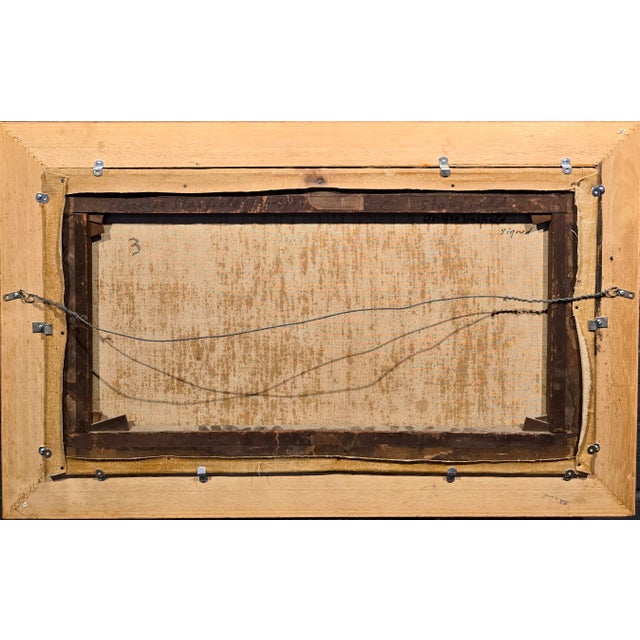
The reverse of the painting provides a fascinating record of its long history and offers valuable physical evidence documenting its passage through time.
Stretcher & Canvas
The painting retains its traditional nineteenth-century keyed wooden stretcher with mitered corner construction. The reverse of the original heavy linen canvas displays pronounced vertical oxidation staining and natural age-related discoloration developed over many decades, characteristics commonly encountered in paintings of this period.
An inventory number, "3," appears neatly applied to the left side of the canvas.
Early Handwritten Inscriptions
Several handwritten inscriptions appear on the stretcher bars.
Across the upper left stretcher is an early inscription reading:
"Clarkson Stanfield 1793–1867."
Toward the upper right appears another early handwritten notation identifying the artist as "C. Stanfield."
These inscriptions reflect the painting's historical attribution and its long-standing identification within previous collections.
London Conservation Label
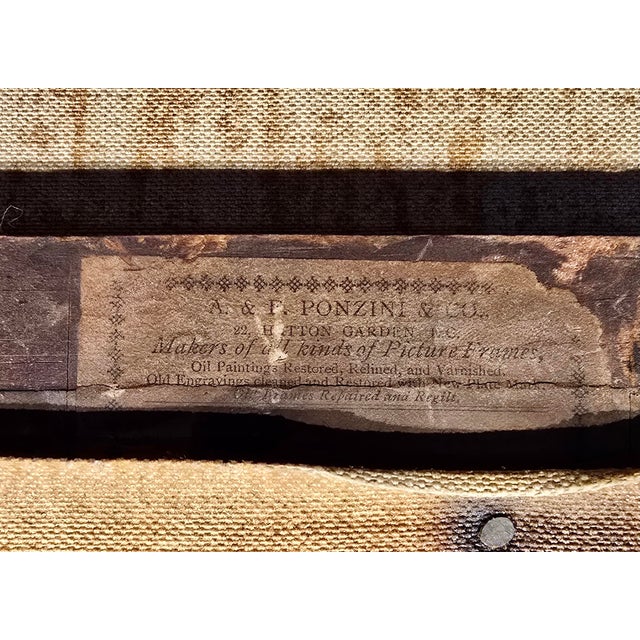
Affixed to the upper stretcher is an original paper trade label from A. & F. Ponzini & Co., 22 Hatton Garden, E.C., London, an established nineteenth-century firm of picture framers and restorers.
The presence of this label indicates that the painting passed through the workshop of this respected London business during the late Victorian period, adding another documented chapter to its provenance and preservation history.
Later Collector's Notation
A later hand has written "Clarkson Stanfield" together with the notation "signed," accompanied by an arrow identifying the location of the signature on the front of the painting. While clearly added at a later date, these annotations demonstrate continued scholarly or collector interest in documenting the painting's attribution and signature placement.
Artist Biography:Clarkson Frederick Stanfield, R.A. (1793–1867)
Clarkson Stanfield was one of the most celebrated and commercially successful English marine painters of the Victorian era. Renowned for his technical precision, dramatic lighting, and atmospheric depth, Stanfield was widely considered a premier rival to J.M.W. Turner in the depiction of seafaring themes and tumultuous coastal waters.
Early Life and Seafaring Beginnings
Born on December 3, 1793, in the bustling port town of Sunderland, Stanfield grew up surrounded by maritime culture. He was the son of James Field Stanfield—an Irish author, actor, and anti-slavery activist—and Mary Hoad, an accomplished artist from whom Clarkson inherited his early creative instincts.
Before dedicating his life to the canvas, Stanfield gained literal, firsthand experience with the ocean:
In 1806, he began an apprenticeship with a coach decorator but left the position shortly after.
In 1808, he went to sea aboard a coal ship. Later that year, he was press-ganged into the Royal Navy, serving on the guardship HMS Namur.
Following a medical discharge in 1814, he joined the merchant navy and traveled as far as China on the East Indiaman Warley in 1815, filling sketchbooks with invaluable visual references of open waters and shifting weather patterns.
Theatrical Scene Painting Success
An injury cut his naval career short, forcing Stanfield to look for work ashore. He transitioned seamlessly into the world of theatrical scene painting in London, starting at the Royalty Theatre before moving to the Royal Coburg Theatre.
By the 1820s, alongside his close friend and fellow landscape painter David Roberts, Stanfield had risen to become a chief scenic designer at the prestigious Theatre Royal, Drury Lane. He achieved massive acclaim for creating moving panoramas and illusionistic dioramas. This high-pressure environment of the stage shaped his mature signature style, instilling in him a masterly grasp of theatrical composition, dramatic light sources (chiaroscuro), and large-scale visual impact.
Royal Academy and Professional Prominence
In 1827, eager to cement his status as a serious fine artist, Stanfield resigned from full-time theater production to focus entirely on easel painting. His rise within the British art establishment was swift:
He became a founding member of the Society of British Artists.
He was elected an Associate of the Royal Academy of Arts (ARA) in 1832 and achieved full Academician status (RA) by 1835.
His mastery quickly drew royal patronage; King William IV commissioned major works from him, including The Opening of New London Bridge and The Entrance to Portsmouth Harbour.
Stanfield traveled extensively throughout continental Europe, making long sketch-gathering trips across the Rhine Valley, Italy, France, and Holland. These trips broadened his scope, allowing him to merge his classic ocean storms with highly accurate coastal topography and European architectural ruins.
Notable Circle and Legacy
Affectionately known as "Stanny" to his contemporaries, Stanfield was a centerpiece of the Victorian cultural elite. He maintained deep lifelong friendships with major cultural titans, including the prominent art critic John Ruskin—who frequently praised Stanfield’s unmatched understanding of cloud formations and wave mechanics—and the author Charles Dickens, with whom he frequently collaborated on private amateur theatrical productions.
Stanfield passed away on May 18, 1867, in Hampstead, London. Today, his masterpieces hang in elite public collections globally, including the Tate Britain, the Victoria and Albert Museum, the Royal Collection Trust, and the National Maritime Museum in Greenwich. His legacy endures as a definitive voice of British Romantic maritime history, famously capturing both the mechanical accuracy of naval engineering and the raw, dangerous beauty of the open sea.
See less
- Dimensions
- 28ʺW × 3ʺD × 24ʺH
- Art Subjects
- Seascape
- Frame Type
- Framed
- Period
- Mid 19th Century
- Country of Origin
- United Kingdom
- Item Type
- Vintage, Antique or Pre-owned
- Materials
- Canvas
- Oil Paint
- Condition
- Good Condition, Original Condition Unaltered, Some Imperfections
- Color
- Blue
- Condition Notes
- Excellent - Minor wear consistent with age and history Excellent - Minor wear consistent with age and history less
Questions about the item?
Returns & Cancellations
Return Policy - All sales are final 48 hours after delivery, unless otherwise specified in the description of the product.
Cancellation Policy - Prior to shipping or local pickup, buyers may cancel an order for up to 48 hours, unless otherwise specified.
Related Collections
- Ed Ruscha Paintings
- Photorealism Canvas Paintings
- Ralph Lauren Paintings
- Photorealism Paintings in New York
- Karen Offutt Paintings
- Richard Serra Paintings
- Silk Velvet Paintings
- Jeff Slemmons Paintings
- Black Photorealism Paintings
- Herman Miller Paintings
- Cassina Paintings
- Jaanika Peerna Paintings
- Photorealism Paintings in Los Angeles
- BDDW Paintings
- Louise Nevelson Paintings
- Jo Baskerville Paintings
- Hans Andersen Paintings
- Pedro Friedeberg Paintings
- Peter Behrens Paintings
- Piet Hein Eek Paintings
- Raphael Paintings
- Johannes Andersen Paintings
- Jean-Paul Barray Paintings
- Lee Reynolds Paintings
- Mid-Century Modern Paintings