

Details
Description
Four auspicious motifs. One Nishijin gold ground. Woven once in Kyoto.
The Oshidori-Goshoguruma is a wall tapestry mounted from a …
Read more
Four auspicious motifs. One Nishijin gold ground. Woven once in Kyoto.
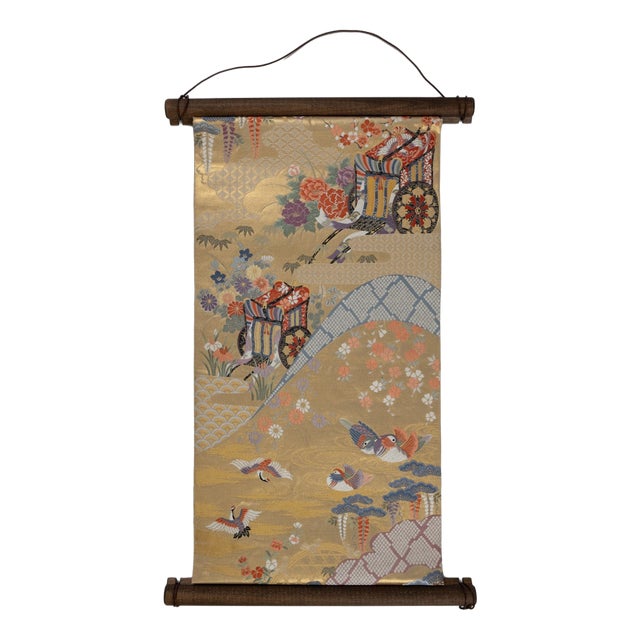
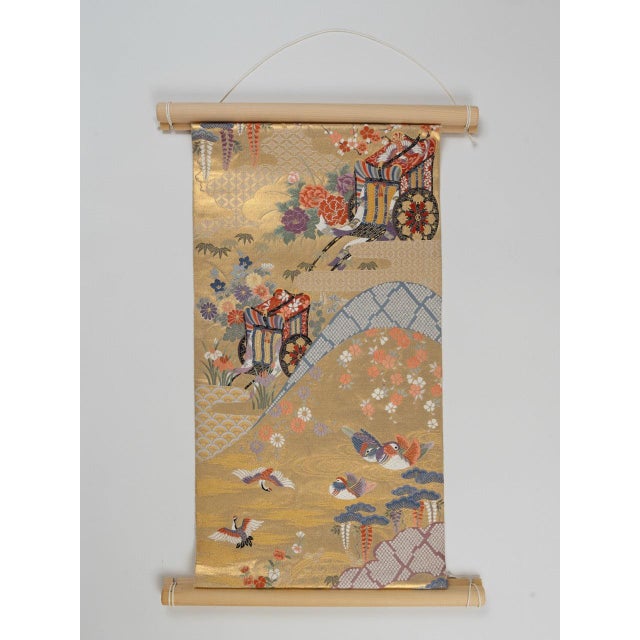
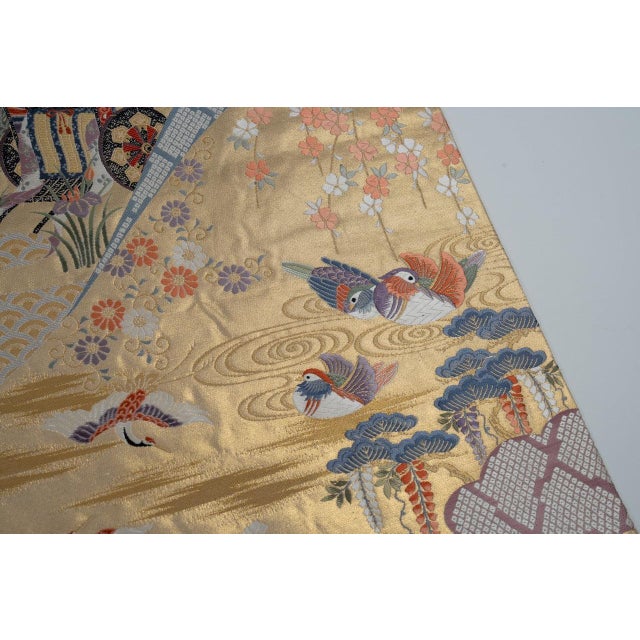
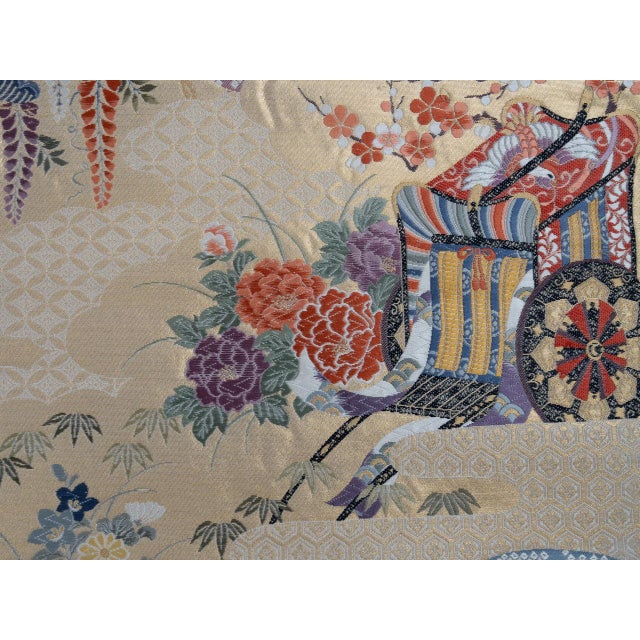
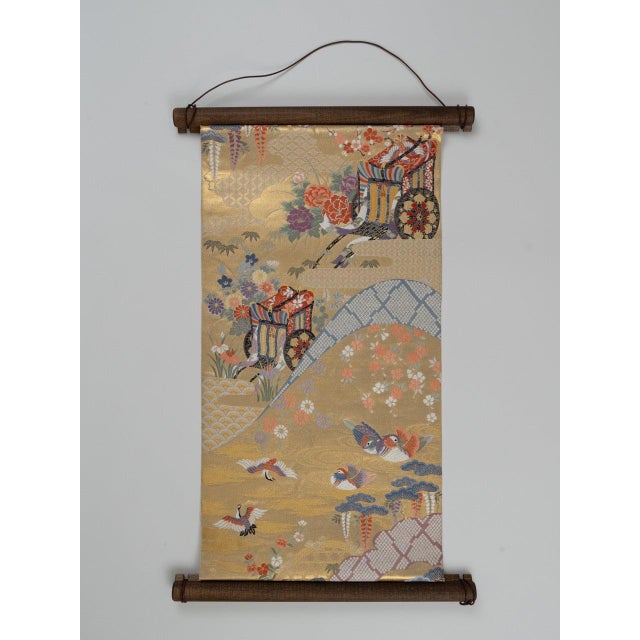
The Oshidori-Goshoguruma is a wall tapestry mounted from a fukuro-obi (袋帯), the double-layered obi reserved for the most formal Japanese ceremony, handwoven in the Nishijin (西陣) district of Kyoto. The ground is kinran (金襴): gold thread carried through the body of the silk rather than laid on its surface, present at different depths of the weave, shifting with the room's light as no print or coating can. Four motifs are gathered for a single occasion of consequence — oshidori (鴛鴦), mandarin ducks, the emblem of enduring love and the only paired-bird motif in the Renaras collection; goshoguruma (御所車), the imperial carriage, mark of the highest aristocracy; tsuru (鶴), cranes in flight, for longevity; matsu (松), pine, for constancy. On a fukuro-obi, that density of auspicious imagery means one thing: a wedding, or its equivalent.
At the atelier we cut a length from the obi, redesigned the composition for vertical wall format, and lined the reverse with undyed support cloth to carry the weight of the gold thread. The silk is mounted between handmade hardwood bars at top and bottom, finished with a leather hanging cord, and arrives ready to hang. The bars are part of the work, not a separate purchase. Nothing on the visible surface has been altered; the silk hangs as it was woven. This is our mottainai — new imagination brought into a living tradition.
The Oshidori-Goshoguruma belongs in a principal room furnished for permanence: dark walnut, aged brass, deep velvet, ivory plaster. The drawing room of a private residence, the entrance of a hotel that wants its threshold to carry weight, the central wall of a fine-dining restaurant. A piece for the collector who knows what a fukuro-obi is — and for the buyer who does not yet know, and will spend the next decade glad they chose it.
Each tapestry arrives with its passport from the atelier — a small handmade record of the silk's first life and its transformation, signed and dated in Amsterdam.
Material:
Japanese ceremonial silk — fukuro-obi (袋帯) in Nishijin kinran (西陣金襴) gold-thread weave
Construction:
Cut and redesigned from the original obi; lined with undyed support silk; mounted on handmade hardwood bars, top and bottom; leather hanging cord supplied. No metal touches the visible silk.
Care:
Dust with a soft brush. Keep out of direct sunlight.
Origin:
Japanese ceremonial silk, redesigned and finished at the Renaras atelier, Amsterdam.
One silk. One story. One piece. Never repeated. Labeled by Maker
See less
- Dimensions
- 11.81ʺW × 0.39ʺD × 24.8ʺH
- Styles
- Contemporary
- Period
- Early 21st Century
- Country of Origin
- Netherlands
- Item Type
- New
- Materials
- Silk
- Condition
- Mint Condition, No Imperfections
- Color
- Gold
- Condition Notes
- New — This is a new (unused) item of contemporary design. New — This is a new (unused) item of contemporary design. less
Returns & Cancellations
Return Policy - All sales are final 48 hours after delivery, unless otherwise specified in the description of the product.
Cancellation Policy - Prior to shipping or local pickup, buyers may cancel an order for up to 48 hours, unless otherwise specified.
Related Collections
- Loloi Rugs Textile Art
- Louis XIII Textile Art
- Workaday Handmade Textile Art
- Resin Textile Art
- Antique Gold Finish Textile Art
- Kenneth Ludwig Chicago Textile Art
- Chanel Textile Art
- Mid-Century Modern Textile Art
- Chinese Textile Art
- Japanese Textile Art
- Tapestry
- Framed Scarves
- Scandinavian Textile Art
- Aubusson Tapestry
- Edwardian Textile Art
- Cardboard Textile Art
- Ralph Lauren Textile Art
- Märta Måås-Fjetterström Textile Art
- Surrealism Textile Art
- Space Age Textile Art
- Pablo Picasso Textile Art