

Details
Description
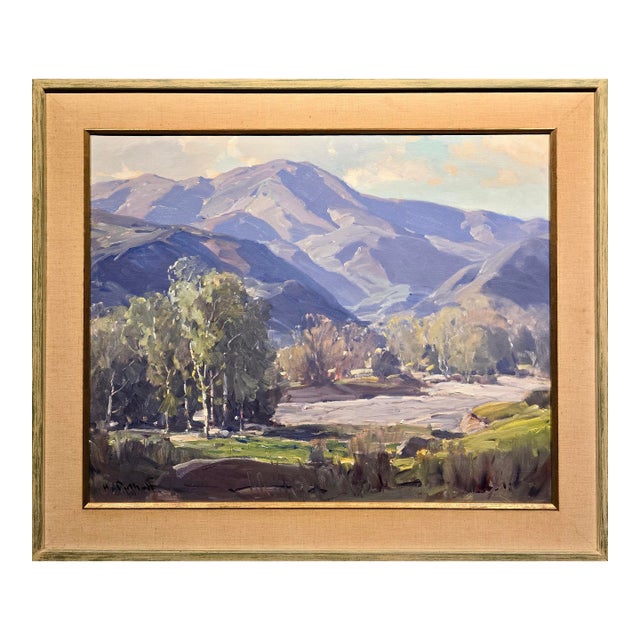
Hanson Duvall Puthuff –Southern California Arroyo Landscape-Original 1930s Oil Painting
California Impressionist - Oil Painting on canvas - Signed
Canvas …
Read more
Hanson Duvall Puthuff –Southern California Arroyo Landscape-Original 1930s Oil Painting
California Impressionist - Oil Painting on canvas - Signed
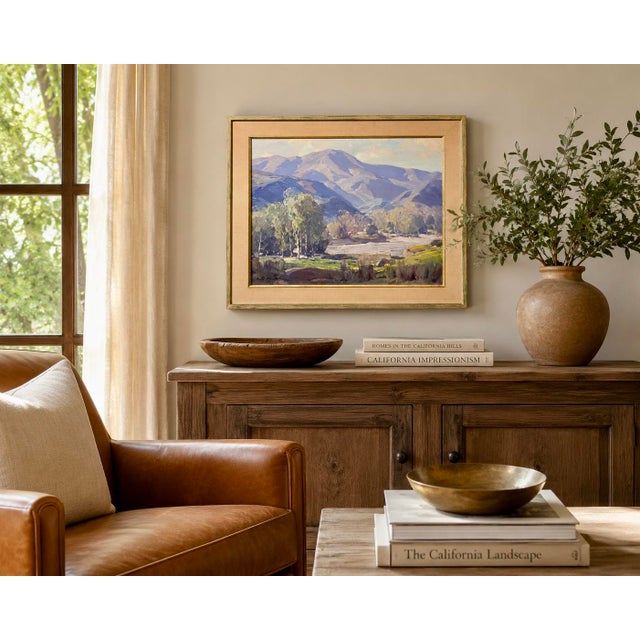
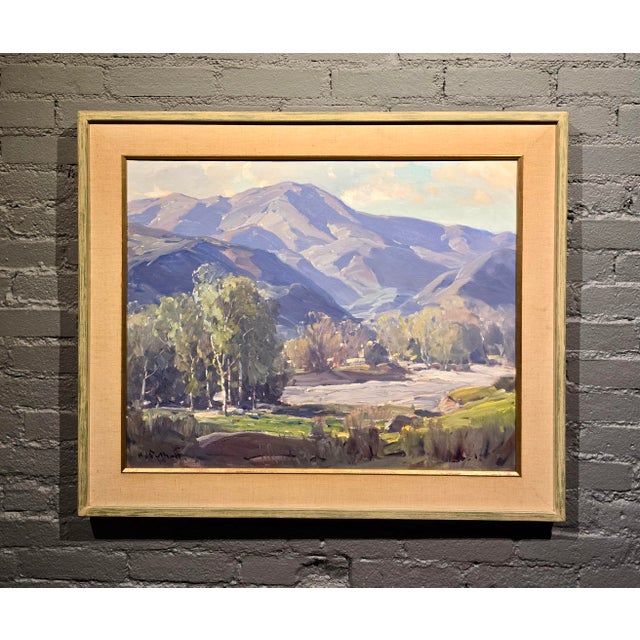
Canvas size 24x30" - Frame size 30x36x1,5"
Description
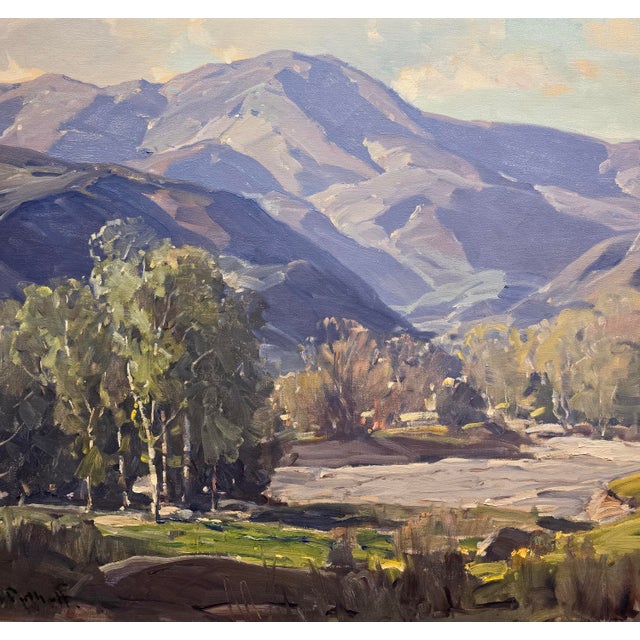
This arroyo valley landscape painting by historic American artist Hanson Duvall Puthuff stands as an exceptional example of early 20th-century California Impressionism. It beautifully demonstrates the artist's remarkable ability to capture the unique light, atmosphere, and expansive geography of Southern California through confident plein air brushwork, masterful color relationships, and a highly structured compositional design.
Visual Presentation and Composition
Foreground:
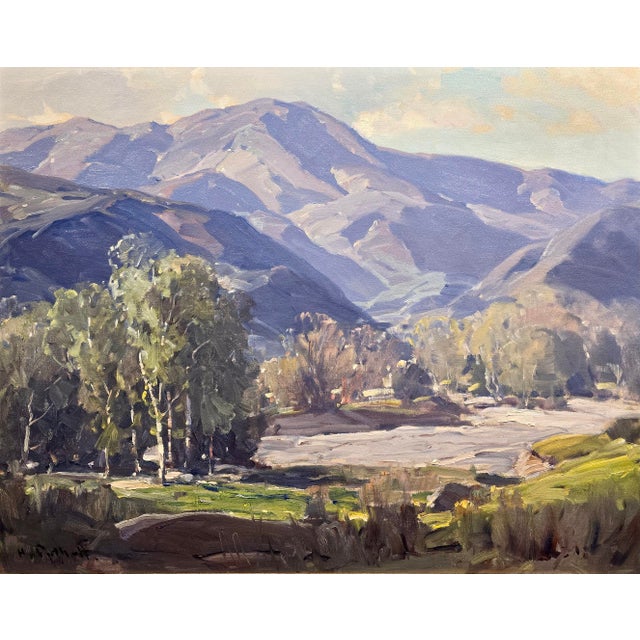
A rugged, sun-drenched Southern California basin floor is animated by thick clumps of native brush, parched grasses, and warm sandy earth tones. A dense grove of eucalyptus and sycamore trees anchors the left side of the composition, rendered with layered, expressive brushstrokes of olive green, chartreuse, and soft cream highlights that convincingly capture sunlight filtering through the foliage.
Midground:
A broad, dry river wash—characteristic of the Arroyo Seco and neighboring Southern California valleys—extends horizontally across the scene. Puthuff employs loose, gestural strokes of muted taupe, lavender, and cool gray to suggest the reflective, stony texture of the sunlit basin floor while naturally guiding the viewer's eye toward the distant mountains.
Background:
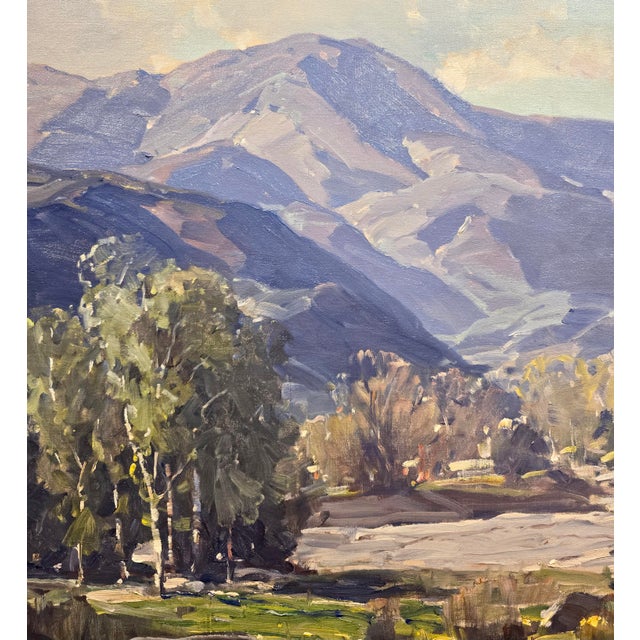
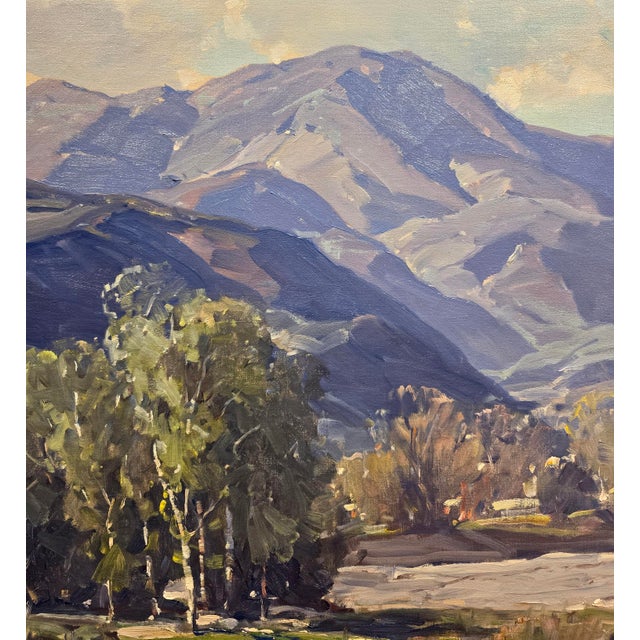
Towering coastal mountain ranges dominate the upper portion of the canvas, their sweeping forms divided into broad passages of light and shadow. Rather than relying on excessive detail, Puthuff constructs the mountains through large, simplified planes that convey both monumental scale and the constantly shifting atmosphere of a brilliant California afternoon.
Artistic Analysis
Subject Matter:
The painting captures a sweeping Southern California arroyo landscape characteristic of the regions Puthuff explored extensively throughout Los Angeles, Pasadena, and the surrounding foothills. It perfectly reflects the rugged natural beauty that became one of the defining subjects of his career.
Color Palette:
Puthuff masterfully creates remarkable depth through rich lavender, slate blue, and violet passages that define the distant mountain ranges, while balancing them with warm ochres, golden earth tones, and vibrant eucalyptus greens across the valley floor. The result is a harmonious interplay of warm and cool color that gives the landscape both luminosity and spatial depth.
Artist's Signature:
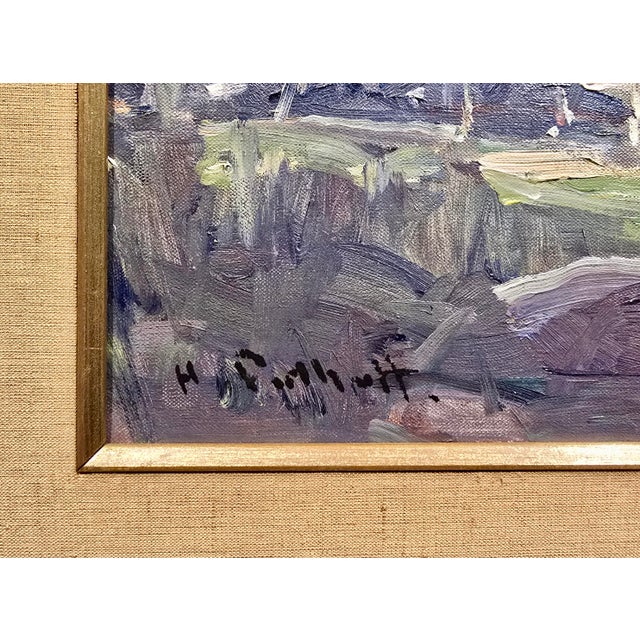
His distinctive hand-brushed signature, "H. Puthuff," is clearly visible in the lower-left corner of the canvas.
Framing:
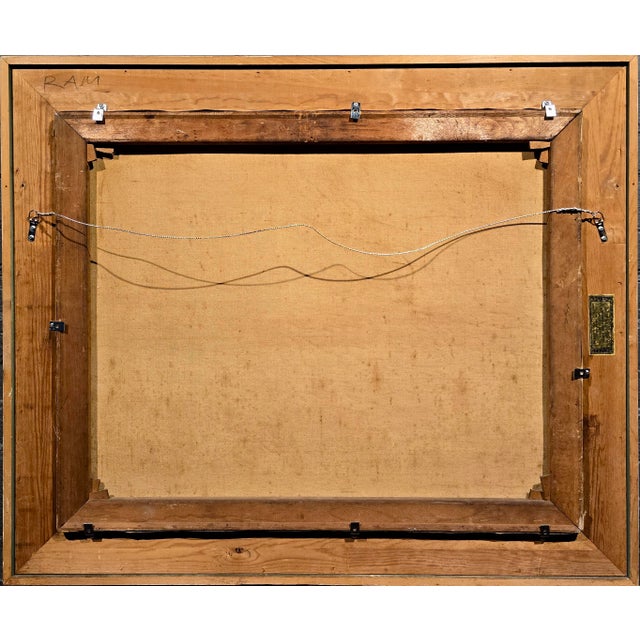
The painting is housed in a period-appropriate, hand-finished plein air frame featuring a beautifully textured linen liner and a delicate gold leaf lip, complementing the historic character and presentation of the artwork.
Palette and Color Theory
Atmospheric Color Relationships:
The distant mountain ranges dissolve into harmonious passages of cool violet, lavender, and hazy slate blue, creating an extraordinary sense of depth and geographic distance that is characteristic of California Impressionism.
Warm and Cool Balance:
Brilliant golden sunlight enters from the upper right, casting long, cool shadows across the mountain ridges and valley floor. This sophisticated balance between cool blues and violets and the warm ochres, greens, and sunlit highlights creates a remarkable sense of both realism and tranquility.
The Sky:
A soft expanse of pale blue sky rises above the mountain ridges, accented with delicate wisps of cream and pastel orange clouds that reinforce the quiet serenity of the late afternoon light.
Style and Execution
Executed entirely en plein air (outdoors on location), the painting displays extraordinary structural confidence and painterly freedom. Rather than pursuing meticulous detail, Puthuff organizes the landscape into broad masses of color and tonal value, building form through confident impasto brushwork and fluid, expressive strokes. This economical yet highly sophisticated approach allows the entire landscape to breathe with natural light, movement, and atmospheric vitality while preserving the immediacy that defines his finest outdoor paintings.
Historical Significance & Provenance
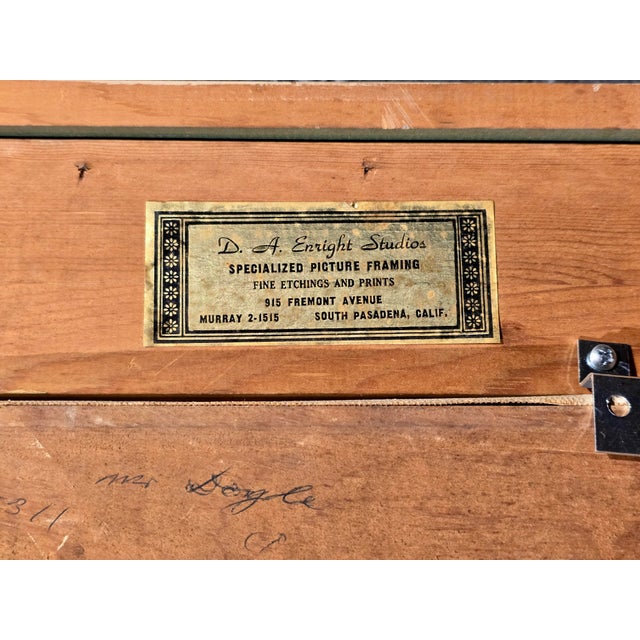
A vintage gold-trimmed label from D.A. Enright Studios, located at 915 Fremont Avenue, South Pasadena, California, remains affixed to the reverse of the frame. The studio specialized in fine picture framing, quality etchings, and works on paper, and was well known throughout Southern California during the mid-20th century.
The Framing Studio:
D.A. Enright Studios earned an excellent reputation for producing custom frames and providing professional presentation for important works of art throughout the region.
Connection to the Painting:
The presence of the D.A. Enright Studios label aligns naturally with the painting's Southern California origins. Since Hanson Duvall Puthuff lived and painted extensively throughout the Los Angeles and Pasadena area, it is entirely consistent that one of his landscapes would have been professionally framed by a respected local studio of the period. This association further reinforces the painting's authentic regional history.
Handwritten Markings:
Below the studio label, a handwritten pencil inscription reading "Mrs. Doyle" most likely identifies an early owner or collector who commissioned the framing. The faint pencil notation "311" at the far left is believed to represent either a framing inventory number or a gallery reference.
Artist Biography
Hanson Duvall Puthuff (August 21, 1875 – May 12, 1972) was a foundational figure in the California Impressionism movement. He spent over seven decades capturing the rolling hills, arid desert expanses, and canyons of Southern California and the American Southwest.
Early Life and Artistic Foundations
Born in Waverly, Missouri, to a struggling carpenter, Puthuff faced significant early childhood instability. Following his mother’s death when he was just two years old, he was placed under the lifelong care of her close friend, Elizabeth Stadley Puthuff, a Civil War widow who earned a living as a seamstress. Out of profound respect and gratitude for his surrogate mother, he permanently adopted her surname.
Puthuff pursued formal art training at the Art Institute of Chicago before relocating to Colorado in 1889. In 1893, he enrolled at the University of Denver Art School, eventually complementing his academic foundation with further studies at the Chicago Academy of Fine Arts.
The Commercial Years and Moving West
In 1903, drawn by commercial opportunities and the region's climate, Puthuff moved to Los Angeles, California. For the next 23 years, he sustained his family by working as a commercial muralist and billboard painter for industry giants like Foster & Kleiser.
During these decades, easel painting remained a passionate, part-time endeavor. Whenever time permitted, Puthuff packed his portable painting box and ventured into the rural valleys around his home in Eagle Rock, California. There, he meticulously observed the shifting desert light and atmospheric transformations of the local terrain.
Transition to Full-Time Fine Art
By 1906, Puthuff shifted his artistic attention entirely away from figure painting toward outdoor landscape painting (en plein air). In 1926, at fifty years old, he made the bold decision to abandon commercial advertising completely to focus exclusively on fine art and exhibitions.
His career rapidly gained national momentum:
The Santa Fe Railway Commission: In 1927, the railroad commissioned him to paint a series of panoramic landscapes capturing the sweeping, deep vistas of the Grand Canyon.
Museum Habitat Backgrounds: His commercial backdrop expertise translated seamlessly into fine art commissions. He was hired to paint the vast panoramic backdrops for the wildlife habitat exhibits at the Los Angeles Museum of History, Science, and Art, as well as the prestigious Theodore Roosevelt Memorial at the American Museum of Natural History in New York City.
Travels with Edgar Payne: Puthuff traveled extensively alongside his close friend and legendary contemporary, Edgar Payne, making frequent painting treks to Arizona’s Canyon de Chelly and the Navajo Reservation.
Signature Style and Artistic Philosophy
Puthuff’s mature style is characterized by a "lyric interpretation" of nature. Rather than rendering precise topographical facts, he utilized high-key colors, a wide chromatic spectrum, and a highly loose, rhythmic brushwork format to capture the sheer weight and spatial depth of raw landmasses.
Art historians often draw comparisons between his robust brushstroke structures and those of his close contemporary, William Wendt, with whom he collaborated on significant municipal art murals. Puthuff is particularly celebrated for his poetic renderings of native California eucalyptus and sycamore tree canopies.
Community Activism and Legacy
Puthuff was deeply dedicated to building an institutional footprint for Western art. He co-founded the Art Students League of Los Angeles in 1906 and helped establish the Painters Club of Los Angeles, which directly served as the immediate forerunner to the historic California Art Club.
Puthuff passed away on May 12, 1972, in Corona del Mar, California. Today, his oil paintings are permanently preserved in elite collections nationwide, including the Los Angeles County Museum of Art (LACMA), the Laguna Art Museum, the Bowers Museum, and the Smithsonian American Art Museum inventor
Conclusion:
Combining exceptional painterly confidence, luminous California light, outstanding regional provenance, and a beautifully preserved period presentation, this remarkable landscape embodies the qualities that have made Hanson Duvall Puthuff one of the foremost figures of the California Impressionist movement. Rich in atmosphere, color, and historical significance, it represents an outstanding opportunity to acquire an authentic plein air painting by one of Southern California's most celebrated landscape masters.
See less
- Dimensions
- 36ʺW × 1.5ʺD × 30ʺH
- Styles
- American
- Impressionist
- Art Subjects
- Landscape
- Frame Type
- Framed
- Period
- 1930s
- Country of Origin
- United States
- Item Type
- Vintage, Antique or Pre-owned
- Materials
- Canvas
- Oil Paint
- Condition
- Good Condition, Original Condition Unaltered, Some Imperfections
- Color
- Sky Blue
- Condition Notes
- Excellent - Minor wear consistent with age and history Excellent - Minor wear consistent with age and history less
Questions about the item?
Returns & Cancellations
Return Policy - All sales are final 48 hours after delivery, unless otherwise specified in the description of the product.
Cancellation Policy - Prior to shipping or local pickup, buyers may cancel an order for up to 48 hours, unless otherwise specified.
Related Collections
- Photorealism Canvas Paintings
- Photorealism Paintings in New York
- Ed Ruscha Paintings
- Richard Serra Paintings
- Herman Miller Paintings
- Jo Baskerville Paintings
- Louise Nevelson Paintings
- Karen Offutt Paintings
- Nicola Simbari Paintings
- BDDW Paintings
- James McCray Paintings
- Joseph Stella Paintings
- Karl-Erik Ekselius Paintings
- Leroy Neiman Paintings
- Jaanika Peerna Paintings
- Cassina Paintings
- Lawson-Fenning Paintings
- Black Photorealism Paintings
- Jean-Paul Barray Paintings
- Hans Andersen Paintings
- Johannes Andersen Paintings
- Pedro Friedeberg Paintings
- Peter Behrens Paintings
- Piet Hein Eek Paintings
- Raphael Paintings