

Details
Description
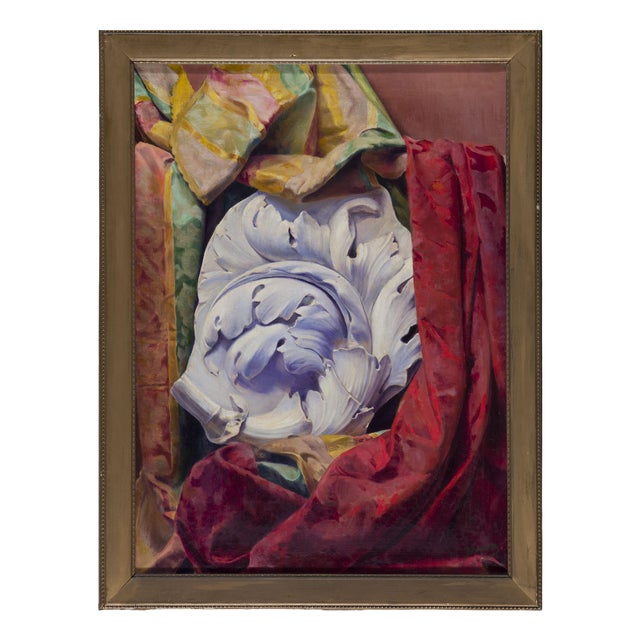
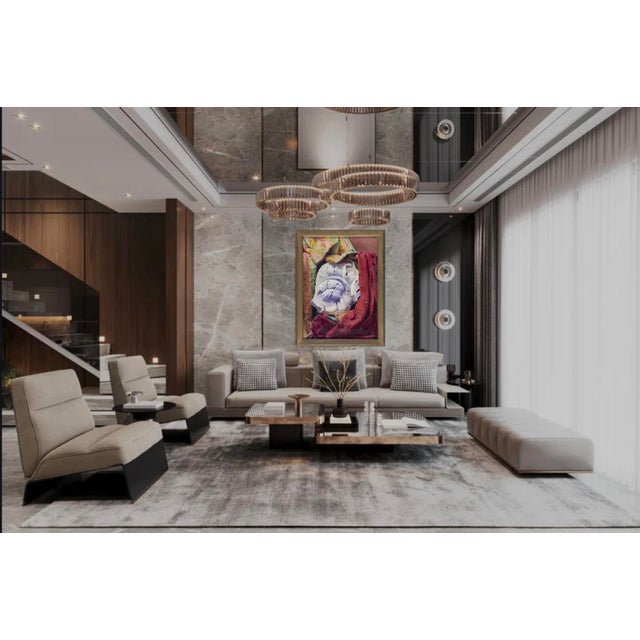
Luigi lucioni mid-century italian still-life signed painting oil on canvas
this wonderful still life, credited to luigi lucioni (1900–1988), is …
Read more
Luigi lucioni mid-century italian still-life signed painting oil on canvas
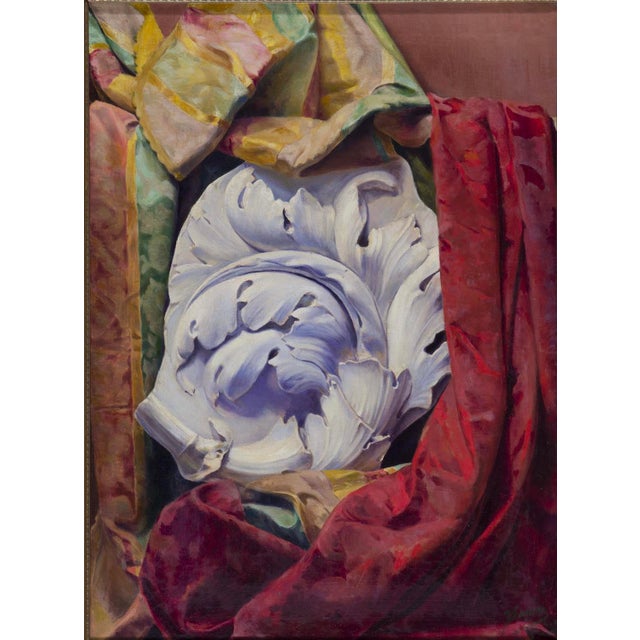
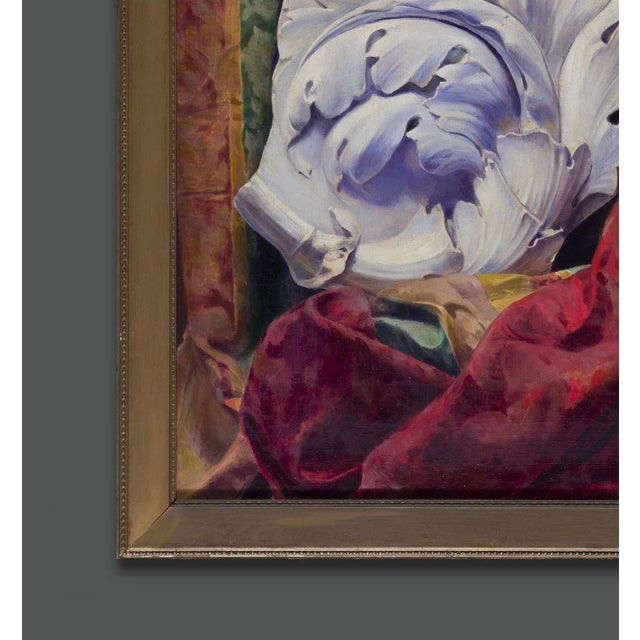
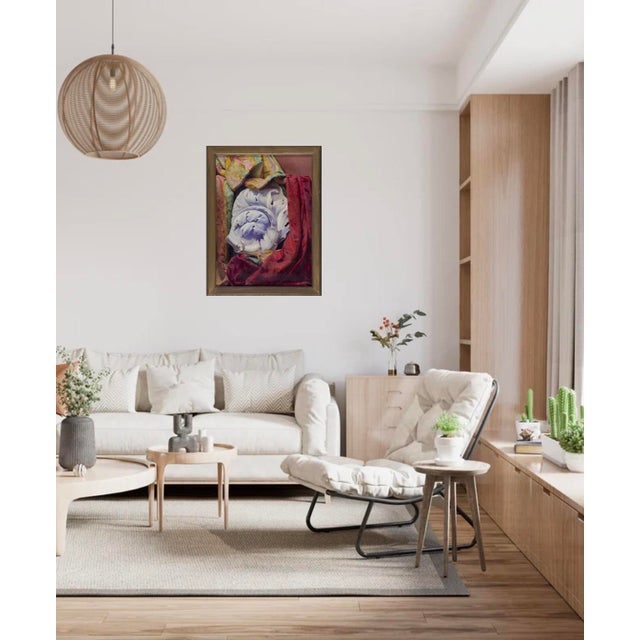
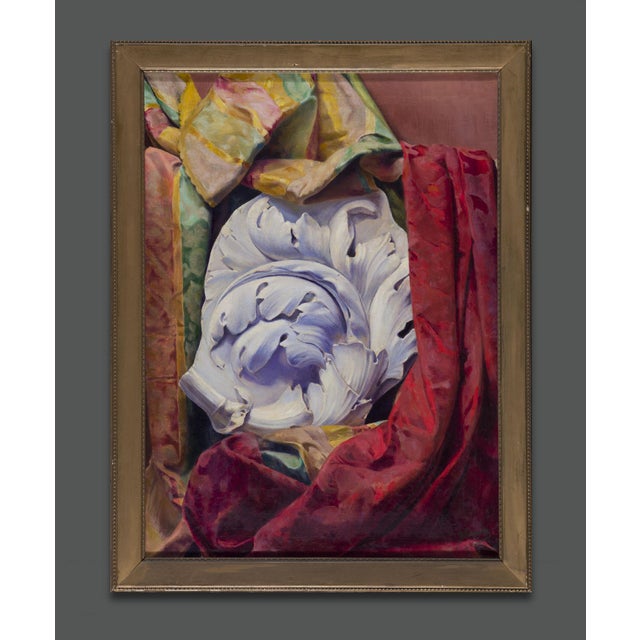
this wonderful still life, credited to luigi lucioni (1900–1988), is a characteristic example of his "super-realism" style, which combines 20th-century precision with the technical rigors of the early italian renaissance.
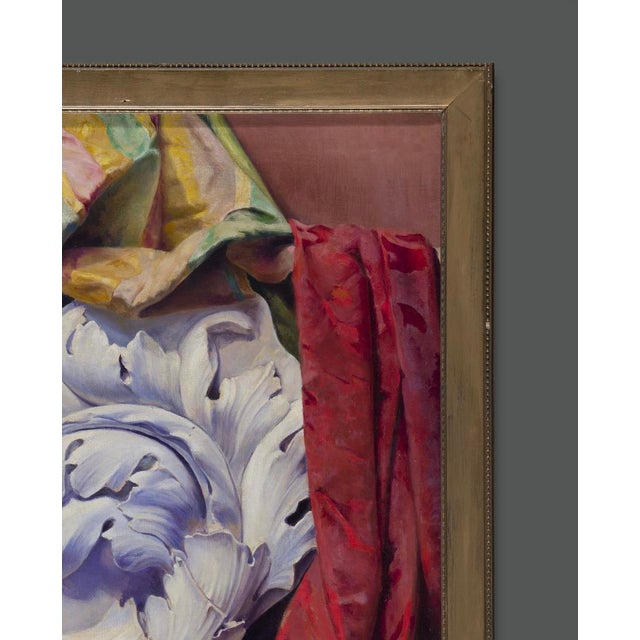
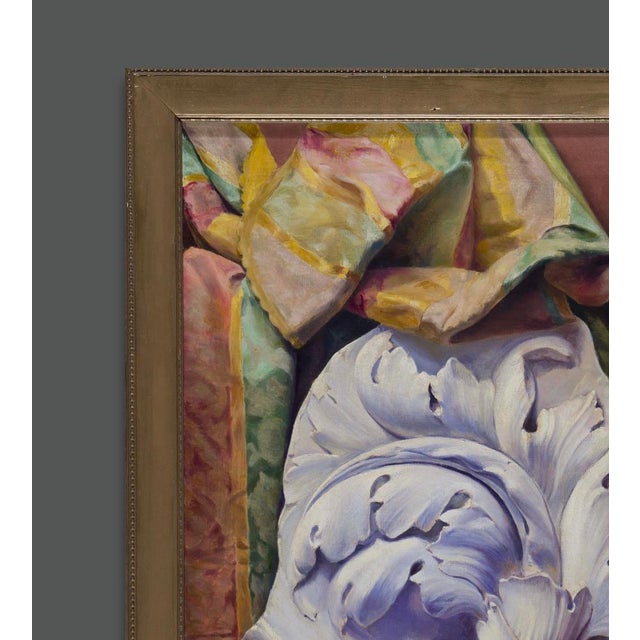
the focal point is a meticulously rendered plaster cast, likely an architectural fragment featuring an acanthus leaf or similar botanical scrollwork.
lucioni was known for his "exquisitely composed" and "meticulously finished" forms that achieve a nearly trompe l'oeil effect.
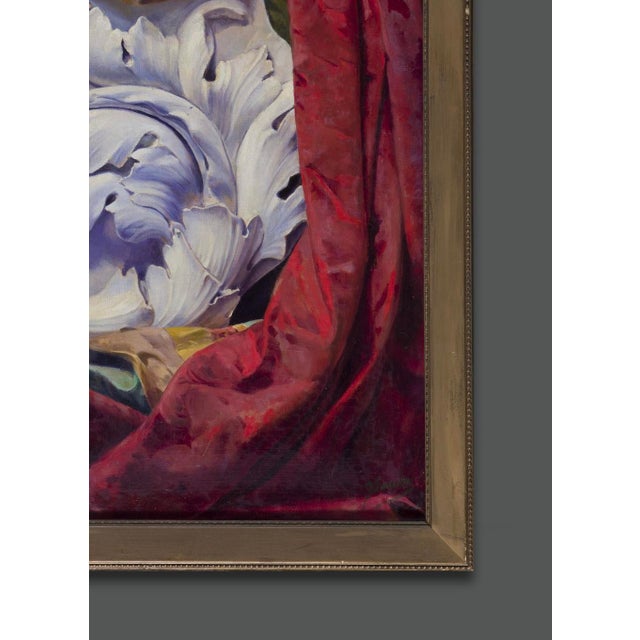
the work features "superbly painted draperies" with a multitude of complex folds—a technical challenge lucioni famously embraced.
the composition contrasts a saturated crimson fabric on the right with a variegated, patterned textile (likely featuring yellow and green tones) on the left.
true to his training as an etcher, lucioni employs "clean clear lines" and a "smooth paint surface" to define contours with photographic precision.
this hyper-focus on line and form creates a "dense, silky texture" typical of his 1930s-1940s output. Lucioni often planned "distinctive, harmonious color combinations," frequently utilizing "color-saturated" palettes to heighten the reality of his subjects.
the dramatic play of light and shadow on the white plaster highlights his ability to render "difficult materials" with exceptional clarity.
luigi lucioni was a prominent realist painter who rejected modern abstraction in favor of a "cool, precise style".
his still lifes often placed ordinary or "antiquated decoration" into carefully controlled, almost surreal arrangements that emphasize texture and formal balance
luigi lucioni (born giuseppe luigi carlo benevenuto lucioni; november 4, 1900 – july 22, 1988) was an italian americanpainter known for his still lifes, landscapes, and portraits.
luigi lucioni was born on november 4, 1900, in malnate, italy, which lies in a mountainous region approximately 30 miles north of milan, in the foothills of the alps near the border between italy and switzerland.
lucioni's parents, angelo and maria beati lucioni, who were married in 1890, were from the nearby region of castiglione olona, as were lucioni's grandparents.
lucioni had three older sisters: angela (b. 1891), alice (b. 1893) and aurora (b. 1897), and the family lived in a two-room apartment with no gas, running water or a bathtub.
as lucioni's grandmother was upset by the "pagan" names given to his sisters, his parents named him giuseppe luigi carlo benevenuto lucioni, naming him after three saints, in order to make amends with her. Lucioni, who was greatly influenced by his strict disciplinarian mother, called her "la bella beati", or a beautiful blonde woman.
as a child, lucioni came to adore the natural beauty of the hills and mountainsides when he explored the region between malnate and the swiss border, and showed an early interest in art, in particular drawing, possibly influenced by a cousin of his father's, who also harbored a talent for drawing.
his first classes were in geometrical drawing, and at age six, his talent caught the attention of his teacher, miss gadisco, a woman from varese who had some artistic training herself, and who encouraged him to pursue drawing and etching as a career.
members of the lucionis extended family had emigrated to the transvaal colony in africa and to south america, which was a favored destination of northern italians at the time.
40-year-old angelo emigrated to new york city in 1906, and after establishing himself as a coppersmith and tinsmith, sent for the rest of the family.
maria, having heard about the "savages and indians" in the united states, took lucioni to milan, his first time in a big city, where he was confirmed in the duomo in order to protect his soul.
on july 15, 1911, the family boarded the ship duke of genoa for the u.s and the family was transferred to ellis island.
the family then moved in with angelo in the apartment he rented on christopher street in manhattan.
maria, who had never lived in a large city, took an immediate dislike to living in new york, and threatened to return to malnate if the family did not move to a smaller town.
on the suggestion of an american that the family had met on the duke of genoa, the family moved to north bergen, new jersey, and then several more times before settling in 1929 at 403 new york avenue in union city, new jersey.
luigi lucioni spent four years learning english on the streets of his newly adopted country, and was not placed in first grade until age 11.
he was made to scrub the home's wooden floor on his hands and knees, and not permitted to go out and play until this task was completed, which he credited with instilling in him a sense of discipline that served him well in his artistic life.
our artist advanced through his grades and won an academic medal in 1916.
after completing the eighth grade, he did not attend school until college.
he did take drawing lessons for several years at a drawing school where he worked every night after his studies concluded, copying the plaster heads.
he left the school after he refused to acknowledge an instructor's criticism of his perspective.
the school curriculum was divided into four years, in which he would study geometric shapes, then drawing heads, then antiquities and then finally, drawing from life.
for painting, he studied under william de leftwich dodge.
as lucioni recalls it, dodge was initially not interested in lucioni's work, and made his feelings known, but was kind and gentle, and allowed lucioni to visit his studio on west 9th street, where lucioni received sound criticism.
he cites dodge as an influence in his own realization that one's belief in oneself is the key to fully realize one's own artistic vision, and not the adoption of contemporary trends in art or catering to others' expectations, a theme that lucioni would express in his career.
lucioni's work was marketed through associated american artists in new york.
lucioni's portrait of paul cadmus was included in the brooklyn museum's show "youth and beauty: art of the american twenties" (winter 2010–2011) and was reproduced for the show's poster.
in 1938, lucioni met ethel waters through their mutual friend, carl van vechten.
after several months, lucioni asked waters if he could paint her portrait and she readily agreed so a sitting was arranged at his studio on washington square.
waters bought the finished portrait from lucioni in 1939 for $500.
waters was at the height of her career in 1939, at that time, she was the first african american to have a starring role on broadway and was already a jazz and blues legend.
in her portrait, waters wears a beautifully tailored red dress with an elegant mink coat draped over the back of her chair.
not until one actually views this portrait in person can one feel the human emotion that lucioni so deftly articulated on canvas.
he positioned waters with her arms tightly wrapped around her waist, a gesture that conveys a sense of vulnerability as if she were trying to protect herself.
intentional or not, this gesture is aptly symbolic of the challenges she faced as an impoverished african american woman growing up in a social climate of racial and gender discrimination.
in 2017, the huntsville museum of art (hma) acquired the historic portrait of ethel waters. Hma executive director, christopher j. Madkour, and luigi lucioni historian, dr. Stuart embury, heard of the painting and were able to track down its whereabouts.
the painting was thought to be lost since it had not been viewed by the public since 1942, but the two traced it to a private residence in 2016 and learned the family had plans to auction the painting off in the coming months.
the owner graciously allowed the huntsville museum of art to display portrait of ethel waters in the exhibition, american romantic: the art of luigi lucioni, where it was viewed by the public for the first time in over 70 years.
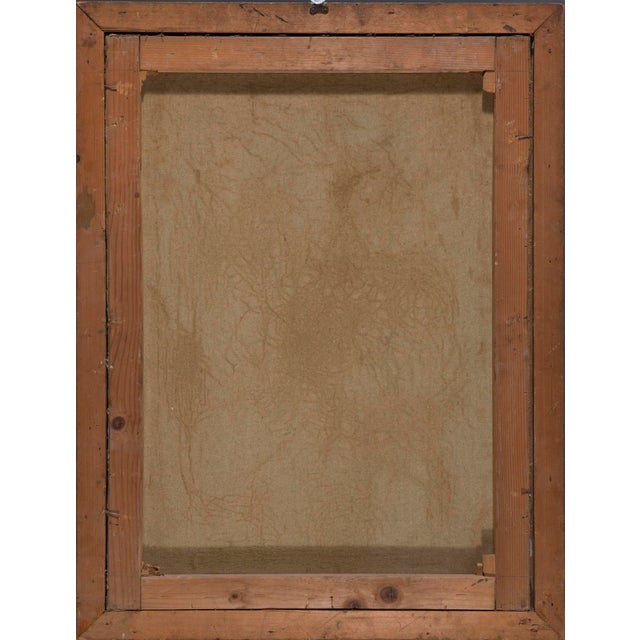
the museum successfully negotiated the purchase of portrait of ethel waters and, thanks in large part to the generosity of the huntsville community, lucioni's portrait of ethel waters now has a new home at the huntsville museum of art in huntsville, alabama where it will be made accessible for public viewing. This piece is attributed to the mentioned designer/maker. It has no attribution mark and no
official proof of authenticity,
however it is well documented in design history. I take full responsibility for any authenticity
issues arising from misattribution
See less
- Dimensions
- 25.2ʺW × 1.57ʺD × 33.07ʺH
- Styles
- Modern
- Art Subjects
- Nude
- Period
- 1920s
- Country of Origin
- Italy
- Item Type
- Vintage, Antique or Pre-owned
- Condition
- Good Condition, Unknown, Some Imperfections
- Color
- Condition Notes
- Patina Consistent with Age and Use Patina Consistent with Age and Use less
Returns & Cancellations
Return Policy - All sales are final 48 hours after delivery, unless otherwise specified in the description of the product.
Cancellation Policy - Prior to shipping or local pickup, buyers may cancel an order for up to 48 hours, unless otherwise specified.
Related Collections
- Photorealism Canvas Paintings
- Ed Ruscha Paintings
- Photorealism Paintings in New York
- Richard Serra Paintings
- Herman Miller Paintings
- BDDW Paintings
- Louise Nevelson Paintings
- Karen Offutt Paintings
- James McCray Paintings
- Milton Avery Paintings
- Carl-Axel Acking Paintings
- Joseph Stella Paintings
- Karl-Erik Ekselius Paintings
- Leroy Neiman Paintings
- Photorealism Paintings in Los Angeles
- Jaanika Peerna Paintings
- Jo Baskerville Paintings
- Nicola Simbari Paintings
- Soicher Marin Paintings
- Cassina Paintings
- Lawson-Fenning Paintings
- Black Photorealism Paintings
- Jean-Paul Barray Paintings
- Hans Andersen Paintings
- Johannes Andersen Paintings