

Details
Description
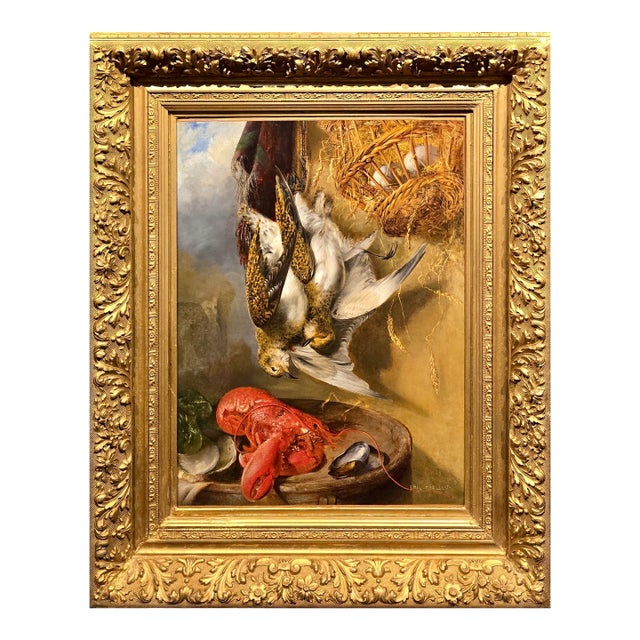
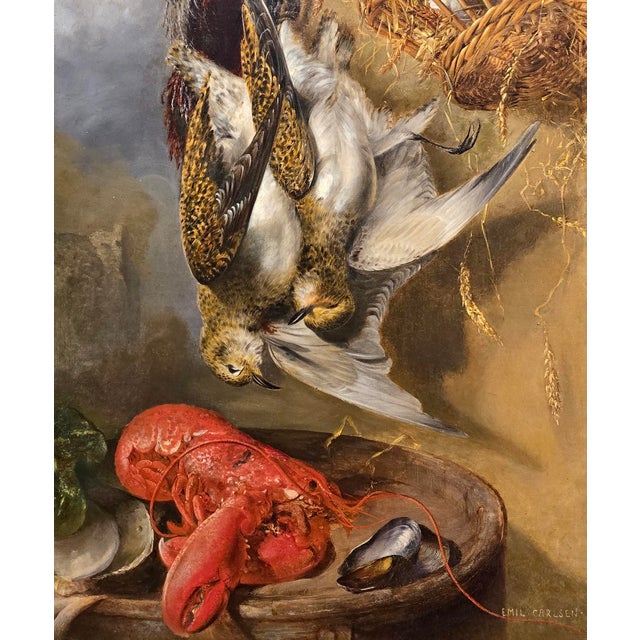
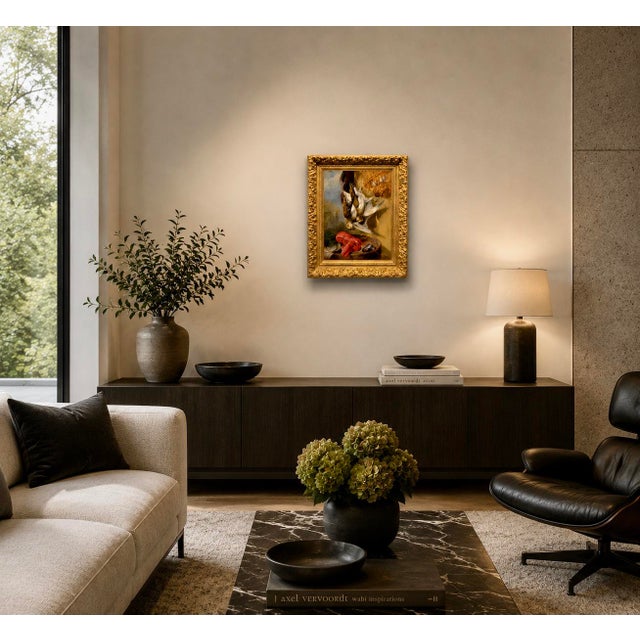
Emil Carlsen - Still Life of Lobster & Game - 19th century Oil painting
American Academic Realism - Oil Painting …
Read more
Emil Carlsen - Still Life of Lobster & Game - 19th century Oil painting
American Academic Realism - Oil Painting on Canvas - signed circa 1880s
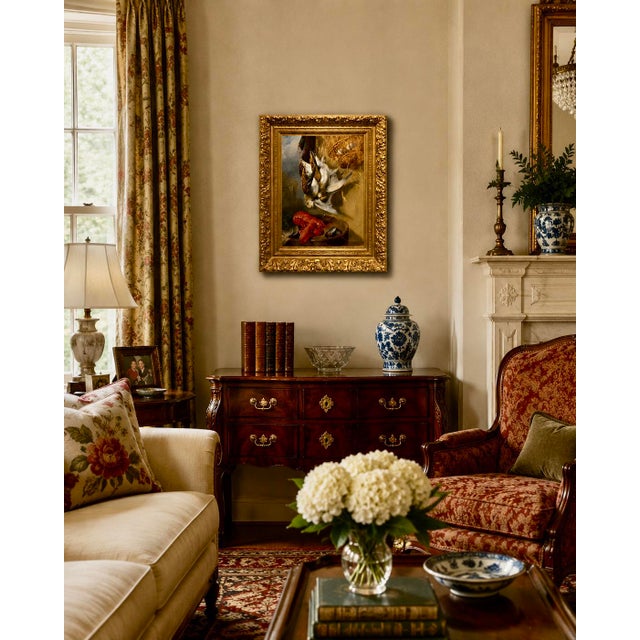
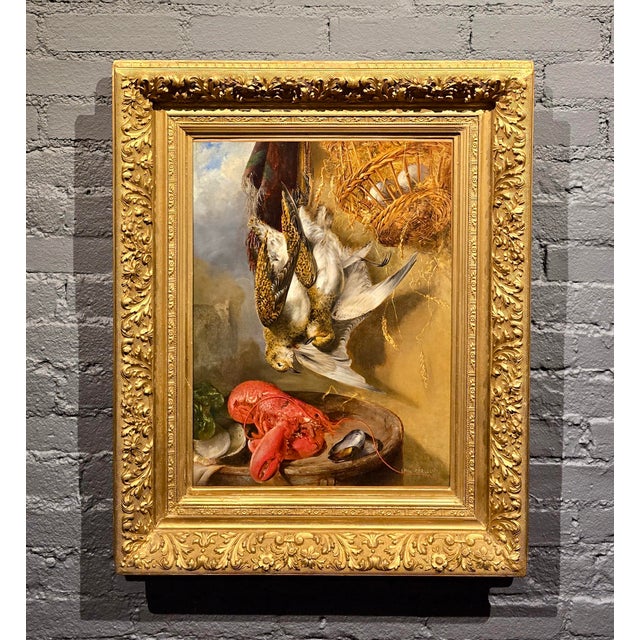
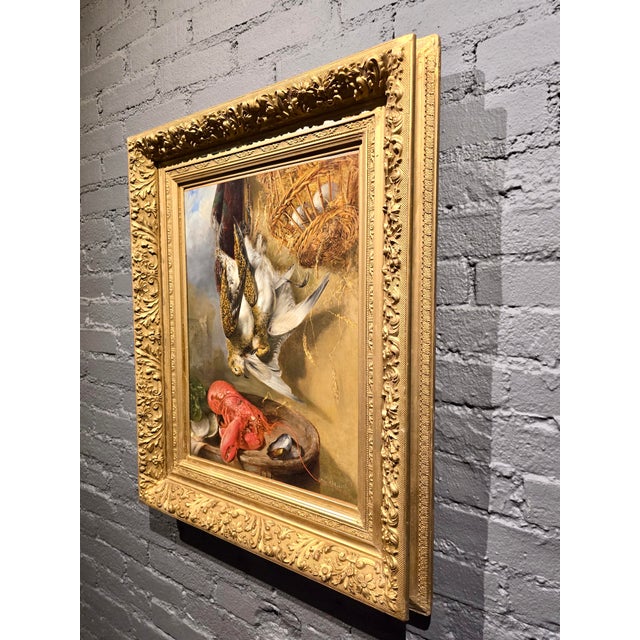
Canvas size 21x16" - Frame size 30x25x4"
Description:
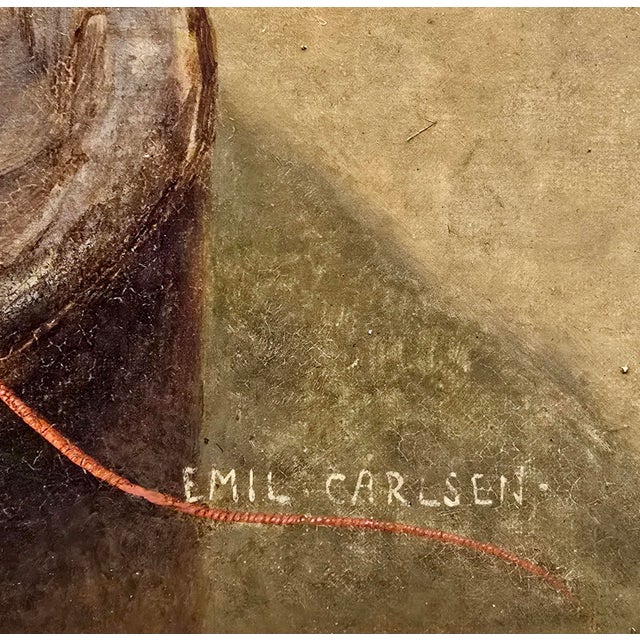
This oil painting also known simply as Still Life by the Danish-born American artist Emil Carlsen. Signed by the artist in the lower-right corner, it showcases Carlsen's masterful blend of traditional European still-life textures with an early 20th-century American Tonalist sensibility.
1. Subject Matter and Composition
The painting is a vertical still life structured around a rich, texturally diverse harvest from both the earth and the sea. The composition relies on strong vertical lines juxtaposed against rounded, organic forms:
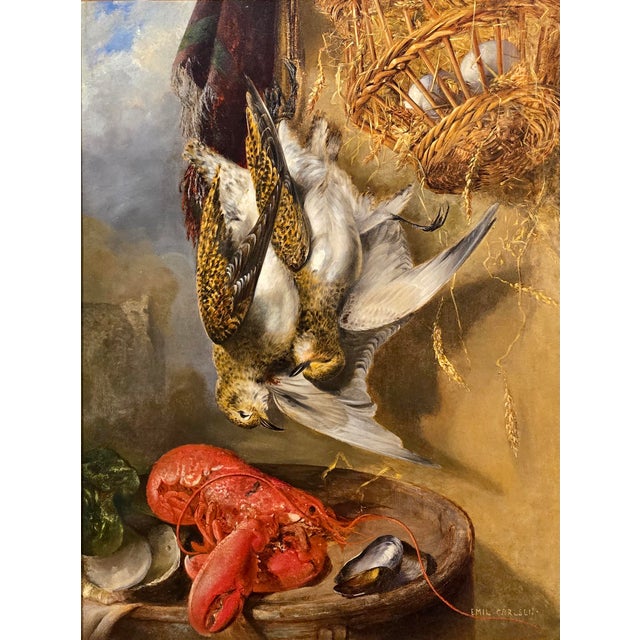
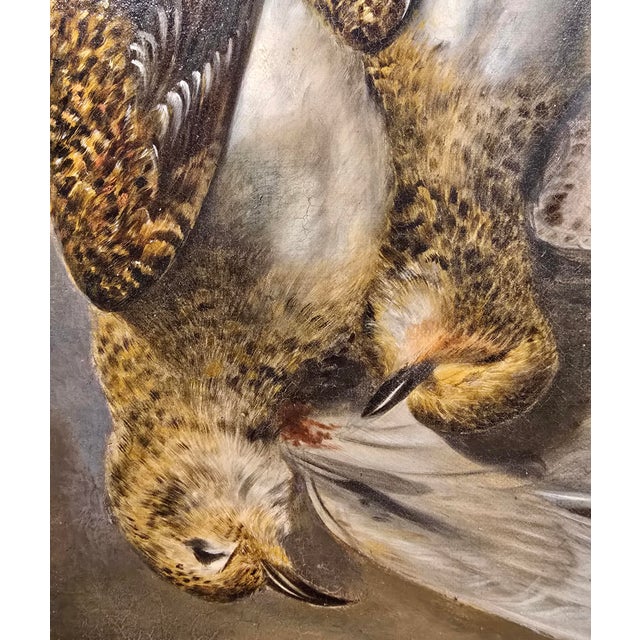
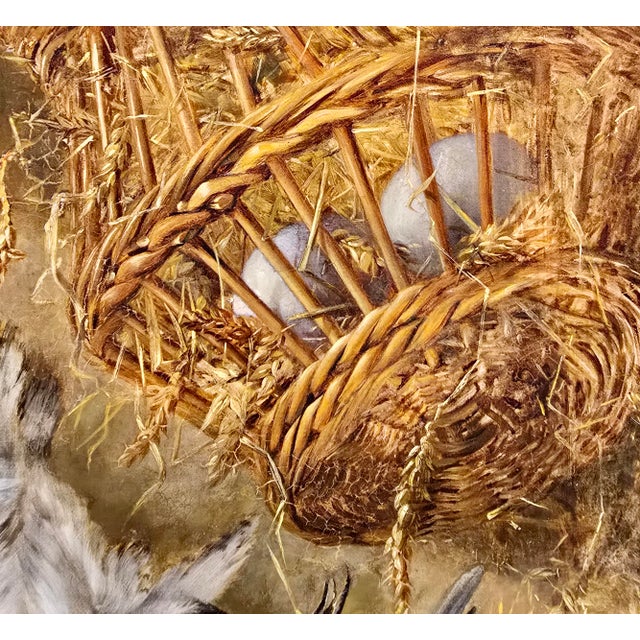
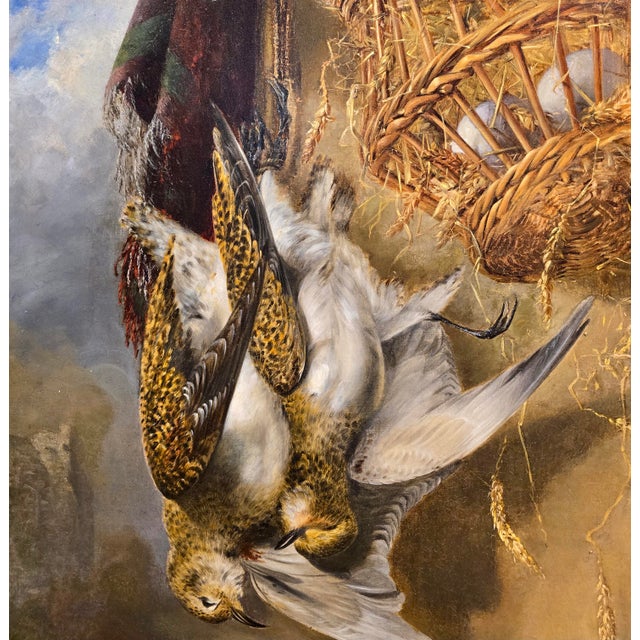
The Upper Register: A cluster of white and brown feathers game birds hangs upside down, suspended by their feet against a warm, earthen wall. Their wings drape downward, creating dramatic diagonals. Adjacent to them hangs a beautifully woven straw basket containing pale, intact bird eggs, nestled amongst dried stalks of wheat.
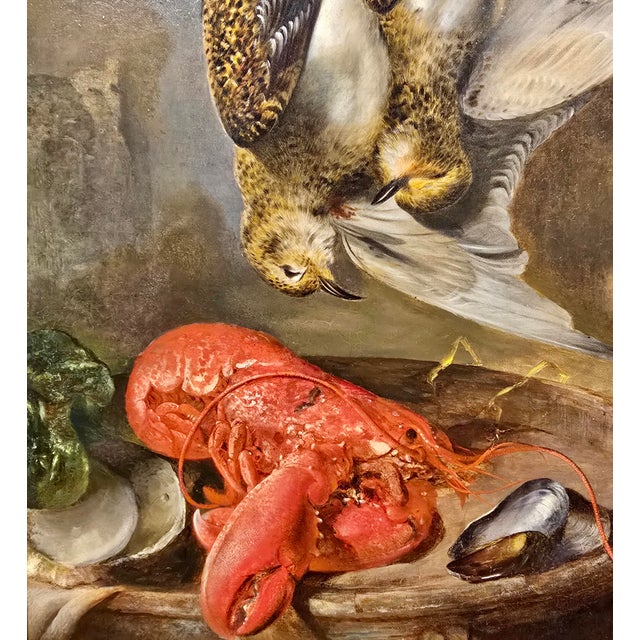
The Lower Register: A deep, shallow wooden basin or tabletop grounds the composition. The centerpiece is a brilliant, freshly boiled red lobster, its smooth, segmented carapace providing a sharp color contrast to the rest of the scene. Clustered near the lobster are dark open mussels, pale oyster shells, and a subtle arrangement of leafy green vegetables tucked to the left side.
2. Color Palette and Light
Carlsen implements a tightly controlled, harmonic color palette heavily influenced by Dutch Golden Age masters.
Tonal Contrast: The background is an atmospheric, muted golden-brown ochre that isolates the objects and emphasizes their form.
Color Accents: The dominant neutrals—the soft creams, browns, and grays of the bird feathers—are punctuated by the striking, vibrant red of the lobster.
Chiaroscuro: A soft light source enters from the upper left, casting gentle shadows to the right. This light glints off the wet sheen of the mussel shells and highlights the coarse texture of the straw basket.
3. Technique and Texture
The canvas is notable for its varied and tactile paint application. Carlsen uses thin, translucent glazes to capture the delicate, airy quality of the birds' downy plumage. In contrast, he employs thicker, deliberate brushstrokes to render the rigid, heavy armor of the lobster shell and the rustic weave of the hanging basket. The overall mood is quiet, contemplative, and deeply rooted in the academic tradition.
Artist Biography: Emil Carlsen (1853–1932)
Søren Emil Carlsen was born on October 19, 1853, in Copenhagen, Denmark. He grew up in an artistic household—his mother was a painter, and his cousin was an influential Danish writer. Carlsen originally studied architecture at the Royal Danish Academy of Fine Arts in Copenhagen for four years before pivoting his focus completely toward the fine arts.
Immigration and Move to America
In 1872, at the age of 19, Carlsen immigrated to the United States, settling in Chicago. He initially found work as an architectural draftsman and an assistant to a sculptor before becoming the first teacher of drawing and painting at the newly formed Academy of Design (which later became the Art Institute of Chicago).
European Transformation and Influence
Seeking deeper artistic maturation, Carlsen returned to Europe in 1875, spending six critical months studying in Paris. It was here that he discovered the works of the 18th-century French still-life master Jean-Baptiste-Siméon Chardin. Chardin’s approach—finding extraordinary, poetic beauty in ordinary kitchen utensils, game, and vegetables—profoundly shaped Carlsen’s creative philosophy for the rest of his career. He returned to Paris again from 1884 to 1886, refining a specialized technique for rendering delicate surfaces and subtle lighting.
Mid-to-Late Career and Legacy
Upon moving back to the United States, Carlsen split time between Boston, San Francisco (where he directed the San Francisco Art Association's school), and eventually New York City, where he settled permanently in 1891. He became a highly respected instructor, teaching at the National Academy of Design and the Pennsylvania Academy of the Fine Arts.
By the early 1900s, Carlsen was recognized as one of America's premier still-life painters, often referred to by contemporary critics as "The American Chardin." He was elected a full Academician of the National Academy of Design in 1906 and won numerous prestigious awards, including gold medals at the St. Louis Exposition (1904) and the San Francisco Panama-Pacific International Exposition (1915). Today, his works are preserved in major public collections, including the Metropolitan Museum of Art, the Smithsonian American Art Museum, and the National Gallery of Art
Emil Carlsen had a vast, multi-decade teaching career spanning from coast to coast. Interestingly, he openly complained that teaching stole precious time away from his own canvas. Out of financial necessity, however, he became one of the most sought-after and influential instructors of the American Tonalist and Impressionist eras.
Key Eras and Institutions of Carlsen's Teaching Career
The Chicago Years (1870s): Shortly after immigrating, Carlsen was appointed the very first teacher of drawing and painting at the newly formed Academy of Design (which evolved into the prestigious Art Institute of Chicago).
The San Francisco Era (1887–1891): Carlsen moved west to serve as the Director of the California School of Design. Here, he notably shook up the curriculum by introducing his West Coast students to the cutting-edge work of East Coast heavyweights like J. Alden Weir and John La Farge.
The New York and Philadelphia Heyday (1891–1918): Upon returning east, he took up major posts at the National Academy of Design and the Art Students League of New York. For many years, he also famously endured a grueling commute from New York to Philadelphia to lecture at the Pennsylvania Academy of the Fine Arts.
His Most Prominent Students
Carlsen’s instructional legacy spans across several distinct regions and movements of American art history. According to historical records from the Emil Carlsen Archives and museum rosters, his most notable pupils include:
Guy Rose (1867–1925): Rose studied under Carlsen at the California School of Design and went on to become one of America’s most revered California Impressionists, closely associating with Claude Monet in Giverny.
Armin Hansen (1886–1957): A major figure in West Coast art history, Hansen studied under Carlsen at the National Academy of Design. He became renowned for his powerful, moody, and dynamic paintings of raw marine life and Monterey fishermen.
Louis Lozowick (1892–1973): Striking a completely different path from Carlsen’s classical nature themes, Lozowick studied at the National Academy of Design and went on to become a titan of American Precisionism, famous for his geometric lithographs of industrial cityscapes.
Dines Carlsen (1901–1966): Emil Carlsen's only child was homeschooled and trained directly in his father's studio. He inherited his father's distinct touch, building his own successful career as an artist and getting elected to the National Academy at a remarkably young age.
James Guilford Swinnerton (1875–1974): Swinnerton studied under Carlsen in San Francisco and later pioneered early American comic strips (like The Little Bears) before moving into striking desert landscape paintings.
See less
- Dimensions
- 25ʺW × 4ʺD × 30ʺH
- Art Subjects
- Animals
- Still Life
- Frame Type
- Framed
- Period
- Late 19th Century
- Country of Origin
- United States
- Item Type
- Vintage, Antique or Pre-owned
- Materials
- Canvas
- Oil Paint
- Condition
- Good Condition, Original Condition Unaltered, Some Imperfections
- Color
- Red
- Condition Notes
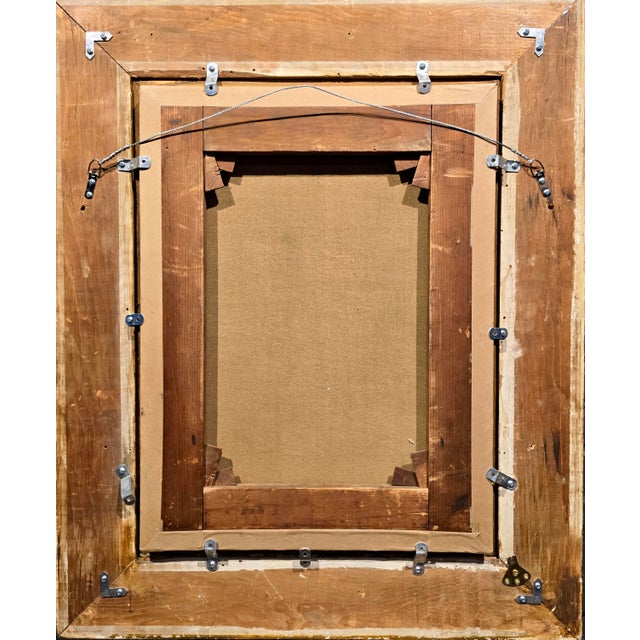
- Excellent - Minor wear consistent with age and history Excellent - Minor wear consistent with age and history less
Questions about the item?
Returns & Cancellations
Return Policy - All sales are final 48 hours after delivery, unless otherwise specified in the description of the product.
Cancellation Policy - Prior to shipping or local pickup, buyers may cancel an order for up to 48 hours, unless otherwise specified.
Related Collections
- Ed Ruscha Paintings
- Photorealism Canvas Paintings
- Ralph Lauren Paintings
- Photorealism Paintings in New York
- Richard Serra Paintings
- Silk Velvet Paintings
- Black Photorealism Paintings
- Herman Miller Paintings
- Cassina Paintings
- Jaanika Peerna Paintings
- Photorealism Paintings in Los Angeles
- BDDW Paintings
- Jo Baskerville Paintings
- Raphael Paintings
- Jean-Paul Barray Paintings
- Hans Andersen Paintings
- Johannes Andersen Paintings
- Pedro Friedeberg Paintings
- Peter Behrens Paintings
- Piet Hein Eek Paintings
- Louise Nevelson Paintings
- Lee Reynolds Paintings
- Mid-Century Modern Paintings
- Abstract Paintings
- Nautical Paintings